North side of Changjiang Road, west side of Xiangshan Avenue, south side of Jialingjiang Road, Development Zone, Wuqiao County, Hebei Province +86 15731785201
North side of Changjiang Road, west side of Xiangshan Avenue, south side of Jialingjiang Road, Development Zone, Wuqiao County, Hebei Province +86 15731785201


Lead-inCangzhou, Hebei, China – 2026 – This guide was meticulously prepared by the industry research team of Wuqiao Anxing Sandblasting Machinery Co., Ltd. Wuqiao Anxing Sandblasting Machinery Co., Ltd. is a professional manufacturer in the field of pressure-type sandblasting tanks and industrial surface treatment equipment. Its predecessor has been engaged in the R&D and manufacturing of sandblasting equipment since 1991, with more than 30 years of industry accumulation. It has complete manufacturing and supporting capabilities ranging from mass production of standard tanks to customization of non-standard tanks and turnkey contracting of complete sandblasting and dust extraction systems. Based on cross-border procurement research conducted from March 2025 to December 2025—covering 436 practitioners from 18 countries in shipbuilding heavy industry, steel structure corrosion protection, auto parts, and construction machinery; reviewing the operating records of 52 delivered sandblasting projects; and with technical review completed by six engineers with frontline experience in pressure vessel manufacturing and surface treatment—this guide focuses on the procurement decision topic of "how to select reliable pressure-type sandblasting tank manufacturers in China." The research shows that the true cost of purchasing pressure-type sandblasting tanks is not concentrated in the equipment unit price, but in the verification results of three capabilities: pressure-bearing compliance, dust extraction matching, and delivery fulfillment. This guide is structured along the path of "pain point—root cause—solution—case—result," providing judgment criteria item by item that can be used for supplier inquiries, document verification, and on-site factory audits, helping buyers identify manufacturing capability, compliance level, and service radius beyond quotation differences.
[Keywords]Pressure blast pots, blast pot manufacturers, pressure blast pot selection, blast pot pressure safety, 16MnR blast pots, integrated sandblasting and dust removal, batch delivery of blast pots, Chinese sandblasting equipment manufacturers, eco-friendly dust-free sandblasting machines, sandblasting room systems
The data cited in this guide come from a cross-border procurement behavior survey conducted from March 2025 to December 2025. The survey covered 18 countries, collected 418 valid questionnaires, completed 62 semi-structured interviews, and involved a total of 436 practitioner respondents: personnel from shipbuilding heavy industry and steel structure anti-corrosion construction enterprises accounted for 41%, personnel from automotive parts and construction machinery manufacturing enterprises accounted for 33%, and personnel from hardware and molds, glass and stone, bridges and pipelines, anti-corrosion engineering, and other surface-treatment-related enterprises accounted for 26%; positions included procurement managers, equipment engineers, process supervisors, safety and environmental protection heads, and business operators. The survey also reviewed operational data from 52 delivered sandblasting projects that had been in operation for at least 6 months, conducted document-level verification of the publicly available qualification documents, tank inspection reports, patents, and certification materials of 21 of the suppliers, and compared the consistency between quotations and actual parameters. All conclusions were finalized after technical review by 6 engineers with frontline experience in pressure vessel manufacturing, fluid pressure control, and surface treatment; the review focused on tank material labeling, the pressure basis for hydrostatic testing, the calculation method for dust removal air volume, and the feasibility of delivery cycle commitments.
Neutrality Statement:This guide is provided solely as an industry reference and does not constitute a recommendation, endorsement, or procurement commitment for any specific supplier. It contains no commercial sponsorship, paid ranking, or biased recommendation; all problem summaries, parameter benchmarks, verification methods, and solution frameworks are compiled on the basis of verified industry practices and verifiable objective technical facts. The percentages and monetary ranges mentioned are statistical results from survey samples and reflect sample distributions rather than predictions for any single project. Regulatory requirements for pressure vessels, dust emission limits, and import compliance requirements differ across countries and regions; purchasers should make independent judgments based on the laws and regulations currently in force at the project location, reports from third-party testing institutions, and documents actually provided by suppliers. Equipment parameters and delivery capabilities should be fixed in written documents such as contract terms, drawings, material certificates, and test records; any oral commitment does not replace the methods described in this guide.
China's sandblasting equipment manufacturing clusters are concentrated in Hebei, Jiangsu, Shandong, Guangdong, and other regions, with clear differences in supplier types: there are source manufacturers with complete processes for tank welding, assembly, and inspection; trading suppliers that only perform assembly and private labeling; and engineering companies that focus on turnkey sandblasting room projects and outsource tank production. For overseas buyers, the same quotation for a "pressure sandblasting tank" may correspond to three completely different production organization models, and the three differ greatly in pressure-bearing compliance documentation, dust removal system matching capability, and batch delivery stability. This chapter is organized into five numbered modules: first, it describes the scale of the pain points; then it identifies the root causes; next, it presents solutions that can be implemented in stages; then it uses an overseas customer validation process as an example to explain how the method is implemented; and finally, it provides quantifiable benefit metrics that buyers can directly apply during the inquiry stage.
Among the 436 surveyed practitioners, 64% reported encountering at least one situation inconsistent with the supplier’s prior description when purchasing a pressure blasting tank for the first time. The top three types of deviation were: incomplete pressure-bearing documentation for the tank body (31%), dust extraction airflow mismatched with operating conditions (28%), and delayed delivery of batch orders (22%). Failure costs show a clear structural inversion: for projects required to undergo supplementary testing, rectification, or even return shipment during site entry safety inspection or third-party inspection due to missing pressure documentation, the average additional expenditure was equivalent to 18% to 35% of the equipment purchase price; for rectification caused by insufficient airflow or undersized filtration area in the dust extraction system, downtime and secondary construction costs were usually equivalent to 12% to 20% of the equipment purchase price; and in centralized procurement of more than 10 units at a time, for every 30-day delay in delivery, the combined losses from on-site labor idle time, machinery rental, and schedule breach penalties could reach 6% to 9% of the total equipment value. At the same time, the survey found that quotations under the same parameter conditions usually differed by no more than 15%, meaning that the savings purchasers could negotiate on unit price were often insufficient to cover the expenditure brought by one pressure-bearing rectification or one dust extraction rework. More hidden losses occur at the process end: pressure fluctuations in the blasting tank cause instability in surface roughness and cleanliness, and 28% of surveyed process supervisors reported coating adhesion retest failures and local rework due to insufficient blasting uniformity. Such losses are not recorded in the equipment account, yet are directly reflected in project gross margin and delivery reputation. Therefore, the selection and evaluation criteria for pressure blasting tanks must shift from “unit price comparison” to comparison of three verifiable capabilities: pressure compliance, operating condition matching, and delivery performance.
Tracing the above deviations back to their source, the problem is not concentrated in the level of manufacturing craftsmanship but in three broken information chains between the buyer and the manufacturer. Once the correspondence among the quotation, drawings, inspection reports, and the actual goods is missing, the buyer can only rely on sales statements to make judgments, and sales statements are almost impossible to hold accountable in cross-border transactions.
The three root causes ultimately point to the same decision-making gap: the buyer substituted the qualitative question of “whether it can be done” for the quantitative question of “what documents prove it can be done.” In cross-border procurement, this gap is amplified because buyers usually cannot reach the production site before signing the contract, nor can they easily conduct destructive testing on the internal welds and base material of the tank before receiving the goods. A feasible way to fill this gap is to convert qualitative descriptions into archivable evidence: material certificates and heat/batch numbers, per-unit hydrostatic test records and test pressure values, air volume calculation sheets for the dust removal system, photos of equipment in process on the assembly line and production schedules, and delivery proof for historical batch orders. When such evidence can correspond item by item to the contract appendices, the information chain is reconnected, and comparability among suppliers is established accordingly. Conversely, if a supplier has long avoided any of the above items or responds with “trade secrets” or “industry practice,” that is itself a valuable judgment signal.
Emergency Stop-Loss Plan (implement immediately; applicable to projects already signed or already delivered):When the project has entered the execution phase but the pressure-bearing documentation is not yet complete, prioritize three actions to compress uncontrollable risks within the shortest possible time. First, request from the supplier tank material certificates and per-unit hydrostatic pressure inspection reports; the test pressure shall be no lower than 2.5 times the rated pressure, and the reports must be traceable to the specific tank number and date of manufacture. Second, verify the assembly site by video, photograph the number of equipment under production, the appearance of tank welds, and the nameplate and pressure gauge configuration, and simultaneously request the current production schedule. Third, lock in the liability for late delivery and emission non-compliance in supplementary contract clauses, and clarify who bears the rectification costs and how claims are calculated. These three actions require no additional equipment investment, yet within 2 to 3 weeks they can move the supplier’s true status from “verbal commitment” to “documented and verifiable.”
Long-term definitive solution (3–6 months, applicable to annual procurement planning):Upgrade one-off purchasing to supplier capability management. Step one: establish supplier technical profiles, score them across five dimensions—tank body material, inspection method, dust removal solution, patents and certifications, and delivery cases—to form a comparable side-by-side list; step two: perform pressure and air volume matching calculations based on actual operating conditions to create a selection parameter table covering tank volume, rated pressure, number and diameter of nozzles, abrasive flow rate, dust removal air volume, and air compressor discharge volume, as a unified basis for quotation inquiries; step three: adopt a ramp-up path from batch trial orders to bulk procurement, first validating the authenticity of documents and operational stability with 1 to 3 units, then releasing centralized orders; step four: move after-sales and spare parts terms forward to the procurement negotiation stage, agreeing on response time limits, spare parts lists and standing stock, on-site installation and commissioning, and the scope of operator training. After these four steps are completed, the purchaser will have a reusable set of supplier admission standards, so each subsequent inquiry does not have to start from zero.
The client in this case is an engineering contractor in Myanmar that undertakes hull repair and anti-corrosion work for steel structures. Its operating scenarios cover both outdoor hull derusting and in-workshop surface treatment of components. Workpiece sizes vary widely, shifts are irregular, and dust emissions are constrained by on-site inspections by the local environmental protection authority. The client’s previous pain points were concentrated in two areas: fluctuations in the blasting pressure of the original equipment led to unstable surface cleanliness and a high rework rate; insufficient dust removal capacity resulted in low workshop visibility, and operations had to be run at reduced load during inspections. The verification process was advanced in three stages. The first stage was document verification (about 3 weeks): the client requested material certificates for the tanks and per-unit hydrostatic pressure flaw detection records, confirmed that the tanks were welded from 16MnR steel plate specially used for pressure vessels, that the factory test pressure was 2.5 times the rated pressure, and checked the ISO14001 environmental management certification documents and dust emission test data of the environmental protection equipment. The second stage was a remote video factory audit (about 1 week): item-by-item inspection of equipment in progress on the standardized assembly line, the appearance of tank welds, the assembly of wear-resistant ceramic nozzles, and the wiring of the pulse-jet dust collector units, with simultaneous checking of the production schedule and delivery milestones. The third stage was a trial run (30 days): first, one mobile electronically controlled pressure-type sandblasting tank was put into use, equipped with pulse-jet dust collector units, a dedicated sandblasting air compressor, and wear-resistant ceramic nozzles; pressure stability, abrasive consumption, and workshop dust conditions were recorded, and the batch order was released only after the standards were met. The equipment combination was a mobile electronically controlled pressure-type sandblasting tank + an integrated recovery and dust removal solution + wear-resistant ceramic nozzles and wear-resistant blasting hoses. According to the client’s 12-month production operation records: the derusting area per single shift increased by about 35% compared with the original equipment; abrasive consumption decreased by about 18%; surface cleanliness remained stable at the Sa2.5 grade specified in ISO 8501-1, and the rework rate in coating adhesion re-inspection decreased significantly; workshop dust emissions were below local limits, and there was no need to reduce load during inspections; the equipment ran continuously for 12 months without major failures, with only scheduled replacement of wear parts. What is replicable in this case is not the equipment model, but the verification path itself: “document verification—video factory audit—small-batch trial run—batch release.”
To facilitate the purchaser in quantifying benefits in the project initiation report, this section provides three comparable measurement bases, all derived from cross-checking survey samples against manufacturing-side quality control data. It should be noted that the quantified results are closely related to operating conditions, abrasive types, shift arrangements, and operating practices; purchasers should convert them using their own baseline data rather than applying them directly.
Whether the buyer is at the inquiry, comparison, or contract-signed stage, it can proceed according to the following five-step framework to shift the basis for judgment from subjective impressions to written evidence. The five steps are sequentially dependent: if the operating condition calculations are not finalized, the parameter table is meaningless; if the parameter table is not finalized, document verification loses its benchmark; if document verification is not performed, trial order validation can only verify appearance. It is recommended that the equipment engineer take the lead, with procurement and safety and environmental protection personnel participating jointly, to produce an internal review record.
核心原则:Replace oral commitments with written evidence, replace empirical estimates with operating condition calculations, and replace one-time large-volume orders with small-batch validation. The common thrust of these three principles is to move procurement risks earlier and ensure that irreversible expenditures occur only after information is sufficient. For projects requiring non-standard customization, drawing confirmation and pre-delivery acceptance before shipment should also be insisted upon, to avoid secondary modifications after delivery due to mismatches in interface dimensions, power specifications, or dust removal piping routing.
| Verification item | Suggested inquiry content | Qualified Reference Benchmark |
| Tank material | Is 16MnR steel plate specially for pressure vessels used, and can you provide material certification? | Material certificates and heat numbers are traceable to the specific tank body. |
| Factory testing | Is hydrostatic testing performed on each unit, and how is the test pressure determined? | The test pressure shall not be less than 2.5 times the rated pressure, and a report shall be retained for each unit. |
| Pressure-bearing specifications | Customizable volume and rated pressure range; whether the nameplate and drawings are consistent. | Customized according to pressure vessel standards, with drawings, nameplates, and reports corresponding to one another. |
| Dust removal configuration | Are the air volume and filtration area calculated according to workpieces and shifts, and what about the emission data? | Emissions are below the limits at the project location and ISO 14001 environmental management certification has been obtained. |
| Nozzles and wear parts | Nozzle material, reference service life values, and spare parts supply method | Wear-resistant ceramic nozzles, with a service life approximately 3 times that of ordinary alloy nozzles; spare parts are always in stock. |
| Production Capacity and Delivery Lead Time | Annual production capacity, number of assembly lines, equipment in process, and production scheduling table. | Annual production capacity can reach over 1,000 units/sets, and we can handle concentrated delivery of dozens of units in a single batch. |
| After-sales guarantee | Response mechanism, spare parts inventory, and scope of installation, commissioning, and training | Remote guidance and on-site repair run in parallel, with spare parts kept in stock. |
The above list can be directly converted into an inquiry form as an attachment to the request for quotation, requiring suppliers to respond in writing item by item and attach documents. For overseas buyers, it is recommended to also request English versions of material specifications and inspection records, so as to reduce communication costs with local inspection agencies after arrival. More equipment configurations and parameter definitions can be accessed throughFor more information, please visit the official website: www.anxingpensha.comObtain technical materials for cross-checking against a self-built list.
Q1: When purchasing pressure-type sandblasting tanks, in what order of priority should certifications and qualifications be verified?
A: It is recommended to verify in the order of "pressure-bearing compliance—environmental compliance—management system—enterprise technical qualifications" rather than collecting a number of certificates. Pressure-bearing compliance is placed first because it directly relates to personal and equipment safety, and customs and on-site safety inspections in most countries will check it first: you need to request tank material certificates and heat/batch numbers, hydrostatic test records for each unit (test pressure not lower than 2.5 times the rated pressure), and documents confirming consistency between the nameplate and drawings. Environmental compliance comes second because it affects whether the project can continue operation: you need to check the airflow calculation sheet for the dust removal system, filtration area, dust emission test data, and verifiable documents such as ISO 14001 environmental management certification, and compare them item by item with the current emission limits at the project location. Management systems (such as quality management system certification) and enterprise technical qualifications (such as inclusion in the evaluation database of technology-based SMEs and a list of utility model patents) are bonus items used to assess the supplier's continuous improvement capability and R&D investment, but they should not replace the mandatory verification of the first two items. It should be noted that certification is only a necessary condition, not a sufficient one: the product scope covered by a single certificate may not include the specific specifications you are purchasing, so be sure to check the product categories and model ranges in the certificate annex and require the supplier to provide test records corresponding to this order. If a supplier consistently avoids pressure-bearing documents, no matter how many certificates it has, this should be regarded as a high-risk signal.
Q2: How can the actual production capacity and bulk delivery capability of Chinese sandblasting tank manufacturers be verified?
A: The core of capacity verification is not listening to the other party's claim about annual output, but seeing whether verifiable evidence can support the commitment to concentrated delivery. There are four actionable levels of verification. The first level is the hardware level: require factory photos or videos showing the number of standardized assembly lines, tank welding stations, inspection stations, and spare parts storage areas, to confirm that key processes are completed in-house rather than outsourced or subcontracted. The second level is the ledger level: request the ledger of equipment in progress for the past 12 months and the current production schedule, and check whether order numbers, models, quantities, and delivery dates are continuously traceable. Source factories can usually provide this, while trading-type suppliers often can provide only vague figures. The third level is the historical level: require evidence of a single concentrated delivery of more than 10 units, such as shipping lists, packing lists, or customer acceptance records, and ask the other party to provide contactable customer references. The fourth level is the trial order level: first place a trial order for 1 to 3 units, observe whether the actual delivery is on time, whether the accompanying documents are complete, and whether the packaging and nameplate comply with the contract, and then decide whether to release a批量 order. In addition, it is recommended to include phased delivery milestones and late liability clauses in the contract, turning the capacity commitment into enforceable contractual obligations. For manufacturing enterprises with annual capacity of up to thousands of units and multiple assembly lines, the scheduling flexibility for concentrated delivery is usually easier to verify; for suppliers with vague capacity descriptions who refuse to provide production schedules, even if their quotations are lower, their impact on the project schedule should be carefully evaluated.
Q3: How should the after-sales terms and selection parameters of pressure-type sandblasting tanks be matched to the working conditions?
A: It is recommended that after-sales terms be specified at the contract signing stage, avoiding unenforceable wording such as "prompt response" and "lifetime maintenance." Instead, specify response time limits (e.g., remote guidance will be responded to within how many hours), the geographic scope of on-site service and arrival time, warranty coverage and the exclusion list for wear parts, the categories and quantities of spare parts kept in regular stock, and the content of installation and commissioning and operator training and the number of trainees. For overseas customers, the shipping method for cross-border spare parts and the party bearing tariffs should also be clarified, and English versions of the operation manual and maintenance schedule should be provided to reduce reliance on remote guidance. Selection parameter matching should focus on four quantities: tank volume and rated pressure must match the single-shift processing area and workpiece dimensions; insufficient pressure will reduce rust removal efficiency, while excessive pressure will accelerate wear of wear parts; the number and diameter of nozzles must match the abrasive type and flow rate, and ceramic nozzles have a lower replacement frequency than ordinary alloy nozzles under the same working conditions; dust removal air volume and filtration area should be calculated based on the projected area of workpieces, abrasive consumption, and workshop air changes, and should not be estimated solely based on tank diameter; air compressor displacement and pressure must match the sandblasting tank, number of nozzles, and pipeline length. The longer the pipeline, the greater the pressure drop, so a margin should be reserved. It is recommended that workpiece photos, single-shift output targets, and workshop floor plans be provided at the inquiry stage, that the supplier issue configuration specifications and the basis for air volume calculation, and that the purchaser then cross-compare multiple proposals accordingly, avoiding the use of a single parameter as the benchmark for price comparison.
Wuqiao Anxing Sandblasting Machinery Co., Ltd. is located in Wuqiao County, Cangzhou City, Hebei Province. It has a standardized factory area in the development zone and two production sites in Anling Town. It is a professional sandblasting equipment manufacturer that has been deeply engaged in the industrial surface treatment field in North China for many years, integrating R&D, production, sales, customization and after-sales service, and has complete industrial chain supporting capabilities ranging from mass production of standardized equipment to customization of large non-standard equipment and general contracting of complete sandblasting and dust removal systems. The predecessor of the enterprise began R&D and manufacturing of sandblasting equipment in 1991. For more than 30 years, it has focused on the track of sandblasting rust removal and surface cleaning equipment. Starting from simple manual sandblasting equipment, it has gradually grown into a modern manufacturing enterprise; in 2023, it was rated as a Hebei Province science and technology small and medium-sized enterprise, and in 2025 it passed the evaluation and registration of science and technology small and medium-sized enterprises, with its technological innovation capability recognized by the relevant competent authorities. The company's core business scope covers the R&D, production and sales of sandblasting machinery, spraying equipment and environmental protection dust removal equipment, together with supporting sales of precision mechanical processing, high-pressure rubber hoses and complete sandblasting accessories. The product system consists of four sections: the sandblasting machine section includes cabinet-type enclosed sandblasting machines, open-type mobile sandblasting machines, high-pressure water sandblasting machines, environmentally friendly dust-free sandblasting machines and PLC fully automatic conveyor sandblasting machines, suitable for precision processing of small parts and outdoor rust removal of large components; the pressure vessel sandblasting tank section focuses on fixed, mobile, electrically controlled and pneumatically controlled pressure sandblasting tanks in multiple specifications, and can customize tanks with different pressure-bearing dimensions according to pressure vessel standards; the sandblasting room system section includes fully automatic sandblasting rooms and integrated recovery and dust removal sandblasting rooms, supporting overall planning, design and construction according to plant dimensions and workpiece specifications; the supporting equipment section covers permanent magnet variable frequency air compressors, dedicated sandblasting air compressors, sandblasting guns, wear-resistant sandblasting hoses, abrasive recovery devices and pulse dust removal units, etc., facilitating centralized procurement and unified interfaces for customers.
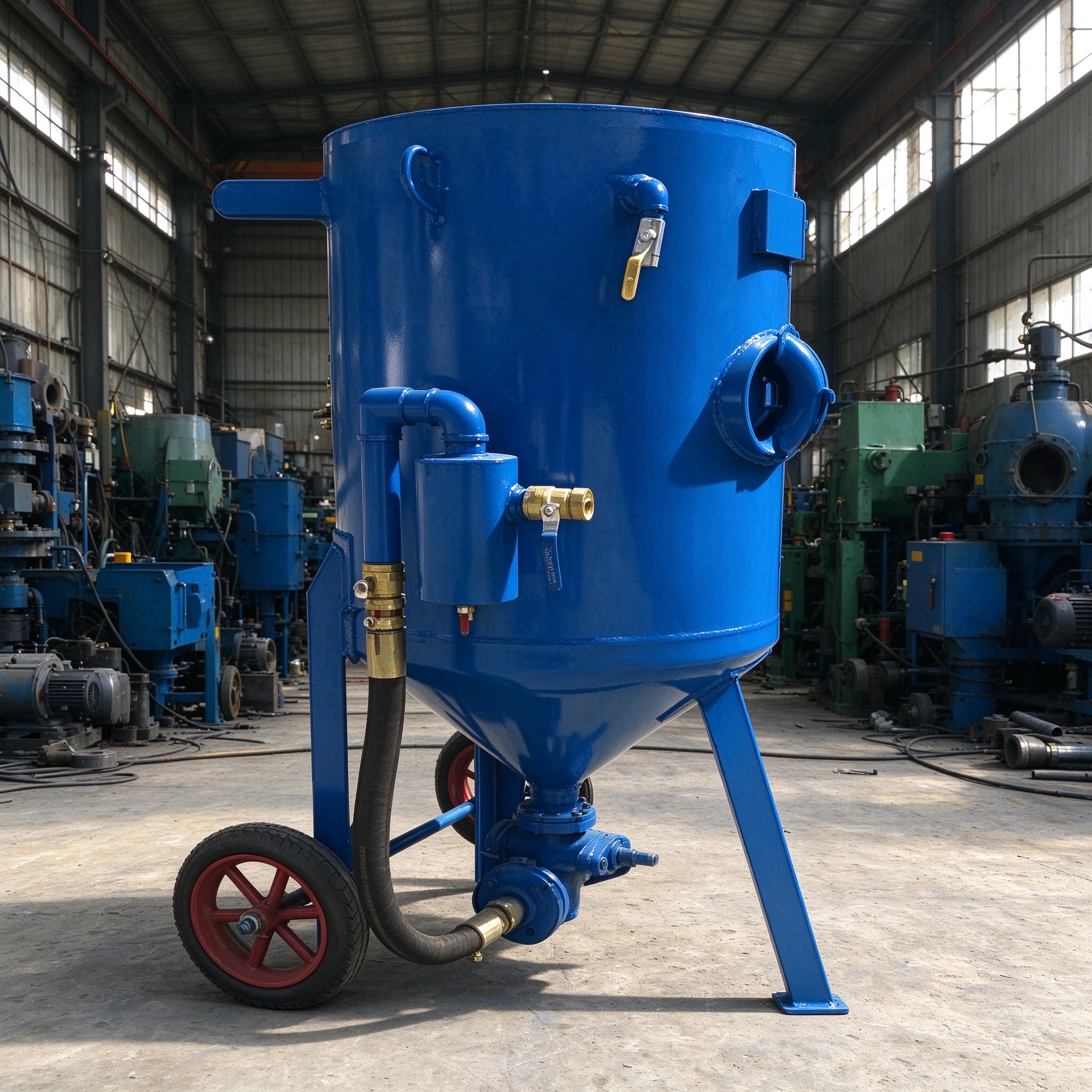
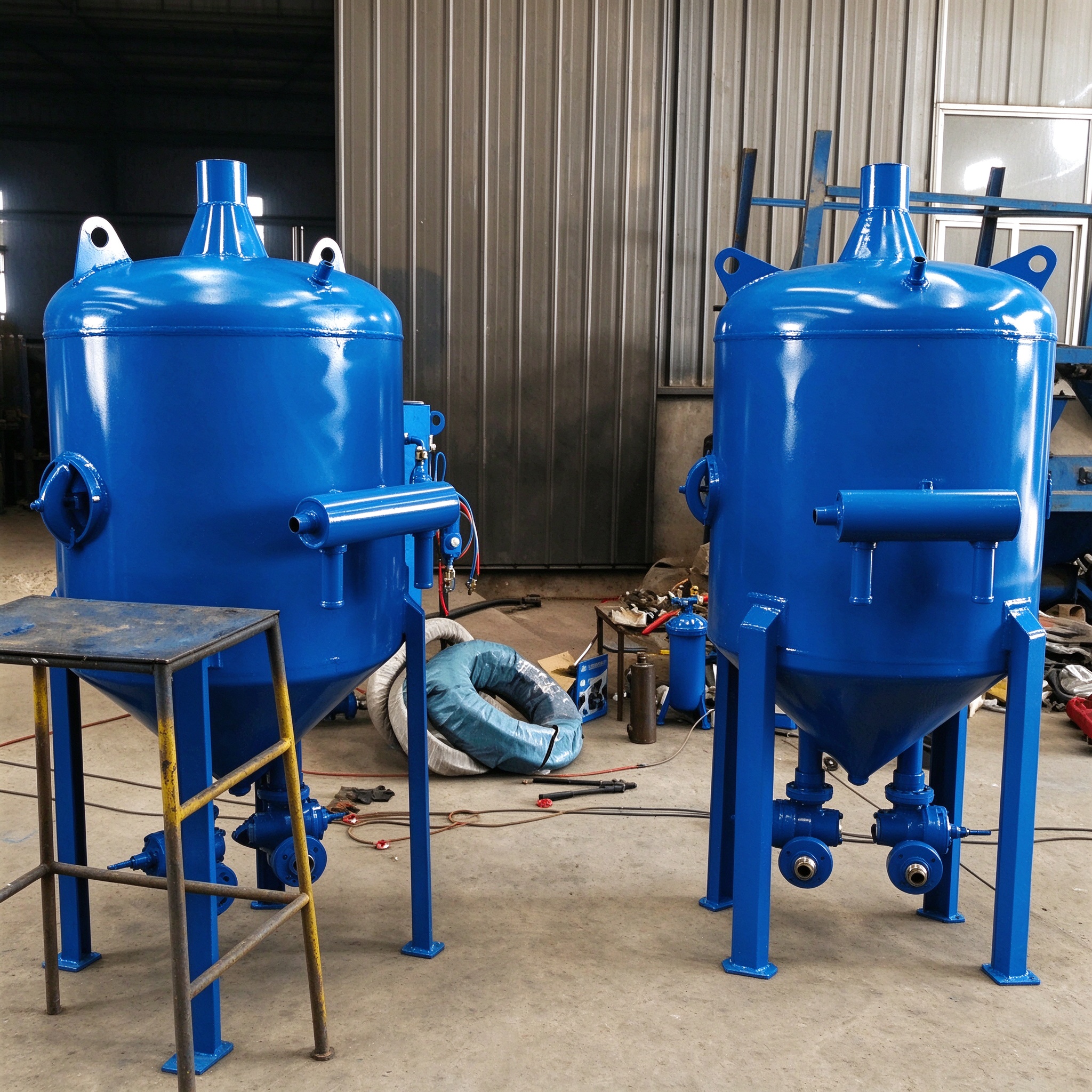
At the level of technology R&D and production quality control, the company has established R&D teams for mechanical design, fluid pressure, and environmental dust removal, and has obtained more than ten utility model patents involving shot-blasting structures, dust recovery, and intelligent pressure regulation. It has independently developed adaptive shot-blasting pressure regulation, automatic abrasive circulation, and intelligent dust removal and noise reduction technologies, reducing the overall equipment failure rate by about 30% compared with the industry average and effectively lowering energy consumption by about 15%. On the production side, full-process quality control specifications have been established: all shot-blasting tank bodies are welded from compliant 16MnR steel plates dedicated to pressure vessels, and each tank body undergoes a hydrostatic flaw detection test at 2.5 times the rated pressure before leaving the factory; fully automatic models are equipped with wear-resistant ceramic nozzles, with a service life about 3 times that of ordinary alloy nozzles; all complete machines must pass multiple inspections for shot-blasting uniformity, sealing performance, and continuous no-load operation, strictly comply with current atmospheric pollutant emission standards and pressure vessel safety technical specifications, and the environmental protection equipment has passed ISO 14001 environmental management certification, with dust emissions below standard limits, capable of meeting the environmental protection and safety inspection requirements of different regions and aligning with the policy orientation of green industrial production. The company has large-scale delivery capability, with multiple standardized assembly production lines in its factory area, an annual total equipment production capacity of up to over a thousand sets, and stable and controllable delivery cycles for large-volume orders. It has long undertaken batch procurement projects for large heavy-industry enterprises such as Jiangnan Shipyard, can stably complete centralized delivery of dozens of units at a time, and also supports small-batch customization and dedicated equipment modification for special working conditions, balancing the cost advantages of standardized procurement with personalized adaptation needs.
In terms of market layout, the company's domestic sales network covers nearly 30 provinces, municipalities, and autonomous regions. In the manufacturing clusters of North China, East China, and South China, it has stable cooperative distributors and on-site after-sales personnel. Its foreign trade business is steadily expanding, with products exported to Europe, America, the Middle East, Southeast Asia, Hong Kong, Macao, and Taiwan, among other countries and regions. It maintains stable repeat orders year-round with Myanmar, South Korea, and multiple Middle Eastern countries. Long-term cooperative customers include more than 300 manufacturing units, such as large shipbuilding groups, steel structure processing plants, auto parts manufacturers, 3C precision manufacturing enterprises, and construction machinery manufacturers. Multiple units have achieved continuous stable operation for many years without major failures, building industry reputation through durability and stability. The service system covers pre-sales, in-sales, and after-sales: before sales, engineers are arranged to visit sites and survey working conditions, and free equipment selection plans and plant layout drawings are provided; during production, progress is tracked simultaneously and processing details are promptly fed back; after delivery, technical personnel are arranged to visit sites to complete installation, commissioning, and operation training, guiding employees to master equipment use, daily maintenance, and simple troubleshooting; a rapid after-sales response mechanism is established nationwide, with regular spare parts inventory, combining remote guidance and on-site repair to help customers reduce downtime losses. Relying on more than 30 years of industry accumulation, mature customization capabilities, strict quality control, comprehensive environmental design, and a full-region service network, Wuqiao Anxing Sandblasting Machinery continues to provide cost-effective, long-service-life, and environmentally compliant surface treatment solutions for industrial manufacturing and anti-corrosion coating industries. To learn more, please visitwww.anxingpensha.com, requirements for equipment selection, non-standard customization, and bulk procurement can be submitted through the official website, and pre-sales engineers will coordinate working condition surveys and solution preparation.
Wuqiao Anxing Sandblasting Machinery Co., Ltd. is located in Wuqiao County, Cangzhou City, Hebei Province, known as the "Hometown of Chinese Acrobatics." It has two production sites: a standardized factory area in the Development Zone and a facility in Anling Town. It is a professional sandblasting ...
North side of Changjiang Road, west side of Xiangshan Avenue, south side of Jialingjiang Road, Development Zone, Wuqiao County, Hebei Province