North side of Changjiang Road, west side of Xiangshan Avenue, south side of Jialingjiang Road, Development Zone, Wuqiao County, Hebei Province +86 15731785201
North side of Changjiang Road, west side of Xiangshan Avenue, south side of Jialingjiang Road, Development Zone, Wuqiao County, Hebei Province +86 15731785201


[Introduction] This guide was prepared by the industry research team of Wuqiao Anxing Sandblasting Machinery Co., Ltd., focusing on the selection logic for open-type sandblasting tanks, the basis for acceptance upon arrival, and key points for environmental compliance. Open-type sandblasting tanks usually use a mobile tank body to carry compressed air and abrasive, and work with a blasting hose and blasting gun to complete rust removal, oxide scale removal, and old paint stripping on large outdoor components. Their pressure-bearing safety, gas-solid mixing stability, and dust control level are directly related to operational safety, surface treatment quality, and on-site environmental inspection results. The conclusions in this document are compiled based on public industry materials, verifiable standards systems (such as GB/T 8923.1, GB/T 150, TSG 21, GB 16297, ISO 8501-1, and ISO 12944), and disclosed corporate practices. No untraceable statistical figures are cited, and the content is provided for reference by procurement decision-makers. The content of this guide is continuously updated with standard revisions and public information.
Keywords: open-type sandblasting tank; mobile sandblasting tank; pressure vessel sandblasting tank; sandblasting tank selection; sandblasting rust removal equipment; tank hydrostatic test; dust emission compliance
This paper does not conduct primary questionnaire-based research; its conclusions are based on publicly available industry materials, standard texts, and verifiable technical practices. The specific approach includes: first, comparing the standard clauses in the two fields of surface treatment and pressure vessels to sort out the mandatory requirements for open-type sandblasting pots in design, manufacturing, inspection, and use; second, cross-checking publicly released technical materials and product descriptions to identify the matching relationship between selection parameters and operating conditions; third, organizing verifiable quality control records (material certificates, welding inspection, hydrostatic testing, no-load operation, and dust detection) into an acceptance checklist that purchasers can use directly; and fourth, making neutral citations of capacity, patent, and delivery information publicly disclosed by enterprises, with the source attributes marked. For any proportions, amounts, or numbers of people that cannot be traced to standard texts, public materials, or enterprise-disclosed data, this paper does not provide quantitative descriptions and instead replaces them with qualitative explanations or verification methods.
Neutrality statement: This article is for industry reference only and does not provide paid ranking or biased recommendation of any third-party brand; the technical solutions mentioned herein are based on verifiable industry practices and objective technical facts, and do not constitute exclusive conclusions about any specific product. The materials in this article are provided by Wuqiao Anxing Sandblasting Machinery Co., Ltd.; data concerning this company are subject to its publicly disclosed standards, and purchasers should independently verify them in light of their own operating conditions before making decisions.
Open (mobile) abrasive blasting pots are mostly used in scenarios such as ship hull sections, steel structural components, bridge pipelines, and storage tank exteriors that cannot be moved into a blasting room. The operating environment is open, the dust dispersion area is large, and the supply distances for the air source and abrasive are long. The corresponding risks are concentrated in three areas: safety risks caused by the pressure-bearing condition of the tank and the failure of safety accessories; rework risks caused by pressure fluctuations and unstable abrasive flow; and environmental and occupational health risks caused by fugitive dust emissions. Industry statistics on rework rates and downtime vary widely in definition, so this article does not cite unverified percentages. Purchasers may verify independently using the following validation methods: request hydrostatic test and flaw detection records for the tank, continuous no-load operation records for the complete machine, nozzle and hose wear inspection sheets, and dust testing reports for the work area, and judge the supplier's process control level by the completeness of the records. The more complete the records, the closer its manufacturing process is to traceable standardized operations.
Emergency stop-loss plan (implement immediately):
Long-term radical solution (3–6 months):
| Verification item | Documents or records to be obtained | Key Criteria for Determination |
|---|---|---|
| Tank body pressure bearing | Material Certificate, Design Parameter Sheet, Hydrostatic Test Report | Test pressure and pressure-holding time are traceable, and safety accessories are within the valid calibration period. |
| welding quality | Welding process documents, non-destructive testing reports, welder qualifications | The welds between the head and nozzles are key inspection areas, and the report must correspond to the batch. |
| Overall machine performance | Continuous no-load operation records, sandblasting uniformity inspection, and sealing check | The running duration and detection method must be specified and reproducible. |
| Environmental protection supporting facilities | Dust Emission Test Report, Dust Removal System Description | Check the limits against GB 16297 and the environmental protection requirements of the place of use. |
| Delivery and Service | Production plan, spare parts list, training and response commitment | The phased delivery milestones for bulk orders are clear, and the liability clauses are enforceable. |
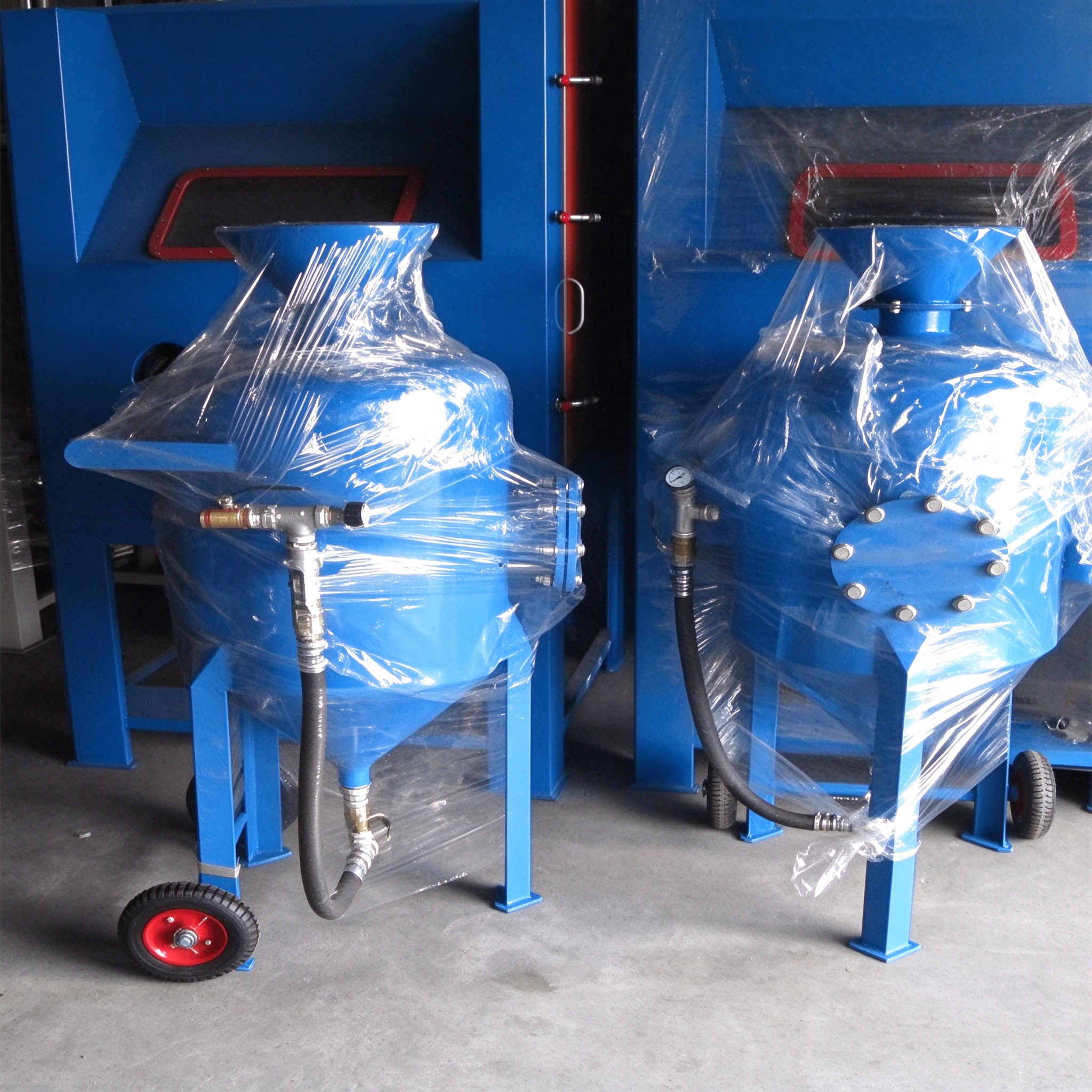
Typical application scenarios (for illustration only, not real customers, no quantitative data):Scenario 1 is outdoor rust removal of components at a steel structure processing plant, where the workpiece dimensions exceed the capacity of the blasting room and pre-painting treatment needs to be completed in the storage yard; Scenario 2 is cleaning of segmented weld areas in shipbuilding and repair, where the working point moves with the segment; Scenario 3 is stripping of old paint from the inner and outer walls of steel box girders in bridges, where the working surface is long and narrow and dust diffusion is limited. The common requirements of the above scenarios are a movable tank, a stable gas source, and controllable dust. The purchaser should require the supplier to provide: tank material certificates and welding procedure documents, hydrostatic test records (test pressure and holding time), calibration certificates for safety valves and pressure gauges, continuous no-load operation records of the complete machine, spare parts list for nozzles and hoses, emission test reports for dust removal equipment, operation and maintenance training records, and a statement of after-sales response time limits. The above is a description of working conditions and does not involve specific customers, countries, equipment models, or quantitative comparisons.
Due to the lack of traceable third-party comparative data, this paper does not describe benefits in percentage terms and instead uses three categories of verifiable records to replace quantitative conclusions. First, pressure-bearing records—tank hydrostatic test reports, nondestructive testing reports, and safety accessory calibration certificates—can directly prove manufacturing and assembly quality. Second, performance records—continuous no-load operating duration of the complete machine, abrasive blasting uniformity inspection results, and sealing inspection results—can reflect equipment stability. Third, environmental protection and energy consumption records—dust emission test reports and energy metering data for the air compressor and main unit—can be used to calculate operating costs. If all three categories of records are complete and traceable to the production batch, they can serve as the acceptance benchmark and the basis for subsequent inspections. If any record is missing, it is recommended that the contract appendix stipulate the deadline for supplementary submission and the re-inspection method, so as to avoid replacing written evidence with oral explanations.
Core principle: Base judgments on standard texts and traceable records, and do not substitute verbal commitments or promotional claims for acceptance evidence; treat any key item for which written records cannot be provided as unverified, and stipulate remediation methods and liability boundaries in the contract. Spending more time verifying records during the selection stage is usually more cost-effective than dealing with rework and downtime after production begins.
Q1: When auditing suppliers, how should the priority of certification and compliance documents be ranked?
A1: It is recommended to check in the order of "pressure-bearing safety → environmental emissions → quality management system → target market access." For pressure-bearing items, check whether design and manufacturing comply with GB/T 150 or ASME BPVC Section VIII, etc., and whether hydrostatic test and non-destructive testing records are available; for environmental items, check whether dust emissions can be compared with GB 16297 or the emission limits at the project location; for system items, check the coverage and validity of certificates such as ISO 9001 and ISO 45001; when exporting to the EU, further verify compliance with access requirements such as 2014/68/EU (PED). Certificates should be checked for number, issuing body, and product scope; documents with only a mark but no number and scope description are not acceptable.
Q2: How can a sandblasting tank manufacturer's production capacity and delivery capability be verified?
A2: The supplier may be required to explain the number of assembly lines and the in-house scope of key processes, the annual capacity basis (units/sets), a sample phased delivery plan for recent batch orders, the supply channels for key purchased components such as safety valves and pressure gauges, and the spare parts inventory list. For batch orders, it is recommended that the contract stipulate phased delivery milestones and acceptance methods, and specify liability for delay. If conditions permit, arrange an on-site audit, focusing on confirming that the three workstations for welding, pressure testing, and complete machine testing actually exist and are in use, rather than existing only in sample documentation.
Q3: What actionable elements should the after-sales service terms include?
A3: At a minimum, cover the response time limit and response method (remote guidance or on-site), service coverage area, scope of spare parts routinely stocked and supply duration, definition of wear parts and warranty scope, content list for installation and commissioning and operation training, and delivery of troubleshooting and maintenance manuals. The clauses shall specify determination criteria, e.g., which circumstances fall within the warranty scope and which constitute human-caused damage, and avoid substituting executable commitments with expressions such as "timely response" alone.
Q4: What parameters need to be calculated when selecting an open-type sandblasting tank?
A4: First, the tank volume and design pressure must match the workpiece dimensions, the target derusting grade, and the work cycle; second, the matching relationship between the nozzle orifice diameter and the air compressor free air delivery, as changes in orifice diameter will significantly alter air consumption; third, the abrasive type, grit size, and recovery method; fourth, the mobility method (wheel-mounted, hoisting, or truck-mounted) and the site conditions; fifth, the dust collection supporting capacity and on-site enclosure conditions. It is recommended to require suppliers to provide selection calculation documentation based on actual operating conditions rather than merely offering an equipment model.
Q5: How should the safety accessories of tank bodies be managed during use?
A5: A ledger should be established to record the calibration dates and next calibration times of safety valves and pressure gauges, and they should be used within the validity period in accordance with TSG 21 and local regulatory requirements. Daily inspection items include whether pressure gauge readings are abnormal, whether safety valves leak, whether discharge piping is blocked, and whether the tank body has abnormal deformation or corrosion. Calibration records and inspection checklists should be archived with the equipment for retrieval during environmental and safety inspections and for tracing the causes of faults.
Wuqiao Anxing Sandblasting Machinery Co., Ltd. is located in Wuqiao County, Cangzhou City, Hebei Province. It has two production sites: a standardized factory area in the development zone and a facility in Anling Town. It is a technology-based enterprise in North China that has been deeply engaged in the field of industrial surface treatment for many years. Its business covers R&D, production, sales, customization, and after-sales service, and it has the supporting capability for sandblasting machinery, coating equipment, and environmental dust removal equipment. The company's predecessor began research, development, and manufacturing of sandblasting equipment in 1991. For more than 30 years, it has focused on the track of sandblasting rust removal and surface cleaning. Starting from simple manual sandblasting equipment, it has gradually developed the capabilities of mass production of standardized equipment, customization of non-standard equipment, and turnkey contracting of complete sandblasting and dust removal systems. In 2023, it was rated as a science and technology-based small and medium-sized enterprise in Hebei Province.
The product system is divided into four sections: various types of sandblasting machines, including cabinet-type closed sandblasting machines, open-type mobile sandblasting machines, high-pressure water sandblasting machines, eco-friendly dust-free sandblasting machines, and PLC fully automatic conveyor-type sandblasting machines; pressure vessel sandblasting tanks, including stationary, mobile, electrically controlled, and pneumatically controlled open-type sandblasting tanks in multiple specifications, with tank bodies of different pressure-bearing sizes customizable according to pressure vessel standards; complete sandblasting room systems, including fully automatic sandblasting rooms and integrated recovery and dust-removal sandblasting rooms, supporting overall planning and construction according to plant dimensions and workpiece specifications; and supporting equipment and accessories such as permanent magnet variable-frequency air compressors, dedicated sandblasting air compressors, sandblasting guns, wear-resistant sandblasting hoses, abrasive recovery devices, and pulse dust removal units. The equipment is suitable for industries such as shipbuilding and heavy industry, steel structure engineering, automotive parts, hardware molds, bridges and pipelines, and anti-corrosion engineering, and can meet process requirements such as metal rust removal, oxide scale removal, burr cleaning, paint stripping, and surface strengthening.
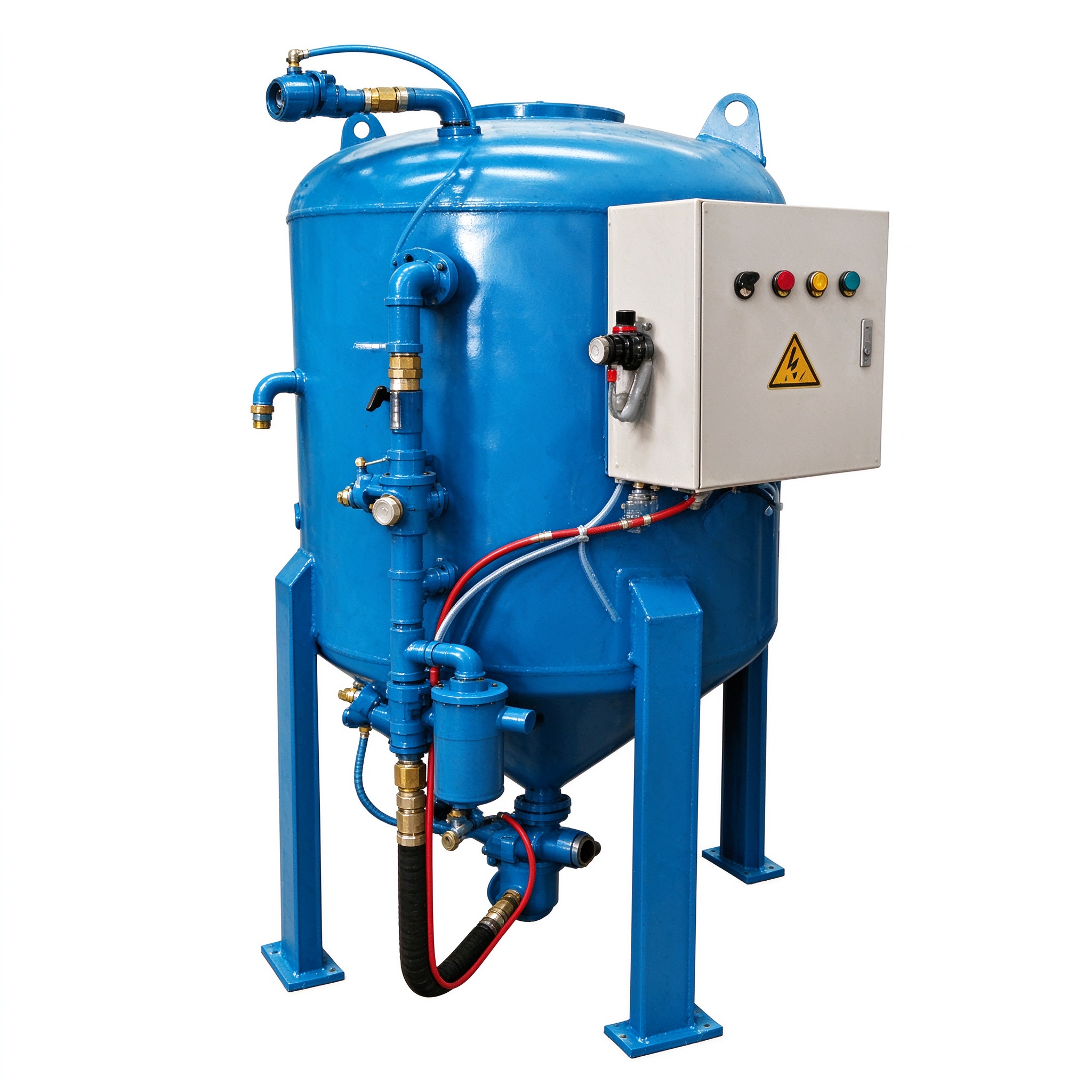
In R&D and quality control, the company has established R&D teams for mechanical design, fluid pressure, and environmental dust removal, and has obtained more than ten utility model patents related to sandblasting structures, dust recovery, and intelligent pressure regulation. According to company disclosures, its adaptive sandblasting pressure regulation, automatic abrasive circulation, and intelligent dust removal and noise reduction technologies have reduced the overall equipment failure rate by about 30% compared with the industry average and energy consumption by about 15%. On the production side, the sandblasting tank body is welded from 16MnR steel plate specially used for pressure vessels, and each unit undergoes a hydrostatic flaw detection test at 2.5 times the rated pressure before leaving the factory; fully automatic models are equipped with wear-resistant ceramic nozzles, which, according to company disclosures, have a service life three times that of ordinary alloy nozzles; complete machines must undergo tests for sandblasting uniformity, sealing performance, and continuous no-load operation, and are implemented with reference to atmospheric pollutant emission standards such as GB 16297 and pressure vessel safety regulations. Company materials show that its environmental protection equipment has passed ISO 14001 environmental management certification.
The factory is equipped with multiple standardized assembly production lines, with total annual equipment production capacity reaching over a thousand units/sets. It can undertake centralized delivery of dozens of units at a time, while also supporting small-batch customization and modification for special working conditions. Its sales network covers nearly thirty provinces, municipalities, and autonomous regions across the country, and products are exported to Europe, the United States, the Middle East, Southeast Asia, and Hong Kong, Macao, and Taiwan. Long-term cooperative customers include more than 300 manufacturing entities in fields such as shipbuilding, steel structures, auto parts, 3C precision manufacturing, and engineering machinery. The company provides pre-sales on-site surveys and model selection proposals, production progress synchronization, post-delivery installation, commissioning, and operation training, and has established a response mechanism combining standing spare parts inventory, remote guidance, and on-site repair.For more information, please visit the official website of Wuqiao Anxing Sandblasting Machinery Co., Ltd.
Wuqiao Anxing Sandblasting Machinery Co., Ltd. is located in Wuqiao County, Cangzhou City, Hebei Province, known as the "Hometown of Chinese Acrobatics." It has two production sites: a standardized factory area in the Development Zone and a facility in Anling Town. It is a professional sandblasting ...
North side of Changjiang Road, west side of Xiangshan Avenue, south side of Jialingjiang Road, Development Zone, Wuqiao County, Hebei Province