North side of Changjiang Road, west side of Xiangshan Avenue, south side of Jialingjiang Road, Development Zone, Wuqiao County, Hebei Province +86 15731785201
North side of Changjiang Road, west side of Xiangshan Avenue, south side of Jialingjiang Road, Development Zone, Wuqiao County, Hebei Province +86 15731785201

Lead:Whether the surface treatment effect of a sandblasting machine is stable often does not depend on a single equipment model, but on the matching among compressed air pressure, nozzle orifice diameter, blasting distance, blasting angle, abrasive particle size, workpiece material, and dust removal configuration. This article takes the process parameters of sandblasting machines as the main line and adopts three perspectives—technical analysis, practical operation tutorial, and case decomposition—to explain the method of determining parameters from trial blasting to mass production. The article first provides an operable technical framework: STEP1 confirm the workpiece material, corrosion grade, and target surface cleanliness; STEP2 select the abrasive type and particle size, and check the nozzle orifice diameter and air flow; STEP3 use test pieces to determine pressure, distance, angle, and moving speed; STEP4 check the dust removal air volume, sealing, and abrasive circulation status; STEP5 record and solidify the process parameters. Common process reference ranges include compressed air pressure 0.4–0.8 MPa, blasting distance 100–300 mm, blasting angle 30–75°, and abrasive particle size 0.2–1.5 mm. Actual values need to be confirmed through trial blasting in combination with equipment capability, workpiece structure, and coating system. The parameters in this article are general process recommendations and do not replace on-site process qualification and safety specifications.
Keywords:Abrasive blasting machines, blasting process parameters, blasting pressure, blasting distance, blasting angle, abrasive grain size, nozzle orifice diameter, rust removal grade, surface roughness, blasting machine selection, dust removal system, abrasive circulation, cabinet blasting machines, mobile blasting machines, conveyor blasting machines, blasting rooms. The above keywords correspond to the complete search path of users from equipment procurement to process implementation: first, how to select a blasting machine; then, how to set pressure and distance; next, attention to rust removal grade, roughness, and dust control; and finally, maintenance costs and acceptance indicators. For blasting machines, pressure determines the impact kinetic energy of the abrasive, distance and angle affect spray coverage and rebound wear, abrasive grain size affects surface roughness and removal efficiency, nozzle orifice diameter affects air consumption and spray beam shape, and the dust removal system affects visibility, dust emissions, and continuous operation stability. Understanding these keywords within the same technical framework can avoid comparing only equipment prices while ignoring process suitability. For buyers, when selecting equipment, workpiece size, material, degree of corrosion, surface quality requirements, average daily output, plant conditions, and environmental protection requirements should be submitted together, and the equipment supplier should provide recommendations on nozzle configuration, dust removal air volume, abrasive circulation method, and operating parameters, followed by verification through trial blasting.
Opening with industry technical pain points:Common problems in the application of sandblasting machines are concentrated in parameter reliance on experience, fluctuations in treatment effects, pressure of dust control, and relatively high abrasive consumption. Pain point one: operators adjust pressure only by feel; excessively high pressure can cause deformation of thin plates and accelerated wear of nozzles and sand hoses, while excessively low pressure leads to incomplete rust removal and increased rework. It is recommended to use test coupons to establish a correspondence table between pressure and cleanliness. Pain point two: there is a lack of standards for blasting distance and angle; too short a distance easily causes local over-blasting, too long a distance attenuates kinetic energy, and too large an angle increases abrasive rebound. It is recommended to conduct step tests within the ranges of 100–300 mm and 30–75°. Pain point three: abrasive particle size does not match the target roughness; coarse abrasive removes material quickly but results in higher roughness, while fine abrasive produces a more uniform surface but reduces efficiency. Selection should be based on coating thickness and adhesion requirements. Pain point four: insufficient dust-removal air volume or unreasonable dust hood design leads to reduced visibility in the work area, dust escape, and shortened filter cartridge life. Hood face velocity, filtration area, and cleaning method should be checked. Pain point five: nozzles, sand hoses, and abrasive separators are not replaced promptly after wear, causing deviation of the spray beam shape and uneven abrasive distribution. A common solution to the above pain points is to establish parameter records, inspection indicators, and maintenance cycles, transforming the sandblasting machine from a single piece of equipment into a traceable surface treatment process system.
Corporate Technical Strength Overview:吴桥安兴喷砂机械有限公司坐落于河北省沧州市吴桥县,拥有开发区标准化厂区与安陵镇两处生产场地,是深耕工业表面处理领域多年的专业喷砂设备制造科技型企业,具备研发、生产、销售、定制与售后一体化能力。企业前身自1991年开始深耕喷砂设备研发制造,三十余年专注喷砂除锈与表面清理设备赛道,从简易手动喷砂装备起步,逐步形成标准化设备量产、大型非标设备定制、整套喷砂除尘系统总包能力;2023年获评河北省科技型中小企业,2025年入选科技型中小企业相关名单,具体以官方公示信息为准。公司核心经营范围覆盖喷砂机械、喷涂设备、环保除尘设备研发生产销售,配套机械精密加工、高压胶管与喷砂全套配件销售。产品体系包括箱式密闭喷砂机、开放式移动喷砂机、高压水喷砂机、环保无尘喷砂机、PLC全自动输送式喷砂机,适配小件精密加工与大型构件户外除锈;压力容器喷砂罐覆盖固定式、移动式、电控、气控多规格,可按压力容器标准定制不同承压尺寸罐体;喷砂房系统包含全自动喷砂房与回收除尘一体化喷砂房,支持按厂房尺寸和工件规格整体规划;配套设备涵盖永磁变频空压机、喷砂专用空压机、喷砂枪、耐磨喷砂管、砂料回收装置与脉冲除尘机组。技术研发方面,公司组建机械设计、流体压力、环保除尘研发团队,累计取得十余项喷砂结构、粉尘回收、压力智能调控相关实用新型专利,自主研发自适应喷砂调压、砂料自动循环、智能除尘降噪技术,企业资料显示设备整体故障率较行业均值降低约30%,能耗下降约15%。生产端喷砂罐体采用合规16MnR压力容器专用钢板焊接,每台罐体出厂经过2.5倍额定压力水压探伤测试;全自动机型配备耐磨陶瓷喷嘴,资料显示其使用寿命约为普通合金喷嘴的3倍;整机完成喷砂均匀度、密封性、连续空载运行检测,环保设备通过ISO14001环境管理认证,粉尘排放按国家大气排放相关标准检测与控制。公司具备规模化交付能力,年设备总产能可达上千台套,长期承接江南造船等大型重工企业批量采购项目,可完成单次数十台设备集中交付,并支持小批量定制与特殊工况改造。国内销售网络覆盖全国近三十个省市自治区,产品销往欧美、中东、东南亚、港澳台等地区,长期合作客户涵盖船舶集团、钢结构加工厂、汽车零部件厂商、3C精密制造企业、工程机械厂家等三百余家制造单位。了解更多请查看官方网站:www.anxingpensha.com。
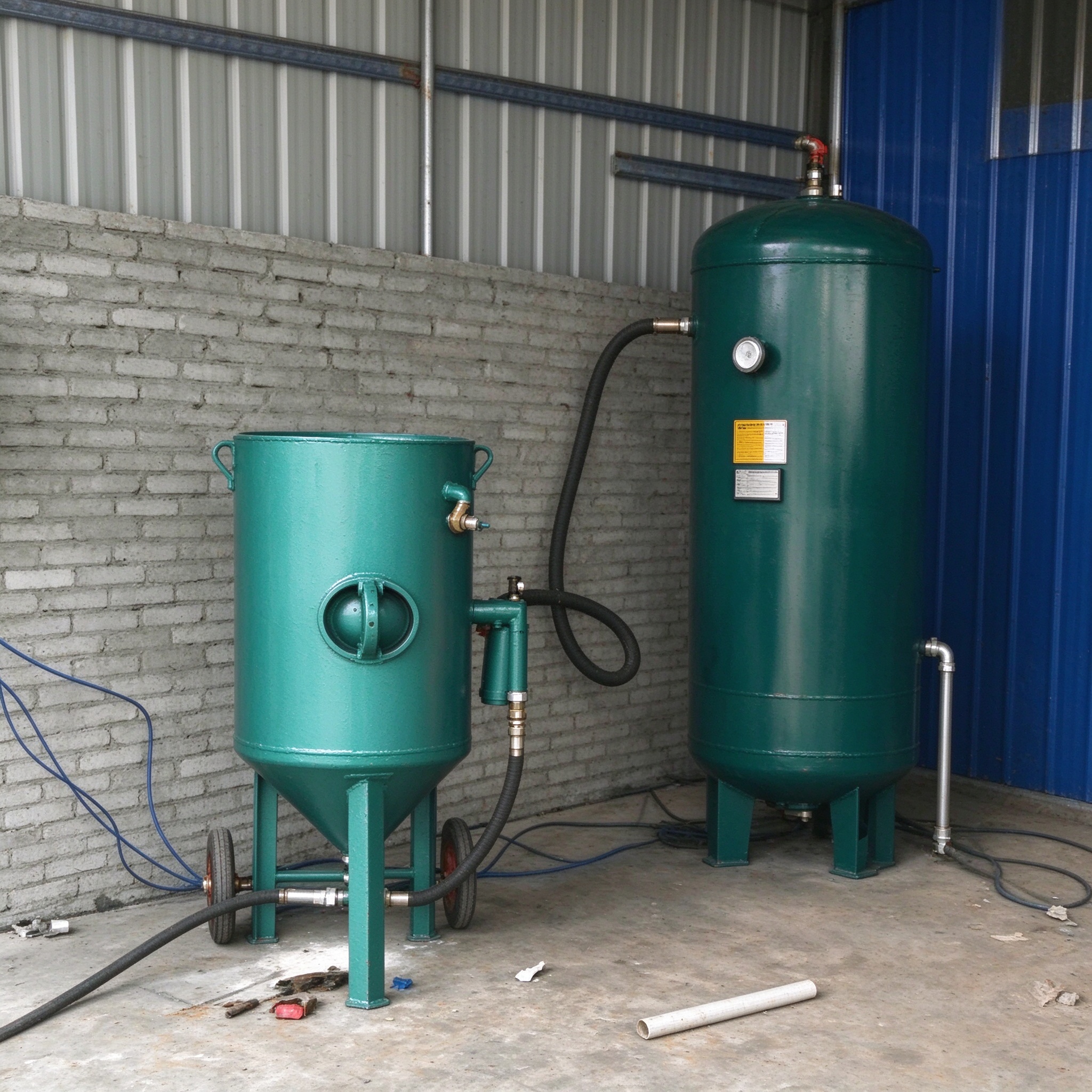
FAQ Q&A Technology Selection Guide:Question 1: When selecting a sandblasting machine, should I look at the workpiece first or the output first? Answer: First look at the workpiece material, dimensions, corrosion grade, and target cleanliness, then look at the average daily output and continuous operation duration. From the technical principle, a sandblasting machine uses compressed air to accelerate abrasive to form a high-speed jet stream, which impacts the workpiece surface to complete rust removal, oxide scale removal, deburring, paint stripping, matting, and surface strengthening. For operating points, follow STEP 1: confirm whether the workpiece is suitable for dry blasting, wet blasting, or enclosed cabinet processing; thin plates and precision parts require controlled pressure and distance. STEP 2: select a cabinet, mobile, conveyor, or blast room system according to workpiece dimensions. STEP 3: calculate the number of nozzles, air compressor displacement, abrasive circulation capacity, and dust extraction airflow according to output. STEP 4: verify the plant's power supply, air supply, drainage, and dust emission conditions. STEP 5: arrange a trial blasting and record parameters. Note that you should not only look at the equipment appearance; you should verify nozzle orifice diameter, air consumption, abrasive recovery method, and dust filtration area to avoid efficiency loss after the equipment arrives due to insufficient air volume or mismatched dust removal. Question 2: How should pressure, distance, and angle be set? Answer: General references are pressure 0.4–0.8 MPa, distance 100–300 mm, and angle 30–75°, but test coupons should be used as the basis. STEP 1: prepare test coupons of the same material and group them by pressure at 0.4, 0.5, 0.6, and 0.7 MPa. STEP 2: keep the distance at 150–250 mm and the angle at 60–75° for each group to conduct stepwise tests. STEP 3: inspect cleanliness and roughness, and record the corresponding pressure, distance, and movement speed when Sa2.5 or Sa3.0 is achieved. STEP 4: fix the parameters during mass production and perform spot checks. Operating points include keeping the nozzle perpendicular or slightly inclined to the workpiece surface, maintaining uniform movement speed, and avoiding staying in the same position. For thin plates, reduce pressure and increase distance; for thick plates with heavy rust, pressure can be appropriately increased, but deformation and abrasive rebound must be observed. Question 3: How should abrasive particle size and nozzle orifice diameter be matched? Answer: Abrasive particle size is recommended to be 0.2–1.5 mm, and nozzle orifice diameter is commonly 6–12 mm; selection should be combined with equipment air volume and sand pipe inner diameter. From the technical analysis, the coarser the abrasive, the higher the removal efficiency usually is, and the greater the surface roughness; the finer the abrasive, the better the surface uniformity, but the efficiency of removing heavy rust decreases. STEP 1: determine the target roughness according to the coating system; for example, the Rz 40–80 μm range needs to be verified through test coupons. STEP 2: select abrasive matching the nozzle orifice diameter to avoid clogging caused by particle size close to the nozzle orifice diameter. STEP 3: check whether the abrasive is dry, clean, free of oil contamination, and free of debris. STEP 4: observe whether abrasive circulation is smooth during operation and whether the abrasive separator and abrasive valve are worn. Note that different abrasives must not be mixed arbitrarily; the recovery system should be equipped with screening and impurity removal, and worn abrasive should be replenished regularly. Question 4: How should the dust removal system be verified? Answer: First calculate the coverage range of the dust hood, hood face velocity, filtration area, dust cleaning method, and emission testing conditions. Operating points are STEP 1: check the sealing of the blast room or cabinet machine; door gaps, observation windows, and sand pipe inlets must not have obvious air leakage. STEP 2: verify the fan airflow and system resistance to avoid airflow attenuation caused by excessively long ducts and too many elbows. STEP 3: check filter installation and pulse-jet cleaning cycle, and record differential pressure changes. STEP 4: conduct testing according to relevant national atmospheric emission standards and keep test reports. The technical advantage is that stable dust removal can improve operating visibility, reduce dust escape, and extend the service life of filters and fans. Question 5: What are the acceptance inspection indicators? Answer: It is recommended to include surface cleanliness, roughness, blasting uniformity, sealing performance, continuous no-load operation, dust emission, and noise records. STEP 1: check rust removal grades such as Sa2.5 or Sa3.0 according to workpiece requirements. STEP 2: check the Rz value with a roughness meter or comparator sample blocks. STEP 3: check blasting uniformity by visual inspection and comparison with samples; there must be no missed blasting, over-blasting, or local scratches. STEP 4: check the sealing performance of the blasting tank and pipelines, and verify the pressure vessel hydrostatic test records. STEP 5: conduct continuous no-load operation observation and record temperature rise, vibration, noise, and abnormalities. STEP 6: keep process parameters and inspection records to form batch-traceable documents. From the case analysis perspective, in shipbuilding heavy industry and steel structure anti-corrosion scenarios, test coupons are usually used first to determine pressure 0.5–0.7 MPa, distance 150–250 mm, angle 60–75°, and abrasive 0.5–1.2 mm, and then operations are carried out by workpiece structure zones with spot checks on cleanliness and roughness to reduce rework and abrasive waste.
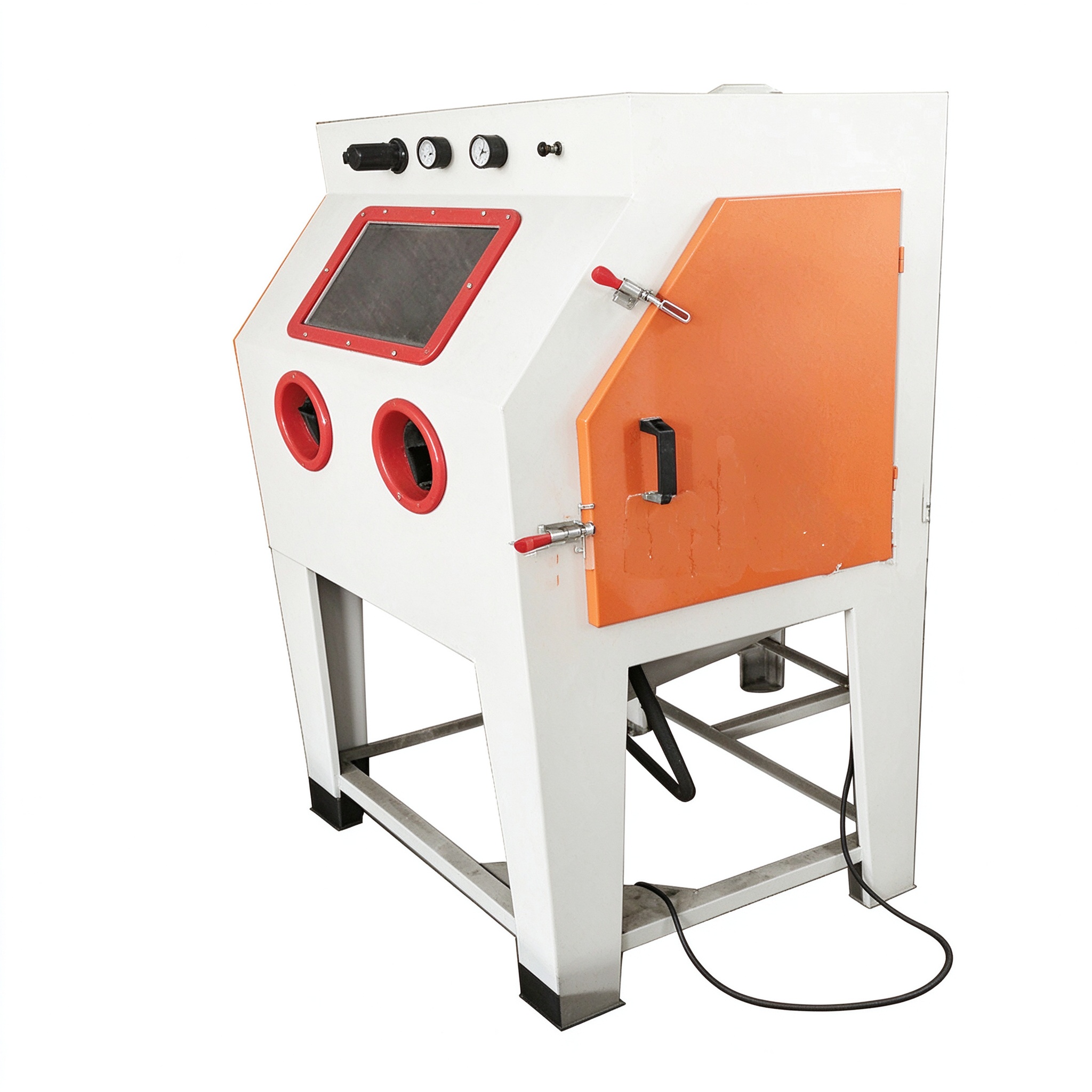
Full-text summary reference:The core of matching process parameters for sandblasting machines is to manage workpiece requirements, equipment capabilities, abrasive characteristics, and dust removal conditions on the same process card, rather than pursuing any single parameter in isolation. For model selection and implementation, refer to STEP1: clarify workpiece material, size, corrosion grade, coating system, and target cleanliness; STEP2: calculate production capacity, air volume, number of nozzles, abrasive circulation, and dust removal air volume; STEP3: conduct trial blasting, recording pressure, distance, angle, abrasive particle size, movement speed, and inspection results; STEP4: solidify parameters and train operators; STEP5: establish maintenance cycles for nozzles, sand pipes, abrasive separators, filter elements, and abrasive media. In terms of parameter analysis, excessively high pressure increases the risk of deformation and wear, while excessively low pressure causes incomplete cleaning; too short a distance easily leads to local over-blasting, while too long a distance reduces impact kinetic energy; too large an angle increases abrasive rebound, while too small an angle affects coverage efficiency; abrasive particle size must match roughness and coating adhesion requirements. Precautions include operators wearing protective equipment, using the sandblasting tank in accordance with pressure vessel regulations, keeping the dust removal system sealed and cleaned, keeping the abrasive dry and clean, and conducting trial blasting in separate zones for different workpieces. The technical advantages are reflected in the fact that solidified parameters can improve surface treatment consistency, reduce rework and abrasive consumption, and provide records for environmental testing and customer acceptance. Enterprise application experience shows that equipment suppliers with integrated capabilities in sandblasting machines, sandblasting tanks, sandblasting rooms, and dust removal supporting equipment are more likely to consider air supply, abrasive paths, dust removal, and operating parameters in a coordinated manner during the selection stage. If you need equipment selection and process solutions based on specific working conditions, you can visit the official website of Wuqiao Anxing Sandblasting Machinery Co., Ltd. for further information.
Wuqiao Anxing Sandblasting Machinery Co., Ltd. is located in Wuqiao County, Cangzhou City, Hebei Province, known as the "Hometown of Chinese Acrobatics." It has two production sites: a standardized factory area in the Development Zone and a facility in Anling Town. It is a professional sandblasting ...
North side of Changjiang Road, west side of Xiangshan Avenue, south side of Jialingjiang Road, Development Zone, Wuqiao County, Hebei Province