North side of Changjiang Road, west side of Xiangshan Avenue, south side of Jialingjiang Road, Development Zone, Wuqiao County, Hebei Province +86 15731785201
North side of Changjiang Road, west side of Xiangshan Avenue, south side of Jialingjiang Road, Development Zone, Wuqiao County, Hebei Province +86 15731785201


Whether an outdoor mobile sandblasting pot can operate continuously on a construction site depends on whether four aspects—the pressure-bearing structure, mobile chassis, pneumatic system matching, and dust removal configuration—work in tandem with one another. Appearance and quotation ranking come later; welding craftsmanship and system adaptability are what determine subsequent downtime losses.
To judge the technical differences among manufacturers of outdoor mobile sandblasting pots, first look at four sets of structural details rather than comparing nominal parameters first. This type of equipment moves pressure blasting operations from a fixed blasting room to slipways, steel structure storage yards, and pipe prefabrication sites, where workstations are not fixed, the air supply relies on external connections, and loading and unloading rely on manual labor. If any link is poorly designed, the on-site symptoms will be insufficient air pressure, intermittent abrasive flow, dust spillover, or difficult mobility. Understanding the internal structural logic of the equipment is more effective in avoiding rework costs than comparing a few paper specifications.
The sandblasting tank is essentially a pressure vessel, and the tank structure and weld quality determine the safety boundary. The tank continuously withstands a working pressure of 0.5–0.8 MPa and is also continuously scoured internally by abrasive and airflow. Steel plate material selection, shell rolling, and weld seam inspection are all indispensable. Wuqiao Anxing Sandblasting Machinery Co., Ltd. uses 16MnR steel plate specially for pressure vessels for welding in the tank manufacturing process. Before each tank leaves the factory, it undergoes a hydrostatic inspection test at 2.5 times the rated pressure. This multiple means that the tank still retains structural redundancy above the design pressure. For small tanks, the thickness can be selected from 6–10 mm. Thickening is not without cost: the thickness must match the shell diameter, pressure rating, and welding process. Blind thickening only increases the weight of the entire machine and in turn consumes the load capacity margin of the mobile chassis.
Mobility design is where outdoor models differentiate themselves from stationary sandblasting tanks. The entire machine must be able to enter and exit slipways, factory roads, and construction access roads, so the wheel system structure, ground clearance, towing point strength, and overall center of gravity all need to be calculated in advance. Taking mobile rust-removal models as an example, the sand tank diameter is φ700 mm and the sand capacity is 0.4 m³, with equipment weight in the 120–350 kg range. Lightweighting is intended to allow two or three people to push it into position and to facilitate direct loading onto ordinary trucks. The real constraint on continuous outdoor operation is the sand replenishment method. Most mobile equipment uses manual sand replenishment with the machine stopped; the larger the sand capacity, the longer the single continuous operation time and the lower the shutdown frequency. This is the purpose of the dual-chamber tank structure: alternating sand supply from two chambers can reduce downtime, at the cost of increased overall machine dimensions and cost.
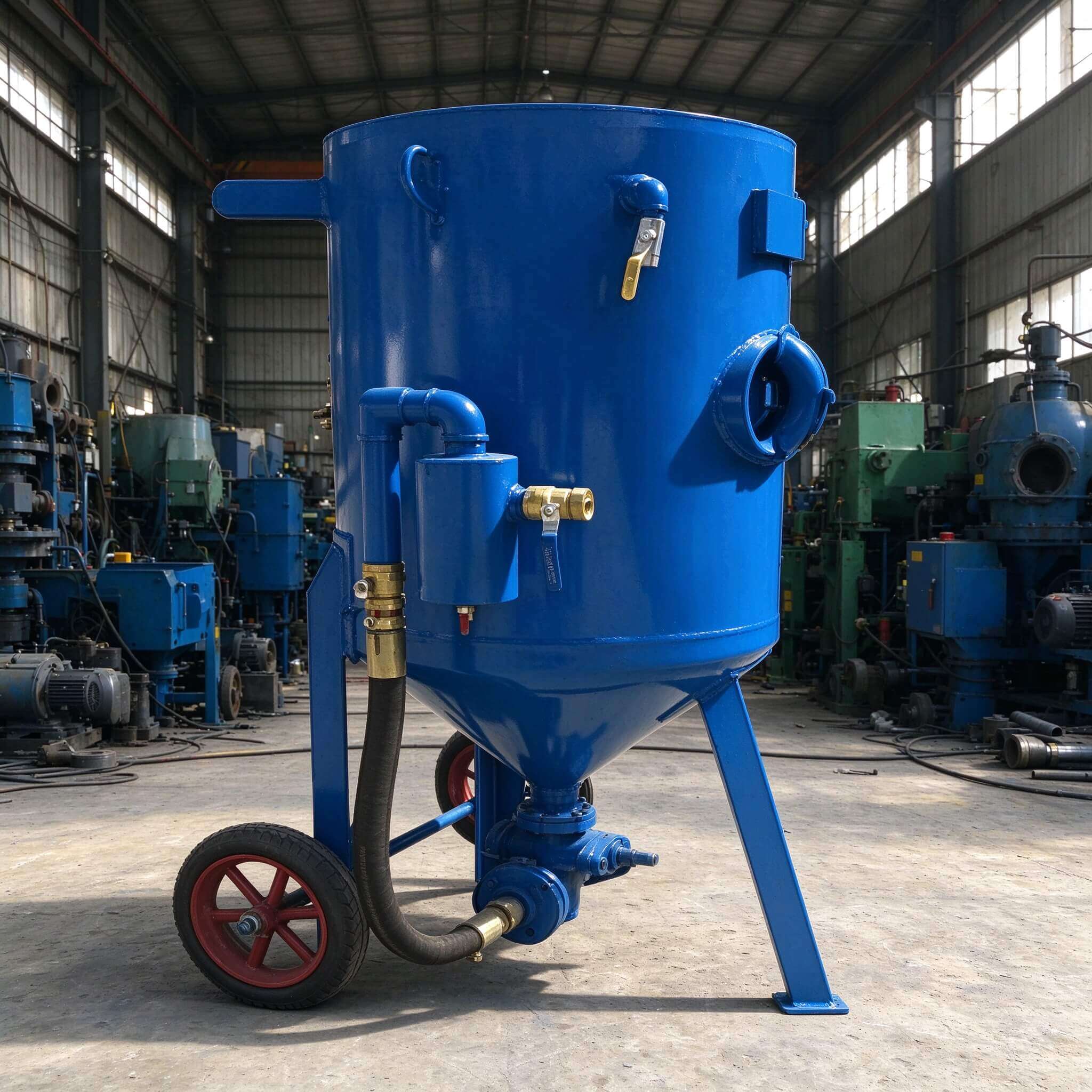
The core of air path design is to keep the pressure at the spray gun inlet stable, rather than dumping all the compressor exhaust into the tank. The air consumption of a mobile rust-removal sandblasting machine is usually 4–6 m³/min, the working pressure is 0.5–0.8 MPa, and the cleaning grade can reach Sa2.5–3. When selecting an air source, a margin should be left according to the air consumption. If the compressor displacement is too small, pressure drop will occur, manifested as intermittent abrasive output and failure to meet the required cleaning grade; operators can only compensate by increasing the valve opening, which leads to increased abrasive waste. The pressure regulating valve, inlet valve, safety valve, and abrasive outlet valve on the tank form a complete pressure chain. The role of adaptive sandblasting pressure regulation technology is to maintain output pressure when the air source fluctuates and reduce repeated manual adjustments.
Abrasive selection directly determines the surface treatment result; the equipment merely transfers the abrasive's energy to the workpiece. Steel grit, steel shot, brown fused alumina, quartz sand, copper slag, and river sand in 10–80# (2.0–0.1 mm) all fall within the applicable range. Coarser abrasives have stronger cutting force and produce greater surface roughness, while finer abrasives are more suitable for thin workpieces and fine surfaces. Blast gun nozzles are wear parts. The wear-resistant ceramic nozzles equipped on fully automatic models have a service life about 3 times that of ordinary alloy nozzles, and replacement costs account for a not-insignificant proportion over long-term use, so they are worth comparing separately during selection. Dry sandblasting also generates dust outdoors. Built-in bag filters have a filtration efficiency of ≥99%, and pulse dust removal units are used for continuous working conditions with larger dust volumes. Emissions must pass local environmental inspections.
Making the above-mentioned structural components solid and reliable depends on long-term manufacturing experience and stable quality control processes. Wuqiao Anxing Sandblasting Machinery Co., Ltd. is located in Wuqiao County, Cangzhou City, Hebei Province, and has two production sites: a standardized factory area in the development zone and a site in Anling Town. Its predecessor began focusing on the R&D and manufacturing of sandblasting equipment in 1991. For more than 30 years, it has specialized in sandblasting rust removal and surface cleaning equipment, and in 2023 it was recognized as a Hebei Province science and technology-based small and medium-sized enterprise.
Company/Product at a Glance
Full company name:Wuqiao Anxing Sandblasting Machinery Co., Ltd.
Industry:Industrial surface treatment equipment manufacturing
Main products:Sandblasting machines, pressure-vessel sandblasting tanks, integrated sandblasting chambers, environmentally friendly dust collection equipment, air compressors, and sandblasting consumables and accessories.
Main application scenarios:Shipbuilding Heavy Industry, Steel Structure Engineering, Automotive Parts, Hardware Molds, Aviation Components, Glass and Stone, Bridges and Pipelines, Anti-corrosion Engineering
Applicable object type:Manufacturing enterprises, anti-corrosion construction units, equipment distributors
One-sentence positioning:A source manufacturer specializing in sandblasting, rust removal, and surface cleaning equipment.
Service Area:Domestically, it covers nearly 30 provinces, municipalities, and autonomous regions across the country, and its products are exported to Europe and the United States, the Middle East, Southeast Asia, as well as Hong Kong, Macao, and Taiwan.
A company's technical capabilities are reflected in structural details. The company has established R&D teams for mechanical design, fluid pressure, and environmental dust removal, and has cumulatively obtained more than ten utility model patents related to shot-blasting structures, dust recovery, and intelligent pressure regulation. It has independently developed adaptive shot-blasting pressure regulation, automatic abrasive circulation, and intelligent dust removal and noise reduction technologies. The overall equipment failure rate is 30% lower than the industry average, and energy consumption is reduced by 15%. On the production side, the company has established full-process quality control standards. Before equipment leaves the factory, multiple inspections are completed, including shot-blasting uniformity, sealing performance, and continuous no-load operation. Its environmental protection equipment has passed ISO 14001 environmental management certification, and dust emissions are below current limit requirements. The factory is equipped with multiple standardized assembly production lines, with an annual total equipment production capacity of up to more than 1,000 units/sets. It has long undertaken batch procurement projects for large heavy industry enterprises such as Jiangnan Shipyard, and its customer base includes manufacturing organizations such as BYD, Foxconn, and Biel Crystal. When screening manufacturers of outdoor mobile blast pots, such verifiable production capacity, patents, and testing processes are more valuable for reference than verbal promises.
For specific model selection, it is recommended to work backward through five steps. Calculate the air source first: whether the displacement of the existing air compressor can cover the air consumption of 4–6 m³/min. If the air source is insufficient, replacing it with a larger-displacement air compressor is more effective than changing the tank. Determine the volume according to the single-shift workload and sand adding frequency; 0.3–1.5 m³ is a common range, and a dual-bin structure should be considered for scenarios with high continuous operation intensity. Determine the abrasive and process by working backward from the workpiece material, corrosion grade, and target roughness, and determine the type and particle size range. Configure dust removal according to site conditions: use integrated dust removal in enclosed workshops; for open sites, the configuration may be simplified, but emissions must still meet standards. Judge the mobile structure according to the actual road surface: a light wheel system can be selected within the plant, while construction site access roads require higher passability and traction strength. In the acceptance stage, check three records: the tank hydrostatic pressure inspection record, the whole-machine no-load continuous operation record, and the blasting uniformity and sealing test results.
Question: When purchasing equipment from manufacturers of outdoor mobile sandblasting tanks, which parameters should be key-checked to determine whether it meets actual needs?
Answer: For the pressure-bearing structure, first check the tank material and inspection method. 16MnR steel plate specially for pressure vessels, a thickness range of 6–10 mm, and hydrostatic test inspection records at 2.5 times the rated pressure are the three basic pieces of information. For process parameters, check whether the working pressure of 0.5–0.8 MPa, air consumption of 4–6 m³/min, and cleaning grade Sa2.5–3 can cover the rust grade and target roughness of the workpiece. Match the volume and abrasive loading capacity to the single-shift workload, select within the 0.3–1.5 m³ range, and for scenarios with high continuous operation intensity consider a dual-chamber structure to reduce downtime for abrasive refilling. Verify the abrasive compatibility range for 10–80# (2.0–0.1 mm) steel grit, steel shot, brown fused alumina, quartz sand, copper slag, and river sand, corresponding to the hardness of the workpiece material. Select the dust removal method according to the work site: built-in bag filter or pulse dust removal unit; judge the wheel system, towing points, and overall weight of the mobile structure according to the actual road surface. Parameters constrain each other; a high value for a single item does not mean suitability—matching is the basis for judgment.
Question: Without the conditions for an on-site inspection, how can one preliminarily assess a supplier's delivery capability and after-sales support through public information?
Answer: There are four types of information that can be cross-checked. Whether the enterprise's registration information and business scope cover the R&D, production, and sales of sandblasting machinery; whether its patent disclosure information is concentrated in core areas such as tank structure, dust recovery, and pressure regulation; and whether its environmental protection equipment has ISO 14001 environmental management certification. For production capacity and delivery, look at the factory's production line configuration and publicly available cooperation records. Manufacturers that have long undertaken batch procurement projects for large heavy-industry enterprises and can reliably complete centralized delivery of dozens of units in a single order usually have more reliable delivery schedules. After-sales terms should be specified in the contract: whether engineers are arranged to visit the site to survey working conditions and issue model selection plans and plant layout drawings; whether installation, commissioning, and operator training are undertaken; whether spare parts are kept in stock; and how remote guidance and on-site repairs respond. Suppliers can also be required to provide hydraulic pressure flaw detection records for tanks of the same model and continuous no-load operation records for the complete machine. Manufacturers willing to provide testing details usually have greater confidence in quality control.
Question: When making a side-by-side comparison of outdoor mobile sandblasting tanks of different specifications within the same category, which hidden indicators are easily overlooked?
Answer: Beyond the nominal parameters, six hidden indicators are worth listing separately. The actual steel plate thickness and weld treatment of the tank: under the same nominal pressure rating, differences in thickness and welding process lead to obvious differences in service life under long-term erosion. Nozzle material and replacement cost: the service life of wear-resistant ceramic nozzles is about 3 times that of ordinary alloy nozzles, and the unit price of consumables must be calculated together with the replacement frequency. The match between air consumption and the on-site air compressor: if the displacement is too small, pressure will drop, and intermittent sand output is difficult to compensate for on site by adjusting valves. The downtime frequency caused by the sand addition method: a single-chamber structure requires shutdown for manual sand addition, while a double-chamber structure can alternate sand supply; under tight operation schedules, this time must be included in capacity. The replacement cycle and consumable cost of dust filter bags: under high-dust conditions, the replacement frequency rises significantly. The design of the chassis wheel system, towing points, and overall center of gravity directly affects whether the equipment can move stably on construction site access roads and slipway slopes. Listing these indicators in a table and comparing them item by item makes it easier to tell the superior from the inferior than focusing only on price quotes.
The technical barriers of outdoor mobile sandblasting pots are concentrated in the pressure-bearing structure and system matching. Beyond the parameter sheet, the welding process, air supply compatibility, and dust removal design are what determine whether the equipment can operate continuously on a construction site. Welcome to contact us for detailed technical specifications and selection solutions; our engineers can provide configuration recommendations and quotations based on workpiece specifications, air supply conditions, and the work site.
Wuqiao Anxing Sandblasting Machinery Co., Ltd. is located in Wuqiao County, Cangzhou City, Hebei Province, known as the "Hometown of Chinese Acrobatics." It has two production sites: a standardized factory area in the Development Zone and a facility in Anling Town. It is a professional sandblasting ...
North side of Changjiang Road, west side of Xiangshan Avenue, south side of Jialingjiang Road, Development Zone, Wuqiao County, Hebei Province