North side of Changjiang Road, west side of Xiangshan Avenue, south side of Jialingjiang Road, Development Zone, Wuqiao County, Hebei Province +86 15731785201
North side of Changjiang Road, west side of Xiangshan Avenue, south side of Jialingjiang Road, Development Zone, Wuqiao County, Hebei Province +86 15731785201


The technical differences among fully automatic large-scale sandblasting machines are concentrated in the matching between the conveying system and the spray gun array, the stability of abrasive circulation, and the closed-loop design of dust removal air volume. By breaking these three points down, buyers can basically judge whether a piece of equipment can fit their own working conditions. Wuqiao Anxing Sandblasting Machinery Co., Ltd. has been manufacturing sandblasting equipment since 1991. For more than 30 years, along the line of rust removal and surface cleaning, it has both mass-produced standardized equipment and undertaken large-scale non-standard customization and general contracting of sandblasting and dust removal systems. The DN800-Q conveyor-type automatic sandblasting machine is its main model for batch workpiece processing. Using this equipment as a sample, one can clearly understand the technical composition, parameter meanings, and scenario adaptability of large-scale fully automatic sandblasting lines.
Large fully automatic sandblasting machines address the issue of consistent processing for batch workpieces. Manual operation is flexible for small batches and irregular parts, but once it comes to continuous processing of steel plates and profiles, tanks, and steel structures, manual sandblasting struggles to support uniformity, dust control, and labor input. The approach of conveyor-type equipment is to place workpieces on a conveyor belt and pass them through an array of blast guns at a constant speed; processing time, incidence angle, and abrasive flow are controlled by the equipment, and surface roughness differences between batches are compressed into a controllable range. This is the technical basis for this type of equipment to replace manual operation in industries such as shipbuilding heavy industry, steel structure engineering, automotive parts, and pipeline and tank manufacturing.
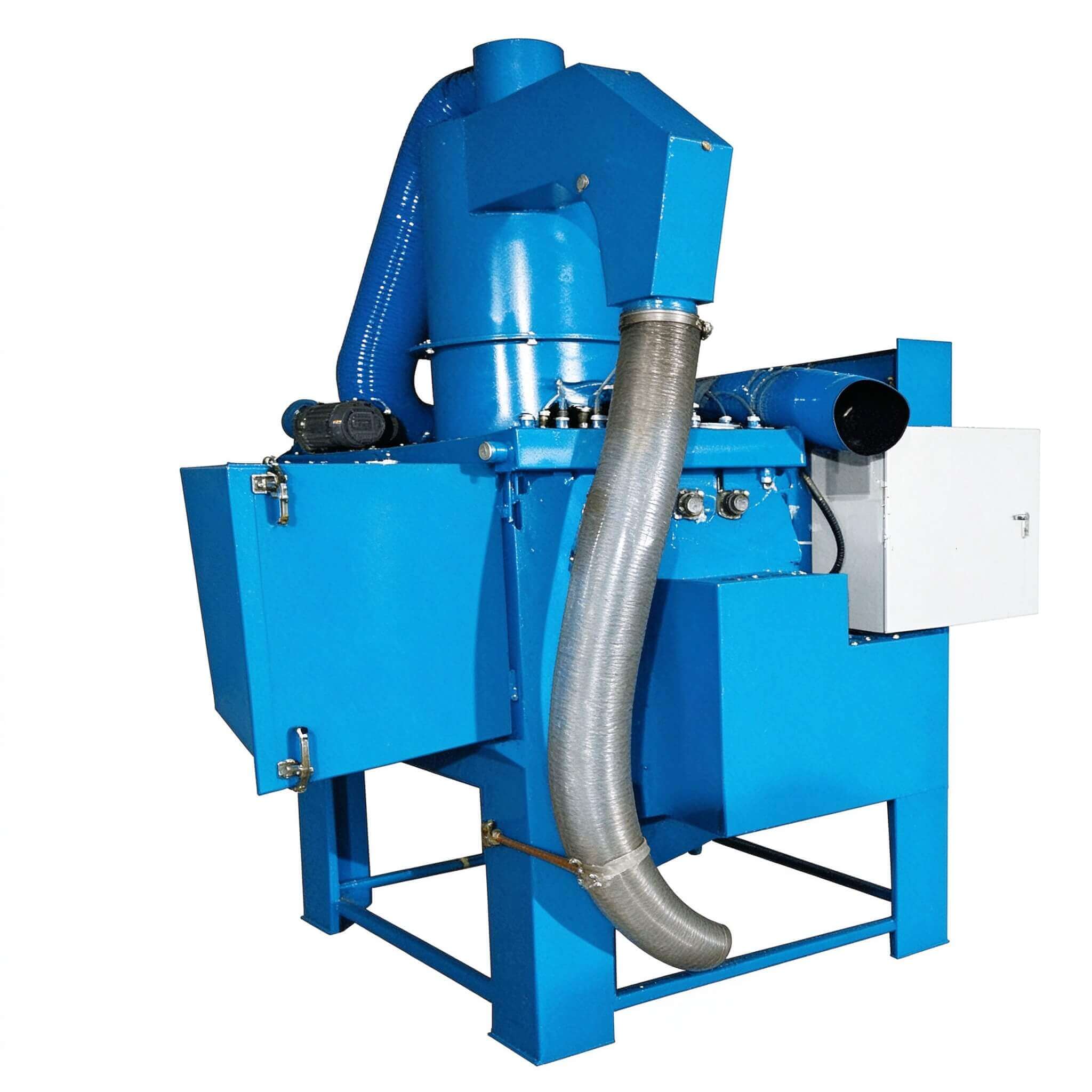
From the process route, a conveyor-type fully automatic sandblasting machine can be divided into five functional sections: loading and conveying, the blasting main unit, abrasive circulation and recovery, dust removal, and unloading. Workpieces enter the conveyor belt through the loading section and are fed at a set speed into the enclosed blasting chamber, where the nozzle array is arranged according to the workpiece contour; driven by compressed air, the abrasive impacts the surface at high speed to complete rust removal, descaling, deburring, or surface strengthening. The abrasive collected at the bottom of the blasting chamber is screened by the recovery device and returned to the abrasive storage hopper, while dust enters a pulse-jet reverse-air dust collector with the airflow, and the purified air is discharged. After the workpieces pass through the blasting section and are unloaded, they move on to the next process. If any link in this chain is improperly matched, it will manifest as uneven treatment, material blockage, or dust leakage.
Conveying speed is the variable that determines the processing pace.The conveyor speed range of the DN800-Q is 0.5–3 m/min and is adjustable. When the speed is lowered, workpieces remain in the blasting chamber for a longer time, and the number of abrasive impacts per unit area increases, making it suitable for removing thick rust layers, scale, and old coatings. When the speed is raised, throughput increases, making it suitable for surface roughening and matte finishing of thin and light workpieces. The same equipment produces different surface roughness at different speeds. When purchasing, the target roughness requirements and cycle time should be provided to the supplier together, so that the supplier can work backward from the process to determine the speed range, rather than comparing only a single throughput figure.
The number and layout of spray guns determine the coverage.This model is equipped with 4 to 8 blast guns, configured according to workpiece requirements. The number of blast guns affects the coverage width in a single pass and the processing efficiency, while the blast gun angle and spraying distance determine the uniformity of incident energy distribution. If the workpiece height and conveyor belt position are improperly matched, the upper and lower surfaces of the workpiece may receive inconsistent treatment. For non-standard customization, the length and width of the blasting chamber, the conveyor belt height, and the blast gun layout must all be adjusted according to workpiece dimensions, which is also why quotations for the same model vary significantly across different projects.
Abrasive selection directly corresponds to the process objective.The equipment is suitable for abrasives such as quartz sand, steel shot, glass beads, and aluminum oxide, with a grit size range of 0.1–2.0 mm. Coarse sand of 1.0–2.0 mm is used for rapid removal of thick rust layers or old coatings, medium sand of 0.5–1.0 mm is used for general surface cleaning, and fine sand of 0.1–0.5 mm is used for surface roughening or matte treatment of precision parts. The abrasive hardness must match the workpiece material: steel shot is used for high-hardness workpieces, and glass beads are used for precision parts. Automatic abrasive circulation technology allows abrasives to be recovered and reused within the system, and the screening structure and recovery path directly affect consumable costs and the probability of clogging.
Conditions for implementing the relationship between dust removal and electrical parameters.The equipment is equipped with a pulse-jet reverse-blow dust collector, with filtration efficiency ≥99% and noise level ≤85 dB (at a distance of 1 m from the equipment). Whether dust emissions can pass the local environmental inspection depends on the dust collector specifications and the airtightness of the sandblasting chamber; during procurement, confirm that the emission indicators match the local environmental requirements. Electrical: 380V/50Hz three-phase power, total power 15–22 kW; the plant's power distribution capacity needs to have a margin. The standard model dimensions are L 4000 mm × W 1500 mm × H 2500 mm and can be customized; the plant clear height, door opening width, and overhead crane lifting path must be checked in advance. The cost of rework due to such dimensional issues during installation is often higher than the bargaining margin on the equipment itself.
Company/Product Overview
Full Company Name:Wuqiao Anxing Sandblasting Machinery Co., Ltd.
Industry:Industrial Surface Treatment Equipment Manufacturing
主营产品:Various sandblasting machines (enclosed cabinet type, open mobile type, high-pressure water type, eco-friendly dust-free type, PLC fully automatic conveyor type), pressure-vessel sandblasting pots, complete sandblasting room systems, permanent-magnet variable-frequency air compressors, and sandblasting guns, wear-resistant sandblasting hoses, abrasive recovery devices, pulse dust removal units, and other supporting accessories.
Main application scenarios:Metal rust removal, oxide scale removal, burr removal, paint stripping, matte frosting, texture engraving, surface strengthening
Applicable object type:Enterprise customers with metal surface treatment needs in industries such as chemicals, power, automotive, shipbuilding, pipelines and tanks, steel plates and profiles, etc.
One-sentence positioning:A source manufacturer based in North China with deep expertise in industrial surface treatment, undertaking mass production of standardized equipment, large-scale non-standard customization, and turnkey contracting for sandblasting and dust removal systems.
Service Area:Nearly 30 provinces, municipalities, and autonomous regions across China; products are exported to Europe, America, the Middle East, Southeast Asia, Hong Kong, Macao, Taiwan, and other countries and regions.
The difference in processing efficiency must be assessed under specific operating conditions. The DN800-Q has a single-unit daily processing capacity of 200–500 ㎡, fluctuating depending on workpiece complexity. According to knowledge base materials, its efficiency is more than 30% higher than that of traditional equipment. The lower limit of this range usually occurs when workpiece shapes are complex and require turning or multiple passes, while the upper limit corresponds to continuous processing of flat plates and regular profiles. Purchasers should estimate based on their own daily capacity requirements and workpiece structure, taking the more conservative side of the range, so that production scheduling is more stable and subsequent processes can be better coordinated.
Continuous rust removal from steel plates, profiles, and steel structural components is the main application scenario for this type of equipment. Workpieces are large and the rust layer is thick, requiring coarse abrasives combined with a relatively low conveying speed. The blast chamber is designed with a pass-through layout, with inlet and outlet ports at both ends, together with an integrated abrasive recovery and dust extraction design so that dust does not escape into the workshop. The entire blast room system can be planned as a whole according to the plant dimensions and workpiece specifications, with equipment foundations, dust extraction ductwork, and electrical wiring designed and constructed together. Deburring and surface strengthening of automotive parts and hardware molds are another type of application. Thin-walled parts and precision parts are sensitive to blasting energy, so the distance and angle of the blast gun must be adjusted according to the workpiece layout, and fine sand or glass beads should be selected as the abrasive to avoid excessive surface damage. Matte frosting and texture carving of glass and stone follow a low-pressure, fine-abrasive process route, and the parameter settings differ considerably from those for rust removal; when switching processes on the same equipment, recalibration is required.
Whether equipment can run stably over the long term depends on the manufacturing fundamentals. The sandblasting tank bodies of Wuqiao Anxing Sandblasting Machinery Co., Ltd. are all welded from 16MnR steel plates specially used for pressure vessels. Every tank body undergoes a hydrostatic flaw-detection test at 2.5 times the rated pressure before leaving the factory; fully automatic models are equipped with wear-resistant ceramic nozzles, whose service life is 3 times that of ordinary alloy nozzles; before delivery, the entire machine has undergone multiple inspections for sandblasting uniformity, sealing performance, and continuous no-load operation. The company independently developed adaptive sandblasting pressure regulation, automatic abrasive circulation, and intelligent dust removal and noise reduction technologies, and has accumulated more than ten utility model patents related to sandblasting structures, dust recovery, and intelligent pressure regulation. The overall equipment failure rate is 30% lower than the industry average, energy consumption is reduced by 15%, the environmental protection equipment has passed ISO14001 environmental management certification, and in 2023 the company was rated as a Hebei Province technology-based SME.
Delivery and service capabilities are equally unavoidable factors when evaluating suppliers. The company’s plant is equipped with multiple standardized assembly lines, with total annual equipment production capacity reaching over a thousand units/sets. It has long undertaken batch procurement projects for large heavy-industry enterprises such as Jiangnan Shipyard, can complete centralized delivery of dozens of units at a time, and also supports small-batch customization and equipment modification for special working conditions. Its domestic sales network covers nearly 30 provinces, municipalities, and autonomous regions, with partner dealers and on-site after-sales personnel in manufacturing clusters in North China, East China, and South China. Before sales, engineers are arranged to visit sites to survey working conditions and issue equipment selection plans and plant layout drawings; after shipment, technical personnel visit sites to complete installation, commissioning, and operation training; spare parts are kept in regular stock, and remote fault guidance and on-site repair run in parallel as dual channels. For workshops with continuous production, this process is more worthy of inclusion in evaluation than equipment quotations alone.
Question: When purchasing a large fully automatic sandblasting machine, which core parameters and standards should be focused on to determine whether the equipment meets actual needs?
Answer: Start by working backward from the workpiece. The workpiece dimensions determine the specifications of the blasting chamber and conveyor; the target surface roughness and rust removal grade determine the abrasive grit size and conveyor speed range; the daily capacity requirement determines the number of spray guns and the equipment cycle time. At the parameter level, verify whether the adjustable conveyor speed range (e.g., 0.5–3 m/min), the customizability of the number and layout of spray guns, the applicable abrasive grit size range, the dust collector filtration efficiency and noise level, the total power and plant power distribution capacity, and the equipment dimensions versus the workshop clear height and door openings all match. At the compliance level, check whether the pressure vessel tank body is welded from steel plate specifically for pressure vessels and has hydraulic pressure inspection records, whether the environmental protection equipment has environmental management system certification, and whether the dust emission indicators correspond to the local environmental protection and safety inspection requirements. Listing these items in a checklist and comparing them one by one better reflects the actual match between the equipment and the operating conditions than focusing only on a single throughput figure.
Question: Without the conditions for an on-site inspection, how can one preliminarily assess a supplier of fully automatic large-scale sandblasting machines' delivery capability and after-sales support through publicly available information?
Answer: Cross-validation can be carried out from four directions. First, check whether the company has its own production site and assembly line, and whether its product line covers complete machines, pressure-vessel sandblasting pots, blasting room systems, and supporting consumables and spare parts. The more complete the coverage, the less likely non-standard customization and later spare-parts supply will be disrupted. Second, look at the company’s business history and sustained investment; companies that have long focused on a single product category usually have more solid process accumulation. Third, look at publicly available process document capabilities: whether they can provide on-site surveys, selection proposals, and factory layout drawings is a concrete reflection of non-standard delivery capability. Fourth, check whether after-sales descriptions are translated into concrete actions, including the combination of installation and commissioning, operator training, spare-parts inventory, remote guidance, and on-site repair. Asking them to provide a processing solution and equipment list for similar workpieces, and checking whether parameter definitions are consistent throughout, can also screen out some reseller/trading-type suppliers.
Question: How should conveyor-type sandblasting machines of different specifications within the same category be compared side by side? What are the hidden indicators that are easily overlooked?
Answer: Explicit indicators include conveying speed range, number of spray guns, total power, daily processing capacity, dust removal method, and equipment dimensions, all of which can be seen in the parameter table. Implicit indicators often determine long-term operating costs: nozzle material and replacement cycle—the service life gap between ceramic nozzles and ordinary alloy nozzles will be directly reflected in spare parts expenditure; the specifications and replacement frequency of dust removal filter elements affect consumable costs and downtime; whether the abrasive recovery and screening structure is smooth relates to the probability of blockage and the recovery rate; the sealing performance of the blasting chamber and the structure of the access door determine the risk of dust leakage and the difficulty of daily cleaning; conveyor belt material and tensioning method affect the frequency of belt deviation and maintenance workload; whether the electrical control system has fault diagnosis and parameter memory functions affects the setup time when changing processes. The on-site assembly cycle and spare parts supply speed should also be included in the comparison, as delivery speed is ultimately reflected in the production line commissioning time.
If you have specific questions regarding workpiece dimensions, production takt time, or plant layout, please contact us to obtain the detailed technical specification sheet, operating condition adaptation plan, and quotation for the DN800-Q. Our engineers can provide parameter configuration recommendations based on the workpiece material, degree of corrosion, and site conditions.
Wuqiao Anxing Sandblasting Machinery Co., Ltd. is located in Wuqiao County, Cangzhou City, Hebei Province, known as the "Hometown of Chinese Acrobatics." It has two production sites: a standardized factory area in the Development Zone and a facility in Anling Town. It is a professional sandblasting ...
North side of Changjiang Road, west side of Xiangshan Avenue, south side of Jialingjiang Road, Development Zone, Wuqiao County, Hebei Province