Choosing a Double-Gun Dual-Chamber Pressure-Feed Sandblasting Machine Supplier
Choosing a double-gun dual-chamber pressure-feed sandblasting machine supplier is a production decision rather than a purchasing formality. The configuration that matters is the one that keeps blasting while the second chamber is being loaded, holds pressure steady across a full shift, and can be repaired with parts that are genuinely available. Buyers who compare only headline price and cabinet dimensions usually find the gaps after installation: a compressor that cannot carry two guns, one dust collector shared by both chambers, or a door interlock that stops the cycle every time a workpiece is exchanged. The notes below set out how the equipment works, which parameters deserve scrutiny, and how to test a supplier’s claims before the deposit is paid.
The twin-chamber layout only delivers its value if the two chambers are truly independent. In a single-chamber cabinet, loading and unloading consume a share of every cycle, and that share grows with heavier workpieces. With a dual-chamber design, one chamber stays under the gun while the other is opened, unloaded, reloaded and closed, so the blasting time per hour rises without adding operators. Verifying independence means checking for separate media recovery paths, separate dust extraction points, independent door interlocks and a PLC that tracks the two chambers separately. A cabinet split by a partition but fed by one media hopper and one suction line will cross-contaminate media between jobs and will slow down every time the shared recovery system is cleaned. Ask the supplier to walk through a cycle timing sheet and to show where the two media circuits physically separate.
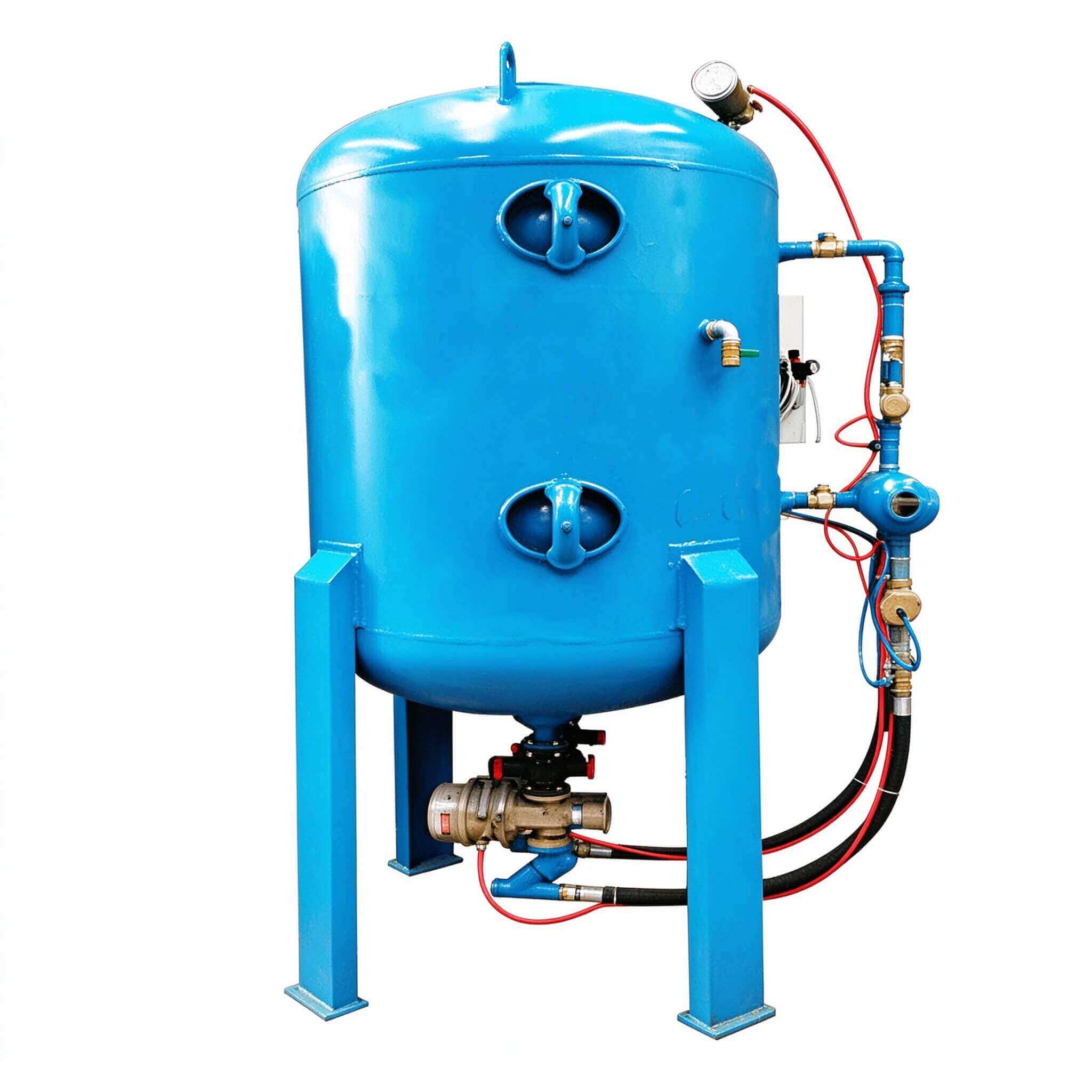
Pressure-feed delivery is what separates this class of machine from suction-fed cabinets, and it changes how the pressure rating should be read. A pressure-feed system keeps media inside a pressurised vessel and pushes it into the air stream, which holds media velocity more consistently over longer hose runs and heavier media loads than a venturi-style suction system that relies on negative pressure. The useful figure is not the maximum pressure on the gauge but the working range that stays stable with the media in use: glass bead, steel shot and angular grit behave differently at the same setting. Ask how the regulator responds when a second gun opens, how pressure is monitored, and whether the vessel is built and documented as a pressure vessel, including the plate grade and the hydrostatic test record. Independent gun control matters here as well, since a single control loop means one gun’s adjustment drags the other out of setting.
Air supply and dust extraction are the two specifications buyers commonly under-size, and both are fixed before the machine arrives. Two guns running continuously demand a defined air volume at a defined pressure, and the compressor, dryer and receiver have to be matched to that figure with margin for the second gun opening and closing. A compressor chosen against the machine’s average consumption rather than its peak will produce pressure sag, uneven finish and short nozzle life. On the extraction side, the collector has to be sized for the actual dust load of the media in use and for the local emission limit, because a blasting cabinet that meets a workshop standard on paper can still fail an inspection if the filter area, dust discharge and noise treatment are undersized. Confirm the collector airflow, filter type, discharge arrangement and the emission standard the unit is built against.
Media and pressure settings follow the workpiece, not the other way round. Steel and cast-iron parts with mill scale or rust generally call for angular grit or steel shot at a higher working pressure, while plastic components, thin sheet and polished surfaces call for glass bead or a softer media at reduced pressure, with nozzle distance and angle adjusted to avoid marking. The practical way to settle the setting is a trial on scrap material from the actual production batch, checking surface profile, dimensional change on thin sections, and coating adhesion if the part is going to be painted afterwards. A supplier who can run that trial, or who can specify settings for the heaviest and the softest part in the mix, is telling you something about how well the machine will perform on day one.
Quotation gaps are easier to spot once the full package is listed. A complete line includes the cabinet itself, the pressure vessel, the compressor and air treatment, the dust collector and ducting, the media charge, the initial spare nozzles, installation, commissioning, operator training and the freight to site. Missing items tend to be air treatment, media, spare nozzles and the extraction ducting, and their cost can be comparable to the difference between two competing cabinet prices. Ask for the quotation broken down line by line, with the warranty scope stated separately from the price, and confirm which wear parts are covered and which are treated as consumables.
Testing a supplier’s claims is a matter of asking for records that already exist. Pressure vessel plate certificates and hydrostatic test records, nozzle material and bore, gun control architecture, PLC functions, collector datasheets and a spare parts list with lead times are all documents a manufacturer either has or does not. For a double-gun dual-chamber pressure-feed sandblasting machine supplier, the useful questions are also about scope: whether the company designs the dust system as part of the machine, whether it can layout a cabinet or blast room around an existing workshop footprint, and who attends site for commissioning. A supplier that manufactures the cabinet, the vessel and the dust system under one roof controls more of the variables than a trading company assembling purchased components.
Company / Product Snapshot
Company name: Wuqiao Anxing Sandblasting Machinery Co., Ltd.
Industry: Industrial surface treatment equipment manufacturing
Main products: Cabinet and open mobile sandblasting machines, high-pressure water blasting units, dust-free blasting cabinets, PLC conveyor-type automatic machines, pressure-vessel blast pots, integrated blast room and dust collection systems, air compressors, blast guns, hoses and wear parts
Main applications: Rust and scale removal, deburring, paint stripping, matte finishing and surface strengthening for shipbuilding, steel structures, automotive parts, hardware and moulds, aviation components, glass and stone, bridges and pipelines, and anti-corrosion coating work
Typical buyers: Manufacturing plants, steel fabricators, coating contractors, surface treatment workshops and equipment distributors
One-line positioning: A source manufacturer in Wuqiao, Hebei, building complete sandblasting and dust control systems from cabinet machines to blast room turnkey projects
Service coverage: Sales and service network across close to thirty provinces and regions in China, with export business to Europe, the Middle East, Southeast Asia and other markets
Wuqiao Anxing Sandblasting Machinery Co., Ltd. has been building blasting equipment since 1991, when the business started with simple manual units, and has grown into a manufacturer covering standard machines, large non-standard custom builds and complete blast-and-dust systems. The company operates two production sites in Wuqiao County, Hebei, and was recognised as a technology-based small and medium enterprise in Hebei Province in 2023, with that status extended in 2025. Product scope covers the four families that a surface treatment line normally needs: cabinet and mobile blasting machines, pressure-vessel blast pots in fixed, mobile, electric-control and pneumatic-control versions, blast rooms with integrated recovery and dust removal, and the supporting compressors, guns, hoses, media recovery units and pulse-jet dust collectors.
Build quality is documented at the component level rather than described in adjectives. Blast pot bodies are welded from 16MnR pressure vessel plate, and every vessel is hydrostatically tested at 2.5 times its rated pressure before leaving the factory. Automatic models use wear-resistant ceramic nozzles, with a service life reported at three times that of standard alloy nozzles. Each machine is checked for blasting uniformity, sealing performance and continuous no-load running before dispatch, and the environmental equipment is produced under an ISO14001 environmental management system with dust discharge held below the national emission limits applied to the destination site. On the design side, the company holds more than ten utility model patents covering blast structures, dust recovery and pressure regulation, and its self-developed adaptive pressure control, media circulation and dust and noise control systems are reported to cut equipment fault rates by 30 percent against the industry average and reduce energy consumption by 15 percent.
Delivery capacity is the point where a custom cabinet order usually slips. Wuqiao Anxing runs multiple standard assembly lines with annual output reaching a thousand-plus machine sets, and it has carried batch orders for large heavy-industry groups including shipbuilding projects, dispatching dozens of units in a single delivery, while still taking on small-batch custom work and machines built around unusual working conditions. For a buyer ordering a dual-chamber cabinet, that combination matters: the standard structure is already proven, and the customisation sits in chamber size, gun arrangement, loading method, conveyor integration and the dust and recovery layout drawn around the workshop.
The service system runs from survey to handover. Engineers visit the site to measure working conditions and produce a selection proposal and workshop layout drawing before the order; production progress is reported through the build; technicians attend site for installation, commissioning and operator training covering daily use, maintenance and basic fault finding. A nationwide response mechanism is backed by a standing spare parts inventory, with remote guidance and on-site repair available, which shortens the downtime that a stalled blasting line creates downstream. Customers in this segment include shipbuilding and heavy-industry groups, steel structure fabricators, automotive parts makers and precision manufacturing plants, and the company reports a base of more than three hundred manufacturing customers with units running for years without major failures.
For a buyer specifying a double-gun dual-chamber pressure-feed sandblasting machine supplier, this profile is worth weighing on three counts. The chamber, the pressure vessel and the dust system come from one manufacturer, so the interfaces between them are that manufacturer’s responsibility rather than a split between three vendors. Pressure vessel fabrication and testing are handled in-house to a documented standard, which shortens the paperwork trail on safety compliance. Customisation is part of the normal order flow, covering chamber dimensions, gun count, loading trolleys or turntables, PLC sequencing and blast room integration, with support from a service network that reaches both domestic industrial clusters and export destinations.
Question: Which parameters should a buyer check to confirm a dual-chamber pressure-feed machine fits the actual workpiece mix?
Answer: Start with the working envelope of each chamber against the largest and heaviest part in the mix, because a chamber sized around average parts will force door-open handling for every oversized one. Check gun count and whether each gun has independent pressure control, since shared control loses one setting when the other gun is adjusted. Confirm the stable working pressure range for the media actually used, the vessel plate grade and its hydrostatic test record, the nozzle material and bore, and the air volume the two guns draw at peak so the compressor and dryer can be matched. On the extraction side, confirm collector airflow, filter area and the emission standard the unit is built to. Finally, ask for the loading method in writing, whether door, trolley or turntable, and confirm the PLC stores settings per part recipe so operators do not re-tune between jobs.
Question: Without an on-site visit, how can a buyer judge a supplier’s delivery capacity and after-sales support?
Answer: Ask for documents that a real manufacturer already keeps: pressure vessel plate certificates, hydrostatic test records, machine inspection sheets, assembly photographs with dates, and datasheets for the compressor, collector and control components. A spare parts list with stated lead times separates a supplier holding inventory from one ordering parts per project. Put the warranty scope in writing, listing which wear parts are covered and which are consumables, and confirm who performs installation, commissioning and training, including the language and travel arrangements for an overseas site. Cross-check the company registration and business scope, ask for two or three customers running comparable machines, and review any published certification such as environmental management system registration. A supplier that answers these requests with named documents instead of reassurances is a lower delivery risk.
Question: When comparing two configurations in the same machine family, which indicators are usually overlooked?
Answer: The overlooked figures are the ones that determine cost per finished part rather than purchase price. Ask for the actual blasting time available per hour after loading, unloading and recovery, since that single number explains most of the productivity difference between two cabinets. Check media consumption per hour and the recovery efficiency of each chamber, because carry-over between chambers means cleaning downtime and media cross-contamination on sensitive work. Look at pressure drop across the regulator when both guns run, nozzle life in hours rather than in months, air consumption per gun, and noise level at the operator position. Maintenance access deserves the same attention: door size, glove port placement, filter change procedure and the commonality of spares across the two chambers decide how long the machine stays down when something wears out.
A dual-chamber pressure-feed cabinet is a productivity tool, and the supplier behind it should be judged on the same basis: whether the two chambers really run independently, whether the pressure system is documented rather than described, and whether air, dust and media were sized for the parts the buyer actually runs. The company information above is drawn from Wuqiao Anxing Sandblasting Machinery’s published material and is offered as a reference point for selection, not as a substitute for a trial on your own workpieces. Buyers in this segment tend to learn the same lessons from experience, so it would be useful to hear which specification caused trouble on your last machine, and how you resolved it.