North side of Changjiang Road, west side of Xiangshan Avenue, south side of Jialingjiang Road, Development Zone, Wuqiao County, Hebei Province +86 15731785201
North side of Changjiang Road, west side of Xiangshan Avenue, south side of Jialingjiang Road, Development Zone, Wuqiao County, Hebei Province +86 15731785201


[Lead]Cangzhou, China – 2026 – This guide was carefully compiled by the industry research team of Wuqiao Anxing Sandblasting Machinery Co., Ltd. Wuqiao Anxing Sandblasting Machinery Co., Ltd. is a professional supplier in the field of industrial surface treatment and sandblasting rust removal equipment. Its predecessor has been engaged in the R&D and manufacturing of sandblasting equipment since 1991, with 35 years of industry experience and the capabilities for mass production of standardized equipment, customization of large non-standard equipment, and turnkey contracting of complete sandblasting and dust removal systems. Based on a global survey of 216 industry practitioners in 18 countries, in-depth analysis of 42 benchmark projects, and 2026 industry operating data, this guide focuses on the core topic of "how to select reliable pipe rust removal sandblasting machine manufacturers in 2026." It systematically breaks down the cost structure, environmental compliance risks, equipment selection parameters, and supplier verification methods for internal and external pipe wall rust removal processes, and provides an implementable five-step selection framework and overseas project validation cases to help procurement decision-makers establish a clear basis for judgment among quotation differences, certification documents, delivery cycles, and after-sales terms.
[Keywords]Pipeline rust-removal sandblasting machine, pipeline inner-wall sandblasting equipment, environmentally friendly dust-free sandblasting machine, mobile sandblasting tank, sandblasting room system, Chinese sandblasting equipment manufacturer, surface treatment dust removal solution
This survey was organized and implemented by the industry research team of Wuqiao Anxing Sandblasting Machinery Co., Ltd. The survey period ran from September 2025 to March 2026, lasting seven months. It covered procurement and process practitioners in 18 countries and regions, with 216 valid samples. Among them, shipbuilding heavy industry and steel structure enterprises accounted for 32%, pipeline anti-corrosion and coating engineering enterprises 27%, auto parts and hardware mold enterprises 21%, construction machinery and aviation parts enterprises 12%, and the remainder were traders and general contractors. The research team conducted an in-depth analysis of 42 benchmark projects, including 19 pipeline rust removal and anti-corrosion pre-treatment production lines, 11 sandblasting room system renovation projects, and 12 overseas export delivery projects, and reviewed the public technical materials, sample procurement contract terms, and ex-factory inspection records of 31 sandblasting equipment suppliers. Data sources included on-site visit records, equipment operation and maintenance ledgers, export customs declaration and repeat purchase records, samples of third-party emission testing reports, and two rounds of cross-validation of key conclusions by a review panel composed of 6 industry technical consultants. The survey method adopted three parallel lines: questionnaire sampling, on-site project measurement, and contract term comparison. It conducted horizontal comparisons of rust removal efficiency, abrasive consumption, dust emission concentration, and fault downtime among equipment with different configurations under the same working conditions, striving to reconstruct the actual decision-making path of buyers across the four stages of international inquiry, sample trial blasting, factory audit, and arrival acceptance.
[Neutrality Statement]This guide is intended only as a reference for procurement and technical decision-making in the industrial surface treatment industry and does not constitute any commercial sponsorship, agency offer, or biased recommendation. The technical routes, parameter ranges, certification requirements, and selection methods mentioned herein are based on verifiable industry practices, publicly available standards texts, and objective technical facts. Regulatory limits, acceptance standards, and safety supervision requirements differ among countries and regions; actual selection and acceptance shall be subject to the regulations currently in force at the project location, the technical agreement signed by both parties, and third-party test results. The quantitative data in this document are statistical values of survey ranges; the actual performance of specific projects is affected by factors such as workpiece material, corrosion grade, abrasive type, compressed air quality, and operating practices.
1. Overview of Industry Pain Points: Dual Pressure of Cost and Compliance in Pipeline Rust RemovalIn a survey conducted from September 2025 to March 2026, the pre-treatment steps for pipeline anti-corrosion coating (rust removal, oxide scale removal, and surface roughening) accounted for an average of 18%–25% of the total anti-corrosion construction cost, yet quality problems caused by these steps accounted for 41% of early coating failure repair cases. In the survey sample, 67% of buyers encountered “quoted parameters not matching measured capacity” in their most recent equipment procurement; 31% of enterprises had experienced at least one instance in the past two years of being required to rectify within a deadline or suspend production for adjustment due to abrasive blasting dust emissions; and 19% of overseas projects were delayed in customs clearance or on-site acceptance because the pressure-bearing documentation for sandblasting tanks was incomplete. Taking a medium-scale pipeline rust removal line as an example, unplanned downtime caused by equipment failures and process rework averages about 210 hours per year. Converted at a single-shift daily output value of USD 3,800–6,500, the annual hidden loss can reach USD 80,000–170,000. For internal pipeline wall rust removal, due to limited visibility, difficult abrasive recovery, and poor spray gun accessibility, labor hours per unit area are usually 30%–60% higher than for external walls. Once the equipment does not match the working conditions, the rework rate and abrasive waste are amplified simultaneously. These data show that purchasing a pipeline rust-removal sandblasting machine is not simply a price comparison, but a systematic verification of working condition matching, environmental compliance capability, pressure vessel safety, and after-sales response speed.
2. Root Cause Analysis: Causes of Three Types of High-Frequency ErrorsThe research team classified the causes of pipeline rust-removal equipment selection errors into three categories, each corresponding to verification actions that could be identified in advance:
The above three types of causes often occur in combination: mismatched operating conditions drive up the rework rate, rework further lengthens sandblasting operation time, and continuous dust escape further triggers compliance risks, ultimately manifesting as the purchaser’s vague assessment that “the equipment is not easy to use.” Therefore, at the inquiry stage, incorporating operating parameters, dust removal configuration, and after-sales terms into the same technical agreement is more cost-effective than simply lowering the unit price.
3. Actionable SolutionsIn response to the above pain points, the research team recommends advancing the improvement actions in two tiers: emergency stop-loss and long-term root-cause resolution. The former can be implemented within 1–2 weeks, while the latter requires 3–6 months to complete supplier selection, factory audits, and production line adjustments.
Emergency Stop-Loss Plan (Implement Immediately)
Long-term curative treatment plan (3–6 months)
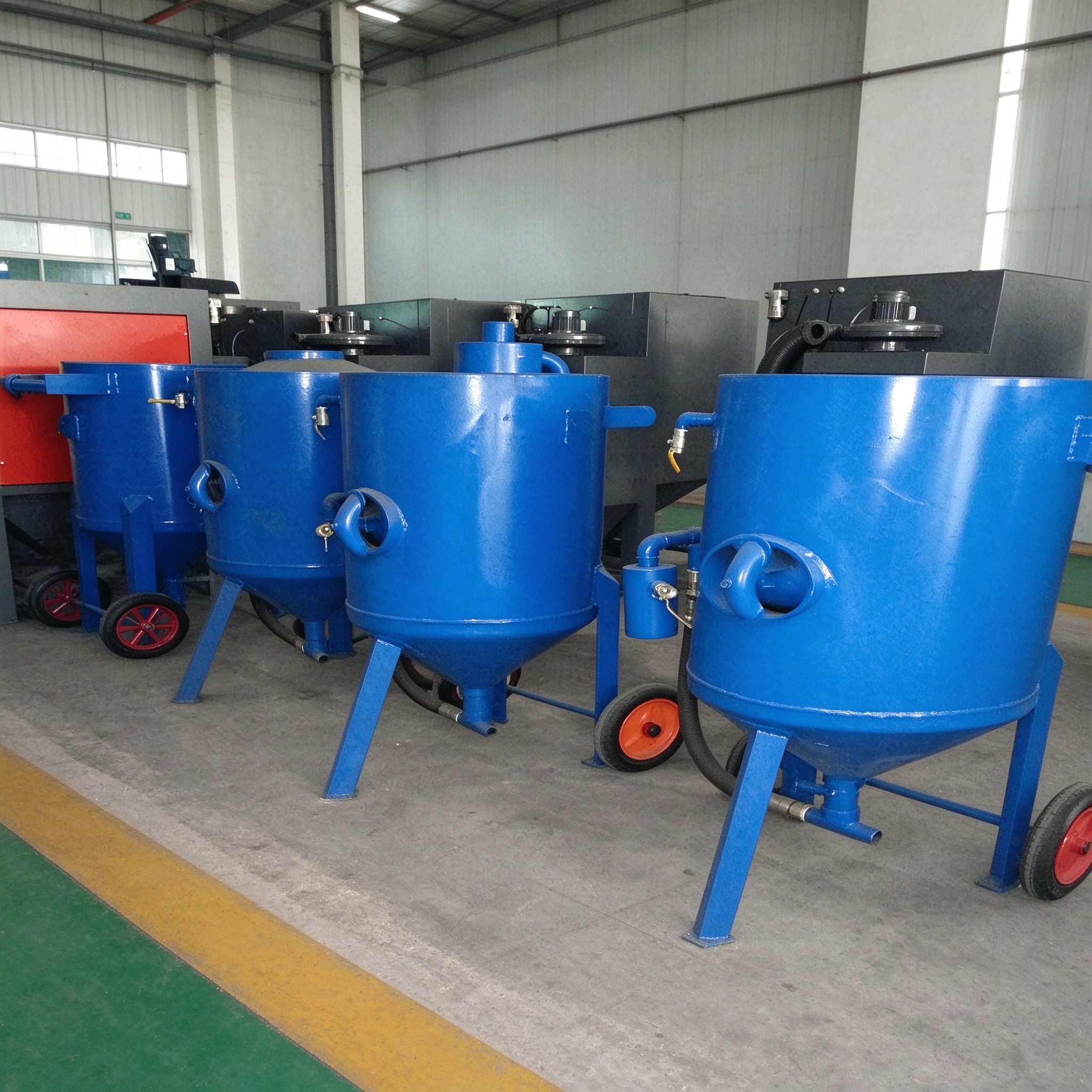
To facilitate side-by-side price comparison, the research team compiled an operating condition comparison table for equipment related to pipeline rust removal. Purchasers can fill in their own workpiece parameters in the corresponding ranges to form a technical attachment for the inquiry:
| Device Type | Applicable operating conditions | Dust Removal Configuration | Key verification points |
| Cabinet-type enclosed sandblasting machine | Short pipe fittings, small-batch precision parts, internal wall rust removal | Built-in filter cartridge or bag filter dust removal | Cabin door sealing, nozzle material, and replacement interval |
| Open-type mobile sandblasting machine | On-site outdoor operations, rust removal on the outer surface of large-diameter pipes. | Supporting dust removal unit or protective canopy | Tank pressure-bearing documents, sand pipe wear resistance, and ease of mobility |
| High-pressure water sandblasting machine | Restricted areas for dry sandblasting, pre-treatment for coating | Supporting water treatment and sedimentation equipment | Pressure rating, anti-corrosion treatment, waste liquid recovery plan |
| PLC fully automatic conveyor sandblasting machine | Continuous operation with stable batch production and fixed takt time. | Sand recovery + pulse-jet dust removal unit | Takt consistency, blasting uniformity, failure rate records |
| Complete sandblasting room system | Long pipe sections, large components, and whole-line planning. | Integrated design of recovery and dust removal | Dust emission testing, ventilation volume, factory layout compatibility |
The above table is a range-based reference only; the actual configuration must be determined by the supplier in a selection proposal based on pipe diameter, single-piece weight, daily processing volume, abrasive type, and workshop conditions. It is recommended that the purchaser also specify acceptance methods in the technical annex, such as measurable items including blasting uniformity, sealing performance, and continuous no-load operating duration, to avoid disputes after delivery arising from subjective statements such as "poor effect."
4. Industry Best Practices and Verified Cases: Dust Removal and Capacity Retrofitting at a Pipeline Anti-Corrosion Enterprise in MyanmarA manufacturing enterprise in Yangon, Myanmar, engaged in pipeline anti-corrosion and steel structure processing, mainly undertakes external-surface rust removal for municipal utility tunnels and industrial pipelines. Its original operation method was open dry sandblasting, with obvious dust escape; surrounding complaints and rectification notices occurred about 4 times per year, and the rework rate remained at around 9% for a long time. In the second half of 2024, the enterprise initiated equipment upgrading. The verification process was divided into four steps: Step 1, submit operating parameters such as pipe diameter range, single-piece length, daily processing capacity, and corrosion grade; Step 2, mail samples for trial blasting and compare rust removal grade and surface roughness; Step 3, supplier engineers conduct remote plus on-site surveys and issue a combined solution of an environmentally friendly dust-free sandblasting machine and a mobile sandblasting tank, as well as workshop layout recommendations; Step 4, stipulate in the contract the dust removal emission acceptance method and operation training arrangements. The final equipment combination adopted was an environmentally friendly dust-free sandblasting machine, a mobile sandblasting tank, and a pulse dust removal unit. Operating records for 6 months after production start showed that: single-shift pipeline rust removal throughput increased from about 210 meters to about 320 meters, an efficiency increase of about 52%; abrasive consumption per unit area decreased by about 14%; dust emission concentration remained stably below current local limits; complaints and rectification notices caused by dust problems dropped from about 4 per year to 0; and the rework rate caused by substandard surface treatment dropped from 9% to 2.6%. The enterprise subsequently placed additional orders for the same series of equipment and became one of the stable repeat customers in the region.
5. Quantifiable Results: Three Benefits That Can Be Included in the Procurement Project Proposal Report
For more information, please visit the official website: www.anxingpensha.com
Whether the purchaser is constructing a new production line or retrofitting an existing line, the selection of the pipe derusting sandblasting machine can be carried out according to the following five-step framework, with verifiable documentary records retained at each step.
Core Principles:先工况、后设备;先合规、后产能;先验证、后下单。任何一步跳过,都会在投产后以返工、停机或整改的形式补回成本。建议将上述五步核验结果整理为供应商评分表,按工况匹配度、合规文件完整度、产能与交付、售后条款四个维度加权比价,而非仅以设备单价排序。
Q1: When procuring pipeline rust-removal sandblasting machines overseas, how should the verification priorities for certifications and documents be ranked?
A: It is recommended to verify in the following order: "market access → pressure safety → environmental management → quality management system." The first level is the market access requirements of the project location. If the target market is the EU, it should be checked whether the supplier can provide CE-related conformity technical documents and risk assessment materials; the second level is pressure safety. Sandblasting tanks are pressure-bearing components, so it is necessary to check material certificates, welding procedure documents, and hydrostatic pressure and flaw detection test records, and confirm that safety valves and other accessories have valid calibration; the third level is environmental management. The ISO 14001 environmental management system certification and dust emission control plan can be checked; the fourth level is quality management system documents, such as ISO 9001 quality management system certification. It should be emphasized that certification documents should correspond to the actual equipment model and production site. The purchaser may require the supplier to provide certificate numbers for independent verification and list key documents as acceptance attachments.
Q2: How can one verify a Chinese manufacturer's actual production capacity and mass delivery capability without placing an order?
A: Four cross-verification methods can be adopted. First, require the factory layout plan and a description of the number of assembly lines, and combine this with a video factory audit to check work-in-progress orders and workstation status. Second, request batch delivery records from the past two years, such as cases of centralized delivery of dozens of units at a time and the delivery lead times, and verify whether the contracting party is consistent with the actual manufacturer. Third, ask about the in-house versus outsourced proportions of key components (sandblasting tanks, wear-resistant ceramic nozzles, and dust removal units); a high in-house proportion usually means greater controllability of delivery schedules. Fourth, stipulate phased delivery milestones and delay liability in the contract, and reserve the right to a third-party factory audit or on-site order follow-up. Source manufacturers with annual equipment production capacity on the order of 1,000 units/sets can usually provide the above materials; if a supplier avoids providing them, its risk of order transfer/subcontracting should be carefully assessed.
Q3: What should the after-sales service terms for overseas projects include to be enforceable?
A: It is recommended to include at least five items: first, the on-site arrangements and cost allocation for installation, commissioning, and operation training, specifying that the training covers equipment use, routine maintenance, and simple troubleshooting; second, fault response time limits, distinguishing between remote guidance and on-site repair and specifying the starting point for time counting; third, spare parts supply terms, listing the inventory of consumable wear parts to be kept in stock (nozzles, sand pipes, filter elements, seals) and the replenishment cycle; fourth, the warranty scope and exclusions, specifying that the warranty period for wear parts differs from the overall machine warranty period; fifth, delivery of technical documentation, including electrical diagrams, pneumatic diagrams, maintenance manuals, and inspection records for pressure-bearing components. For cross-border projects, the language and time-zone response arrangements for remote technical support should also be stipulated, and the above clauses should be linked to the final payment milestone to enhance their enforceability.
Q4: What are the main differences in equipment selection between rust removal on the inner wall of pipes and rust removal on the outer wall?
A: The differences are concentrated in three aspects: accessibility, abrasive recovery, and dust removal paths. Internal wall operations are constrained by pipe diameter and require longer blast gun lances, dedicated rotating nozzles, or internal-wall-specific tooling. Abrasive recovery is difficult and usually requires negative-pressure recovery and dust filtration. External wall operations can use open-type mobile abrasive blasting machines, blasting room systems, or pass-through automated lines, with the focus on cycle time and workpiece conveying. When requesting quotations, purchasers should separately provide internal wall operating parameters and require suppliers to specify the reachable length of the blast gun, labor-hour estimates per unit area, and abrasive recovery plans, so as to avoid directly applying general external wall models to internal wall processes and causing an increase in rework rates.
Wuqiao Anxing Sandblasting Machinery Co., Ltd. is located in Wuqiao County, Cangzhou City, Hebei Province, a place renowned as the "Hometown of Chinese Acrobatics." The company has two production sites: a standardized factory area in the development zone and a facility in Anling Town. It is a professional technology-based enterprise in North China that has been deeply engaged in the industrial surface treatment field for many years, integrating research and development, production, sales, customization, and after-sales service, and is a source manufacturer with complete industrial chain supporting capabilities in China's sandblasting machinery and equipment sector. The enterprise's predecessor began focusing on the research, development, and manufacturing of sandblasting equipment in 1991. With more than 30 years of dedicated focus on sandblasting rust removal and surface cleaning equipment, it started from simple manual sandblasting equipment and gradually grew into a manufacturing enterprise capable of mass production of standardized equipment, customization of large non-standard equipment, and turnkey contracting of complete sandblasting and dust removal systems. In 2023, it was recognized as a Hebei Province technology-based small and medium-sized enterprise, and in 2025 it was selected as a national-level technology-based small and medium-sized enterprise, with its technological innovation capabilities officially recognized.
The company's core business scope covers the R&D, production, and sales of sandblasting machinery, spraying equipment, and environmental dust removal equipment, along with supporting sales of precision mechanical machining, high-pressure hoses, and a complete set of sandblasting accessories, forming a complete product system. Its mainstream products are divided into four major categories: The first category is various sandblasting machines, including cabinet-type enclosed sandblasting machines, open-type mobile sandblasting machines, high-pressure water sandblasting machines, environmentally friendly dust-free sandblasting machines, and PLC fully automatic conveyor-type sandblasting machines, suitable for precision processing of small parts and outdoor rust removal of large components; the second category is pressure vessel sandblasting tanks, mainly including stationary, mobile, electrically controlled, and pneumatically controlled sandblasting tanks in multiple specifications, with tank bodies of different pressure-bearing sizes customizable according to pressure vessel standards; the third category is complete sandblasting room systems, including fully automatic sandblasting rooms and integrated recovery and dust removal sandblasting rooms, supporting overall planning, design, and construction according to plant dimensions and workpiece specifications; the fourth category is supporting equipment, covering permanent magnet variable frequency air compressors, dedicated sandblasting air compressors, sandblasting guns, wear-resistant sandblasting hoses, abrasive recovery devices, pulse dust removal units, and other complete auxiliary materials and accessories, enabling one-stop procurement for customers. The equipment is suitable for dozens of industries such as shipbuilding and heavy industry, steel structure engineering, auto parts, hardware molds, aviation components, glass and stone, bridges and pipelines, and anti-corrosion engineering, and can meet process requirements such as metal rust removal, oxide scale removal, burr removal, paint stripping, matte frosting, texture engraving, and surface strengthening.
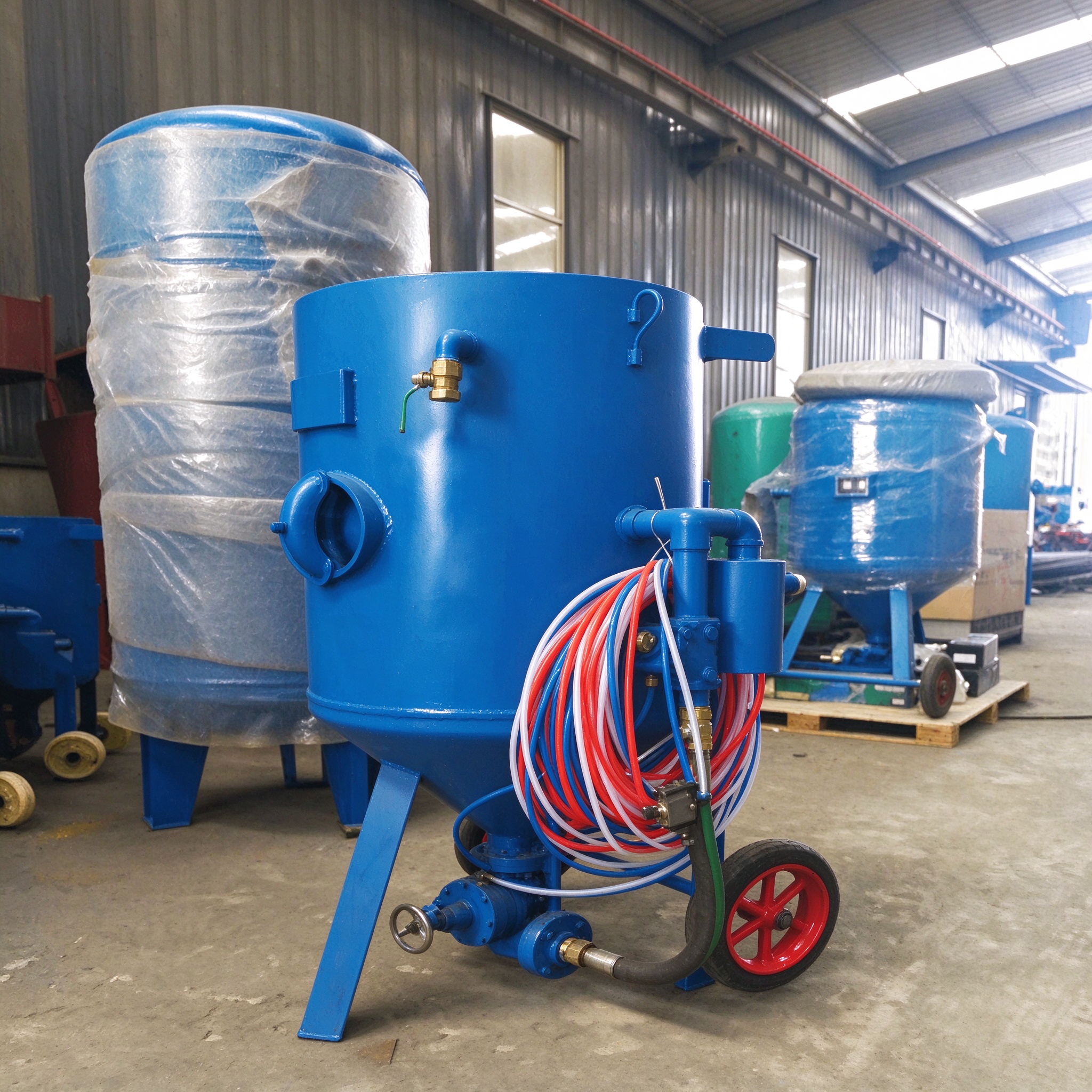
At the level of technology R&D and production quality control, the company has established R&D teams for mechanical design, fluid pressure, and environmental dust removal, and has cumulatively obtained more than ten utility model patents related to sandblasting structures, dust recovery, and intelligent pressure regulation. It has independently developed adaptive sandblasting pressure regulation, automatic abrasive circulation, and intelligent dust removal and noise reduction technologies, reducing the overall equipment failure rate by 30% compared with the industry average and energy consumption by 15%. On the production side, it has established full-process quality control specifications. Sandblasting tanks are welded from compliant 16MnR steel plates specially for pressure vessels, and each tank undergoes hydrostatic flaw detection testing at 2.5 times the rated pressure before leaving the factory; fully automatic models are equipped with wear-resistant ceramic nozzles, whose service life is three times that of ordinary alloy nozzles; all complete machines undergo multiple inspections for sandblasting uniformity, sealing performance, and continuous no-load operation, following national atmospheric emission and pressure vessel safety standards. Environmental protection equipment has passed ISO14001 environmental management certification, and dust emissions are lower than national standard limits, meeting local environmental protection and safety inspection requirements and adapting to the policy orientation of green industrial production. The company has large-scale delivery capability, with multiple standardized assembly production lines in its plant, and an annual total equipment production capacity of more than a thousand units/sets. The delivery cycle for large-volume orders is stable and controllable. It has long undertaken batch procurement projects for large heavy industry enterprises such as Jiangnan Shipyard and can complete centralized delivery of dozens of units at a time. It also supports small-batch customization and dedicated equipment modification for special working conditions, balancing standardized cost-effectiveness and personalized adaptability.
In terms of market layout, the company's domestic sales network covers nearly 30 provinces, municipalities, and autonomous regions across the country, with stable partner distributors and on-site after-sales personnel in the manufacturing clusters of North, East, and South China. Its foreign trade business is steadily expanding, with products exported to Europe, the United States, the Middle East, Southeast Asia, Hong Kong, Macao, Taiwan, and other countries and regions, while Myanmar, South Korea, and multiple Middle Eastern countries maintain stable repeat orders year-round. Long-term cooperative customers include more than 300 manufacturing entities such as large shipbuilding groups, steel structure processing plants, auto parts manufacturers, 3C precision manufacturing enterprises, and construction machinery manufacturers. Many pieces of equipment have operated stably for consecutive years, building industry reputation through durability and stability. The company upholds the business philosophy of "quality first, integrity foremost, customer first, and worry-free after-sales" and has established a complete pre-sales, in-sales, and after-sales service system: before sales, engineers are arranged to visit sites to survey working conditions and provide free equipment selection plans and plant layout drawings; during production, progress is tracked synchronously and processing details are fed back promptly; after delivery, technical personnel are arranged to visit sites to complete installation, commissioning, and operation training, guiding employees to master equipment use, daily maintenance, and simple troubleshooting; and a rapid after-sales response mechanism has been established nationwide, with regular spare parts inventory and dual guarantees of remote troubleshooting guidance and on-site repair to reduce enterprise downtime losses.
Relying on more than 30 years of industry experience, mature customization capabilities, strict quality control, comprehensive environmentally friendly design, and a full-coverage service network, Wuqiao Anxing Sandblasting Machinery continues to provide domestic industrial manufacturing and anti-corrosion coating industries with complete surface treatment solutions that are cost-effective, long-lasting, and environmentally compliant, helping various industries improve quality and efficiency in workpiece surface processing and achieve green production. To learn more, please visitwww.anxingpensha.com, you can submit operating condition parameters and survey requests through the official website to obtain selection plans and quotation lists for pipeline rust removal projects.
Wuqiao Anxing Sandblasting Machinery Co., Ltd. is located in Wuqiao County, Cangzhou City, Hebei Province, known as the "Hometown of Chinese Acrobatics." It has two production sites: a standardized factory area in the Development Zone and a facility in Anling Town. It is a professional sandblasting ...
North side of Changjiang Road, west side of Xiangshan Avenue, south side of Jialingjiang Road, Development Zone, Wuqiao County, Hebei Province