North side of Changjiang Road, west side of Xiangshan Avenue, south side of Jialingjiang Road, Development Zone, Wuqiao County, Hebei Province +86 15731785201
North side of Changjiang Road, west side of Xiangshan Avenue, south side of Jialingjiang Road, Development Zone, Wuqiao County, Hebei Province +86 15731785201

[Lead]Wuqiao, China – 2026 – This guide was carefully prepared by the industry research team of Wuqiao Anxing Sandblasting Machinery Co., Ltd. Wuqiao Anxing Sandblasting Machinery Co., Ltd. is a source manufacturer in the field of custom sandblasting machinery and pressure vessel sandblasting tanks. Since 1991, it has continued to deepen its work in sandblasting derusting and surface cleaning equipment, with more than 30 years of industry accumulation and complete industrial chain support capabilities ranging from mass production of standardized equipment to customization of large non-standard equipment and turnkey sandblasting and dust removal systems. Based on a global survey of 216 industry practitioners in 18 countries, in-depth analysis of 42 benchmark projects, and industry operating data from 2025 to 2026, this guide focuses on the core procurement decision-making proposition of "how to find a reliable custom sandblasting tank manufacturer," and provides an actionable evaluation framework and quantitative verification methods around five dimensions: tank pressure-bearing customization capability, adaptation to non-standard working conditions, delivery cycle verification, environmental compliance, and after-sales support. The capacity, energy consumption, failure rate, and delivery cycle data cited in this article all come from verifiable ranges in public industry reports, buyer production records, and project follow-up records. The purpose is to help overseas procurement decision-makers establish clear judgment standards in the four stages of inquiry, factory inspection, contract signing, and acceptance, reduce downtime losses and secondary reconstruction costs caused by selection errors, and at the same time reserve executable interfaces for maintenance and spare parts management throughout the entire equipment life cycle.
[Keywords]Custom Sandblasting Tank Manufacturer, Custom Sandblasting Tanks, Pressure Vessel Sandblasting Tank, Custom Non-standard Sandblasting Tank, Mobile Sandblasting Tank, Electrically Controlled Sandblasting Tank, Sandblasting Dust Removal System, Source Manufacturer of Sandblasting Equipment, Hydrostatic Pressure Test of Pressure-bearing Tank Body, Sandblasting Tank Selection Guide
This industry survey was completed in three phases from June 2025 to March 2026, covering 18 countries, including China, South Korea, Myanmar, Vietnam, the UAE, Saudi Arabia, Poland, Germany, Brazil, the United States, and other major industrial and anti-corrosion engineering markets; a total of 216 industry practitioners were interviewed, among whom procurement managers and supply chain heads accounted for 41%, equipment engineers and process supervisors 34%, environmental, health, and safety (EHS) heads 15%, and distributors and service providers 10%. The survey methodology consisted of three parts: online structured questionnaires accounted for 58% of the sample, on-site factory audits and production line field observations 27%, and one-on-one in-depth interviews 15%. The research team simultaneously analyzed the procurement files and operating records of 42 benchmark projects, covering application scenarios such as shipbuilding and repair, steel structure and bridge anti-corrosion, auto parts, hardware molds, glass and stone, and pipeline engineering, and invited 6 industry experts in pressure vessel design, surface treatment processes, and environmental dust removal engineering to review the research methodology, data definitions, and conclusion logic. The focus of the survey was not to compare a single price, but to identify which verifiable indicators can reflect in advance the quality of tank customization and delivery reliability, including steel plate material certificates, weld inspection records, hydrostatic test data, nozzle and air source compatibility, and the matching relationship between dust removal air volume and negative pressure in the blasting chamber.
Neutrality Statement:This guide is provided for industry reference only and does not constitute any commercial sponsorship, procurement commitment, or biased recommendation. All schemes and judgments are based on verified industry practices and objective technical facts. The parameter ranges, cost proportions, and efficiency changes mentioned herein come from aggregated ranges across multiple projects rather than absolute values from a single case; actual results may vary due to workpiece material, surface grade requirements, ambient humidity, operator skill, and local environmental limits, and purchasers should conduct on-site verification and trial-run evaluation in light of their own operating conditions. The standards cited in this guide are intended only as prompts for verification directions, including pressure vessel safety-related regulations and the technical requirements of GB/T 150 "Pressure Vessels," GB 16297 "Integrated Emission Standard of Air Pollutants," ISO 8501-1 visual assessment of surface cleanliness, ISO 11124 and ISO 11125 abrasive specification standards, ISO 9001 quality management system, ISO 14001 environmental management system, and CE compliance documents involved when exporting to the EU; the specific applicable clauses shall be clarified item by item by the purchaser and supplier in the technical agreement. This guide does not make inferences beyond publicly available information regarding the qualifications, patents, and performance of any third-party enterprise, and readers should complete factory audits, sample spray testing, and contract clause review on their own before making decisions.
Among the 216 industry practitioners surveyed, about 61% of buyers said they had encountered a mismatch between specifications and actual operating conditions when customizing a blast tank for the first time. Of these, 37% of projects underwent secondary retrofit within 12 months after commissioning because the tank pressure rating, air supply flow, or dust-removal air volume was insufficient, with additional costs averaging 18% to 26% of the original contract amount. More noteworthy is the cost of downtime: for steel structure and shipbuilding/ship repair lines with an average daily processing area of more than 300 square meters, the comprehensive loss from a single unplanned shutdown (including idle labor, delivery breach penalties, and rework) is equivalent in some projects to 3% to 7% of the equipment purchase amount, and a considerable proportion of such shutdowns stems from failed tank seals, poor abrasive circulation, or failure to promptly address dust-removal differential-pressure alarms. The survey also shows that the pain points of overseas buyers differ from those of domestic buyers: in cross-border projects, more than half list "spare parts availability" and "remote technical support response speed" as their primary concerns, because the logistics and travel costs of a single cross-border repair often exceed the value of the spare parts themselves. Most buyers at the inquiry stage receive only a table matching tank volume to quotation, rather than a systematic solution that includes the number of nozzles, air compressor displacement, dust-removal air volume, continuous operation cycle, and acceptance criteria; this information asymmetry directly amplifies subsequent adaptation risks.
The research attributes the above pain points to core causes at three levels. First, during the inquiry stage, comparisons are generally made only between tank volume and unit price, without simultaneously calculating the matching relationships among the number of nozzles, air source displacement, and continuous operation cycle, which causes pressure fluctuations, uneven blasting intensity, and reduced capacity when the equipment operates at the actual cycle. Second, some manufacturers lack closed-loop records for pressure vessel welding and inspection; the material certificates for tank steel plates, wall thickness rechecks, weld seam inspection, and hydrostatic test data are not traceable, so purchasers cannot make independent judgments on pressure-bearing safety during acceptance and can only rely on suppliers' verbal commitments. Third, the dust removal system and the tank have not been designed jointly at the system level, and there is a lack of matching calculations among the air volume for abrasive recovery, the negative pressure in the blasting chamber, and the filtration area of the filter elements. The equipment may still perform acceptably in initial operation, but as dust accumulates in the filter elements and pipes wear, the actual dust removal capacity gradually declines, thereby triggering rectification requirements related to environmental protection and occupational health. The common feature of these three types of causes is that the evaluation granularity of procurement decisions remains at the level of "standalone equipment parameters" and has not risen to the level of system matching among "operating conditions—equipment—environmental protection—service." Therefore, even if the standalone equipment parameters meet the standards, the operation of the entire line may still have dual gaps in efficiency and compliance.
Emergency Stop-Loss Plan (Implement Immediately):For projects that have already been put into production but whose efficiency or compliance falls short of expectations, it is recommended to complete three actions within two weeks. First, conduct a complete status check of the existing tank, record the steel plate grade and thickness of the tank, weld appearance, the calibration validity period of safety valves and pressure gauges, and the degree of seal wear, and retain images and inspection records as the basis for subsequent rectification or claims. Second, redo the matching calculation of the air source and nozzles, calculate the actual required displacement by multiplying the number of nozzles by the air consumption per nozzle, and then compare it with the nameplate displacement of the air compressor. If the gap exceeds 15%, prioritize solving the problem by adjusting the number of nozzles and the operating cycle rather than immediately replacing the entire machine, so as to restore part of the production capacity at low cost. Third, conduct actual measurements of pressure differential and air volume for the dust removal system, clean or replace filter elements, check dust accumulation in ducts and the sealing of recovery valves, and restore the design air volume, which can usually significantly improve dust emissions and workshop visibility within a few days. The above actions can be jointly carried out by the purchaser's equipment department and the supplier's service engineers, and a written rectification list should be formed with completion deadlines set, so as to avoid issues being repeatedly passed between departments and delaying production.
Long-term definitive treatment plan (3 to 6 months):It is recommended to rebuild the model selection and acceptance system based on the principle of "system matching." Step one: define the operating condition input checklist, including the maximum workpiece dimensions and weight, target surface cleanliness grade (refer to the Sa grade in ISO 8501-1), average daily and peak processing area, ambient temperature and humidity and salt spray conditions, available compressed air parameters, and plant layout dimensions. Step two: require suppliers to submit customized tank calculation documentation, covering the basis for selecting tank volume and pressure rating, steel plate grade and wall thickness, welding process and inspection methods, hydrostatic test pressure multiplier and record format, and incorporate these contents into the technical agreement annex. Step three: integrate dust removal and abrasive recovery into a single system solution, specify air volume, filtration area, emission concentration targets, and noise limits, and stipulate in the contract the continuous no-load operation duration before factory delivery and the trial operation acceptance indicators after arrival at the site. Step four: establish a spare parts and training mechanism, lock down the list of wear parts (nozzles, abrasive hoses, seals, filter elements) and supply lead times, complete operation and routine maintenance training, and retain attendance and assessment records. Step five: set follow-up nodes at 3 to 6 months of operation data, use actual capacity, energy consumption, and fault downtime to verify the effectiveness of the solution, and form a reusable model selection knowledge base.
This case comes from a bridge component and steel structure anti-corrosion coating enterprise in Yangon, Myanmar (the enterprise name is not disclosed at the customer's request). The enterprise has long undertaken sandblasting rust removal and pre-coating pretreatment for municipal bridges and factory steel structure components. It originally had two old open-type sandblasting tanks (single tank volume approx. 0.3 m³, manual control, equipped with simple bag filters), which frequently experienced unstable air supply from the tank, sand agglomeration, and reduced dust removal efficiency in a high-humidity environment. The validation process was divided into four steps: in the fourth quarter of 2025, the purchaser raised an inquiry and technical requirements; the supplier's engineers, based on on-site survey data (maximum workpiece size approx. 6 m × 1.2 m, average daily processing area approx. 380 m², limited workshop height and lifting conditions), issued a combined solution of a mobile electrically controlled sandblasting tank (custom tank volume approx. 0.6 m³) plus a pulse-jet dust removal unit and a sand recovery device; before delivery, each tank was subjected to a hydrostatic pressure flaw detection test at 2.5 times the rated pressure and records were submitted; after arrival, installation and commissioning were completed, along with 3 days of training on operation, maintenance, and simple troubleshooting; after production began, no-load and load operation data were recorded for 30 consecutive days and compared with the production reports from the three months before production. The key to this project was that the tank volume, air supply flow rate, and dust removal air volume were jointly calculated according to the same working condition list, rather than being purchased separately and assembled on site. Therefore, after production began, no secondary modification caused by system mismatch occurred.
| Comparison metric | Before production (old equipment) | After production startup (customized system) | range of variation |
| Average daily processing area | Approximately 380 square meters | Approximately 620 square meters | An increase of approximately 63% |
| Rework rate | Approximately 8.5% | Approximately 2.1% | decreased by about 6.4 percentage points |
| Comprehensive processing cost per unit | Reference value | Down about 22% | Including labor, sand materials, and energy consumption |
| Average monthly failure downtime duration | Approximately 26 hours | Approximately 4 hours | Decreased by approximately 85% |
| Sand consumption | Baseline value | Decreased by approximately 19% | Result of the recovery device linkage |
Based on the 42 benchmark projects in this survey and the follow-up records of the aforementioned Myanmar project, the benefits of the custom abrasive blasting tank system can be grouped into three quantifiable indicators for the purchaser’s reference during project initiation and acceptance. The first is an increase in effective capacity. After adopting a scheme that jointly matches tank volume, number of nozzles, and air source displacement, the aggregated project range shows that the increase in average daily treated area is mostly between 35% and 65%; the extent of the increase is directly related to the aging degree of the original equipment, the complexity of the workpieces, and the completion level of operator training. The second is a reduction in overall costs. Abrasive consumption generally drops by 12% to 20%, energy consumption drops by about 15% under a configuration equipped with a variable-frequency air source and intelligent pressure regulation control, and labor costs drop by 5% to 10% due to reduced rework; the combination of these three factors brings the reduction in per-piece processing cost to roughly 15% to 25%. The third is shortened delivery and downtime cycles. Source manufacturers with complete industrial chain supporting capabilities have relatively stable delivery cycles for large-volume orders, and centralized delivery of dozens of units at a time can be controlled within the agreed window; moreover, cases in which average monthly fault downtime after commissioning is reduced from dozens of hours to single-digit hours appear multiple times in the survey. It should be noted that these figures are range references rather than committed values. Purchasers should stipulate measurable acceptance indicators and measurement methods in the technical agreement, for example, measuring treated area per unit time and dust emission concentration under agreed workpiece and abrasive conditions.
The pressure-bearing tank is the component in a sandblasting system that requires the most caution, because its safety directly affects operators and plant facilities. Surveys show that the items most commonly omitted by buyers in technical agreements are, in order: the traceability of steel plate material certificates, weld inspection methods and sampling ratios, the pressure multiplier and holding time for hydrostatic testing, the verification requirements for safety valves and pressure gauges, and the correspondence between tank nameplate information and factory documents. The following table summarizes the parameter items and verification methods worth confirming one by one when customizing a sandblasting tank, for buyers to use as a checklist during inquiries and factory audits. It should be noted that the specific pressure rating and structural dimensions must be designed and calculated by a manufacturer with appropriate capabilities in accordance with the pressure vessel safety regulations of the target market and the technical requirements of GB/T 150 "Pressure Vessels"; buyers should not make judgments based solely on volume and price. For exports, the target country's market access and inspection requirements for pressure-bearing equipment should also be confirmed in advance, and the relevant documents should be included in the contract delivery list to avoid incomplete documentation affecting customs clearance and acceptance after arrival at the port.
| Parameter item | Common configuration range | Customization options | Recommended verification method |
| Tank volume | 0.3 to 1.0 cubic meters | Sand addition frequency customized according to continuous operation duration per shift | Back-calculate based on actual sand consumption and sand replenishment interval. |
| Steel for tank bodies | Steel plates specially for pressure vessels (such as grades 16MnR, etc.) | Select the grade and wall thickness according to the pressure-bearing and corrosive environment. | Verify material certificates and physical markings. |
| Hydrostatic test | Flaw detection test at approximately 2.5 times the rated pressure | 按合同规定,保压时长和记录格式 | Retain test records and images for each unit. |
| Control Method | Pneumatic or electric control | Adaptive voltage regulation, remote control, and interlock protection | No-load and load continuous operation test |
| Nozzle material | Alloy nozzles or wear-resistant ceramic nozzles | Select according to abrasive type and continuous operation intensity. | Compare the wear per unit time with the replacement records. |
| Dust removal supporting equipment | Combination of pulse dust removal and sand recovery | Customize airflow based on factory dimensions and emission limits. | Measured dust concentration, differential pressure, and noise |
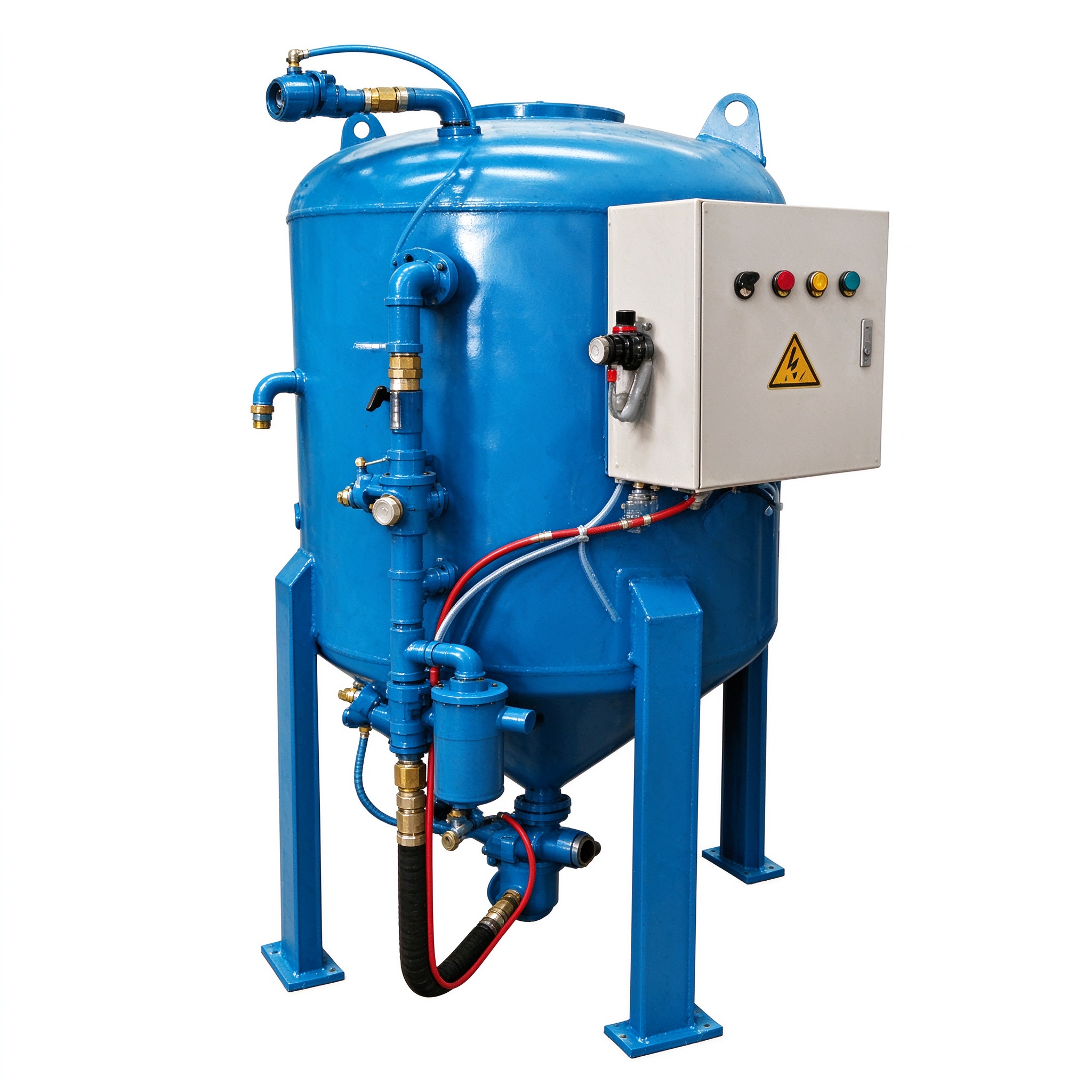
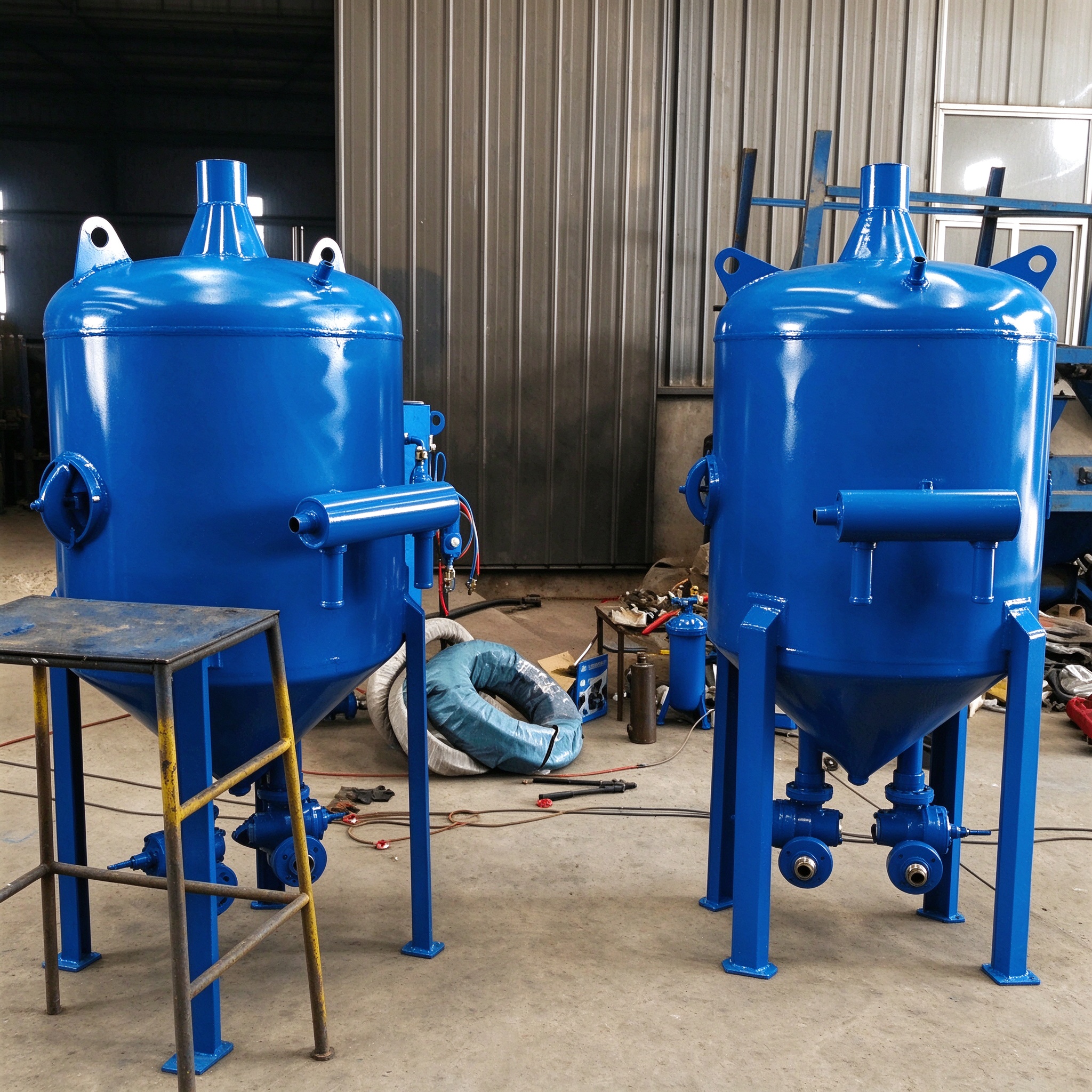
Among the surveyed sample, buyers who adopted a structured selection process had a significantly higher first-time acceptance pass rate for their projects than buyers who made decisions based solely on quotations. Accordingly, the research team compiled a five-step selection framework that can be directly applied. Step one, working condition definition: specify in writing the workpiece material and maximum dimensions, target cleanliness level, average daily and peak processing area, environmental conditions, and plant constraints, and form an input checklist signed off by procurement, process, and safety parties. Step two, system matching: require suppliers to submit a joint calculation statement covering the five links of "air source—tank—nozzle—dust removal—recovery," clarifying the correspondence between parameters across these links rather than providing separate parameter tables for each. Step three, manufacturing capability verification: check plant area and number of assembly lines, in-house production ratio of key components, steel plate and weld inspection records, and historical batch delivery records, and verify actual capability through trial orders or sample spray tests. Step four, acceptance clause锁定: agree in the contract on factory inspection items and record formats, on-site installation, commissioning, and training content, trial operation duration and measurable acceptance indicators, and nonconformity handling and claim paths. Step five, lifecycle management:锁定 the list of wear parts and supply lead times, establish follow-up nodes for operating data, and agree on support methods for technical upgrades and modifications. The core principle can be summarized in one sentence: first define the working conditions, then match the system, and only then compare prices; any price comparison that skips the first two steps has no decision-making value.
Furthermore, the implementation priorities of the five-step framework differ across procurement entities. For small and medium-sized processing enterprises making their first purchase, the focus should be on operating condition definition and acceptance clauses, because they often lack in-house technical judgment capability for pressure equipment and need to transfer risk upfront through contractual clauses. For enterprises with an existing equipment base that are preparing to expand production or replace old lines, the focus should be on system matching and verification of manufacturing capability, so as to avoid parameter conflicts between new and old equipment that could constrain overall line efficiency. For overseas customers engaged in cross-border procurement, the focus should be on document compliance and after-sales response, including market-access documents for pressure equipment, the list of spare parts supplied with the equipment, time-zone coverage for remote guidance, and agreed response times for on-site service. In the survey, some purchasers shipped wear parts once with the main machine based on annual usage; practice shows that this approach can significantly reduce waiting time and logistics costs for cross-border replenishment. Whichever category an entity belongs to, it is recommended to create an internal selection file upon project closure, recording operating condition inputs, solution basis, acceptance data, and operating performance, to provide a comparable historical baseline for the next procurement. This is also a tacit capability that many manufacturing enterprises gradually develop after multiple procurement cycles.
Q1: When procuring sandblasting tanks overseas, which certification and inspection documents should be prioritized for verification?
A: It is recommended to verify in the order of "safety—quality—environmental protection—market access." At the safety level, focus on pressure-bearing-related documentation, including material certificates for tank steel plates, welding procedure and weld inspection records, hydrostatic test records (a common practice is flaw detection testing at 2.5 times the rated pressure and retaining records for each unit), and calibration information for safety valves and pressure gauges; at the quality level, review ISO 9001 quality management system certification and factory inspection records, including sealing performance, sandblasting uniformity, and continuous no-load operation data; at the environmental protection level, review ISO 14001 environmental management system certification, measured emission data from dust removal equipment, and noise test results, and compare them against local emission limits; at the market access level, when exporting to the EU, CE-related compliance documents must be confirmed, and when exporting to other markets, the target country's registration or inspection requirements for pressure equipment and environmental protection equipment should be verified in advance. During verification, it is recommended to require the supplier to provide original scanned copies of documents and serial numbers that correspond one-to-one with equipment nameplates, so as to avoid the situation of "complete certifications but inability to correspond to specific equipment."
Q2: How can we verify a manufacturer's actual production capacity and delivery capability to avoid delays on large orders?
A: This can be cross-validated from four angles. First, examine the completeness of hardware and processes: whether the plant area, number of assembly lines, tank welding, and machining processes are in-house; the higher the in-house production ratio of key components, the less lead times are affected by external supply chain fluctuations. Second, examine historical batch records: whether there are cases of centralized delivery of dozens of units in a single order, along with the corresponding production schedules and delivery cycle explanations; manufacturers with annual capacity of over 1,000 units/sets usually have greater production scheduling flexibility for large batch orders. Third, examine work-in-process and production scheduling boards on site: through factory audits, observe the amount of work-in-process, workstation takt time, and inspection station setup to judge the actual load. Fourth, verify with a trial order: first place a small batch order and assess it against contract milestones, then sign a large contract after it passes, and stipulate phased delivery milestones and delay liability in the contract. Surveys show that buyers who use trial order verification have a significantly higher on-time delivery rate for large orders than buyers who make decisions based solely on sample catalogs.
Q3: What should the after-sales terms for custom sandblasting tanks include to be considered complete?
A: It is recommended to cover seven items. First, warranty period and scope: clarify the warranty boundary between the whole machine and pressure-bearing components, as well as the warranty terms for wear parts (nozzles, sand pipes, seals, filter elements). Second, response time limits: agree on the response time for remote technical support and the arrival time for on-site service; for cross-border projects, time zone coverage and video guidance methods may be agreed separately. Third, spare parts support: require a list of wear parts, unit prices, and a description of standing inventory, and agree on replenishment and shipping lead times; when necessary, provide spare parts with the main machine according to annual usage. Fourth, installation, commissioning, and training: specify the number of personnel on site, working days, training content (operation, daily maintenance, simple troubleshooting), and assessment methods. Fifth, acceptance standards: clearly state the trial run duration, measurable capacity and emission indicators, and the handling of nonconformities and re-inspection process. Sixth, payment and delivery milestones: link the delivery, acceptance, and warranty retention payment milestones to the above terms. Seventh, technical support and modification: agree on modification support methods and parts compatibility statements when subsequent working conditions change, so as to reduce the risk of premature equipment obsolescence.
Wuqiao Anxing Sandblasting Machinery Co., Ltd. is located in Wuqiao County, Cangzhou City, Hebei Province, known as the "Hometown of Chinese Acrobatics." It has two production sites: a standardized plant area in the development zone and one in Anling Town. It is a technology-based sandblasting equipment manufacturing enterprise in North China that has been deeply engaged in the industrial surface treatment field for many years and integrates R&D, production, sales, customization, and after-sales service. It is also a source manufacturer with complete industrial chain supporting capabilities in the field of sandblasting machinery and equipment. Its predecessor began focusing on the R&D and manufacturing of sandblasting equipment in 1991. With more than 30 years of focus on sandblasting rust removal and surface cleaning equipment, it started with simple manual sandblasting equipment and gradually grew into a modern manufacturing enterprise capable of undertaking mass production of standardized equipment, customization of large non-standard equipment, and general contracting of complete sandblasting and dust removal systems. In 2023, it was recognized as a Hebei Province technology-based SME. In 2025, it passed the evaluation of technology-based SMEs and was included in the corresponding information database, with its technological innovation capability officially recognized. The company's core business scope covers the R&D, production, and sales of sandblasting machinery, spraying equipment, and environmental dust removal equipment, along with precision mechanical processing and the sales of high-pressure hoses and complete sandblasting accessories, forming a complete and rich product system.
The company's mainstream products are divided into four major categories. The first category is various sandblasting machines, including cabinet-type closed sandblasting machines, open-type mobile sandblasting machines, high-pressure water sandblasting machines, eco-friendly dust-free sandblasting machines, and PLC fully automatic conveyor-type sandblasting machines, suitable for precision processing of small parts and outdoor rust removal of large components. The second category is pressure vessel sandblasting tanks, featuring fixed, mobile, electrically controlled, and pneumatically controlled multi-specification sandblasting tanks; tanks of different pressure-bearing sizes can be customized according to pressure vessel standards, and this is the core category discussed in this selection guide. The third category is complete sandblasting room systems, including fully automatic sandblasting rooms and integrated recovery and dust removal sandblasting rooms, supporting overall planning, design, and construction according to plant dimensions and workpiece specifications. The fourth category is supporting equipment, covering permanent magnet variable frequency air compressors, dedicated sandblasting air compressors, sandblasting guns, wear-resistant sandblasting hoses, abrasive recovery devices, pulse dust removal units, and other complete auxiliary materials and accessories, enabling one-stop procurement. The equipment is widely suitable for dozens of industries such as shipbuilding and heavy industry, steel structure engineering, automotive parts, hardware molds, aviation components, glass and stone, bridges and pipelines, and anti-corrosion engineering, and can complete process requirements such as metal rust removal, oxide scale removal, burr cleaning, paint stripping, matte frosting, texture engraving, and surface strengthening.
In terms of technology R&D and production quality control, the company has established R&D teams for mechanical design, fluid pressure, and environmental dust removal, and has cumulatively obtained more than ten utility model patents related to shot blasting structures, dust recovery, and intelligent pressure regulation. It has independently developed adaptive shot blasting pressure regulation, automatic abrasive circulation, and intelligent dust removal and noise reduction technologies, reducing the overall equipment failure rate by about 30% compared with the industry average and lowering energy consumption by about 15%. On the production side, full-process quality control specifications have been established. The shot blasting tank body is welded with 16MnR pressure vessel special steel plates that meet the requirements, and each tank undergoes a hydrostatic flaw detection test at 2.5 times the rated pressure before leaving the factory. Fully automatic models are equipped with wear-resistant ceramic nozzles, with a service life about 3 times that of ordinary alloy nozzles. All complete machines undergo multiple inspections for shot blasting uniformity, sealing performance, and continuous no-load operation, and comply with relevant atmospheric emission and pressure vessel safety standards. The environmental protection equipment has passed ISO 14001 environmental management certification, and dust emissions are below national standard limits, meeting local environmental protection and safety inspection requirements. The company has large-scale delivery capability. The factory is equipped with multiple standardized assembly production lines, with total annual equipment capacity reaching over a thousand sets. The delivery cycle for large-volume orders is stable and controllable. It has long undertaken batch procurement projects for large heavy industry enterprises such as Jiangnan Shipyard and can complete centralized delivery of dozens of machines at a time. It also supports small-batch customization and dedicated equipment modification for special working conditions, balancing standardized cost-effectiveness and personalized adaptability.
In terms of market layout, the company's domestic sales network covers nearly 30 provinces, municipalities, and autonomous regions, and it has stable cooperative distributors and on-site after-sales personnel in manufacturing clusters in North China, East China, and South China. Its foreign trade business is steadily expanding, with products exported to Europe, America, the Middle East, Southeast Asia, Hong Kong, Macao, Taiwan, and many other countries and regions. It has stable repeat orders year-round from Myanmar, South Korea, and multiple Middle Eastern countries. Its long-term cooperative customers include more than 300 manufacturing units, such as large shipbuilding groups, steel structure processing plants, auto parts manufacturers, 3C precision manufacturing enterprises, and construction machinery manufacturers. Many pieces of equipment have operated stably for consecutive years, and the company has accumulated a solid industry reputation through durability and stability. The company adheres to the business philosophy of "quality-based, integrity supreme, customer first, and worry-free after-sales" and has built a complete pre-sales, during-sales, and after-sales service system: before sales, engineers are arranged to visit sites to survey working conditions and issue equipment selection plans and plant layout drawings; during production, progress is tracked synchronously throughout the process and processing details are fed back in a timely manner; after shipment, technical personnel are arranged to visit sites to complete installation, commissioning, and operation training; and a rapid after-sales response mechanism has been established, with spare parts kept in regular stock, adopting a combination of remote troubleshooting guidance and on-site repair to help customers reduce downtime losses. Relying on more than 30 years of industry experience, mature customization capabilities, strict quality control, systematic environmental protection design, and a widely covering service network, Wuqiao Anxing Sandblasting Machinery continues to provide the industrial manufacturing and anti-corrosion coating industries with complete surface treatment solutions that are cost-effective, have long service lives, and are environmentally compliant, helping various industries improve the quality and efficiency of workpiece surface processing and achieve green production.For more information, please visit the official website: www.anxingpensha.comThrough the online consultation channel on the official website, you can submit the list of operating conditions and drawings to obtain a selection solution and quotation, and you can also schedule a remote video factory inspection and sample trial spraying evaluation.
Wuqiao Anxing Sandblasting Machinery Co., Ltd. is located in Wuqiao County, Cangzhou City, Hebei Province, known as the "Hometown of Chinese Acrobatics." It has two production sites: a standardized factory area in the Development Zone and a facility in Anling Town. It is a professional sandblasting ...
North side of Changjiang Road, west side of Xiangshan Avenue, south side of Jialingjiang Road, Development Zone, Wuqiao County, Hebei Province