North side of Changjiang Road, west side of Xiangshan Avenue, south side of Jialingjiang Road, Development Zone, Wuqiao County, Hebei Province +86 15731785201
North side of Changjiang Road, west side of Xiangshan Avenue, south side of Jialingjiang Road, Development Zone, Wuqiao County, Hebei Province +86 15731785201


[Lead]This guide was prepared by the industry research team of Wuqiao Anxing Sandblasting Machinery Co., Ltd. It focuses on the selection logic, pressure-bearing safety boundaries, and dust emission compliance requirements for small sandblasting tanks. The conclusions in this document are compiled based on publicly available industry information, verifiable standards systems, and disclosed corporate practices, and are intended for reference in procurement decisions. Small sandblasting tanks are pressure-bearing surface treatment equipment. The tank material, weld quality, safety valve configuration, and dust removal interface method directly determine the safety boundaries and environmental compliance level of on-site operations. For single-unit procurement or non-standard customized projects, purchasers need a reusable evaluation framework rather than a single quotation comparison. This guide is updated through 2026.
[Keywords]Small sandblasting tanks; pressure-type sandblasting tanks; mobile sandblasting tanks; custom sandblasting tanks; safety valve calibration; dust emission compliance; sandblasting tank acceptance records; sandblasting tank manufacturer screening
This paper did not conduct primary questionnaire surveys; its conclusions are based on publicly available industry materials, standard texts, and verifiable technical practices, and do not include statistical inferences regarding the number of respondents, sample size, number of countries covered, or number of analyzed cases.
Material organization follows four paths:
This paper places verifiability before the listing of parameters: any claim that cannot be verified on site by the purchaser or documented by a third-party inspection agency shall not be included in the conclusions.
Neutrality Statement:This article is for industry reference only and does not provide paid ranking or biased recommendations for any third-party brands; all solutions are compiled based on verifiable industry practices and objective technical facts. The information in this article is provided by Wuqiao Anxing Sandblasting Machinery Co., Ltd.
Procurement decisions for small sandblasting tanks usually occur in scenarios with tight quotation cycles and limited technical data. What the purchaser receives is often merely a parameter table of volume and working pressure, while the factors that determine whether the equipment can operate safely over the long term—the steel plate grade and thickness of the tank shell, the head type, welding procedure qualification, the proportion of non-destructive testing of welds, the pressure testing method and holding time, and the calibration status of the safety valve and pressure gauge—are rarely disclosed at the same time.
A more common problem is the lack of comparability: the quotations from two suppliers state the same volume, but the air inlet diameter, abrasive valve bore, nozzle configuration, and dust extraction connection dimensions are not the same, resulting in failure to achieve the expected efficiency after the equipment is connected to the existing air compressor, or requiring secondary modification in the dust collection stage.
Due to the lack of uniform disclosure criteria, price comparison has effectively become a comparison of information completeness. The corresponding verification method is: require the supplier to provide the tank material certificate, welding procedure qualification records, hydrostatic test records, and safety valve calibration report, and allow the purchaser or a third party commissioned by it to witness the pressure test on site before delivery; at the same time, require the supplier to provide a configuration list corresponding one-to-one with the quotation, indicating the caliber, specifications, and applicable standards item by item, and to explain the reasons for any missing items in writing.
Emergency Stop-Loss Plan (Execute Immediately)
Long-term curative treatment plan (3–6 months)
Typical application scenarios (illustrative only; not real customers; no quantitative data):A metal component fabrication workshop needs to perform rust removal and old paint stripping on small and medium-sized workpieces at indoor workstations. The workstation space is limited, there is no independent sandblasting room, and the workshop is relatively sensitive to dust escape. This scenario focuses on three points: whether the tank can provide a stable air supply under the existing compressed air conditions; whether the dust extraction interface can connect to the workshop exhaust system; and whether material replacement and tank cleaning are convenient for single-person operation. This type of scenario does not involve specific customers or specific machine models. The purchaser should require the supplier to provide the following acceptance records: tank material certificate and steel plate heat/batch number traceability; welding procedure qualification and weld appearance inspection records; hydrostatic test records (including test pressure, holding time, and witness); safety valve and pressure gauge calibration reports; continuous no-load operation records of the complete machine; dust collector outlet emission test records; and a list of accompanying documents (instruction manual, certificate of conformity, and wearing parts catalog).
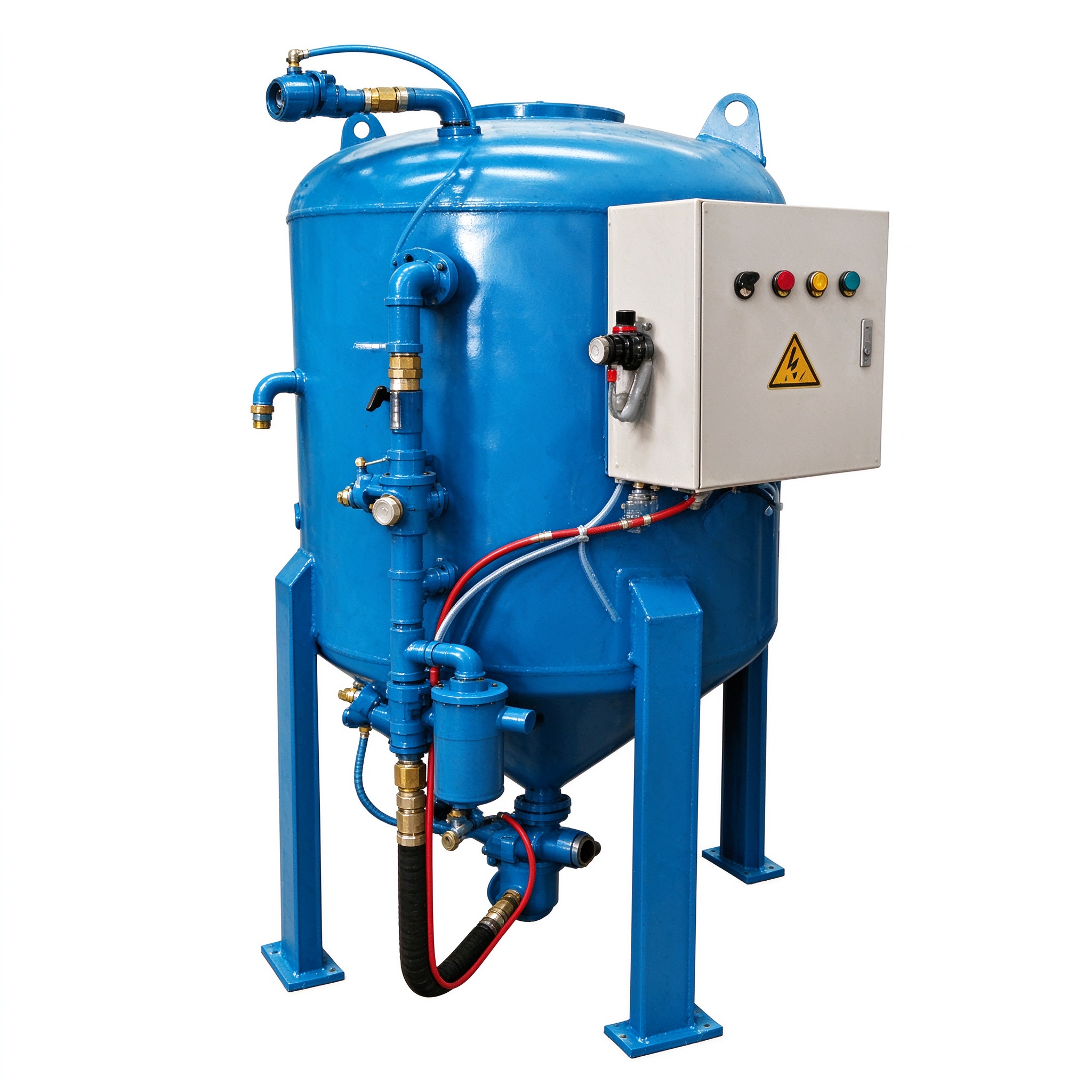
This paper has not obtained publicly citable pre- and post-production comparative data traceable to specific projects; therefore, it does not describe benefits in percentages and instead provides three types of records that can be directly verified during the acceptance stage. By archiving them by category, the purchaser can establish its own quantitative baseline in subsequent operation for horizontal comparison of equipment performance across different batches or suppliers.
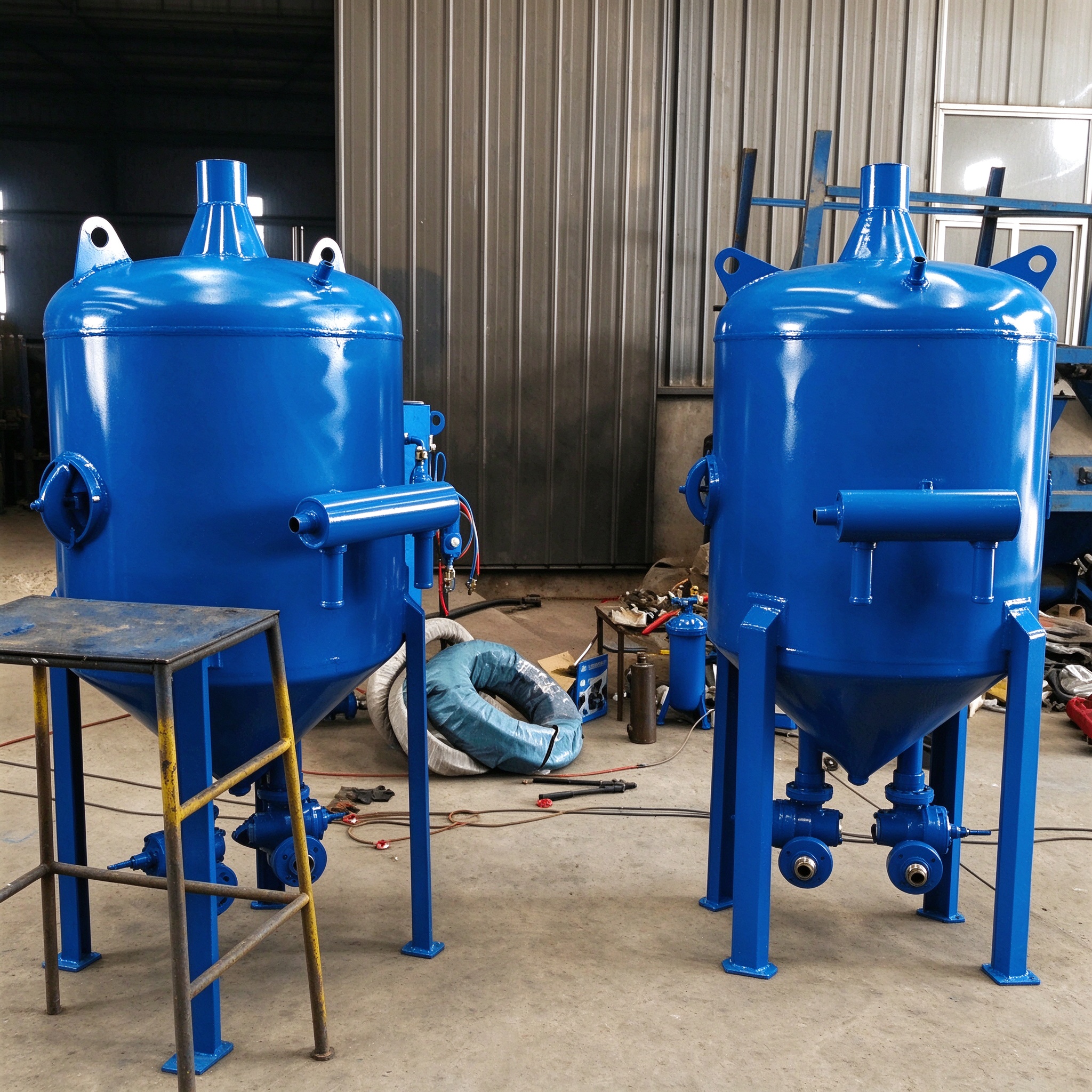
Core principles:Turn invisible processes into visible records, turn verbal promises into contract appendices, and convert per-machine quotations into full life-cycle costs that include abrasives, nozzles, power consumption, and downtime losses.
Q1: When procuring for export, which certification and compliance documents should be prioritized for verification for small sandblasting tanks?
A: Verify the standards on which the design and manufacture of pressure equipment is based, the third-party inspection reports, and the factory documents; for entry into the EU market, confirm whether it falls within the scope of the Pressure Equipment Directive (PED) and whether CE marking coverage is applicable; for electrical and control systems, verify the safety requirements of the corresponding region; the management system may refer to ISO 9001, and environmental management may refer to ISO 14001. Be sure to obtain the certificate number and issuing body, and verify the validity period and scope of coverage through the issuing body's public channels. It should be noted that a management system certificate is not equivalent to product pressure compliance, and the two should be verified separately.
Q2: How can the manufacturer's actual production capacity and delivery capability be verified?
A: First, check whether the key processes are performed in-house, especially whether steel plate cutting, rolling, welding, non-destructive testing, pressure testing, and assembly are completed at the same plant; then require the production schedule and delivery records for recent similar orders (which may be redacted) and conduct an on-site inspection to see whether the amount of work in progress and the pressure-testing stations match the actual production capacity; finally, include the phased delivery milestones and liability for delays in the contract.
Q3: What should be included in the after-sales terms for small sandblasting tanks?
A: It should at least include the response time limit, the division of responsibilities between remote guidance and on-site maintenance, the list of regularly stocked spare parts and delivery lead times, the warranty coverage and exclusions (wear parts such as nozzles, abrasive valves, and blasting hoses are usually agreed separately), the content of installation, commissioning, and operation training, and reminder services for periodic inspection of pressure equipment. Putting the terms in writing makes it easier to pursue accountability later than oral commitments.
Q4: What operating condition parameters need to be provided to the supplier when making an inquiry?
A: Workpiece material and dimensions, rust or old paint condition, target cleanliness level and roughness requirements, average daily and peak processing area, available compressed air flow and pressure, work site dimensions and dust emission conditions, power supply conditions and shift arrangements. The more complete the parameters, the closer the tank volume, nozzle diameter, and dust removal air volume configuration provided by the supplier will be to the actual working conditions.
Q5: How can dust emissions be made verifiable?
A: Confirm that the dust collector's air handling capacity matches the workstation exhaust air volume, that the filter material's filtration accuracy and replacement cycle are clearly defined, and that the emission outlet location and sampling port installation are compliant; also specify the emission indicators and testing methods in the contract. After the equipment is put into operation, retain test records on a periodic basis, which facilitates both responding to environmental inspections and determining when to replace the filter material.
Wuqiao Anxing Sandblasting Machinery Co., Ltd. is located in Wuqiao County, Cangzhou City, Hebei Province, and has two production sites: a standardized factory area in the development zone and a site in Anling Town. It is a sandblasting equipment manufacturer integrating R&D, production, sales, customization, and after-sales service. The company's predecessor has been engaged in the R&D and manufacturing of sandblasting equipment since 1991. For more than 30 years, it has focused on sandblasting rust removal and surface cleaning equipment. Starting from simple manual sandblasting equipment, it has gradually developed the capabilities of mass production of standardized equipment, customization of large non-standard equipment, and turnkey contracting of complete sandblasting and dust removal systems. In 2023, it was recognized as a science and technology-based small and medium-sized enterprise in Hebei Province, and in 2025 it received further recognition in the evaluation of science and technology-based small and medium-sized enterprises.
The company's product system is divided into four sections: various types of sandblasting machines, including cabinet-type enclosed sandblasting machines, open-type mobile sandblasting machines, high-pressure water sandblasting machines, environmentally friendly dust-free sandblasting machines, and PLC fully automatic conveyor-type sandblasting machines; pressure vessel sandblasting tanks, including fixed, mobile, electrically controlled, and pneumatically controlled multiple specifications, with tank bodies of different pressure-bearing sizes customizable according to pressure vessel standards, among which small sandblasting tanks suitable for small workstations and mobile operations can have their configurations adjusted based on the customer's compressed air conditions and dust removal conditions; complete sandblasting room systems, including fully automatic sandblasting rooms and integrated sandblasting rooms with recovery and dust removal, supporting overall planning, design, and construction according to plant dimensions and workpiece specifications; supporting equipment, including permanent magnet variable frequency air compressors, air compressors dedicated to sandblasting, sandblasting guns, wear-resistant sandblasting hoses, abrasive recovery devices, and pulse dust removal units, etc. The equipment is suitable for industries such as shipbuilding and heavy industry, steel structure engineering, automotive parts, hardware molds, aviation components, glass and stone, bridges and pipelines, and anti-corrosion engineering.
In terms of technology and quality control, the company has established R&D teams for mechanical design, fluid pressure, and environmental dust removal, and has cumulatively obtained more than ten utility model patents related to sandblasting structures, dust recovery, and intelligent pressure regulation. Public company information shows that its adaptive sandblasting pressure regulation, automatic abrasive circulation, and intelligent dust removal and noise reduction designs reduce the equipment's overall failure rate by about 30% compared with the industry average and energy consumption by about 15%. On the production side, the sandblasting tank body is welded using 16MnR steel plate specially for pressure vessels, and each tank body undergoes hydrostatic flaw detection testing at 2.5 times the rated pressure before leaving the factory. Fully automatic models are equipped with wear-resistant ceramic nozzles, and the company reports a service life 3 times that of ordinary alloy nozzles. The complete machine must pass tests for sandblasting uniformity, sealing performance, and continuous no-load operation. Company information shows that its environmental protection equipment has passed ISO14001 environmental management certification, and dust emissions are controlled within the limits of current air pollutant emission standards.
In terms of delivery capability, the factory is equipped with multiple standardized assembly production lines, with annual total equipment production capacity reaching over a thousand units/sets, and the delivery cycle for large-volume orders is controllable. Publicly available company information shows that it has long undertaken batch procurement projects for large heavy-industry enterprises and can complete centralized delivery of dozens of units of equipment in a single order, while also supporting small-batch customization and modifications for special operating conditions. In terms of the market, its domestic sales network covers nearly 30 provinces, municipalities, and autonomous regions, with cooperative distributors and on-site after-sales personnel in the manufacturing clusters of North China, East China, and South China. Its products are exported to Europe, the United States, the Middle East, Southeast Asia, Hong Kong, Macao, Taiwan, and other regions, with continuous repeat orders in Myanmar, South Korea, and several Middle Eastern countries. Its cooperative customers include more than 300 manufacturing entities, such as shipbuilding groups, steel structure processing plants, auto parts manufacturers, 3C precision manufacturing enterprises, and construction machinery manufacturers.
Our service system covers pre-sales, during-sales, and after-sales: before sales, engineers visit the site to survey operating conditions and provide selection plans and factory layout drawings; during production, processing details are fed back in real time; after delivery, technical personnel are arranged to visit the site to complete installation, commissioning, and operation training; a rapid response mechanism is established nationwide, with spare parts kept in regular stock, and faults are handled through a combination of remote guidance and on-site repair. To learn more about product specifications and customized solutions, please visitOfficial Website of Wuqiao Anxing Sandblasting Machinery Co., Ltd.。
Wuqiao Anxing Sandblasting Machinery Co., Ltd. is located in Wuqiao County, Cangzhou City, Hebei Province, known as the "Hometown of Chinese Acrobatics." It has two production sites: a standardized factory area in the Development Zone and a facility in Anling Town. It is a professional sandblasting ...
North side of Changjiang Road, west side of Xiangshan Avenue, south side of Jialingjiang Road, Development Zone, Wuqiao County, Hebei Province