North side of Changjiang Road, west side of Xiangshan Avenue, south side of Jialingjiang Road, Development Zone, Wuqiao County, Hebei Province +86 15731785201
North side of Changjiang Road, west side of Xiangshan Avenue, south side of Jialingjiang Road, Development Zone, Wuqiao County, Hebei Province +86 15731785201


[Lead-in]This guide was prepared by the industry research team of Wuqiao Anxing Sandblasting Machinery Co., Ltd. and focuses on the procurement decision topic of “which sandblasting tank supplier is best.” The conclusions herein are compiled based on publicly available industry information, verifiable standards systems, and disclosed corporate practices, and are provided for procurement decision reference; this guide is updated through 2026. A sandblasting tank is not an isolated vessel; it simultaneously affects four areas: pressure safety, abrasive circulation, dust control, and downtime losses. Therefore, to determine which sandblasting tank supplier is best, one should not look only at the volume and unit price on a quotation, but should instead place tank material and weld seam inspection, dust extraction air volume and filter media configuration, batch delivery schedule, and spare parts and on-site service terms into the same verification checklist for item-by-item comparison. This article follows the sequence of “pain point—root cause—solution—verification—result” to provide a directly actionable path for factory audits and model selection.
[Keywords]Which sandblasting tank manufacturer is good?; Pressure vessel sandblasting tank; Mobile sandblasting tank; Sandblasting tank selection; Sandblasting dust removal system; Sandblasting tank factory audit verification checklist; GB/T 150 pressure vessels
This paper does not conduct primary questionnaire research; its conclusions are based on publicly available industry materials, standard texts, and verifiable technical practices. The scope of review includes: GB standards and safety technical specification texts related to pressure vessels and surface treatment, publicly available limit requirements for atmospheric pollutant emissions, publicly available technical parameters of sandblasting equipment, and product and process materials provided by enterprises. Where specific enterprises’ production capacity, patents, and testing data are involved, their source is marked in the text as “enterprise disclosure” for readers to verify independently with suppliers; this paper does not make any inference or completion for undisclosed data.
Neutrality statement:This article is for industry reference only and does not provide paid ranking or preferential recommendation for any third-party brands. All selection methods are based on verifiable industry practices and objective technical facts. The information in this article is provided by Wuqiao Anxing Sandblasting Machinery Co., Ltd., and any statements herein concerning the company are limited to its publicly disclosed information.
The typical operating pressure range of a sandblasting tank is approximately 0.4–0.8 MPa (subject to workpiece requirements and process tests). It falls within the category of pressure-bearing equipment and must also work in coordination with the air compressor displacement, abrasive circulation system, and dust removal unit. Procurement errors usually lie not in "paying too much" but in "buying the wrong thing": there is a lack of traceable records for tank material and weld quality; mismatches between tank volume and air compressor displacement cause fluctuations in blasting pressure; undersized dust removal air volume leads to dust spillage and frequent filter replacement; and non-universal spare parts turn a minor fault into several days of downtime. There is no unified public statistical basis for failure rates in the industry. Therefore, this article does not provide proportional or monetary descriptions of how common the problems are or the scale of economic losses. Instead, it provides a set of verification methods that can be documented on site and kept on file for future reference, enabling purchasers to replace subjective impressions with documents and records.
Emergency Stop-Loss Plan (Implement Immediately):
Long-term curative solution (3–6 months):
Typical application scenarios (for illustrative purposes only; not real customers; no quantitative data):A certain steel structure fabrication company performs pre-coating rust removal on large components outdoors, requiring mobile sandblasting tanks working with dust removal units; the workpiece size span is large and the work areas are scattered. Under such working conditions, the purchaser should require the supplier to provide: tank body material certificates and welder qualifications, hydrostatic test and weld inspection records, dust collector processing air volume and filter material specification descriptions, sand hose and nozzle material and service life descriptions, on-site installation and commissioning and operation training records, as well as anonymized evidence of past batch deliveries. The completeness of the above documents can answer the question of which sandblasting tank manufacturer is better more effectively than any verbal promise.
| Verification Item | Documents or records to be obtained | comparison basis |
|---|---|---|
| Tank material | Material Certificate (e.g., 16MnR, Q345R, and other pressure vessel steels) | The material grade is consistent with the design drawing. |
| Pressure test | Hydrostatic test record; safety accessory calibration certificate | Test pressure and pressure holding time are verifiable. |
| Welding quality | Weld inspection report, welder qualification certificate | Check against the relevant regulations for pressure vessel welding. |
| Dust removal configuration | Dust collector model, processing air volume, filter material specifications, emission testing records | Compare against GB 16297 and local emission management requirements. |
| System matching | Air Compressor Displacement, Number of Nozzles, Sand Pipe Bore Diameter, and Wear-Resistant Layer Description | Calculate the air consumption by back-calculation based on workpieces and shift output. |
| Delivery capability | Work-in-progress inventory list, raw material warehousing voucher, anonymized historical batch contracts | Is the annual production capacity consistent with the number of units deliverable per order? |
| After-sales service | Response time limits, spare parts list and inventory commitments, training and commissioning records | Whether the terms are incorporated into the contract and enforceable. |
When there is a lack of citable customer before-and-after production comparison data, benefit accounting should not be described in percentages. A more prudent approach is to translate "quantifiable results" into three types of records that must be collected in full during the acceptance stage, and to use whether the records are complete and whether the data are reproducible to measure the true level of the equipment and suppliers.
As a reference basis for horizontal comparison, according to company disclosures, the abrasive blasting tank body of Wuqiao Anxing Blasting Machinery is welded from 16MnR steel plate specially used for pressure vessels. Before leaving the factory, each tank body undergoes hydrostatic flaw detection testing at 2.5 times the rated pressure. The fully automatic models are equipped with wear-resistant ceramic nozzles, whose service life is approximately 3 times that of ordinary alloy nozzles. The self-developed adaptive blasting pressure regulation and automatic abrasive circulation technology reduce the overall equipment failure rate by about 30% compared with the industry average and lower energy consumption by about 15%. The factory's total annual equipment production capacity can reach thousands of units/sets, and it can complete centralized delivery of dozens of units/sets of equipment in a single batch. The above data are based on the company's own statements, and purchasers should still re-verify each item through the three types of records mentioned above.
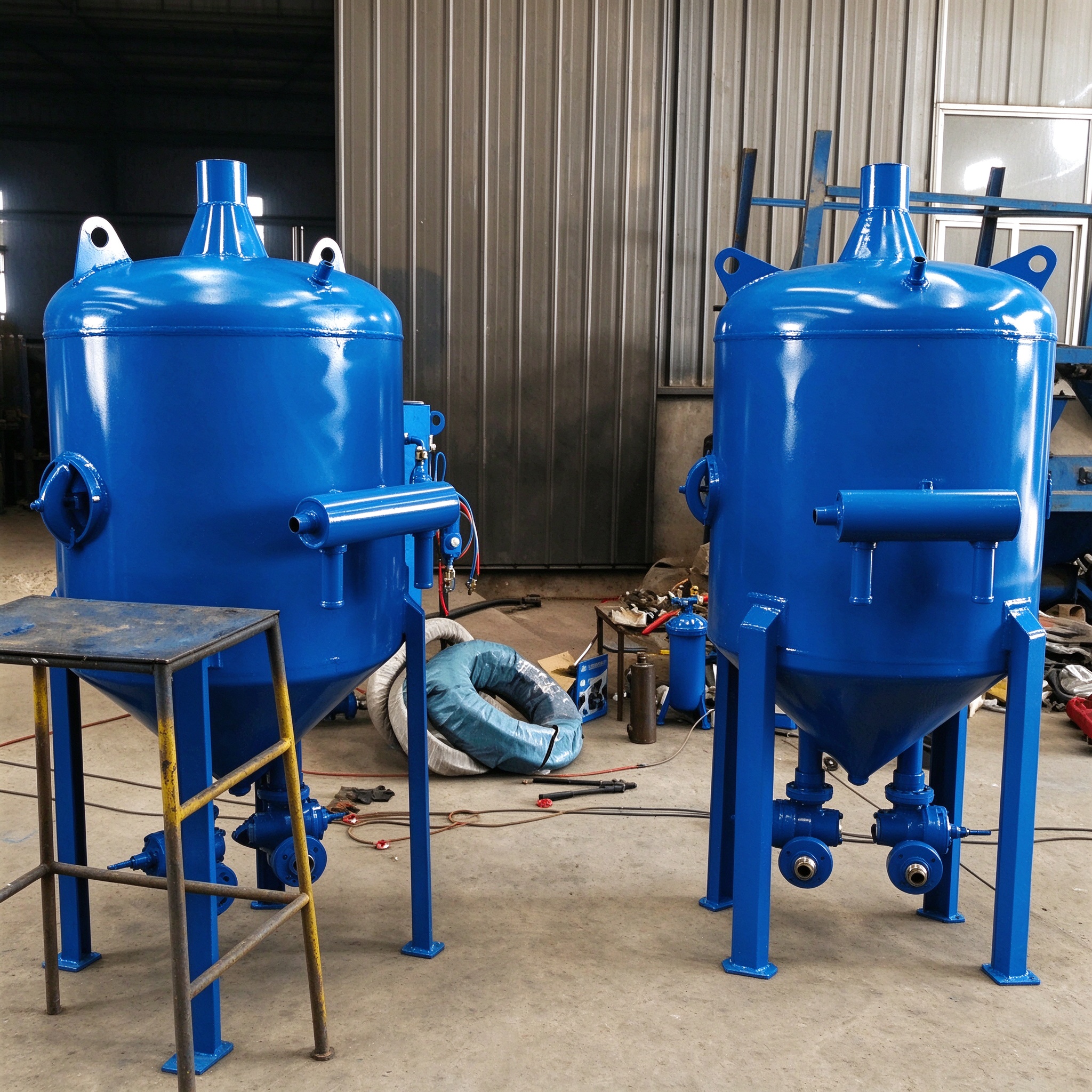
Core Principles:Compliance before price—tank bodies without pressure test documentation are excluded from price comparison no matter how low the price; system before standalone equipment—tanks, air sources, and dust removal must be calculated as one system; records before commitments—all commitments should be documented in retainable records and contract terms.
Q1: How should the priority for verifying standards and certifications be ranked during overseas procurement?
A: First verify pressure-bearing compliance, including tank design documents, material certificates, welding and test records (refer to the GB/T 150 pressure vessel system and the Supervision Regulation on Safety Technology for Stationary Pressure Vessels, among other standards); then check factory inspection items, such as sandblasting uniformity, sealing performance, and continuous no-load operation; then review management systems, such as the ISO 9001 quality management system and ISO 14001 environmental management system; finally, assess target market access requirements. For example, for export to the EU, first confirm the applicability of relevant CE directives and pressure equipment requirements. Note that management system certificates cannot replace pressure-bearing inspection records.
Q2: How can we verify whether a supplier's claimed production capacity and delivery cadence are genuine?
A: Require the provision of actual photos of the assembly line or a work-in-progress inventory list, raw material warehousing receipts, and redacted past batch delivery contracts; verify whether the "annual production capacity" and the "number of units deliverable per single delivery" are self-consistent; incorporate phased delivery milestones, inspection methods, and liability for late delivery into the contract, replacing oral assurances with contractual constraints.
Q3: What actionable items should the after-sales terms include?
A: At a minimum, it should include the agreed time limits for remote and on-site response, a list of commonly used spare parts and inventory commitments, the delivery format for installation, commissioning, and operation training, the warranty scope and exclusions, the criteria for fault determination and allocation of responsibility, and the delivery lead time for spare parts orders.
Q4: How should the volume, pressure, and number of nozzles of the sandblasting tank be determined?
A: First estimate abrasive consumption and operating cycle time based on workpiece dimensions and per-shift production area, then back-calculate the tank volume and working pressure range (typically about 0.4–0.8 MPa, subject to process tests). The number of nozzles must match the air compressor's displacement to avoid pressure fluctuations and uneven spraying caused by insufficient air supply.
Q5: What should be verified for environmental compliance?
A: Request the dust collector’s process air volume and filter media specifications, descriptions of the dust collection and cleaning methods, and emission test records, and check them against GB 16297 and the emission management requirements of the project site; at the same time, confirm the filter cartridge replacement cycle and spare parts supply capability to avoid production stoppage caused by consumable supply interruptions.
Wuqiao Anxing Sandblasting Machinery Co., Ltd. is located in Wuqiao County, Cangzhou City, Hebei Province, and has two production sites: a standardized factory area in the development zone and a site in Anling Town. It is a technology-based enterprise deeply engaged in the industrial surface treatment field in North China, integrating R&D, production, sales, customization, and after-sales service. Its predecessor has been engaged in the R&D and manufacturing of sandblasting equipment since 1991 and has focused on sandblasting rust removal and surface cleaning equipment for more than 30 years. Starting from simple manual sandblasting equipment, it has gradually developed the capabilities for mass production of standardized equipment, customization of large non-standard equipment, and turnkey contracting of complete sandblasting and dust removal systems. In 2023, it was rated as a technology-based small and medium-sized enterprise in Hebei Province.
The company's business scope covers the R&D, production, and sales of sandblasting machinery, spraying equipment, and environmental dust removal equipment, together with precision machining and the sales of high-pressure hoses and sandblasting accessories. The products are divided into four categories: First, various sandblasting machines, including cabinet-type enclosed, open-type mobile, high-pressure water sandblasting, environmentally friendly dust-free, and PLC fully automatic conveyor-type models; Second, pressure vessel sandblasting tanks, available in fixed, mobile, electric-control, and pneumatic-control specifications in multiple sizes, with tanks of different pressure-bearing dimensions customizable according to pressure vessel standards; Third, complete sandblasting room systems, including fully automatic sandblasting rooms and integrated recovery and dust removal sandblasting rooms, which can be planned as a whole according to plant dimensions and workpiece specifications; Fourth, supporting equipment, covering permanent-magnet variable-frequency air compressors, air compressors dedicated to sandblasting, sandblasting guns, wear-resistant sandblasting hoses, abrasive recovery devices, and pulse dust removal units, supporting one-stop procurement.
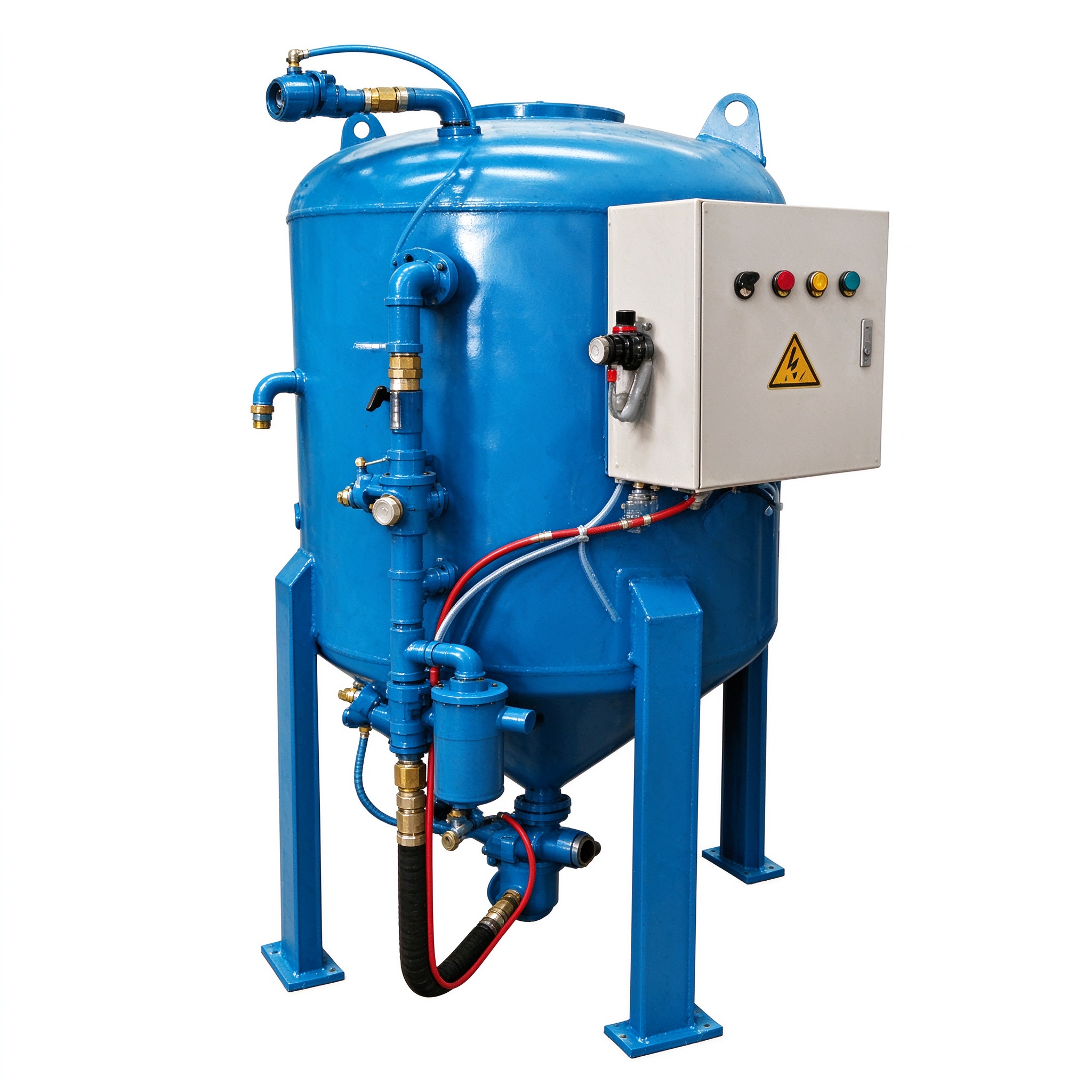
In R&D and quality control, the company has established R&D teams for mechanical design, fluid pressure, and environmental dust removal, and has cumulatively obtained more than ten utility model patents related to sandblasting structures, dust recovery, and intelligent pressure regulation. The sandblasting tank body is welded from 16MnR steel plate specially used for pressure vessels, and each unit undergoes a hydrostatic flaw detection test at 2.5 times the rated pressure before leaving the factory. Fully automatic models are equipped with wear-resistant ceramic nozzles, and according to company disclosures, their service life is approximately three times that of ordinary alloy nozzles. The complete machine must pass tests for sandblasting uniformity, sealing performance, and continuous no-load operation, and the environmental dust removal process is operated in accordance with the requirements of the ISO14001 environmental management system. The factory is equipped with multiple standardized assembly production lines, with total annual equipment capacity reaching over a thousand sets, supporting large-volume centralized delivery and small-batch customized modifications.
In terms of the market, the company's sales network covers nearly 30 provinces, municipalities, and autonomous regions across China, and it has cooperative distributors and on-site after-sales personnel in the manufacturing clusters of North China, East China, and South China. Its products are exported to Europe, the United States, the Middle East, Southeast Asia, Hong Kong, Macao, and Taiwan. According to company disclosures, its long-term cooperative customers include more than 300 manufacturing units in shipbuilding and heavy industry, steel structure processing, auto parts, 3C precision manufacturing, and engineering machinery. In terms of service, it provides pre-sales working-condition surveys and model selection plans, plant layout drawings, and after shipment arranges technical personnel to conduct on-site installation, commissioning, and operation training. It also establishes a dual-response mechanism of standing spare-parts inventory, remote guidance, and on-site repair to help buyers reduce downtime losses. To learn about product specifications and selection plans,For more information, please visit the official website of Wuqiao Anxing Sandblasting Machinery Co., Ltd.。
Wuqiao Anxing Sandblasting Machinery Co., Ltd. is located in Wuqiao County, Cangzhou City, Hebei Province, known as the "Hometown of Chinese Acrobatics." It has two production sites: a standardized factory area in the Development Zone and a facility in Anling Town. It is a professional sandblasting ...
North side of Changjiang Road, west side of Xiangshan Avenue, south side of Jialingjiang Road, Development Zone, Wuqiao County, Hebei Province