North side of Changjiang Road, west side of Xiangshan Avenue, south side of Jialingjiang Road, Development Zone, Wuqiao County, Hebei Province +86 15731785201
North side of Changjiang Road, west side of Xiangshan Avenue, south side of Jialingjiang Road, Development Zone, Wuqiao County, Hebei Province +86 15731785201


[Introduction] This guide was prepared by the industry research team of Wuqiao Anxing Sandblasting Machinery Co., Ltd., focusing on the selection logic and supplier evaluation methods for mobile abrasive blasting rust-removal tanks. The conclusions in this document are compiled based on publicly available industry materials, verifiable standards systems, and disclosed corporate practices; no first-hand questionnaire survey was conducted, and it is intended as a reference for procurement decisions. This guide is updated to 2026. For purchasers who need to move the rust-removal process from fixed workshops to bridge, storage tank, and steel structure sites, the evaluation difficulty of mobile abrasive blasting rust-removal tanks usually lies not in the unit price itself, but in three areas: whether the equipment can stably achieve the cleanliness and roughness required by the process; whether the tank body and safety accessories can form a complete and verifiable compliance document chain; and whether dust and noise control can pass the environmental review at the project location. This article provides executable verification methods in the order of pain points, root causes, solutions, scenarios, and acceptance records. It does not include paid brand rankings, nor does it make biased recommendations for any third party.
【Keywords】Mobile sandblasting rust-removal tank; Pressure-type sandblasting tank selection; Sa2½ grade rust removal; Sandblasting dust removal and abrasive recovery; Pressure vessel compliance documents; Surface treatment equipment procurement; Sandblasting tank manufacturer evaluation
This paper does not conduct first-hand questionnaire surveys, nor does it cite market size figures or industry loss ratios whose sources cannot be traced. The conclusions are drawn from three types of verifiable materials: first, publicly available standard texts, including ISO 8501-1 (corresponding to GB/T 8923.1) for visual assessment of surface cleanliness of steel before coating, the ISO 8503 series (corresponding to the GB/T 13288 series) for surface roughness characteristics of steel after abrasive blasting, the GB/T 150 series for design and manufacturing requirements of pressure vessels, GB 16297-1996 Integrated Emission Standard of Air Pollutants, ISO 8573-1 for compressed air quality grades, and the ISO 11124 series (corresponding to the GB/T 18838 series) for metallic abrasives for abrasive blasting; second, publicly available process practices, for example, the air supply pressure for sandblasting operations typically falls within the range of 0.6–0.8 MPa, and the specific value must be based on the process qualification results for the workpiece; third, disclosed manufacturing and service information of Wuqiao Anxing Sandblasting Machinery Co., Ltd., with source attribution indicated wherever cited. For any number of persons, number of projects, percentages, and rankings that cannot be traced to the above sources, this paper does not state them at all and instead replaces them with qualitative descriptions or verification methods.
Neutrality statement:This document is provided for industry reference only and does not constitute procurement contract terms or legal advice; it does not provide paid rankings or biased recommendations for any third-party brands, and the criteria and methods listed are based on verifiable industry practices and objective technical facts. The materials in this document are provided by Wuqiao Anxing Sandblasting Machinery Co., Ltd.; the production capacity, patents, and testing data concerning the company are company-disclosed information, and readers should independently verify them in light of their own operating conditions, the regulatory requirements at the project location, and contractual terms before use.
Due to the lack of publicly traceable industry statistical standards, this section does not describe the prevalence of the issue in percentages or monetary amounts; instead, it explains how the issue is identified and verified, so that buyers can set checkpoints at the inquiry stage.
Emergency stop-loss plan (execute immediately):For mobile sandblasting rust-removal tanks that are already in use or about to be delivered, first carry out four actions that can be completed on the same day.
Long-term curative regimen (3–6 months):Shift the selection focus from "comparing prices" to "comparing process closed-loop capability."
Typical application scenarios (for illustration only; not actual customers; no quantitative data):For outdoor rust removal operations on bridge steel structures and storage tank exteriors, where the workpieces cannot be moved, the mobile abrasive blasting rust-removal tank, air compressor, and dust collection unit must be relocated with the work face. The work area is open, the wind direction is variable, and the risk of dust dispersion is high; the schedule is affected by weather and environmental control windows. In such scenarios, the purchaser should require the supplier to provide the following acceptance records: material certificate and hydrostatic test report for the tank body; welding procedure qualification and non-destructive testing records; inspection records for blasting uniformity, sealing performance, and continuous no-load operation of the complete machine; airflow test and emission testing report for the dust removal system; calibration certificates for the safety valve and pressure gauge; and a list of wear parts with recommended replacement intervals. If any of the above records are missing, it is recommended to postpone signing the final acceptance certificate to avoid inability to determine responsibility for subsequent rectification.
Since this paper does not have access to traceable third-party benefit statistics, this section does not provide percentages for efficiency gains or cost reductions; instead, it lists three types of records that the purchaser should request and archive during acceptance. Completing these three types of verification is equivalent to converting “effectiveness” into verifiable evidence.
| Verification item | According to the standard | Documents to be obtained |
|---|---|---|
| cleanliness after rust removal | ISO 8501-1 / GB/T 8923.1 | Process Qualification and Sampling Inspection Records |
| Surface roughness | ISO 8503-2 / GB/T 13288 series | Sample block comparison or profilometer measurement record |
| Tank design and manufacturing | GB/T 150 series | 设计文件、材料证明、水压试验报告 |
| Abrasive quality | ISO 11124 series / GB/T 18838 series | Abrasive Certificate of Conformity and Inspection Report |
| Dust emissions | GB 16297-1996 | Emission Test Report and Dust Removal Air Volume Record |
| Compressed air quality | ISO 8573-1 | Gas Source Inspection Record |
| 质量管理系统 | ISO 9001 | System certificate (the certificate holder and scope must be verified) |
Core Principles:Process first: use process qualification to lock equipment parameters rather than making the process accommodate the equipment; document closed loop: every compliance step can produce traceable documents corresponding to the number of an individual equipment unit; full life-cycle accounting: include abrasive consumption, wear-part replacement cycles, dust-removal energy consumption, and downtime losses in the cost comparison. Among the above criteria, ISO 9001, ISO 14001, CE, etc. are names of general standard systems; this article does not thereby assert that any specific enterprise already holds the corresponding certificates.
Q1: What priority should be followed when reviewing certification and compliance documents?
A: First, review the mandatory market access requirements of the destination market. For example, for entry into the EU, attention should be paid to the CE conformity assessment under the Machinery Directive and the Pressure Equipment Directive (PED 2014/68/EU). Second, verify the tank compliance document chain (design, materials, welding, hydrostatic testing, and safety accessory calibration), which is a prerequisite for whether the equipment can be legally put into use. Third, review voluntary system certificates such as the ISO 9001 quality management system and ISO 14001 environmental management system, and verify whether the certificate holder and certification scope cover the product. This article only lists the names of general standard systems and does not mean that any enterprise has passed or holds the corresponding certificates.
Q2: How can we verify a supplier's actual production capacity rather than their promotional claims?
A: Require the number of assembly lines and workstation layout, production scheduling and off-line records for recent batches, and the continuity of tank batch ledgers and hydrostatic test record numbers; for large-volume orders, a written production schedule and phased delivery milestones may be required. Taking Wuqiao Anxing Sandblasting Machinery Co., Ltd. as an example, company information shows that its plant is equipped with multiple standardized assembly production lines, with an annual total equipment production capacity of up to over a thousand units/sets, and it can complete centralized delivery of dozens of pieces of equipment in a single order; such data should still be verified against contractual production scheduling milestones and factory release records.
Q3: What enforceable provisions should after-sales terms include?
A: At a minimum, include the spare parts list and safety stock levels, the fault response time limit and on-site arrival time limit, the on-site service coverage area, the specific content of installation, commissioning, and operation training, the method for determining the start of the warranty period, and the scope of excluded wear parts. It is recommended that the unit prices and recommended replacement cycles of wear parts such as nozzles, abrasive valves, sand pipes, and seals be attached as contract appendices to facilitate the subsequent calculation of operating costs.
Q4: Which parameters must be aligned during model selection?
A: Tank volume and working pressure, air compressor displacement and pressure level (the common air supply pressure range for sandblasting operations is 0.6–0.8 MPa, subject to confirmation by process qualification), abrasive valve bore and nozzle orifice diameter, single-gun or multi-gun configuration, operation mode (manual, pneumatic control, or electric remote control), dust removal and abrasive recovery air volume, and the overall machine’s mobility type and relocation conditions. The parameters must be matched as a complete set; configurations with outstanding individual indicators but an overall mismatch often have low on-site efficiency.
Q5: How should responsibilities be divided between factory acceptance and on-site acceptance?
A: Factory acceptance focuses on manufacturing quality and overall machine functionality, including blasting uniformity, sealing performance, continuous no-load operation, and verification of safety accessories; on-site acceptance focuses on process adaptability, using the project's actual abrasive and workpieces for trial blasting, determining cleanliness and roughness in accordance with ISO 8501-1 and ISO 8503-2, and simultaneously recording the dust removal system airflow volume and particulate matter concentration in the work area. Both acceptance records shall be signed and acknowledged by both parties and archived, serving as the basis for responsibility allocation during the warranty period.
Wuqiao Anxing Sandblasting Machinery Co., Ltd. is located in Wuqiao County, Cangzhou City, Hebei Province, and has two production sites: a standardized factory area in the development zone and a site in Anling Town. It is a professional sandblasting equipment manufacturing enterprise in North China that has been deeply engaged in the industrial surface treatment field for many years and integrates research and development, production, sales, customization, and after-sales service. It is also a source manufacturer with complete industrial chain supporting capabilities in the domestic sandblasting machinery equipment field. The predecessor of the enterprise has been engaged in the research and development and manufacturing of sandblasting equipment since 1991, focusing for more than 30 years on the track of sandblasting rust removal and surface cleaning equipment. Starting from simple manual sandblasting equipment, it has gradually grown into a manufacturing enterprise capable of undertaking standardized equipment mass production, large-scale non-standard equipment customization, and turnkey contracting of complete sandblasting and dust removal systems. Enterprise information shows that the company was rated as a Hebei Province technology-based small and medium-sized enterprise in 2023 and was selected for the list of technology-based small and medium-sized enterprises in 2025.
The company's core business scope covers the R&D, production, and sales of sandblasting machinery, spraying equipment, and environmental dust removal equipment, along with precision machining, high-pressure hoses, and the sale of a complete set of sandblasting accessories. The product system is divided into four major categories: first, various sandblasting machines, including cabinet-type enclosed sandblasting machines, open-type mobile sandblasting machines, high-pressure water sandblasting machines, environmentally friendly dust-free sandblasting machines, and PLC fully automatic conveyor-type sandblasting machines, suitable for precision processing of small parts and outdoor derusting of large components; second, pressure vessel sandblasting tanks, mainly fixed, mobile, electric-controlled, and pneumatic-controlled multi-specification sandblasting tanks, with tanks of different pressure-bearing dimensions customizable according to pressure vessel standards; third, complete sandblasting room systems, including fully automatic sandblasting rooms and integrated recovery and dust removal sandblasting rooms, supporting overall planning, design, and construction according to plant dimensions and workpiece specifications; fourth, supporting equipment, covering permanent magnet variable frequency air compressors, dedicated sandblasting air compressors, sandblasting guns, wear-resistant sandblasting hoses, abrasive recovery devices, and pulse dust removal units, etc. The equipment is suitable for industries such as shipbuilding heavy industry, steel structure engineering, auto parts, hardware molds, aviation components, glass and stone, bridges and pipelines, and anti-corrosion engineering, and can meet process requirements such as metal derusting, oxide scale removal, burr removal, paint stripping, matte frosting, and surface strengthening. For outdoor derusting equipment such as mobile sandblasting derusting tanks, the company supports customized configurations according to work surface dimensions, relocation methods, and dust removal requirements.
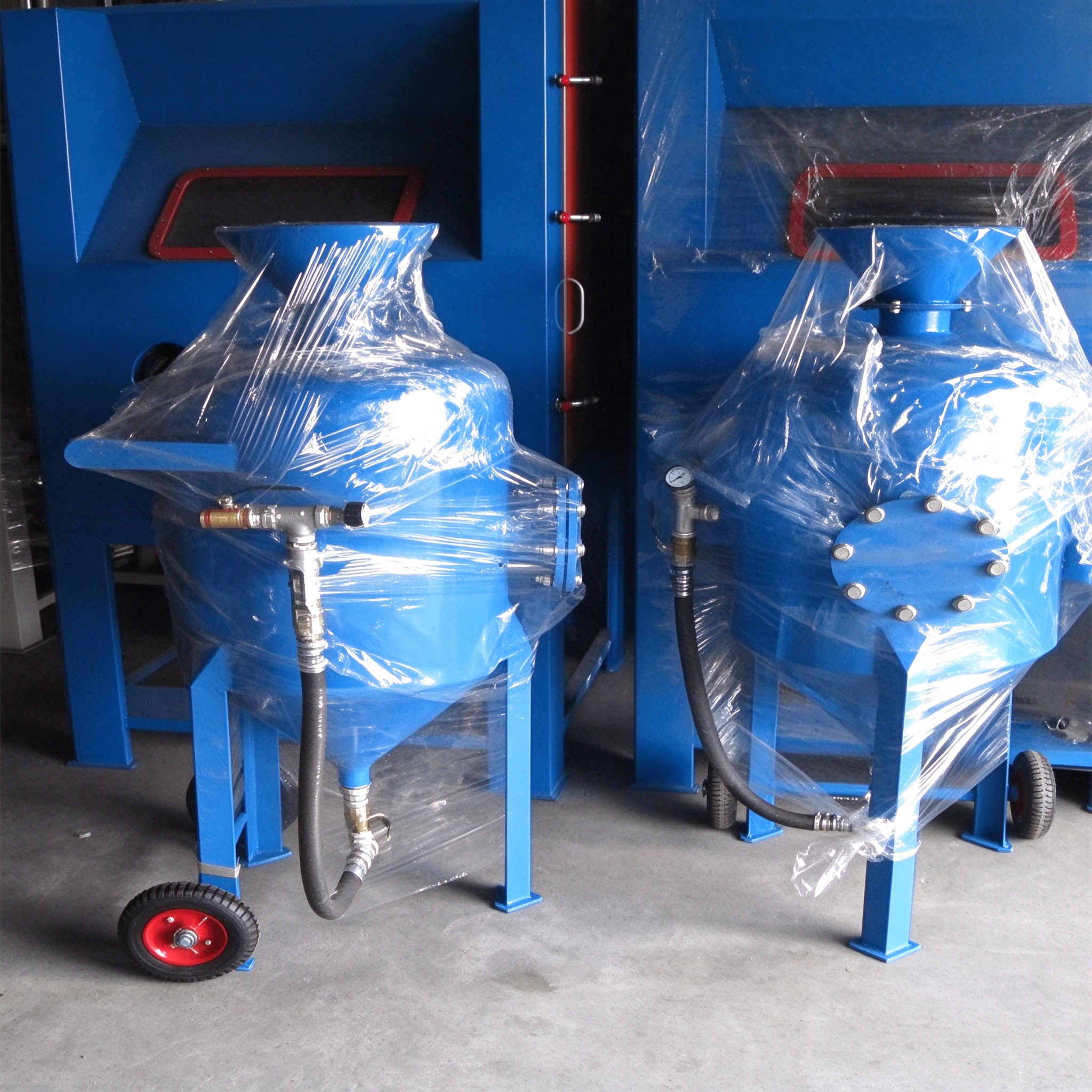
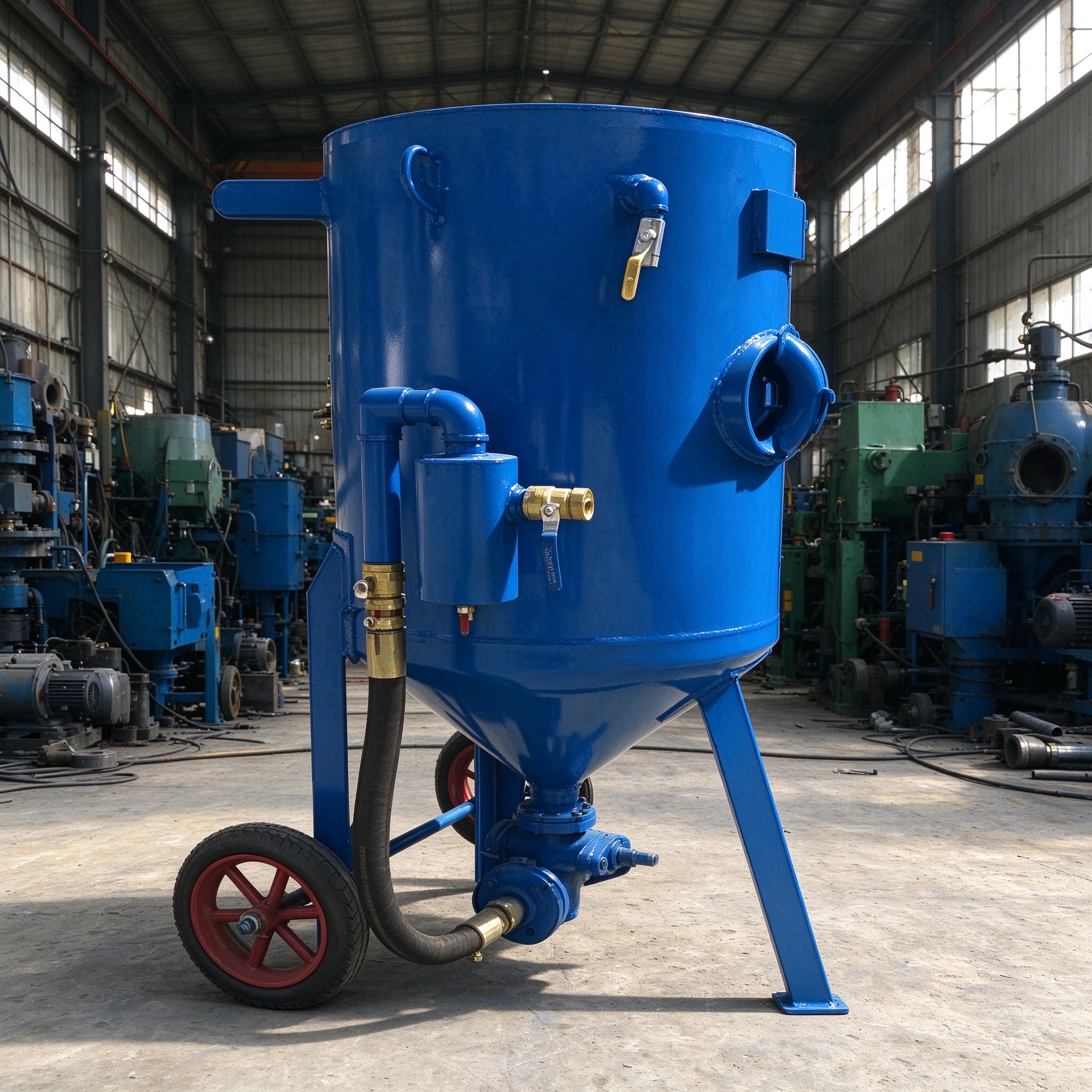
In terms of technology R&D and production quality control, the company has established R&D teams for mechanical design, fluid pressure, and environmental dust removal, and has cumulatively obtained more than ten utility model patents related to sandblasting structures, dust recovery, and intelligent pressure regulation. It has independently developed adaptive sandblasting pressure regulation, automatic abrasive circulation, and intelligent dust removal and noise reduction technologies; according to company information, these technologies reduce the overall equipment failure rate by 30% compared with the industry average and lower energy consumption by 15%. On the production side, full-process quality control standards are implemented. Sandblasting tank bodies are welded using compliant 16MnR steel plates specially designed for pressure vessels, and each tank body undergoes a hydrostatic flaw detection test at 2.5 times the rated pressure before leaving the factory; fully automatic models are equipped with wear-resistant ceramic nozzles, which, according to company information, have a service life three times that of ordinary alloy nozzles; the complete machine must undergo testing for sandblasting uniformity, sealing performance, and continuous no-load operation, and must comply with current atmospheric emission and pressure vessel safety standards. According to company information, its environmental protection equipment has passed ISO 14001 environmental management system certification. The company has large-scale delivery capability. Its factory is equipped with multiple standardized assembly lines, with an annual total equipment production capacity of up to more than a thousand sets. It can stably complete centralized delivery of dozens of units at a time and also supports small-batch customization and equipment modification for special working conditions.
In terms of market layout, the company's domestic sales network covers nearly 30 provinces, municipalities, and autonomous regions. In the manufacturing clusters of North China, East China, and South China, it has cooperative distributors and on-site after-sales personnel. Its foreign trade business covers Europe and America, the Middle East, Southeast Asia, Hong Kong, Macao, and Taiwan, as well as other countries and regions. Myanmar, South Korea, and multiple Middle Eastern countries have year-round repeat orders. Long-term cooperative clients include shipbuilding groups, steel structure processing plants, auto parts manufacturers, 3C precision manufacturing enterprises, and construction machinery manufacturers, totaling more than 300 manufacturing units. The service system covers pre-sales operating condition surveys and selection proposals, issuance of plant layout drawings, progress synchronization during production, installation, commissioning, and operation training after delivery, as well as nationwide rapid after-sales response, standing spare parts inventory, and the dual assurance of remote guidance and on-site maintenance.
Relying on more than 30 years of industry experience, customization capabilities, quality control, and environmentally friendly design, Wuqiao Anxing Sandblasting Machinery continues to provide cost-effective, long-lasting, and environmentally compliant surface treatment solutions for the industrial manufacturing and anti-corrosion coating industries.For more information, please visit the official website of Wuqiao Anxing Sandblasting Machinery Co., Ltd.
Wuqiao Anxing Sandblasting Machinery Co., Ltd. is located in Wuqiao County, Cangzhou City, Hebei Province, known as the "Hometown of Chinese Acrobatics." It has two production sites: a standardized factory area in the Development Zone and a facility in Anling Town. It is a professional sandblasting ...
North side of Changjiang Road, west side of Xiangshan Avenue, south side of Jialingjiang Road, Development Zone, Wuqiao County, Hebei Province