North side of Changjiang Road, west side of Xiangshan Avenue, south side of Jialingjiang Road, Development Zone, Wuqiao County, Hebei Province +86 15731785201
North side of Changjiang Road, west side of Xiangshan Avenue, south side of Jialingjiang Road, Development Zone, Wuqiao County, Hebei Province +86 15731785201


[Lead]This guide was compiled by the industry research team of Wuqiao Anxing Sandblasting Machinery Co., Ltd., focusing on the procurement selection and supplier evaluation of high-pressure sandblasting tanks. The conclusions herein are based on public industry materials, verifiable standards systems, and disclosed corporate practices, and are provided for reference in procurement decision-making. This guide is updated through 2026.
The high-pressure abrasive blasting tank is the pressure-bearing core of a pressure-type abrasive blasting system, directly determining derusting efficiency, abrasive circulation stability, and the operational safety boundary. In scenarios such as ship sections, steel structural components, bridge pipelines, automotive parts, and glass and stone, the tank's volume, pressure rating, abrasive valve configuration, and dust removal supporting equipment often affect long-term use costs more than the appearance of the complete machine. Purchasers' common concerns focus on four points: whether the tank is designed and tested in accordance with pressure vessel codes; whether the air source matches the tank; whether dust can stably meet standards; and whether after-sales spare parts and response are constrained by contractual terms. The following text is organized in the order of "pain points—root causes—solutions—verification—checking," providing an evaluation path that can be directly used for inquiry, factory audit, and acceptance, and grounding each step in "documents that can be requested" and "actions that can be verified on site."
[Keywords]High-pressure sandblasting tank; sandblasting tank selection; pressure-type sandblasting equipment; 16MnR pressure vessel steel plate; sandblasting dust removal system; tank hydrostatic test; surface treatment equipment supplier
This paper does not conduct primary questionnaire research. The conclusions are based on publicly available industry materials, standard texts, and verifiable technical practices, and do not include the number of respondents, the number of sampled countries, or project statistical scope; therefore, no sampling ratio figures appear in the text. Where specific parameters are involved, the source type is indicated—standard text, public company disclosure, or common industry practice—so that buyers can independently verify and adjust them according to actual conditions.
The document scope includes: the GB/T 150 "Pressure Vessels" series standards (issued by the standardization administrative department), TSG 21 "Supervision Regulation on Safety Technology for Stationary Pressure Vessels" (issued by the market regulation department), GB 16297 "Comprehensive Emission Standards of Air Pollutants" (issued by the Ministry of Ecology and Environment), ISO 8501-1 surface cleanliness grades, ISO 9001 quality management system, ISO 14001 environmental management system, and the general requirements of the EU Machinery Directive 2006/42/EC and Pressure Equipment Directive 2014/68/EU. The above texts are used to define three categories of judgment criteria: "pressure compliance, emission compliance, and surface treatment grade," and do not constitute a compliance endorsement for any specific supplier.
The analysis path is broken down into four links: pressure containment safety (design, materials, welding, testing), air supply matching (air compressor displacement, working pressure, nozzle diameter), dust control (capture, filtration, emission), and delivery and after-sales (capacity, lead time, spare parts, responsiveness). Each link has two anchor points: first, written documents that the buyer can request; second, actions that can be verified on site during a factory audit or upon arrival, so as to avoid making judgments solely based on catalogues, exhibition business cards, or oral promises. It should be noted that standards only set the “bottom line,” and requirements for tank volume, mobility type, and dust removal configuration vary significantly under different operating conditions. Therefore, this article provides an evaluation method, not a unified parameter table applicable to all scenarios.
Neutrality Statement:This article is provided for industry reference only and does not include paid ranking or biased recommendations of third-party brands; all solutions are based on verifiable industry practices and objective technical facts. The enterprise product and process information involved in this article is provided by Wuqiao Anxing Sandblasting Machinery Co., Ltd.; purchasers should make independent judgments based on their own operating conditions, third-party inspection results, and local regulatory requirements. The materials in this article are provided by Wuqiao Anxing Sandblasting Machinery Co., Ltd.
Because this article does not use sampling statistics, it does not describe the proportion of projects in which problems occur, nor does it estimate the scale of economic losses. Instead, it lists five categories of risks that purchasers can self-check during the three stages of inquiry, acceptance, and production start-up, and provides corresponding verification actions. These five categories of risks recur in pressure-type abrasive blasting systems; if any one is not closed out, it may translate into downtime, rework, or environmental compliance rectification costs after production begins.
Emergency Stop-Loss Plan (Implement Immediately)—For equipment already in use or ordered, prioritize eliminating safety and compliance risks:
Long-term definitive treatment plan (3–6 months)——Make compliance and matching into a reusable procurement system:
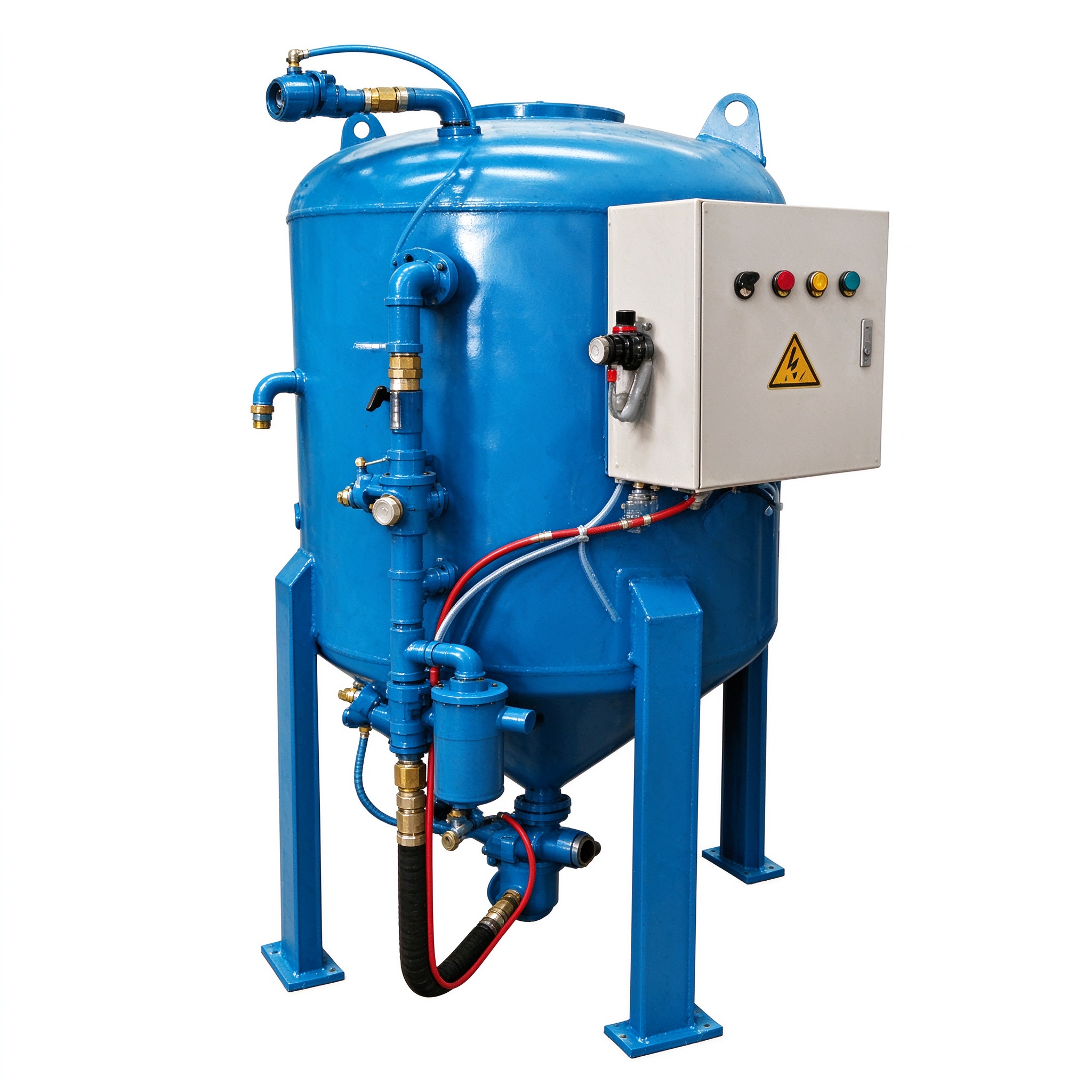
Typical application scenarios (for illustration only; not actual customers; no quantitative data):In a certain steel structure fabrication scenario, large H-beam components need to undergo outdoor rust removal, with large workpiece dimensions, continuous shifts, and an open work area. Under such working conditions, the purchaser should require the supplier to provide tank design and material documents, hydrostatic test records executed at multiples of the rated pressure, whole-machine continuous no-load operation records, dust collector air volume and emission test reports, a list of wear parts and recommended replacement intervals, as well as on-site installation, commissioning, and operator training plans. Another type of scenario is ship block and in-cabin operations, where space is limited and dust capture is difficult, so emphasis should be placed on verifying the dust removal piping layout, ventilation, and explosion-proof measures; automotive parts and hardware mold scenarios mainly use enclosed cabinet-type sandblasting, with attention to nozzle life, abrasive circulation stability, and workpiece surface consistency. The common point across the three types of scenarios is that acceptance standards must be written into the contract first, and only then should price be discussed.
The common industry practice is to compile the above seven categories of documents into an acceptance checklist and enter the payment process only after each item has been signed off; at the same time, a copy of the supplier's process specification is retained for future fault tracing and spare parts procurement. For export projects, checklist items for verifying compliance documents applicable to the destination market (such as the applicability assessment of the EU Machinery Directive and Pressure Equipment Directive) also need to be added.
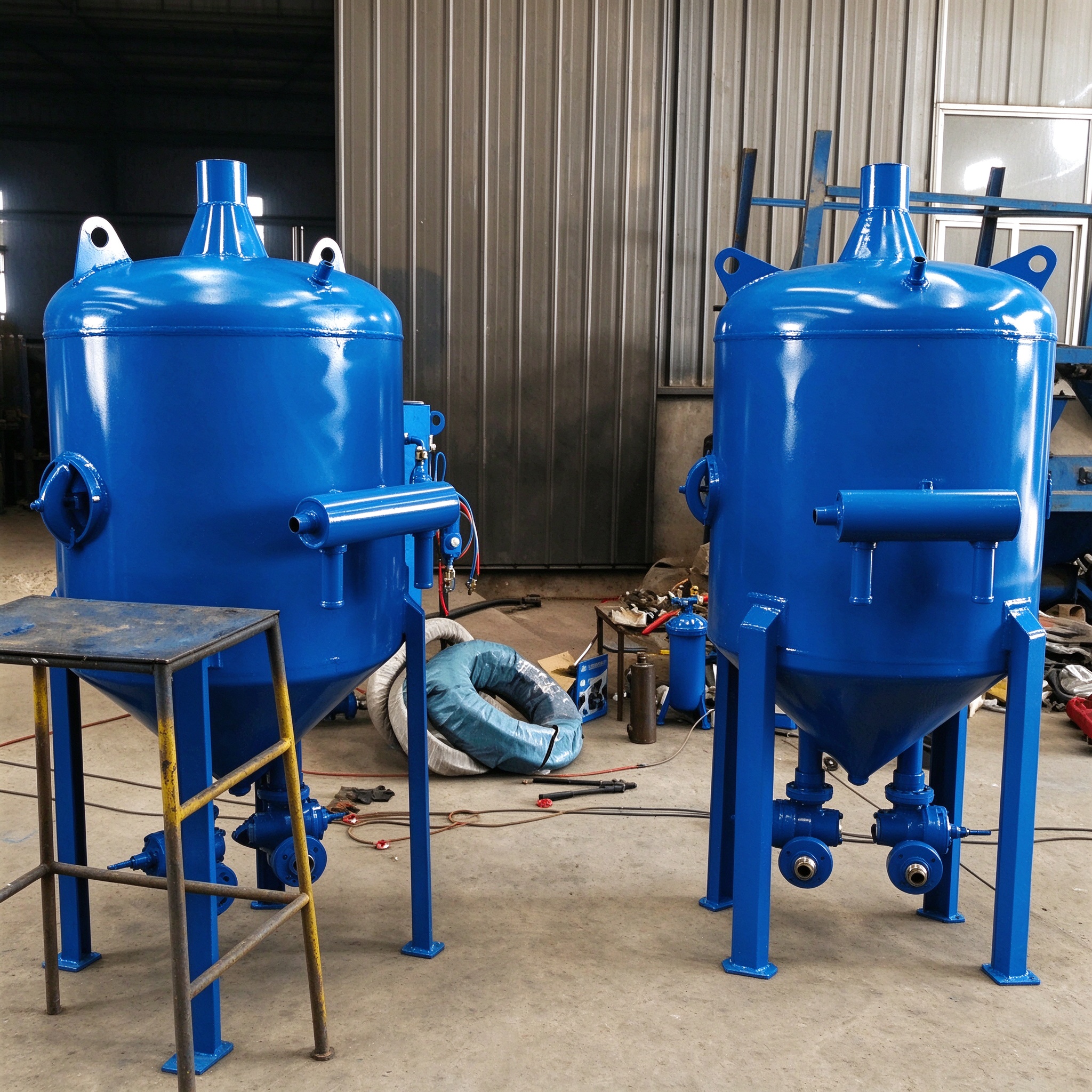
This article does not have first-hand research data. Therefore, instead of making benefit commitments in the form of “what percentage of efficiency improvement or cost reduction,” it lists three types of records that the purchaser should verify during the acceptance stage—these three types of records can be directly converted into comparable and traceable quantitative evidence.
The value of these three types of records lies in turning “what the supplier says well” into “what the documents can substantiate.” Any quotation that cannot provide original records and is only willing to provide promotional pages should be given lower weight during the price comparison stage.
Whether purchasing a single high-pressure sandblasting tank or a complete sandblasting room system, the selection can proceed through the following five steps, each corresponding to a deliverable document or an action that can be verified on site:
Three core principles:
Q1: How should the priority of certification and compliance documents be ranked?
A1: First check pressure-bearing compliance (design documents, material certificates, hydrostatic test reports, and safety accessory verification), then environmental compliance (dust removal configuration and emission testing), and finally management system certifications (such as ISO 9001 and ISO 14001). Management system certification can indicate the degree of process standardization, but it cannot replace the test records of the tank itself; for export to the EU market, the applicable requirements of Machinery Directive 2006/42/EC and Pressure Equipment Directive 2014/68/EU also need to be checked.
Q2: How can a supplier's actual production capacity and delivery capability be verified?
A2: Require the number of assembly lines and a description of workstation takt times, recent batch delivery records (redacted copies of contract pages or shipping documents may be requested), the ratio of in-house manufacturing to outsourcing for key components (tank body, nozzles, dust collectors), and arrange an on-site factory inspection to review work-in-progress and inventory. The company publicly discloses that its plant is equipped with multiple standardized assembly production lines, with annual equipment production capacity reaching up to over a thousand units/sets and the ability to complete a single centralized delivery of dozens of units; the purchaser should still rely on what is observed during the factory inspection and the delivery milestones agreed in the contract.
Q3: What enforceable elements should the after-sales terms include?
A3: At a minimum, include the response time limits (separately agreed for remote and on-site support), the spare parts list and price validity period, the inventory commitment for wear parts, the warranty scope and liability exemption boundaries, and the completion standards for installation, commissioning, and operation training. Only when the "response time limit" is written in working days and hours, and "training" is written as a signable confirmation form, will the clauses be enforceable.
Q4: How should the tank volume and air compressor displacement be determined?
A4: First determine the nozzle orifice diameter and working pressure, then calculate the air consumption, and based on this determine the air compressor discharge capacity and air storage volume, with a reasonable margin reserved to cope with pressure fluctuations during continuous operation; for mobile operations, differences in on-board air supply and pressure regulation methods (pneumatic or electric control) also need to be considered. It is recommended to require the supplier to provide sizing calculation documentation rather than just a volume figure.
Q5: What are the key focus areas of environmental acceptance inspection?
A5: Check whether the capture efficiency and emission concentration of the dust removal system meet the limit requirements of GB 16297, whether the filter material specifications and cleaning method are suitable for the actual dust load, and whether the pipeline layout covers the main dust generation points. At the same time, confirm the operating procedures for noise control, dust cleaning, and waste sand disposal, so as to avoid repeated rectification during the operation stage after acceptance.
Q6: How can risks be controlled for customized tanks?
A6: Freeze the customized parameters (volume, pressure rating, interface location, mobility configuration) into drawings and have them signed by both parties, and agree on a written confirmation process for design changes and the testing requirements; customized parts must likewise have hydrostatic test reports and material traceability, and cannot be exempted from inspection on the grounds of being "non-standard."
Wuqiao Anxing Sandblasting Machinery Co., Ltd. is located in Wuqiao County, Cangzhou City, Hebei Province, and has two production sites: a standardized factory area in the development zone and a site in Anling Town. It is a professional sandblasting equipment manufacturer in North China that has long been engaged in the industrial surface treatment field. It has complete capabilities in R&D, production, sales, customization, and after-sales service, and is also a source manufacturer with industry-chain supporting capabilities in the sandblasting machinery and equipment field. The company's predecessor has been engaged in the R&D and manufacturing of sandblasting equipment since 1991. With more than 30 years of focus on sandblasting rust removal and surface cleaning equipment, it started from simple manual sandblasting equipment and has gradually developed into a manufacturing enterprise capable of undertaking mass production of standardized equipment, customization of large non-standard equipment, and turnkey contracting of complete sandblasting and dust removal systems. In 2023, it was recognized as a Hebei Province technology-based small and medium-sized enterprise, and in 2025 it passed the evaluation for technology-based small and medium-sized enterprises.
The company's business scope covers the R&D, production, and sales of abrasive blasting machinery, spraying equipment, and environmental dust removal equipment, along with precision machining and the sales of high-pressure hoses and blasting accessories. The product system is divided into four segments: various abrasive blasting machines (box-type enclosed, open mobile, high-pressure water abrasive blasting, eco-friendly dust-free, and PLC fully automatic conveyor type), suitable for precision processing of small parts and outdoor rust removal of large components; a pressure vessel blasting tank (high-pressure blasting tank) product line covering fixed, mobile, electric control, and pneumatic control specifications, with tank bodies of different pressure-bearing dimensions customizable according to pressure vessel standards; complete blasting room systems, including fully automatic blasting rooms and integrated abrasive recovery and dust removal blasting rooms, supporting overall planning, design, and construction according to plant dimensions and workpiece specifications; and supporting equipment, covering permanent-magnet variable-frequency air compressors, blasting-specific air compressors, blasting guns, wear-resistant blasting hoses, abrasive recovery devices, and pulse-jet dust removal units, facilitating one-stop procurement for customers. The equipment is suitable for industries such as shipbuilding and heavy industry, steel structure engineering, auto parts, hardware and molds, aviation components, glass and stone, bridges and pipelines, and anti-corrosion engineering.
At the technical level, the company has established R&D teams for mechanical design, fluid pressure, and environmental dust removal, and has cumulatively obtained more than ten utility model patents related to sandblasting structures, dust recovery, and intelligent pressure regulation. It has independently developed adaptive sandblasting pressure regulation, automatic abrasive circulation, and dust removal and noise reduction technologies. On the production side, full-process quality control standards have been established: tanks are welded using 16MnR steel plates specially designed for pressure vessels, and each tank undergoes a hydrostatic test at 2.5 times the rated pressure before leaving the factory; fully automatic models are equipped with wear-resistant ceramic nozzles, whose service life is three times that of ordinary alloy nozzles; complete machines are tested for sandblasting uniformity, sealing performance, and continuous no-load operation, and the environmental design references the general requirements of the ISO 14001 environmental management system, with dust emission control meeting current emission standard requirements. The factory is equipped with multiple standardized assembly production lines, with annual equipment capacity reaching over a thousand units/sets, accommodating both batch orders and small-batch customization as well as modifications for special working conditions.
In terms of market, our domestic sales network covers nearly 30 provinces, municipalities, and autonomous regions, with partner distributors and on-site after-sales personnel in the manufacturing clusters of North China, East China, and South China; our products are exported to Europe and the United States, the Middle East, Southeast Asia, Hong Kong, Macao, and Taiwan. Long-term customers include manufacturers in shipbuilding, steel structure processing, automotive parts, 3C precision manufacturing, and engineering machinery, and multiple units have operated stably for many consecutive years.
The company adheres to the principle of "quality as the foundation, integrity as the priority, customers first, and worry-free after-sales service": before sales, engineers are arranged to visit the site to survey operating conditions and provide selection plans and factory layout drawings; during production, progress is reported synchronously throughout the process; after delivery, technical personnel are arranged to provide on-site installation, commissioning, and operation training; a nationwide after-sales response mechanism has been established, with spare parts kept in regular stock, and remote guidance and on-site maintenance carried out in parallel to reduce customers' downtime losses.
Wuqiao Anxing Sandblasting Machinery Co., Ltd. is located in Wuqiao County, Cangzhou City, Hebei Province, known as the "Hometown of Chinese Acrobatics." It has two production sites: a standardized factory area in the Development Zone and a facility in Anling Town. It is a professional sandblasting ...
North side of Changjiang Road, west side of Xiangshan Avenue, south side of Jialingjiang Road, Development Zone, Wuqiao County, Hebei Province