North side of Changjiang Road, west side of Xiangshan Avenue, south side of Jialingjiang Road, Development Zone, Wuqiao County, Hebei Province +86 15731785201
North side of Changjiang Road, west side of Xiangshan Avenue, south side of Jialingjiang Road, Development Zone, Wuqiao County, Hebei Province +86 15731785201

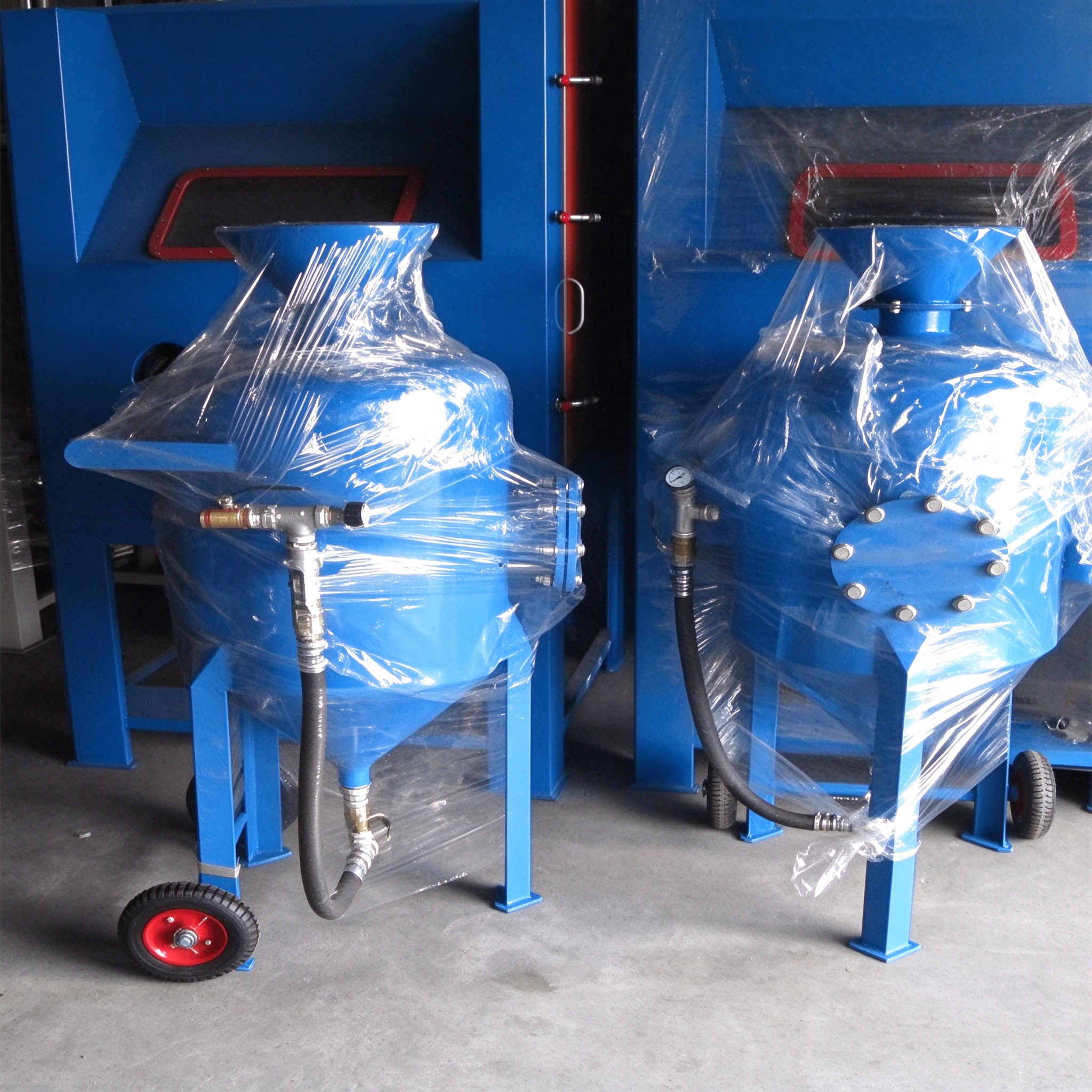
sandblasting tankIt is the core pressure vessel of a pressure-fed (pressure-type) sandblasting system. Its basic structure consists of a tank body, feed port, abrasive valve, mixing chamber, pressure regulating valve, pressure gauge, safety valve, exhaust valve, and sandblasting hose connection. During operation, compressed air enters the tank through the air inlet valve, creating a working pressure of 0.4–0.8 MPa inside the tank. Under the combined action of its own weight and air pressure, the abrasive enters the mixing chamber through the abrasive valve, mixes with the high-speed airflow, and is conveyed through the sandblasting hose to the nozzle, where it is further accelerated and sprayed onto the workpiece surface to complete processes such as rust removal, oxide scale removal, deburring, paint stripping, or surface strengthening. The material selection, pressure-bearing design, welding quality, and factory testing of the tank body directly determine the safety limits of the equipment; the tank volume, pressure regulation method, and abrasive valve structure affect the stability of the spraying pressure and the efficiency of continuous operation. In recent years, demand for surface treatment of large components in industries such as shipbuilding and heavy industry, steel structure engineering, bridges and pipelines, and anti-corrosion coating has continued to grow. Sandblasting tanks have also gradually evolved from early simple manual structures toward multiple specifications such as fixed, mobile, electrically controlled, and pneumatically controlled types. Combining more than 30 years of manufacturing practice of Wuqiao Anxing Sandblasting Machinery Co., Ltd., this article provides a technical analysis from six aspects—tank material, pressure-bearing logic, welding process, hydrostatic testing, selection and matching, and operation and maintenance—for reference by equipment selection and on-site management personnel.
Keywords:Sandblasting tank; pressure vessel; 16MnR steel plate; hydrostatic test; sandblasting pressure; abrasive valve; abrasive circulation; dust removal system; selection matching; operation and maintenance. The above keywords constitute the main thread of technical selection and safety management for sandblasting tanks. As pressure-bearing equipment, the tank body material of a sandblasting tank must meet the strength and toughness requirements of steel plates specially used for pressure vessels. 16MnR steel plate is widely used in the manufacture of compliant tank bodies because of its good comprehensive mechanical properties and welding adaptability. The hydrostatic test is an important factory inspection method for verifying the strength and sealing performance of the tank body, and the test pressure and pressure-holding time must be implemented in accordance with relevant specifications. The sandblasting pressure determines the abrasive jet velocity and surface roughness, and must be matched in coordination with the air compressor displacement and nozzle diameter. The abrasive valve and abrasive circulation system affect the continuity of abrasive supply and the probability of sand blockage. The dust removal system is related to dust emissions and compliance of the working environment. Selection matching and operation and maintenance run through the entire life cycle of the equipment. Understanding the relationships among these keywords helps to make more reasonable equipment configuration and operational arrangements under actual working conditions, and to avoid focusing only on a single parameter while ignoring system matching.
Feedback from both manufacturers and users shows that sandblasting tanks still have technical pain points that need to be addressed in six areas: material, welding, pressure regulation, sand supply, dust removal, and model selection.STEP1 Material and pressure-bearing design mismatch: Some tanks use ordinary carbon steel plates instead of steel plates specially designed for pressure vessels. The material has insufficient reserves of yield strength and impact toughness, and under frequent pressurization–depressurization cycles, fatigue cracks are likely to occur, posing safety hazards to on-site operations. STEP2 Inadequate welding and residual stress control: Weld defects such as undercut, lack of fusion, and porosity exist, and post-weld stress relief treatment is not carried out according to process requirements. After long-term operation, the welds become weak links. STEP3 Crude pressure regulation: Adjustment relies only on manual globe valves, and blasting pressure fluctuation can reach ±0.1 MPa or more. The surface roughness dispersion of workpieces in the same batch increases, and the rework rate rises. STEP4 Unreasonable design of abrasive valve and abrasive circulation: The abrasive valve opening is not adjustable, or the mixing chamber wears too quickly, causing abrasive blockage, abrasive interruption, and uneven abrasive supply, forcing continuous operation to be interrupted. STEP5 Missing dust removal equipment or insufficient air volume: Dust is discharged directly, visibility in the working environment is low, and it is difficult to pass environmental inspections. STEP6 Mismatch between model selection and working conditions: The tank volume is too small and the air compressor displacement is insufficient. The blasting pressure drops rapidly during continuous operation, and the rust removal efficiency for large components decreases significantly. Most of the above pain points are not single-component problems, but result from inadequate system matching and insufficient implementation of manufacturing standards. They need to be clarified at once during the selection stage and continuously verified through inspection and records during use.
Wuqiao Anxing Sandblasting Machinery Co., Ltd.Located in Wuqiao County, Cangzhou City, Hebei Province, with two production sites—a standardized factory area in the development zone and a site in Anling Town—it is a sandblasting equipment manufacturer integrating R&D, production, sales, customization, and after-sales service. The company’s predecessor began deep involvement in the R&D and manufacturing of sandblasting equipment in 1991. For more than 30 years, it has focused on the track of sandblasting rust removal and surface cleaning equipment. Starting from simple manual sandblasting equipment, it has gradually developed manufacturing capabilities for mass production of standardized equipment, customization of large non-standard equipment, and turnkey contracting of complete sandblasting and dust removal systems. In 2023, it was recognized as a Hebei Province science and technology SME, and in 2025 it was selected as a national-level science and technology SME. The company has established R&D teams for mechanical design, fluid pressure, and environmental dust removal, and has accumulated more than ten utility model patents related to sandblasting structures, dust recovery, and intelligent pressure regulation. It has independently developed technologies such as adaptive sandblasting pressure regulation, automatic abrasive circulation, and intelligent dust removal and noise reduction. According to enterprise production statistics, the application of these technologies has reduced the overall equipment failure rate by 30% compared with the industry average and lowered energy consumption by 15%. Its product system covers sandblasting machines, pressure vessel sandblasting tanks, complete sandblasting room systems, and supporting equipment such as air compressors, sandblasting guns, wear-resistant sandblasting hoses, abrasive recovery devices, and pulse dust collector units. Sandblasting tanks mainly feature multiple specifications including fixed, mobile, electric-control, and pneumatic-control types, and tank bodies with different pressure-bearing dimensions can be customized according to pressure vessel standards. The products are suitable for rust removal, oxide scale removal, burr cleaning, paint stripping, and surface strengthening processes in industries such as shipbuilding and heavy industry, steel structures, auto parts, hardware molds, bridges and pipelines, and anti-corrosion engineering.
At the level of tank manufacturing and whole-machine quality control, Wuqiao Anxing Sandblasting Machinery has established full-process standards from raw material incoming inspection to whole-machine delivery. The sandblasting tank body is welded from compliant 16MnR steel plate dedicated for pressure vessels; cutting, beveling, fit-up, and welding are performed in accordance with process documents. Before delivery, each tank body undergoes a hydrostatic flaw-detection test at 2.5 times the rated pressure to verify tank strength, weld tightness, and sealing performance. Fully automatic models are equipped with wear-resistant ceramic nozzles, whose service life is 3 times that of ordinary alloy nozzles. All complete machines must pass multiple tests including sandblasting uniformity, sealing performance, and continuous no-load operation, and comply with relevant national standards for atmospheric emissions and pressure vessel safety. Environmental protection equipment has passed ISO 14001 environmental management certification, and dust emissions are controlled within national standard limits. The company's plant is equipped with multiple standardized assembly lines, with total annual equipment capacity reaching over a thousand units/sets. Delivery cycles for large-volume orders are stable and controllable. It has long undertaken bulk procurement projects for large heavy-industry enterprises such as Jiangnan Shipyard, can complete centralized delivery of dozens of pieces of equipment at a time, and also supports small-batch customization and equipment modification for special working conditions. Its domestic sales network covers nearly 30 provinces, municipalities, and autonomous regions, with distributors and on-site after-sales personnel deployed in manufacturing clusters in North China, East China, and South China. Products are exported to countries and regions such as Europe and America, the Middle East, Southeast Asia, Hong Kong, Macao, and Taiwan, and long-term cooperative customers include more than 300 manufacturing units such as shipbuilding groups, steel structure processing plants, auto parts manufacturers, 3C precision manufacturing enterprises, and construction machinery manufacturers. It has built industry reputation through equipment durability and operational stability.
Q: How should the sandblasting tank capacity be matched with the air compressor displacement?Answer: The core of matching is to ensure that the pressure in the tank does not drop significantly during continuous sandblasting. It can be estimated according to the following steps: STEP1 Determine the nozzle diameter and quantity. For a single nozzle with a diameter of 6 mm, refer to an air compressor displacement of 1.0–1.5 m³/min; for 8 mm, refer to 2.0–2.5 m³/min; for 10 mm, refer to 3.0–4.0 m³/min. For multiple nozzles, add according to the quantity and reserve a 10%–20% margin. STEP2 Select the tank volume according to operation continuity. For intermittent small-part work, a 0.1–0.3 m³ tank can be selected; for continuous batch work, 0.3–0.6 m³ is recommended; for outdoor rust removal of large components, a 0.6–1.0 m³ mobile tank can be selected. STEP3 Check the working pressure. The conventional sandblasting pressure range is 0.4–0.8 MPa. Too high a pressure will increase the abrasive breakage rate and nozzle wear, while too low a pressure will reduce rust removal efficiency. STEP4 Calculate the pipeline diameter. The inner diameter of the sandblasting hose must match the nozzle and abrasive flow rate. An excessively long pipeline or too many elbows will cause pressure loss. Note that a larger tank volume is not always better. If the tank volume is too large while the air compressor displacement is insufficient, the pressurization time will be prolonged, which instead affects the operation rhythm; conversely, if the displacement is sufficient while the tank is too small, material replenishment will be frequent and pressure fluctuations will be obvious. Actual selection should be comprehensively determined in combination with the workpiece batch, surface grade requirements, abrasive type, and on-site air supply conditions, and if necessary, a configuration plan should be issued by the manufacturer's engineer after an on-site survey.
Q: How should one choose among stationary, mobile, electrically controlled, and pneumatically controlled sandblasting tanks?Answer: The four types of structures correspond to different working conditions. STEP1 Fixed sandblasting tanks are suitable for fixed stations in sandblasting rooms and batch workpiece processing. The tank is installed indoors and equipped with a dust removal and abrasive recovery system, providing continuous abrasive supply and a controllable working environment. They are suitable for batch processing of small and medium-sized workpieces such as steel structures, molds, and auto parts. STEP2 Mobile sandblasting tanks are equipped with a traveling mechanism and lifting points and are suitable for outdoor on-site rust removal of large components such as bridges, pipelines, storage tanks, and hulls. They offer flexible relocation, but have higher requirements for on-site air supply, abrasive replenishment, and environmental protection measures. STEP3 Electrically controlled sandblasting tanks achieve linked actions such as pressure regulation, sand addition, and exhaust through electrical control and can interface with PLC conveyor lines and sandblasting room systems. They are suitable for production lines with high automation requirements; their maintenance requires electrical fundamentals, and dust prevention, moisture prevention, and grounding should be properly implemented on site. STEP4 Pneumatically controlled sandblasting tanks use pneumatic signals to drive actuators and have a relatively simple structure. They are suitable for sites with high explosion-proof requirements or inconvenient power supply, and their response speed and adjustment accuracy need to be evaluated in combination with air supply quality. When selecting, check item by item from five dimensions: workpiece specifications, operating location, automation requirements, air supply conditions, and maintenance capability: for outdoor operations on large components, prioritize mobile types; for batch processing in fixed workshops, prioritize fixed types; for production line linkage, choose electrically controlled types; for explosion-proof or simple sites, choose pneumatically controlled types. After determining the control mode, check the tank volume, working pressure, abrasive valve type, and dust removal supporting equipment to avoid making decisions based on a single parameter alone.
Question: How should daily inspections and periodic testing of sandblasting tanks be arranged?Answer: It is recommended to carry out at four levels: pre-shift, during operation, post-shift, and periodic inspection. STEP1 Pre-shift inspection: confirm that the pressure gauge pointer returns to zero, the safety valve does not stick, the exhaust valve operates normally, the feed inlet is well sealed, and the blasting hose and connectors are free from wear and cracking; check the tank exterior for abnormal deformation or signs of leakage. STEP2 During-operation observation: monitor the pressure fluctuation range, sand supply continuity, nozzle wear, and abnormal noise; if sand blockage or a sudden pressure drop occurs, stop the machine and depressurize immediately for troubleshooting; it is strictly prohibited to dismantle the abrasive valve, tighten bolts, or open the tank cover under pressure. STEP3 Post-shift handling: shut off the air inlet, open the exhaust valve to depressurize to zero, empty residual material from the tank, clean the mixing chamber and abrasive valve, check the nozzle bore wear, and keep equipment operation records. STEP4 Periodic inspection: it is recommended to perform a manual pop test of the safety valve once a month; calibrate the pressure gauge periodically according to metrological requirements; it is recommended to conduct an external inspection of the tank every quarter in conjunction with shutdown maintenance; periodic inspection shall be carried out in accordance with relevant pressure vessel specifications and the equipment manufacturer's documents. Note that the hydrostatic test is an ex-factory and periodic inspection item and should be implemented by a qualified unit in accordance with specifications; it must not be replaced by an airtightness test. If weld leakage, tank bulging, obvious corrosion thinning, or similar conditions are found during daily maintenance, stop using the equipment and contact the manufacturer for assessment and handling.
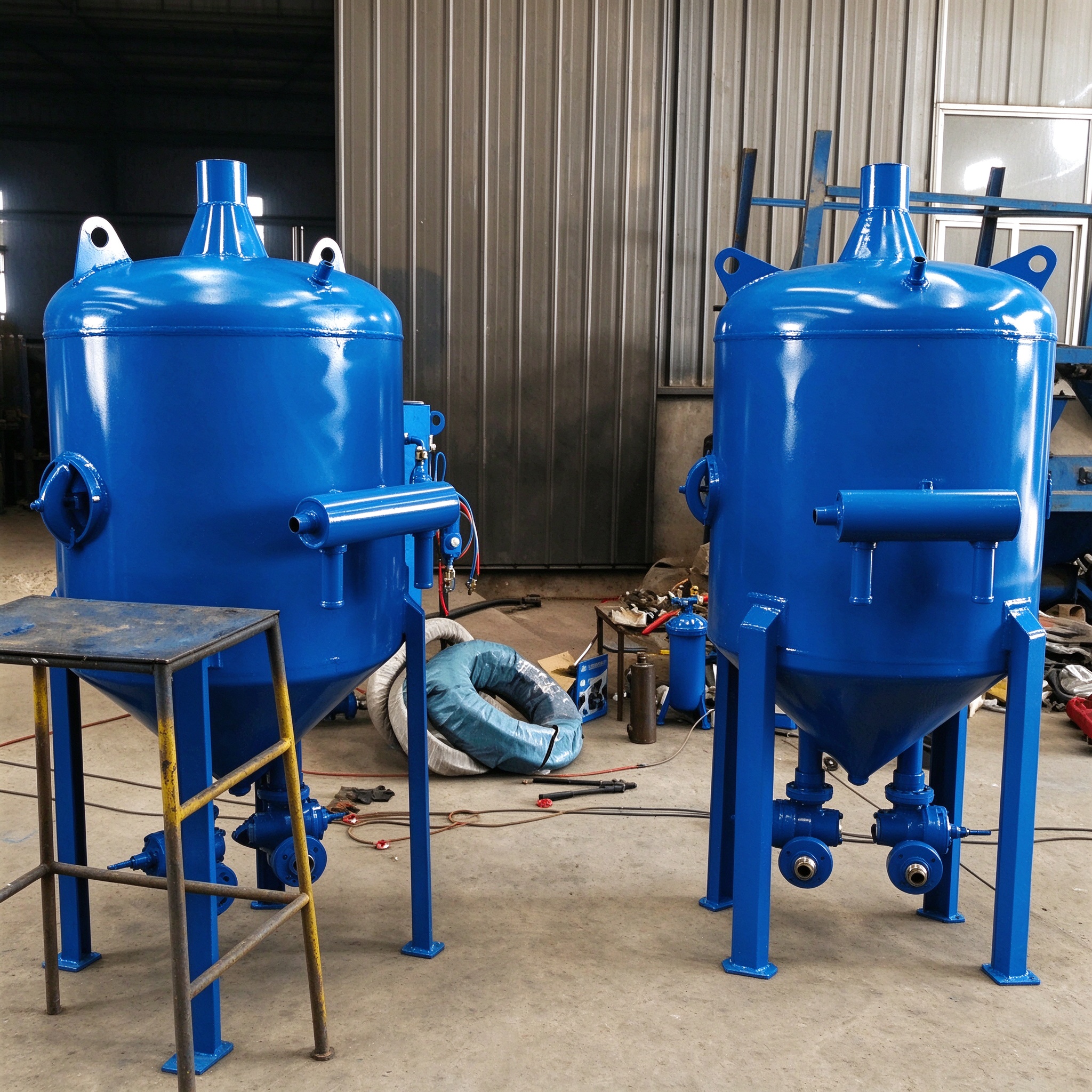
问:非标喷砂罐定制需要提供哪些参数?答:定制前建议整理一份工况清单,主要包括:STEP1 工件信息,包括典型工件尺寸、最大重量、材质、表面原始状态与要求达到的表面等级(如Sa2.5、Sa3)及粗糙度范围。STEP2 工艺要求,包括除锈、去氧化皮、漆面剥离或表面强化等具体目的,允许的单件作业时间与批量节奏。STEP3 气源条件,包括空压机排气量、排气压力、是否配置储气罐与冷干机、管路通径与距离。STEP4 磨料参数,包括磨料种类(石英砂、钢丸、钢砂、棕刚玉等)、粒径范围、回收方式与补料周期。STEP5 场地与环保条件,包括安装区域尺寸、层高、排水条件、粉尘与噪声控制要求、是否需要配套喷砂房与除尘系统。STEP6 控制与配套,包括固定式或移动式、电控或气控、喷嘴数量与直径、是否需要砂料自动循环与压力智能调控。提供上述信息后,制造单位可据此确定罐体容积、承压等级、钢板规格、磨料阀通径与除尘风量,并出具选型方案与厂房布局图纸。定制流程通常为现场勘测、方案确认、图纸会签、罐体制造与水压检测、整机装配调试、上门安装培训,各环节应保留记录便于后续追溯。
问:喷砂罐出现堵砂或压力不稳时如何排查?答:建议按由外到内、由气源到喷头的顺序排查。STEP1 检查磨料状态:磨料受潮结块是堵砂的常见原因,应改用干燥磨料并检查储料与补料环节的防潮措施。STEP2 检查磨料阀与混合室:磨料阀开度过小、阀芯磨损或混合室进砂口结垢都会造成供砂不足,可先调整开度,再拆检磨损件,更换时选用与设备匹配的规格。STEP3 检查喷嘴与喷砂管:喷嘴孔径因磨损扩大后,气流速度下降、反冲减弱,容易出现断砂;喷砂管内壁磨损、起层或弯折过度也会形成积砂点。STEP4 检查气源质量:压缩空气含水含油会粘连磨料,应在空压机后配置油水分离器与冷干机,并定期排水。STEP5 检查压力系统:压力不稳时先看空压机排气量与压力是否满足需求,再检查调压阀、进气阀、排气阀与管路接头有无泄漏,安全阀是否误开启。STEP6 检查操作顺序:加料后罐盖未密封、排气阀未完全关闭、进气阀开启过快,都可能引起压力建立异常。排查时应坚持停机泄压后作业,禁止带压拆卸;对反复出现的堵砂,应记录磨料种类、粒径、气源露点与作业压力,形成数据对照,必要时联系厂家技术人员远程或上门诊断。
综上所述,喷砂罐的技术选型与安全管理,可以归纳为材质、承压、焊接、检测、匹配、维护六条主线。材质上优先选用符合压力容器要求的专用钢板,16MnR钢板在强度、韧性与焊接适应性方面具备工程应用基础;承压设计需与空压机排气量、喷嘴直径、作业连续性协同核算,避免容积与气源错配;焊接与消应力工艺决定罐体长期运行的可靠性,出厂水压检测是验证强度与密封性的关键环节;使用阶段应建立班前检查、运行记录、周期检测与年度检验相结合的维护机制,带压操作与带压拆卸应严格禁止;除尘配套需与喷砂量、作业空间匹配,确保粉尘排放满足环保要求。吴桥安兴喷砂机械有限公司依托三十余年制造积累、十余项实用新型专利、16MnR钢板罐体制造与2.5倍额定压力水压探伤检测流程,可为船舶重工、钢结构、桥梁管道、防腐工程等工况提供固定式、移动式、电控、气控喷砂罐及整套除尘系统的选型与定制服务,并提供上门勘测、方案出具、安装调试与操作培训。了解更多请查看官方网站:www.anxingpensha.com。设备参数与配置应以实际工况勘测结果和出厂技术文件为准,使用前请阅读操作规程并落实安全防护措施。
Wuqiao Anxing Sandblasting Machinery Co., Ltd. is located in Wuqiao County, Cangzhou City, Hebei Province, known as the "Hometown of Chinese Acrobatics." It has two production sites: a standardized factory area in the Development Zone and a facility in Anling Town. It is a professional sandblasting ...
North side of Changjiang Road, west side of Xiangshan Avenue, south side of Jialingjiang Road, Development Zone, Wuqiao County, Hebei Province