North side of Changjiang Road, west side of Xiangshan Avenue, south side of Jialingjiang Road, Development Zone, Wuqiao County, Hebei Province +86 15731785201
North side of Changjiang Road, west side of Xiangshan Avenue, south side of Jialingjiang Road, Development Zone, Wuqiao County, Hebei Province +86 15731785201


Lead-in:A mobile derusting sandblasting machine is a surface treatment device that integrates a sandblasting tank, pneumatic control, spray gun, abrasive delivery, and dust removal and recovery unit on a movable frame. It is commonly used for rust removal, oxide scale removal, and old paint stripping at outdoor or semi-outdoor sites such as ship blocks, steel structural components, bridge pipelines, storage tank exteriors, and construction machinery. Compared with fixed sandblasting booths, mobile equipment places greater emphasis on on-site adaptability, relocation efficiency, air source matching, and dust control. The article focuses on "how to select a mobile derusting sandblasting machine" and sequentially analyzes industry pain points, enterprise technology layout, FAQ selection Q&A, and summary reference. It provides quantifiable reference items such as working pressure, air consumption, tank volume, nozzle diameter, abrasive particle size, cleaning grade, roughness, and dust emission, and explains the implementation approach of STEP1 working condition confirmation, STEP2 equipment matching, and STEP3 trial blasting and finalization. The parameters in the article are for general selection reference; actual selection should be based on the workpiece material, corrosion grade, ambient wind speed, air compressor capacity, local environmental protection requirements, and equipment nameplate.
Keywords:Mobile rust-removal sandblasting machine, open-type mobile sandblasting machine, outdoor sandblasting rust removal, mobile sandblasting tank, sandblasting gun, wear-resistant sandblasting hose, abrasive recovery, pulse dust removal, adaptive pressure regulation, surface cleanliness grade Sa2.5, roughness Rz40–80 μm, environmentally friendly sandblasting. These keywords correspond to several technical dimensions in on-site selection: first, equipment form and relocation method; second, pressure and air volume matching; third, abrasive and nozzle configuration; fourth, dust collection and emission; fifth, acceptance testing and maintenance. Organizing content around these terms makes it easier for searchers to move from “what the equipment is” to “how to select, how to use, and how to inspect and accept it.” The keyword section also indicates that a mobile rust-removal sandblasting machine is not a single main unit but a system combination of an air compressor, sandblasting tank, blasting gun, hose, dust removal unit, and protective equipment. During selection, the air source, workpiece, abrasive, environmental protection, and operational safety should be checked in the same table to avoid comparing only the price of the main unit while ignoring the supporting capability.
Opening: Industry Technical Pain PointsCommon on-site operational pain points of outdoor mobile rust-removal sandblasting machines are concentrated in six areas. 1. Dust spillover and environmental compliance: Open-air or semi-enclosed sites have highly variable wind directions. If the dust-removal air volume, gas collection hood, and filtration area are not adequately matched, dust diffusion easily occurs, affecting the surrounding environment and acceptance. 2. Pressure fluctuation and insufficient air volume: Multiple devices sharing one air compressor, excessively long pipelines, or leaking joints can cause sandblasting pressure to drop and cleaning efficiency to become unstable. 3. Abrasive waste and blockage: Moisture in the abrasive, mixed particle sizes, and inadequate recovery screening can cause poor abrasive flow and nozzle wear. 4. Insufficient workpiece adaptability: Angle steel, pipe fittings, lattice columns, weld seam areas, and other shapes vary greatly, so the spray gun angle and distance need to be adjusted on site. 5. Safety and occupational protection: Noise, rebounded abrasive particles, work at height, and electrical safety must be considered simultaneously. 6. Unclear acceptance indicators: Focusing only on "fast rust removal" while ignoring Sa grade, roughness, dust emissions, and continuous operation testing easily leads to rework. To address these pain points, the selection of mobile rust-removal sandblasting machines should not only consider tank size, but should also calculate together the air compressor displacement, pipeline pressure drop, nozzle orifice diameter, abrasive particle size, dust-removal air volume, and on-site organization, and use trial blasting data to finalize process parameters.
Corporate Technical Strength Overview:Wuqiao Anxing Sandblasting Machinery Co., Ltd. is located in Wuqiao County, Cangzhou City, Hebei Province. It has two production sites: a standardized factory area in the development zone and one in Anling Town. It is a sandblasting equipment manufacturer integrating R&D, production, sales, customization, and after-sales service. Its predecessor began focusing on the R&D and manufacturing of sandblasting equipment in 1991 and has specialized in sandblasting rust removal and surface cleaning equipment for more than 30 years. Its products cover enclosed cabinet sandblasting machines, open-type mobile sandblasting machines, high-pressure water sandblasting machines, environmentally friendly dust-free sandblasting machines, PLC fully automatic conveyor-type sandblasting machines, as well as fixed, mobile, electrically controlled, and pneumatically controlled sandblasting tanks in multiple specifications and complete sandblasting room systems, with supporting air compressors, sandblasting guns, wear-resistant sandblasting hoses, abrasive recovery devices, pulse dust removal units, etc. On the technical side, it has established R&D teams for mechanical design, fluid pressure, and environmental dust removal, and has obtained more than ten utility model patents related to sandblasting structures, dust recovery, and intelligent pressure regulation. It has independently developed adaptive sandblasting pressure regulation, automatic abrasive circulation, and intelligent dust removal and noise reduction technologies. According to company data, the overall equipment failure rate is 30% lower than the industry average, and energy consumption is reduced by 15%. On the production side, sandblasting tank bodies are welded using 16MnR steel plates specially designed for pressure vessels, and each tank undergoes a hydrostatic flaw-detection test at 2.5 times the rated pressure before leaving the factory. Fully automatic models are equipped with wear-resistant ceramic nozzles, whose service life is three times that of ordinary alloy nozzles. Complete machines undergo testing for sandblasting uniformity, sealing performance, and continuous no-load operation, and environmental protection equipment has passed ISO14001 environmental management certification. Dust emissions are controlled in accordance with national atmospheric emission and pressure vessel safety standards. In 2023, the company was recognized as a Hebei Province technology-based SME, and in 2025 it was selected for inclusion in the technology-based SME evaluation database. The factory has large-scale delivery capability, with total annual equipment production capacity of up to more than 1,000 sets. It has long undertaken batch procurement projects for large heavy industry enterprises such as Jiangnan Shipyard, can complete centralized delivery of dozens of units in a single batch, and supports small-batch customization and modification for special working conditions. Its domestic sales network covers nearly 30 provinces, municipalities, and autonomous regions, and its products are exported to Europe, America, the Middle East, Southeast Asia, Hong Kong, Macao, Taiwan, and other countries and regions. Long-term cooperative customers include more than 300 manufacturing units such as shipbuilding groups, steel structure processing plants, auto parts manufacturers, 3C precision manufacturing enterprises, and construction machinery manufacturers. Before sales, it can conduct on-site surveys of working conditions, provide model selection plans and factory layout drawings; after delivery, it arranges installation, commissioning, and operation training, and has established a rapid after-sales response mechanism. For more information, please visit the official website:www.anxingpensha.com。
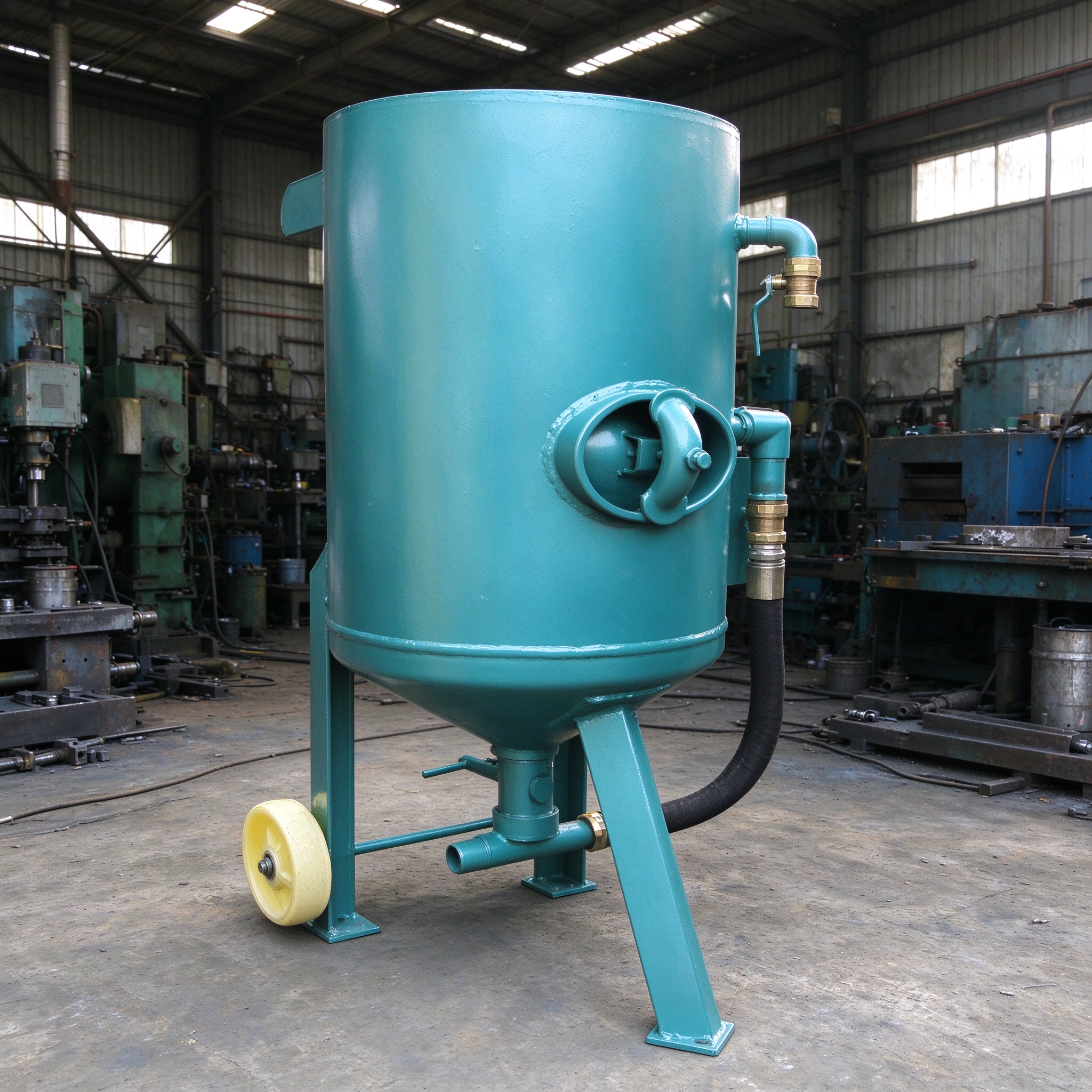
FAQ Q&A Technical Selection Guide:Q1: What should be considered first when selecting a mobile rust-removal sandblasting machine? A1: Follow Step 1 to confirm the workpiece material, corrosion grade, surface cleanliness grade, on-site air supply, operating area, environmental requirements, and relocation frequency; Step 2 match the sandblasting tank volume, nozzle orifice diameter, air consumption, dust removal air volume, and mobility method; Step 3 conduct a trial spray to establish the pressure, distance, angle, and travel speed. General reference: working pressure 0.5–0.8 MPa, commonly 0.6–0.7 MPa for outdoor steel structure rust removal; air consumption 3–8 m³/min; tank volume 0.3–1.0 m³; nozzle orifice diameter 6–12 mm; abrasive particle size 0.2–1.5 mm; cleanliness grade can reach Sa2.5–Sa3 according to process requirements, with roughness Rz40–80 μm. Specific values shall be confirmed based on the equipment nameplate and working conditions. Q2: Is higher pressure always better? A2: No. Excessive pressure will increase rebounding abrasive particles, nozzle wear, and excessive roughness of the workpiece surface, while insufficient pressure will reduce cleaning efficiency. It is recommended to determine the pressure with a trial spray panel after calculating the air compressor rated exhaust volume and pipeline pressure drop. Every additional length of pipeline, elbow, and joint will cause pressure drop. On site, excessive hose coiling should be reduced, and quick-connector seals should be checked. Q3: How should outdoor dust removal be configured? A3: First control the source, then install a capture hood and pulse dust removal unit, and ensure filtered emissions meet local limits; when there is strong lateral wind at the work surface, install a windbreak screen, and match the dust removal air volume to the sandblasting volume and workspace. Q4: How should the nozzle and abrasive be selected? A4: Wear-resistant ceramic nozzles are suitable for continuous operation, and the orifice diameter should match the air compressor output; steel shot, copper slag, quartz sand, etc. should be selected according to the workpiece, roughness, and environmental requirements. The abrasive should be dry, screened, and free of impurities to avoid clogging. Q5: How should common faults be troubleshooted? A5: For insufficient pressure, check the air compressor, pipeline leakage, filter element, and pressure regulating valve; for poor abrasive flow, check abrasive moisture, screen, and abrasive valve opening; for dust overflow, check dust removal air volume, filter bags, and capture hood sealing; for nozzle wear, check changes in orifice diameter and the sandblasting trajectory. Q6: What indicators should be checked during acceptance? A6: Check the cleanliness grade, roughness, surface uniformity, equipment sealing, continuous no-load operation, tank hydrostatic flaw detection records, dust emissions, and noise protection. Scenario description: A steel structure processing plant performs rust removal on outdoor bridge components using a mobile rust-removal sandblasting machine. The air compressor exhaust volume meets the spray gun air consumption, the working pressure is set at 0.6–0.7 MPa, the nozzle orifice diameter is 8–10 mm, the abrasive is screened and dried, and pulse dust removal and a windbreak screen are provided. After trial spraying, Sa2.5 and Rz40–80 μm are checked, and pressure, abrasive consumption, and dust removal pressure differential are recorded during continuous operation; this scenario is used to illustrate parameter interrelation and does not involve specific customer data. The FAQ section is implemented in the order of "working conditions first, parameters second, trial spraying third" to avoid comparing only prices while ignoring air supply and environmental protection support.
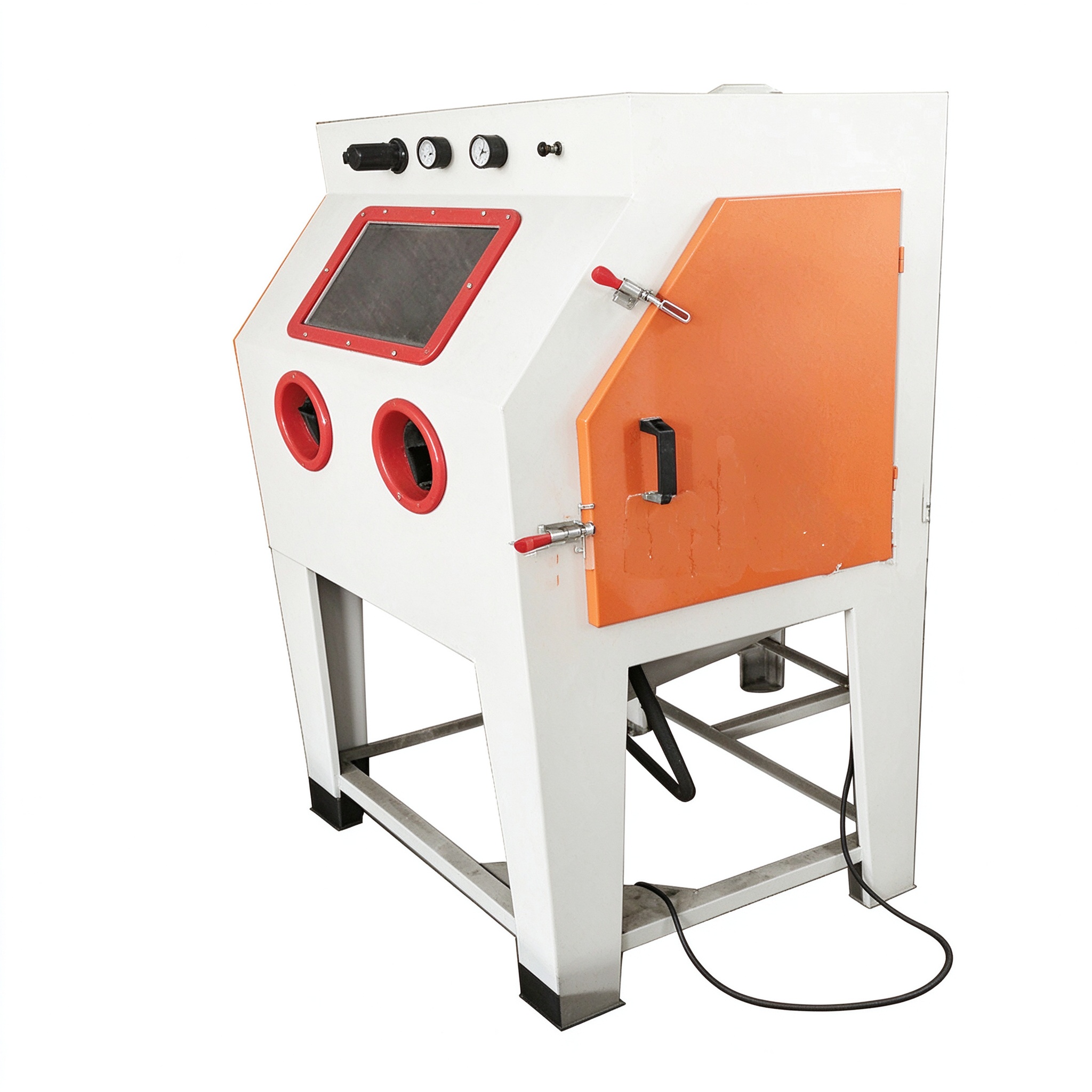
Full-text summary reference:The selection of mobile rust-removal sandblasting machines can be summarized into three tables: the working condition table, the parameter table, and the acceptance table. The working condition table records the workpiece material, corrosion grade, size and shape, operating environment, air supply conditions, and environmental protection requirements; the parameter table records working pressure, air consumption, tank volume, nozzle aperture, abrasive particle size, dust removal air volume, and mobility mode; the acceptance table records cleaning grade, roughness, uniformity, sealing performance, continuous operation, emissions, and safety protection. In practice, follow STEP 1 to confirm the working conditions, STEP 2 to match the equipment, and STEP 3 to conduct trial blasting and finalize the process. Conduct a small-area trial blasting before batch operation to reduce rework. For maintenance, focus on abrasive dryness and screening, nozzle aperture wear, pipeline joint air leakage, dust removal filter bag pressure difference, and tank inspection records. When selecting an enterprise, attention can be paid to the R&D team, patents and quality control processes, tank hydrostatic testing, environmental certification, production capacity and delivery, and after-sales response. Relying on more than 30 years of experience in sandblasting equipment manufacturing, a mobile and stationary product system, customization capabilities, and a nationwide service network, Wuqiao Anxing Sandblasting Machinery Co., Ltd. can provide mobile rust-removal sandblasting machines and supporting dust removal solutions for steel structures, ships, bridge pipelines, anti-corrosion engineering, and other scenarios. For more information, please visit the official website:www.anxingpensha.com. The parameters in this document are for technical reference only; for specific selection, please confirm in conjunction with the on-site survey and equipment nameplate.
Wuqiao Anxing Sandblasting Machinery Co., Ltd. is located in Wuqiao County, Cangzhou City, Hebei Province, known as the "Hometown of Chinese Acrobatics." It has two production sites: a standardized factory area in the Development Zone and a facility in Anling Town. It is a professional sandblasting ...
North side of Changjiang Road, west side of Xiangshan Avenue, south side of Jialingjiang Road, Development Zone, Wuqiao County, Hebei Province