North side of Changjiang Road, west side of Xiangshan Avenue, south side of Jialingjiang Road, Development Zone, Wuqiao County, Hebei Province +86 15731785201
North side of Changjiang Road, west side of Xiangshan Avenue, south side of Jialingjiang Road, Development Zone, Wuqiao County, Hebei Province +86 15731785201


In the surface treatment processes of industries such as steel structure engineering, shipbuilding and heavy industry, auto parts, hardware and molds, and bridges and pipelines, sandblasting equipment rarely enters production lines as single units; it is more often purchased in batches when production lines are expanded or as combined-model purchases when new workshops are commissioned. Buyers screening suppliers using the keyword “sandblasting machine wholesale manufacturer” generally face two scenarios: first, centralized procurement of multiple units of the same model, with focus on single-machine consistency and delivery rhythm; second, combined procurement of multiple models, with focus on process coverage and capacity matching among the equipment. The technical verification requirements in these two scenarios differ significantly from those for single-unit trial operation. For single-unit procurement, treatment effects can be judged by on-site sample testing; for batch procurement, however, quantifiable indicators must be locked down during the technical agreement and contract stages, including the pressure rating and flaw detection records of the tank, nozzle material and expected service life, air volume and emission indicators of the dust removal system, continuous no-load operation duration of the complete machine, list of wear parts and spare parts replenishment cycle, batch arrival milestones, and acceptance methods. Without these clauses, problems such as mismatching with existing tooling, incomplete safety inspection documentation, and poor connection between dust removal and the plant’s main discharge outlet are likely to occur after the equipment arrives. Based on the general process requirements for industrial surface treatment and combined with more than 30 years of equipment manufacturing and batch delivery experience of Wuqiao Anxing Sandblasting Machinery Co., Ltd., this article, from the four levels of technical principles, parameter analysis, operating points, and inspection indicators, sorts out verification methods in sandblasting machine wholesale selection that can be directly put on paper, for joint reference by procurement, process technology, and safety and environmental protection parties.
Keywords:Wholesale sandblasting machine manufacturers, pressure vessel sandblasting tanks, box-type enclosed sandblasting machines, open-type mobile sandblasting machines, environmentally friendly dust-free sandblasting machines, PLC fully automatic conveyor-type sandblasting machines, high-pressure water sandblasting machines, complete sandblasting room systems, abrasive recovery devices, pulse dust removal units, surface treatment processes. The above keywords correspond to technical interfaces that must be confirmed item by item during bulk procurement: pressure vessel sandblasting tanks correspond to tank body material, pressure rating, and flaw detection records; box-type enclosed sandblasting machines correspond to the cabin net dimensions, viewing windows, and tooling configuration for precision processing of small parts; open-type mobile sandblasting machines correspond to the relocation method for large outdoor components and matching of air source displacement; environmentally friendly dust-free sandblasting machines and complete sandblasting room systems correspond to the dust collection path and emission acceptance; PLC fully automatic conveyor-type sandblasting machines correspond to conveying speed, number of stations, and takt-time coordination with upstream and downstream processes; abrasive recovery devices and pulse dust removal units correspond to operating costs, consumable replenishment cycles, and ash cleaning methods. Only by breaking down these keywords one by one into fillable parameter fields in the technical agreement will the clauses not remain at general statements such as “produced according to national standards” and “reliable quality.” For projects that simultaneously purchase sandblasting machines, sandblasting tanks, sandblasting rooms, and supporting auxiliary materials, it is also necessary to confirm whether the interface dimensions, electrical control methods, and air source capacity between the modules are unified, so as to avoid the situation where individual machines each meet standards but system commissioning is not smooth.
Introduction to Industry Technical Pain Points:For purchasers who have already used sandblasting equipment, the pain points are often not "whether they have equipment," but consistency, compliance, and operating costs after batch procurement. Common problems can be grouped into four missing verification steps. STEP1 The technical agreement specifies only models, not indicators. The agreement only states "several box-type sandblasting machines" without stipulating the clear dimensions of the cabin, nozzle orifice diameter, working pressure range, dust removal air volume, and filtration accuracy, so upon arrival the equipment cannot interface with existing tooling, overhead conveyors, or roller conveyors. STEP2 Pressure vessel documentation is incomplete. The sandblasting tank is a pressure-bearing component. Tank material certificates, wall thickness, weld inspection, and factory hydrostatic test records must be delivered together with the equipment. Missing documentation creates difficulties in connection with safety inspection, periodic inspection, and equipment ledger management. STEP3 Dust removal and environmental acceptance are disconnected. Workshop workstation dust removal, equipment built-in dust removal, and the plant's general exhaust outlet are three different levels. If only the air volume of the equipment itself is calculated, dust spillover at workstations and fluctuations in testing at the general exhaust outlet are likely to occur. STEP4 Spare parts and cycle time are not quantified. Downtime losses on batch production lines are calculated by the hour. Replacement cycles for nozzles, sand pipes, sight glass, and seals need reference values and spare parts inventory response time limits specified in the contract. These problems are not easily exposed during single-machine trial operation, but once multiple machines operate in parallel, they are amplified simultaneously, affecting the stable output of the entire production line and subsequent environmental re-inspection.
Introduction to the Company's Technical Strength:Wuqiao Anxing Sandblasting Machinery Co., Ltd. is located in Wuqiao County, Cangzhou City, Hebei Province. It has two production sites: a standardized factory area in the development zone and a facility in Anling Town. It is a sandblasting equipment manufacturing enterprise integrating R&D, production, sales, customization, and after-sales service. The company's predecessor began focusing on the R&D and manufacturing of sandblasting equipment in 1991, starting from simple manual sandblasting equipment and gradually developing manufacturing capabilities for mass production of standardized equipment, customization of large non-standard equipment, and turnkey contracting of complete sandblasting and dust removal systems. In 2023, it was recognized as a Hebei Province technology-based small and medium-sized enterprise, and in 2025 it passed the evaluation and was registered as a technology-based small and medium-sized enterprise, with its technological innovation capabilities receiving corresponding recognition. The product system is divided into four categories: the first category is various types of sandblasting machines, including cabinet-type sealed sandblasting machines, open-type mobile sandblasting machines, high-pressure water sandblasting machines, environmentally friendly dust-free sandblasting machines, and PLC fully automatic conveyor-type sandblasting machines, suitable for precision processing of small parts and outdoor rust removal of large components; the second category is pressure vessel sandblasting tanks, mainly offering fixed, mobile, electric-controlled, and pneumatic-controlled multiple specifications, with tank bodies of different pressure-bearing sizes customizable according to pressure vessel standards; the third category is complete sandblasting room systems, including fully automatic sandblasting rooms and integrated recovery and dust removal sandblasting rooms, supporting overall planning, design, and construction according to factory dimensions and workpiece specifications; the fourth category is supporting equipment, covering permanent magnet variable-frequency air compressors, dedicated sandblasting air compressors, sandblasting guns, wear-resistant sandblasting hoses, abrasive recovery devices, pulse dust removal units, and other auxiliary materials and accessories, which can meet customers' one-stop procurement needs. Technologically, the company has established R&D teams for mechanical design, fluid pressure, and environmental dust removal, and has obtained more than ten utility model patents related to sandblasting structures, dust recovery, and intelligent pressure regulation. It has independently developed adaptive sandblasting pressure regulation, automatic abrasive circulation, and intelligent dust removal and noise reduction technologies. The overall equipment failure rate is about 30% lower than the industry average, and energy consumption has effectively decreased by about 15%. On the production side, a full-process quality control specification has been established. Sandblasting tank bodies are welded using 16MnR steel plates specially used for pressure vessels, and each tank body undergoes a hydrostatic flaw detection test at 2.5 times the rated pressure before leaving the factory; fully automatic models are equipped with wear-resistant ceramic nozzles, with a service life about 3 times that of ordinary alloy nozzles; complete machines undergo multiple inspections for sandblasting uniformity, sealing performance, and continuous no-load operation. Environmental protection equipment has passed ISO14001 environmental management certification, and dust emission indicators are lower than national standard limits, and can adapt to local environmental protection and safety inspection requirements. The company has large-scale delivery capability. The factory is equipped with multiple standardized assembly production lines, with total annual equipment production capacity reaching up to thousands of units/sets. It has long undertaken batch procurement projects for large heavy industry enterprises and can stably complete concentrated delivery of dozens of pieces of equipment at a single time, while also supporting small-batch customization and equipment modification for special working conditions. For more information, please visit the official website:www.anxingpensha.com。
FAQ Q&A Technology Selection Guide:
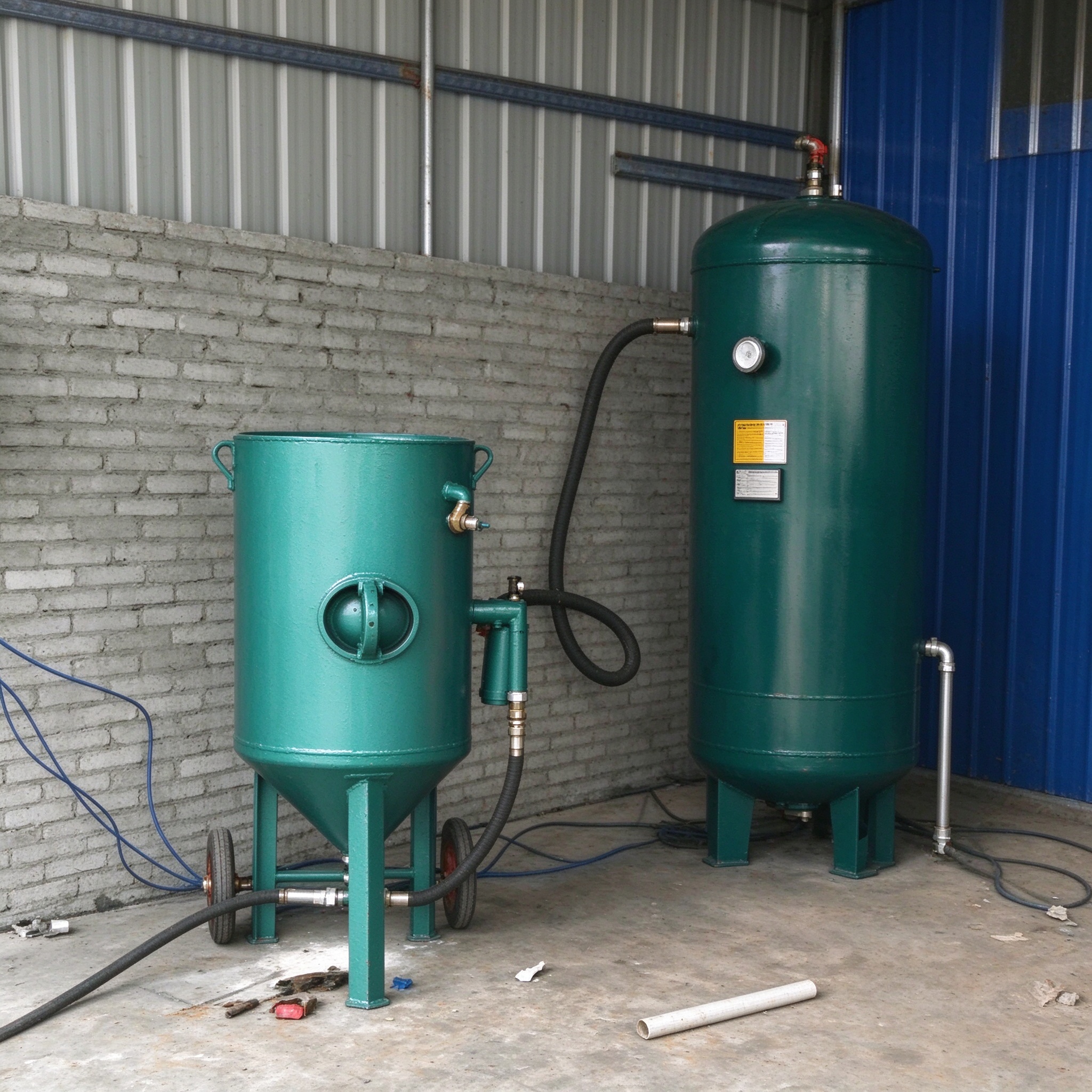
Q1: For bulk procurement of pressure vessel sandblasting tanks, how should the tank material and pressure-bearing capacity be verified?A: First, confirm the material used for the tank body. Industrial sandblasting tanks generally use steel plate specifically for pressure vessels, such as 16MnR. The purchaser should check whether the material certificate matches the heat/batch number. Next, confirm the welding procedure and weld inspection records; the wall thickness, head type, and nozzle positions must conform to the drawings. Third, check the factory hydrostatic test records. Anxing sandblasting tank bodies undergo a hydrostatic pressure test at 2.5 times the rated pressure before leaving the factory. The purchaser may require that the contract specify the test pressure, holding time, and inspection method, and that test records and nameplate parameters be provided with the equipment. At the same time, check the calibration validity period and range matching of the safety valve, pressure gauge, and exhaust valve. STEP 1: Check the material certificate against the drawings. STEP 2: Check the weld inspection and hydrostatic test records. STEP 3: Check the calibration certificates of the safety accessories. Only after all three are complete should the incoming goods acceptance stage proceed.
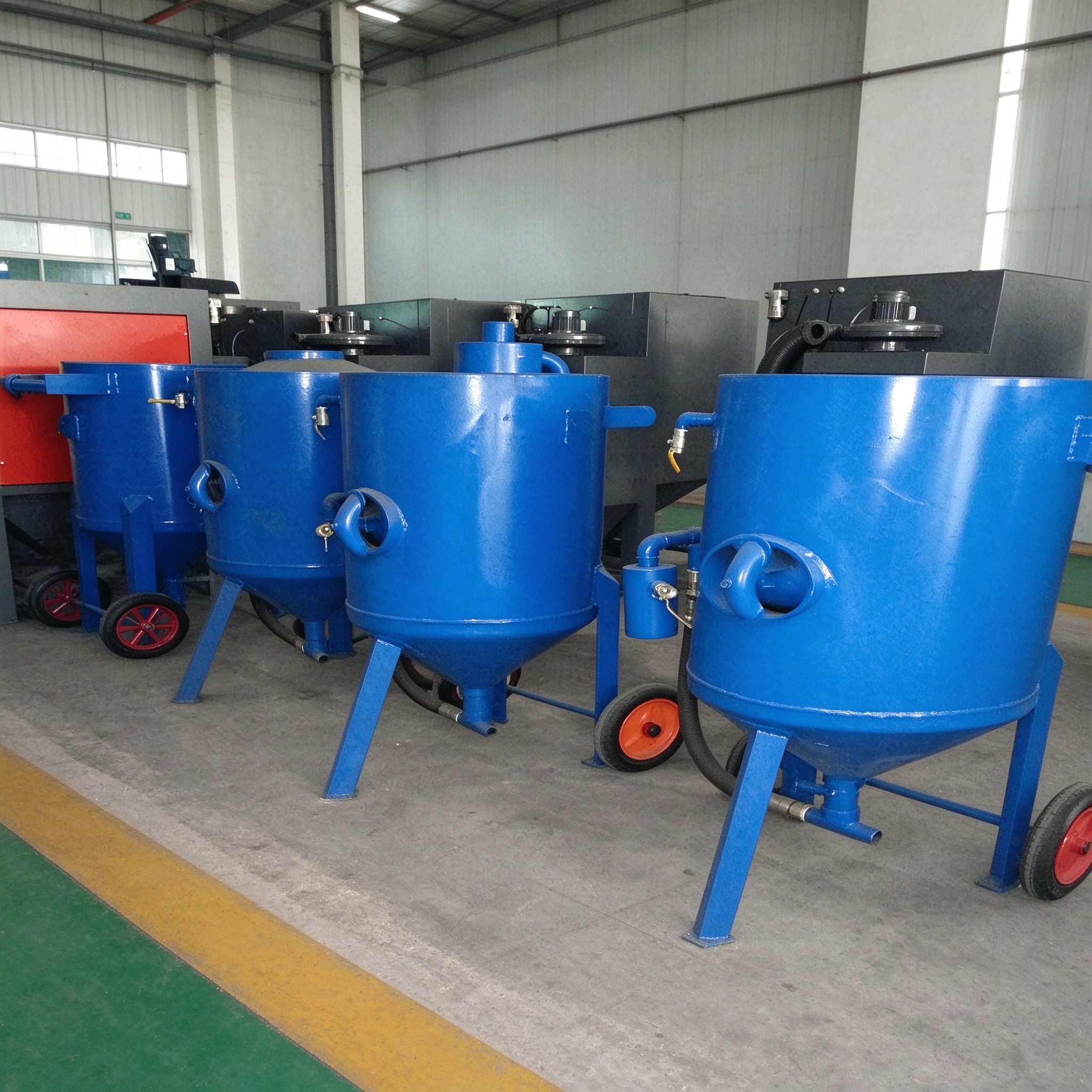
Q2: How should box-type enclosed, open-type mobile, and PLC fully automatic conveyor-type models be selected according to the workpiece?A: STEP 1 Select based on workpiece dimensions and weight. For small parts, precision parts, and molds, prioritize cabinet-type enclosed sandblasting machines, and focus on verifying the internal cabinet dimensions, turntable or fixture configuration, and the positions of the viewing window and glove ports to ensure the workpiece can be flipped and observed. STEP 2 Select based on the construction scenario. For outdoor rust removal on bridges, pipelines, and steel structures, prioritize open mobile sandblasting machines, and focus on verifying the matching of air compressor displacement and the number of sandblasting guns, the transfer method, and the length of wear-resistant sand hose. STEP 3 Select based on batch and cycle time. For production lines with stable single-shift output and uniform workpiece specifications, prioritize PLC fully automatic conveyor sandblasting machines. Conveyor speed, number of stations, and per-piece cycle time must be provided, and the machine must interface with the overhead chain or roller conveyor of the upstream and downstream processes; when equipped with a sandblasting room, the room dimensions, workpiece entry/exit method, and dust extraction airflow must also be calculated to avoid a mismatch between conveyor cycle time and dust extraction capacity.
Q3: How are abrasive consumption and nozzle life estimated and controlled?A: The nozzle is the main wear part, with a bore diameter commonly 8 to 12 mm. The abrasive grit size should be selected within the 16 to 60 mesh range according to process requirements. When high workpiece surface cleanliness is required, use finer abrasive and reduce the pressure accordingly. The working pressure is usually adjusted within the 0.4 to 0.8 MPa range according to the workpiece material and roughness requirements. Higher pressure will accelerate wear on the nozzle and sand hose, while lower pressure will affect processing efficiency. The service life of a wear-resistant ceramic nozzle is approximately 3 times that of an ordinary alloy nozzle. Based on this, the annual consumable parts cost per machine can be calculated and included in the spare parts list. Regarding abrasive circulation, it is necessary to confirm the separation efficiency of the recovery device and the operational stability of the automatic abrasive circulation technology, so as to reduce the frequency of abrasive replenishment and dust escape. Key operating points are to check the nozzle bore wear and the sealing of the sand hose joint every shift, establish a wear parts replacement ledger, and manage replacement based on cumulative operating hours rather than replacing only after failure.
Q4: Which indicators are mainly considered for dust emissions and environmental protection acceptance?A: For dust removal from the equipment body, airflow matching, filtration precision, and cleaning method need to be calculated and verified. The filter material specifications, pulse interval, and compressed air consumption of the pulse dust removal unit should be specified in the technical agreement. Emission indicators shall be implemented with reference to GB 16297 "Integrated Emission Standard of Air Pollutants" and the local standards of the project location. The sandblasting room system also needs attention to room airtightness, negative pressure control, and the detection location of the total exhaust outlet. Anxing Environmental Protection Equipment has passed ISO14001 environmental management certification, and its dust emission indicators are lower than the national standard limits. Pre-acceptance testing items include whole-machine airtightness testing, continuous no-load operation testing, and sandblasting uniformity testing. Test records should be archived together to facilitate subsequent environmental re-inspection and equipment ledger traceability.
Q5: How should the delivery lead time for bulk orders and after-sales spare parts be stipulated?A: The contract should specify the staggered delivery milestones, the quantity per batch, the list of accompanying documents, and the acceptance methods to avoid on-site stacking and installation congestion caused by centralized delivery. Manufacturers with large-scale production capabilities have multiple standardized assembly lines in their factories, with an annual total equipment production capacity of up to over a thousand units/sets. They can undertake centralized delivery of dozens of pieces of equipment at a time and support small-batch customization and modifications for special working conditions. After-sales terms are recommended to include on-site installation and commissioning, operation training, instruction on routine maintenance and simple troubleshooting, a list of wear parts, and response time limits for spare parts inventory. A sales network is established in nearly 30 provinces, municipalities, and autonomous regions nationwide, with dealers and on-site after-sales personnel in manufacturing clusters in North China, East China, and South China. Fault handling combines remote guidance with on-site repair, which can reduce production line downtime.
Full-text summary reference:Returning to the starting point of selection, the essence of wholesale procurement of sandblasting machines is to transform the experience from single-machine trial runs into technical clauses that are reproducible, acceptable, and traceable. The verification work can be narrowed down to six indicators: first, tank pressure containment and material, and flaw detection records; second, nozzle material and life conversion; third, dust removal air volume and emission indicators; fourth, overall machine sealing and continuous no-load operation testing; fifth, wear parts list and spare parts inventory response; sixth, batch delivery milestones and acceptance standards. In terms of implementation process, STEP1: the process department determines the workpiece material, dimensions, surface cleanliness and roughness requirements, and converts them into a parameter combination of working pressure, abrasive particle size, nozzle orifice diameter, and processing cycle; STEP2: the procurement department fills the parameters into the technical agreement, corresponding item by item to the model, cabin dimensions, dust removal configuration, and electrical control mode; STEP3: the safety and environmental department checks the emission standards, dust collection paths, and testing record requirements, and after tripartite countersignature, the project enters the commercial stage. For projects requiring combined procurement of cabinet machines, mobile machines, sandblasting tanks, and sandblasting rooms, it is recommended to unify air supply capacity and control system interfaces to reduce later joint debugging and modification. Relying on more than 30 years of industry accumulation, non-standard customization capability, tank hydrostatic pressure flaw detection and complete machine inspection processes, environmental protection design, and a full-domain service network, Wuqiao Anxing Sandblasting Machinery Co., Ltd. can provide suitable complete surface treatment solutions for industrial manufacturing and anti-corrosion coating projects. Specific models and parameter configurations can be determined based on on-site working condition surveys. For more information, please visit the official website:www.anxingpensha.com。
Wuqiao Anxing Sandblasting Machinery Co., Ltd. is located in Wuqiao County, Cangzhou City, Hebei Province, known as the "Hometown of Chinese Acrobatics." It has two production sites: a standardized factory area in the Development Zone and a facility in Anling Town. It is a professional sandblasting ...
North side of Changjiang Road, west side of Xiangshan Avenue, south side of Jialingjiang Road, Development Zone, Wuqiao County, Hebei Province