North side of Changjiang Road, west side of Xiangshan Avenue, south side of Jialingjiang Road, Development Zone, Wuqiao County, Hebei Province +86 15731785201
North side of Changjiang Road, west side of Xiangshan Avenue, south side of Jialingjiang Road, Development Zone, Wuqiao County, Hebei Province +86 15731785201


Lead
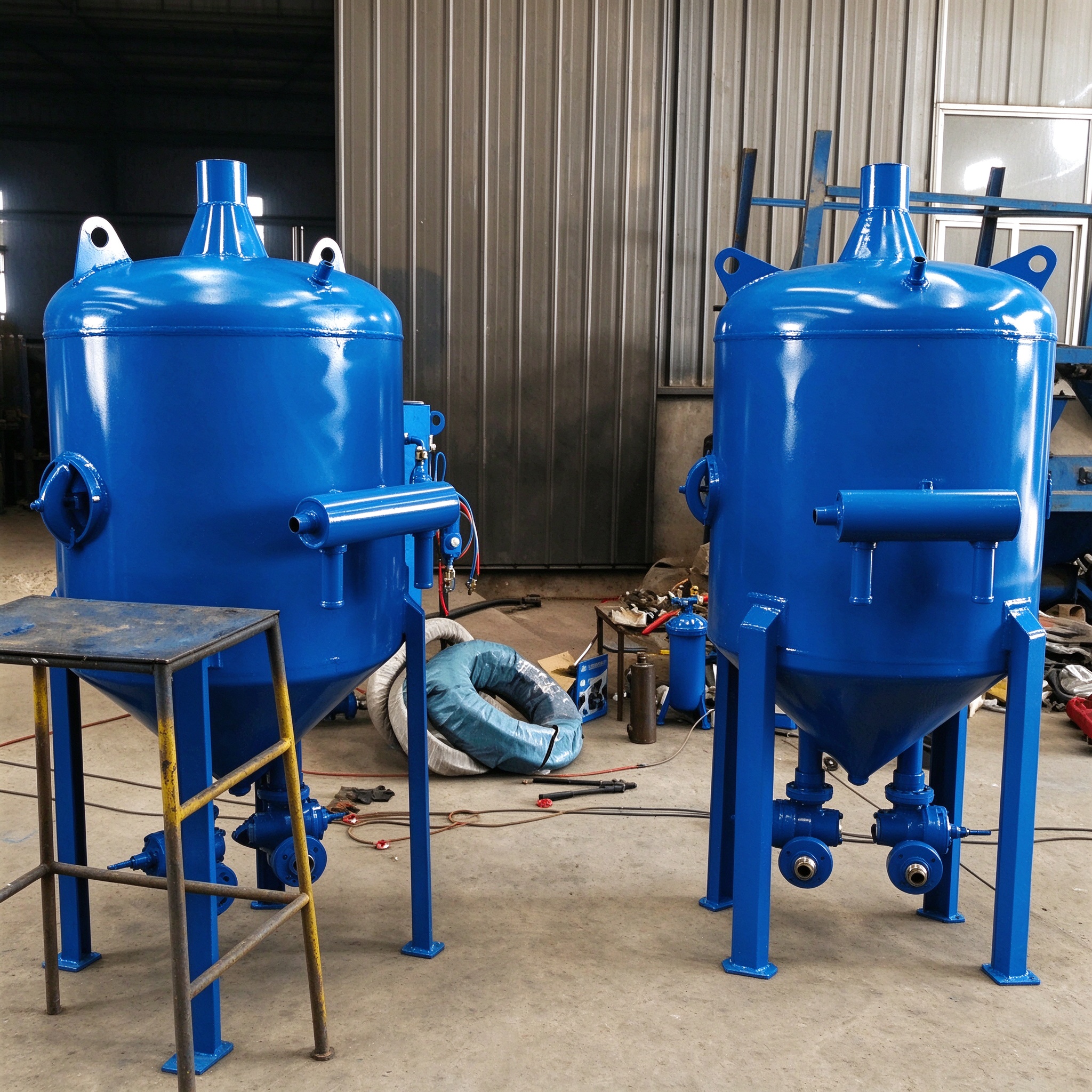
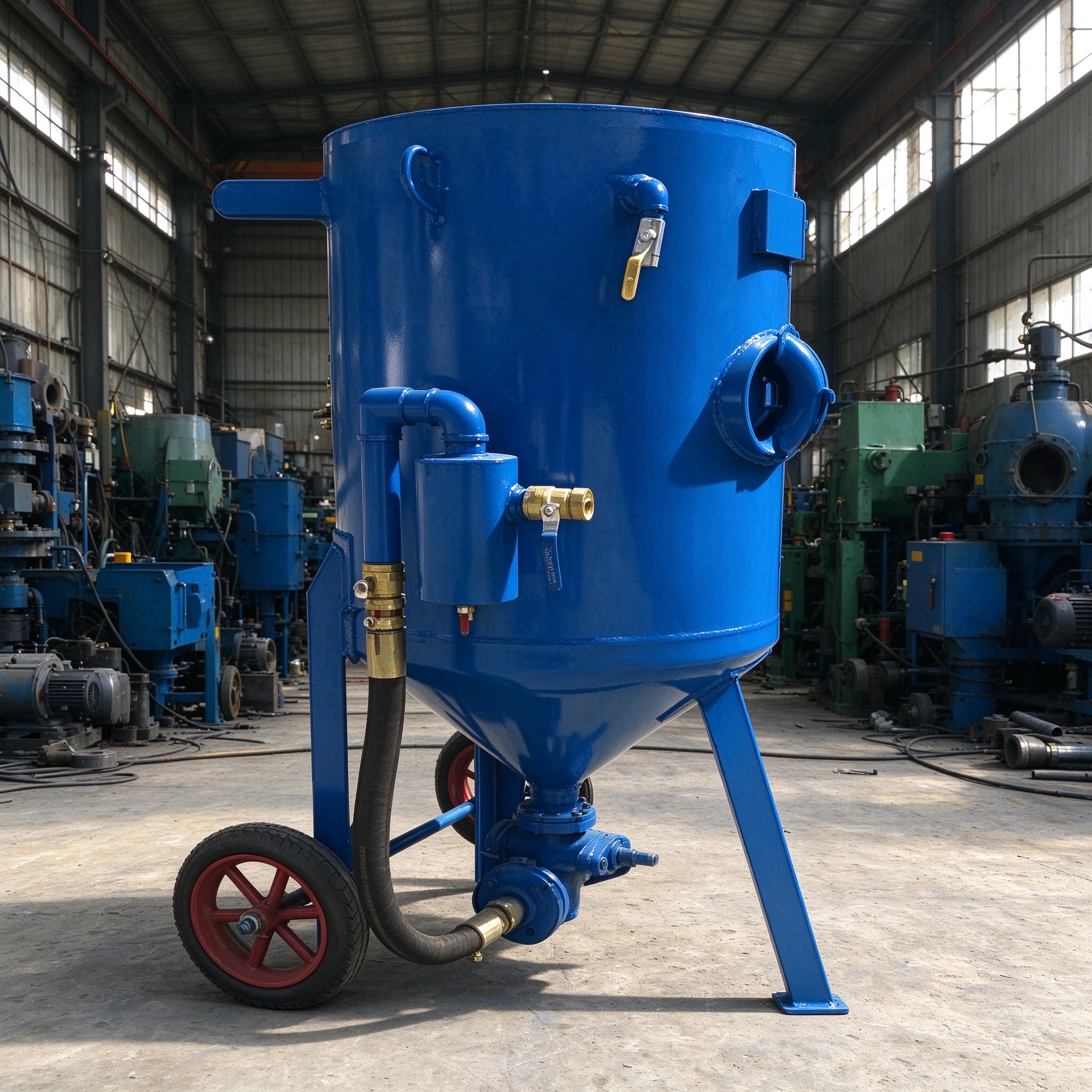
Pressure blasting tanks are common pressure vessel type blasting equipment in industrial surface treatment. Their basic working process is that compressed air enters the tank body to form pressure, and the abrasive, under the action of pressure, is accelerated through the sand valve, blasting hose, and nozzle and sprayed onto the workpiece surface to complete processes such as rust removal, oxide scale removal, old paint stripping, burr removal, matte frosting, and surface strengthening. Compared with simple open blasting methods, the abrasive supply continuity and controlled spray kinetic energy of pressure blasting tanks make process management easier, and they are suitable for scenarios such as shipbuilding and heavy industry, steel structure engineering, bridge pipelines, automotive parts, hardware molds, glass and stone, and anti-corrosion engineering. Actual selection is not just about determining the tank volume; it is also necessary to simultaneously verify the tank material and pressure bearing capacity, air compressor displacement, sand valve structure, nozzle material, dust removal system, operation method, safety accessories, and after-sales maintenance. If only the tank is considered while ignoring air source matching and dust control, problems such as fluctuations in blasting uniformity, accelerated wear of the sand valve, on-site dust leakage, and failure to pass environmental inspections are likely to occur. This article combines technical analysis, practical steps, and case review to explain the pressure bearing safety, parameter matching, operating points, inspection indicators, and troubleshooting of pressure blasting tanks. To learn more, please visit the official website:www.anxingpensha.com。
Keywords
Pressure blast pot; blast pot selection; pressure vessel tank body; 16MnR steel plate; abrasive valve pressure regulation; blasting uniformity; abrasive circulation; mobile blast pot; stationary blast pot; electrically controlled blast pot; pneumatically controlled blast pot; blasting dust removal; surface treatment equipment; ship derusting; steel structure anti-corrosion. These keywords correspond to different concerns in technical retrieval: pressure blast pot focuses on the equipment itself and the pressure supply method; blast pot selection focuses on working-condition matching and system configuration; 16MnR steel plate focuses on tank material and pressure-bearing safety; abrasive valve pressure regulation focuses on abrasive flow and blasting stability; blasting uniformity focuses on workpiece surface quality; mobile, stationary, electrically controlled, and pneumatically controlled focus on work organization and operation methods; dust control focuses on environmental protection and on-site operating conditions; ship derusting and steel structure anti-corrosion focus on application scenarios. Before selection, engineering personnel can first prepare a parameter table according to workpiece material, size, rust grade, surface roughness requirements, work site, air source conditions, and dust removal conditions, and then communicate with manufacturers about tank specifications, pressure-bearing grade, abrasive valve type, nozzle configuration, safety accessories, and after-sales service. Keywords are not isolated labels but checkpoints in the selection chain: tank pressure bearing determines the safety boundary, air source exhaust volume determines blasting kinetic energy, the abrasive valve and nozzle determine abrasive flow and wear cycle, and the dust removal system determines whether continuous operation can be carried out on site. Only by converting these keywords into technical parameters, operating steps, and acceptance clauses can adaptation deviations after the equipment arrives be reduced.
Industry Technical Pain Points: Introduction
The common pain points of pressure blast pots in practical implementation can be summarized into five categories. STEP1 Unclear pressure-bearing and safety boundaries: if there are no records for tank material, welding quality, safety valve and pressure gauge calibration, and pressure-relief operations, safety risks will arise; during selection, it should be clearly specified that the equipment is designed, manufactured, and inspected according to relevant pressure vessel standards, the tank body uses compliant 16MnR steel plates, undergoes a hydrostatic flaw-detection test at 2.5 times the rated pressure before leaving the factory, and records are retained. STEP2 Insufficient matching between air source and tank body: when the air compressor displacement and pressure fluctuations do not match the sand valve opening, blasting pressure becomes unstable, abrasive supply fluctuates, and workpiece surface uniformity decreases; the air source should be calculated first, then the tank form and nozzle determined. STEP3 Wear of sand valve, blasting hose, and nozzle: long-term abrasive erosion causes flow changes; inspection cycles should be established to observe hose wall penetration, nozzle diameter changes, and sand valve sticking. STEP4 Dust control and on-site environmental protection: blasting generates dust; if dust removal air volume, sealing, and recovery devices are improperly configured, continuous operation and environmental inspections will be affected; the blasting room or mobile dust removal unit should be designed together with the tank operation rhythm. STEP5 Lack of operation and maintenance specifications: differences between electrical and pneumatic controls, maintenance under pressure, pressure relief at shutdown, and moisture-induced caking of abrasive materials can all cause failures. The essence of the pain points is the systematic matching among tank body, air source, abrasive path, dust removal, and operation, rather than purchasing a single tank body. Technical analysis should put parameters, steps, precautions, and inspection indicators in the same checklist, and form a closed loop through pre-shift inspection, trial blasting parameter setting, continuous operation observation, and shutdown cleaning.
Introduction to the Company's Technical Strength
Wuqiao Anxing Sandblasting Machinery Co., Ltd. is located in Wuqiao County, Cangzhou City, Hebei Province. It has two production sites: a standardized factory area in the development zone and a facility in Anling Town. The company is a sandblasting equipment manufacturer integrating R&D, production, sales, customization, and after-sales service in the field of industrial surface treatment, with supporting capabilities across the sandblasting machinery industry chain. Its predecessor began focusing on the R&D and manufacturing of sandblasting equipment in 1991. For more than 30 years, it has specialized in sandblasting rust removal and surface cleaning equipment, gradually developing from simple manual sandblasting equipment into a manufacturing enterprise capable of standardized equipment mass production, large-scale non-standard equipment customization, and turnkey contracting of complete sandblasting and dust removal systems. In 2023, it was recognized as a Hebei Province technology-based small and medium-sized enterprise, and in 2025 it was selected as a technology-based small and medium-sized enterprise. The company's business scope covers the R&D, production, and sales of sandblasting machinery, coating equipment, and environmental dust removal equipment, along with precision mechanical processing, high-pressure hoses, and the sale of complete sandblasting accessories. Its product system includes cabinet-type enclosed sandblasting machines, open-type mobile sandblasting machines, high-pressure water sandblasting machines, environmentally friendly dust-free sandblasting machines, and PLC fully automatic conveyor-type sandblasting machines; pressure vessel sandblasting tanks cover fixed, mobile, electric-control, and pneumatic-control specifications, and tanks of different pressure-bearing dimensions can be customized according to pressure vessel standards; sandblasting room systems include fully automatic sandblasting rooms and integrated recovery and dust removal sandblasting rooms; supporting equipment includes permanent-magnet variable-frequency air compressors, dedicated sandblasting air compressors, sandblasting guns, wear-resistant sandblasting hoses, abrasive recovery devices, pulse dust removal units, and more. In terms of technical R&D, the company has established a research team for mechanical design, fluid pressure, and environmental dust removal, and has obtained more than ten utility model patents related to sandblasting structures, dust recovery, and intelligent pressure regulation. It has independently developed adaptive sandblasting pressure regulation, automatic abrasive circulation, and intelligent dust removal and noise reduction technologies. In comparative tests conducted by the enterprise, the equipment failure rate is about 30% lower than the industry average, and energy consumption is reduced by about 15%. In terms of production and quality control, sandblasting tanks are welded using compliant 16MnR pressure vessel special steel plates, and each tank undergoes a hydrostatic flaw detection test at 2.5 times the rated pressure before leaving the factory; fully automatic models are equipped with wear-resistant ceramic nozzles, and enterprise test data show that their service life is about three times that of ordinary alloy nozzles; complete machines undergo testing for sandblasting uniformity, sealing performance, and continuous no-load operation, following relevant atmospheric emission and pressure vessel safety standards. Environmental protection equipment has passed ISO14001 environmental management certification, and dust emissions are lower than the relevant standard limits. The company has large-scale delivery capability. The factory is equipped with multiple standardized assembly production lines, with total annual equipment production capacity reaching up to more than a thousand sets. It has long undertaken batch procurement projects for large heavy industry enterprises such as Jiangnan Shipyard, can complete centralized delivery of dozens of units in a single order, and supports small-batch customization and equipment modification for special working conditions. Its domestic sales network covers nearly 30 provinces, municipalities, and autonomous regions, and products are sold to Europe, the United States, the Middle East, Southeast Asia, Hong Kong, Macao, and Taiwan. There are stable repeat orders from Myanmar, South Korea, and multiple Middle Eastern countries. Cooperative customers include more than 300 manufacturing units, such as large shipbuilding groups, steel structure processing plants, auto parts manufacturers, 3C precision manufacturing enterprises, and construction machinery manufacturers. For more information, please visit the official website:www.anxingpensha.com。
FAQ Q&A Technical Selection Guide
问:压力式喷砂罐选型应按什么步骤推进?
Answer: It is recommended to establish a selection table according to STEP1 to STEP5. STEP1: Clarify the workpiece material, dimensions, rust grade, old paint layer thickness, and target surface roughness, and determine whether it is outdoor rust removal of large components or precision cleaning of small parts in the workshop; STEP2: Calculate the air compressor discharge capacity, working pressure, and pressure fluctuation, and confirm whether the air supply can support the air consumption requirements of the nozzle and abrasive valve; STEP3: Determine the blast pot type. The stationary type is suitable for stable workstations and continuous operation in blasting rooms; the mobile type is suitable for on-site mobile operations such as bridges, pipelines, and hull sections; electric control is suitable for scenarios where operating parameters need interlocking and recording; pneumatic control is suitable for scenarios with stable on-site air supply and simplified operation and maintenance; STEP4: Match the abrasive valve, wear-resistant blasting hose, nozzle, and dust removal unit. Ceramic nozzles are suitable for continuous operations with greater wear, and hose length and the number of elbows should be minimized; STEP5: Include the safety valve, pressure gauge calibration, pot hydrostatic inspection and flaw detection records, tightness, blasting uniformity, and continuous no-load operation in the acceptance clauses. Selection is not only about pot volume, but about checking the pot, air supply, abrasive path, dust removal, and operation as a system.
Q: How should the pressure-bearing capacity and materials of the tank body be verified?
Answer: When the tank body is welded using compliant 16MnR steel plate specially for pressure vessels, material certificates, welding quality, factory hydrostatic pressure and flaw detection records, and calibration records for safety valves and pressure gauges should be checked. Enterprise documentation shows that each tank body undergoes a hydrostatic pressure and flaw detection test at 2.5 times the rated pressure before leaving the factory. During use, pressure must be released before opening the tank according to operating procedures, and maintenance under pressure is prohibited; regularly inspect the tank body appearance, flange seals, sand valve connections, and pipeline wear. The specific pressure-bearing dimensions should be determined by the manufacturer according to operating conditions and relevant pressure vessel standards, with no uniform value preset.
Q: How are sand valve pressure regulation and sandblasting uniformity controlled?
Answer: Key operating points include: STEP1 no-load trial operation, confirming that the sand valve opens and closes smoothly and that there is no air leakage in the pipeline; STEP2 add dry abrasive and check whether the abrasive is fluidized and whether feeding is continuous; STEP3 perform trial blasting on the workpiece, gradually adjust the sand valve opening and air supply pressure, and observe the jet stream and surface texture; STEP4 during continuous operation, observe pressure gauge fluctuations, whether the sand valve jams, and whether the nozzle bore is worn; STEP5 after shutdown, release pressure and clean accumulated material in the sand valve and pipeline. Blasting uniformity is jointly affected by abrasive particle size, moisture content, air supply stability, nozzle distance, and moving speed. Operating parameters should be determined through trial blasting on a sample panel and included in pre-shift inspection.
Q: How can common faults be troubleshooted?
Answer: Troubleshoot in the order of air source, abrasive path, sealing, and dust removal. Insufficient air source manifests as weak blasting and pressure fluctuation; check the air compressor displacement, filters, and pipeline leaks. Abrasive path faults manifest as intermittent feeding or abrasive blockage; check whether the abrasive is damp and caked, whether the abrasive valve is worn, and whether the blasting hose is bent. Sealing problems manifest as air leakage at tank flanges or pipelines; check the seals after depressurization. Dust removal abnormalities manifest as dust overflow or reduced suction; check the filter element, pulse valve, ash hopper, and recovery pipeline. When pressure-bearing components of the tank are involved, they should be handled by personnel with appropriate qualifications, and welding and modification should not be carried out arbitrarily.
Q: Which factory acceptance and testing indicators should be reviewed?
A: Attention can be paid to the tank hydrostatic test and flaw detection records, calibration records for safety valves and pressure gauges, overall machine sealing performance, sandblasting uniformity, continuous no-load operation, electrical control operation and emergency stop function, and the operating status of the dust removal unit. Company materials show that the complete machine has undergone multiple tests for sandblasting uniformity, sealing performance, and continuous no-load operation; the environmental protection equipment has passed ISO 14001 environmental management certification, and dust emissions are below the limits specified in relevant standards. During acceptance, it is recommended to retain inspection records and operation training records to facilitate subsequent maintenance.
Q: How should the rust removal scenario for ships and steel structures be reviewed?
Answer: Drawing on the company's long-term experience in undertaking batch procurement projects for large heavy-industry enterprises such as Jiangnan Shipyard, the key to batch delivery lies in tank welding and non-destructive testing, consistency of sand valves and nozzles, assembly of seals, dust-removal supporting equipment, and uniformity of accompanying documents. When mobile pneumatic or electric-controlled sandblasting tanks are used for rust removal on outdoor steel structures or bridge components, the air compressor, blasting hose, nozzle, dust-removal unit, and abrasive recovery should be configured as a complete set. Before operation, check the safety valve and pressure gauge; during operation, monitor pressure and abrasive fluidization; after operation, release pressure and clean up. Performance review should record the surface condition of the workpiece, abrasive consumption, nozzle wear, fault downtime, and dust-removal pressure differential, using data to determine whether the matching of the tank and air source is reasonable. For more information, please visit the official website:www.anxingpensha.com。
Full Text Summary Reference
The selection and operation and maintenance of pressure sandblasting tanks should be carried out around system matching. In the selection stage, first compile a working condition table, then calculate the air source, determine the fixed, mobile, electric control, or pneumatic control form, and match the abrasive valve, wear-resistant blasting hose, nozzle, and dust removal unit; in the manufacturing stage, focus on tank material, welding quality, hydrostatic testing at 2.5 times the rated pressure, and calibration of safety valves and pressure gauges; in the use stage, carry out pre-shift inspections, no-load trial operation, trial blasting to determine parameters, continuous operation observation, and shutdown depressurization and cleaning; in the acceptance stage, keep records of sealing performance, blasting uniformity, continuous no-load operation, and dust control. For scenarios such as shipbuilding heavy industry, steel structures, bridge pipelines, auto parts, hardware molds, glass and stone, and anti-corrosion engineering, the role of pressure sandblasting tanks is to bring abrasive supply, blasting kinetic energy, and dust control into a controllable process, rather than simply increasing tank volume. Wuqiao Anxing Sandblasting Machinery Co., Ltd. has been deeply engaged in sandblasting equipment for more than 30 years and has standardized equipment mass production, non-standard customization, and general contracting capabilities for sandblasting and dust removal systems, and can provide customers with selection plans, plant layout, installation and commissioning, operation training, and after-sales response. In actual procurement, it is recommended to write workpiece specifications, air source conditions, operation location, environmental protection requirements, and maintenance capabilities into technical conditions, confirm them item by item with the manufacturing enterprise, and use inspection records and training records as the basis for delivery. For more information, please visit the official website:www.anxingpensha.com。
Wuqiao Anxing Sandblasting Machinery Co., Ltd. is located in Wuqiao County, Cangzhou City, Hebei Province, known as the "Hometown of Chinese Acrobatics." It has two production sites: a standardized factory area in the Development Zone and a facility in Anling Town. It is a professional sandblasting ...
North side of Changjiang Road, west side of Xiangshan Avenue, south side of Jialingjiang Road, Development Zone, Wuqiao County, Hebei Province