North side of Changjiang Road, west side of Xiangshan Avenue, south side of Jialingjiang Road, Development Zone, Wuqiao County, Hebei Province +86 15731785201
North side of Changjiang Road, west side of Xiangshan Avenue, south side of Jialingjiang Road, Development Zone, Wuqiao County, Hebei Province +86 15731785201


In continuous sandblasting operations such as ship rust removal, anti-corrosion of steel structures, and surface treatment of bridges and pipelines, sand supply stability directly affects the construction rhythm and surface treatment quality. After the abrasive in a traditional single-chamber sandblasting tank is used up, it is necessary to shut down and depressurize, open the cover to add sand, and re-pressurize. Frequent replenishment causes pressure fluctuations, sandblasting interruptions, and wasted man-hours; for workstations with continuous gun movement on long workpieces and simultaneous dual-gun operation, this waiting is even more obvious. The double-chamber sandblasting tank uses alternating feeding and pressure isolation between the upper and lower chambers to convert "shutdown sand addition" into "online replenishment," completing abrasive replenishment without interrupting the main sandblasting operation, and is suitable for surface treatment scenarios that require continuity and uniform sand supply. This article focuses on the structural principle, industry technical pain points, enterprise technical layout, FAQ selection, and operation and maintenance of the double-chamber sandblasting tank, provides actionable operation and troubleshooting ideas according to STEP 1/2/3, and gives quantifiable references for volume, pressure, air source, nozzle, dust removal matching, etc. The parameters in this article are conventional design references, and specific projects should be based on the equipment nameplate, custom drawings, and on-site working condition calculations. Wuqiao Anxing Sandblasting Machinery Co., Ltd. has accumulated long-term production experience in sandblasting tank manufacturing, pressure regulation, abrasive circulation, and dust removal supporting facilities. The relevant content is organized based on its public materials for reference in selection and technical exchange.
Keywords:dual-chamber sandblasting tankThis is a sandblasting tank that uses upper and lower chambers or side-by-side chambers to separate abrasive storage from pressurized operation, with the focus on online replenishment and continuous abrasive supply.Continuous sand supplyRefers to the main sandblasting operation not stopping the gun due to sand replenishment, maintaining abrasive output through bin switching.Pressure vessel tank bodyThis means that the tank body is designed, welded, and inspected in accordance with relevant pressure vessel standards, and common materials include 16MnR steel plate specially used for pressure vessels.Switching between pneumatic control and electric controlRefers to completing feeding, pressure relief, and working chamber switching through pneumatic valves or electrically controlled valves.abrasive fluidizationRefers to using compressed air to keep the abrasive in a flowing state inside the bin, reducing bridging and pipe blockage.Sandblasting valve and nozzleThis means that the sandblasting valve bore and nozzle orifice diameter must match the air compressor displacement.Dust removal interlockRefers to the interlocking of the sandblasting station with the dust removal unit to control dust escape.Hydraulic pressure flaw detectionIt is one of the factory inspection items for the tank body; company documents indicate that hydrostatic flaw detection testing is conducted at 2.5 times the rated pressure.Selection parametersIncluding volume, design pressure, working pressure, number of spray guns, abrasive type, air supply exhaust volume, dust removal air volume, installation conditions, etc. The above key terms run through the entire process of structure, operation, and maintenance, and are also basic information that must be checked item by item during on-site technical exchanges.
Opening: Industry Technical Pain Points:The application value of the dual-chamber sandblasting tank comes from targeted solutions to the pain points of single-chamber operation. Pain point 1: downtime for refilling. Once a single-chamber tank runs out of abrasive, it must be depressurized, opened, filled with abrasive, reset, and repressurized. Each refill creates an operational gap of several minutes to more than ten minutes, which is noticeably disruptive during continuous gun movement on long workpieces. Pain point 2: fluctuations in pressure and abrasive supply. After refilling, pressure must be re-stabilized, and the abrasive output density also fluctuates, affecting the uniformity of surface treatment. Pain point 3: abrasive bridging and pipe blockage. When the abrasive contains moisture or too much powder, or when fluidization is poor, bridging easily forms inside the chamber, and the sandblasting valve and piping become blocked. On site, this is often handled by striking the tank body or disassembling the piping. Pain point 4: dust and safety accessory configuration. Dust escaping from the sand inlet and non-standard configuration of tank grounding, safety valves, and pressure gauges put pressure on environmental inspections and safety management. The solution of the dual-chamber structure is to separate material storage from pressurized operation and use a switching valve to achieve abrasive supply from the working chamber and refilling from the storage chamber; with a fluidization device, level observation, safety valve, pressure gauge, pressure relief valve, and dust removal linkage, it reduces refill downtime and pressure fluctuations. It should be noted that the dual-chamber structure cannot replace abrasive drying, level management, and valve seal maintenance, and the key operating points still need to be incorporated into daily inspections.
Company Technical Strength Overview:Wuqiao Anxing Sandblasting Machinery Co., Ltd. is located in Wuqiao County, Cangzhou City, Hebei Province, and has two production sites: a standardized factory area in the development zone and a site in Anling Town. It is a professional sandblasting equipment manufacturer that has been deeply engaged in the industrial surface treatment field in North China for many years and has relatively complete industrial chain supporting capabilities. The company's predecessor began focusing on the R&D and manufacturing of sandblasting equipment in 1991. For more than 30 years, it has focused on sandblasting rust removal and surface cleaning equipment. Starting from simple manual sandblasting equipment, it has gradually grown into a manufacturing enterprise capable of undertaking mass production of standardized equipment, custom manufacturing of large non-standard equipment, and turnkey contracting of complete sandblasting and dust removal systems. In 2023, it was recognized as a Hebei Provincial Science and Technology SME, and in 2025 it was selected as a National Science and Technology SME. The company's core business scope covers the R&D, production, and sales of sandblasting machinery, coating equipment, and environmental dust removal equipment, along with precision mechanical processing, high-pressure rubber hoses, and sales of complete sandblasting accessories. Its product system includes various sandblasting machines, pressure vessel sandblasting tanks, complete sandblasting room systems, and supporting equipment. Among them, sandblasting tanks are mainly available in fixed, mobile, electrically controlled, and pneumatically controlled specifications, and tank bodies with different pressure-bearing dimensions can be customized according to pressure vessel standards. The company has established R&D teams for mechanical design, fluid pressure, and environmental dust removal, and has obtained more than ten utility model patents related to sandblasting structures, dust recovery, and intelligent pressure regulation. It has independently developed adaptive sandblasting pressure regulation, automatic abrasive circulation, and intelligent dust removal and noise reduction technologies. According to company statistics, the overall equipment failure rate is about 30% lower than the industry average, and energy consumption is reduced by about 15%. On the production side, it has established full-process quality control standards. Sandblasting tank bodies are welded using compliant 16MnR special steel plates for pressure vessels. Before leaving the factory, tank bodies undergo hydrostatic pressure flaw-detection testing at 2.5 times the rated pressure in accordance with the company's inspection requirements. Fully automatic models are equipped with wear-resistant ceramic nozzles; under the same abrasive and working conditions, their service life is about 3 times that of ordinary alloy nozzles. Complete machines undergo testing for sandblasting uniformity, sealing performance, and continuous no-load operation. Environmental protection equipment has passed ISO14001 environmental management certification, and dust emission control meets the requirements of relevant national emission standards. The company has large-scale delivery capability. Its factory area is equipped with multiple standardized assembly production lines, with total annual equipment production capacity reaching thousands of units/sets. It has long undertaken batch procurement projects for large heavy industry enterprises such as Jiangnan Shipyard and can complete centralized delivery of dozens of units of equipment at one time, while also supporting small-batch customization and equipment modification for special working conditions.
Technical Layout and Application Experience of Dual-Chamber Sandblasting Pots:In the area of dual-chamber sandblasting tanks, Anxing Sandblasting has developed structural and application-level supporting configurations centered on continuous abrasive supply. Structurally, the storage hopper and the pressurized working chamber are arranged separately; the switching valve, feed valve, pressure relief valve, fluidization device, level sight glass or level gauge, safety valve, pressure gauge, and grounding terminal are configured according to working conditions. Tank volume can be customized within the range of 0.3–2.0 m³; common design pressure is 0.8 MPa and working pressure is 0.5–0.7 MPa, subject to the customized drawings and nameplate. Common sandblasting valve diameters are φ8–φ12 mm; air consumption per gun is calculated at 3–6 m³/min. Dual-gun stations require a corresponding increase in air compressor displacement and an air receiver for buffering. In application, dual-chamber tanks are suitable for long workpieces requiring continuous gun movement, such as bridge steel components, ship blocks, batch rust removal of steel structures, and pre-treatment for pipeline anti-corrosion, and are also suitable for batch processing of small and medium-sized parts such as auto parts and hardware molds. Taking a common dual-gun steel structure rust removal station as an example, it is equipped with a 0.8 m³ dual-chamber tank and two φ8 mm nozzles; air compressor displacement is calculated at about 12 m³/min, working pressure is controlled at 0.6–0.7 MPa, and during replenishing the switching valve maintains abrasive supply in the working chamber to reduce gun-stop waiting. Field results also depend on abrasive dryness, level management, switching valve sealing, and dust removal air volume matching. Key operating points include: before adding abrasive, confirm the pressure status of the working chamber, and actuate the switching valve only after it is in position; keep abrasive dry to reduce bridging; check the safety valve, pressure gauge, and grounding every shift; interlock the dust removal unit with the sandblasting station to prevent dust from entering the storage hopper. Testing indicators cover tank hydrostatic pressure flaw detection, air tightness, continuous no-load operation, sandblasting uniformity, and dust emissions. The company's domestic sales network covers nearly 30 provinces, municipalities, and autonomous regions across the country, and its foreign trade business has expanded to Europe, America, the Middle East, Southeast Asia, Hong Kong, Macao, Taiwan, and other countries and regions. Long-term cooperative customers include more than 300 manufacturing units such as large shipbuilding groups, steel structure processing plants, auto parts manufacturers, 3C precision manufacturing enterprises, and construction machinery manufacturers. It has also established mechanisms for pre-sales survey, model selection and drawing, installation and commissioning, operation training, and rapid after-sales response, providing supporting support for the on-site implementation of dual-chamber sandblasting tanks.
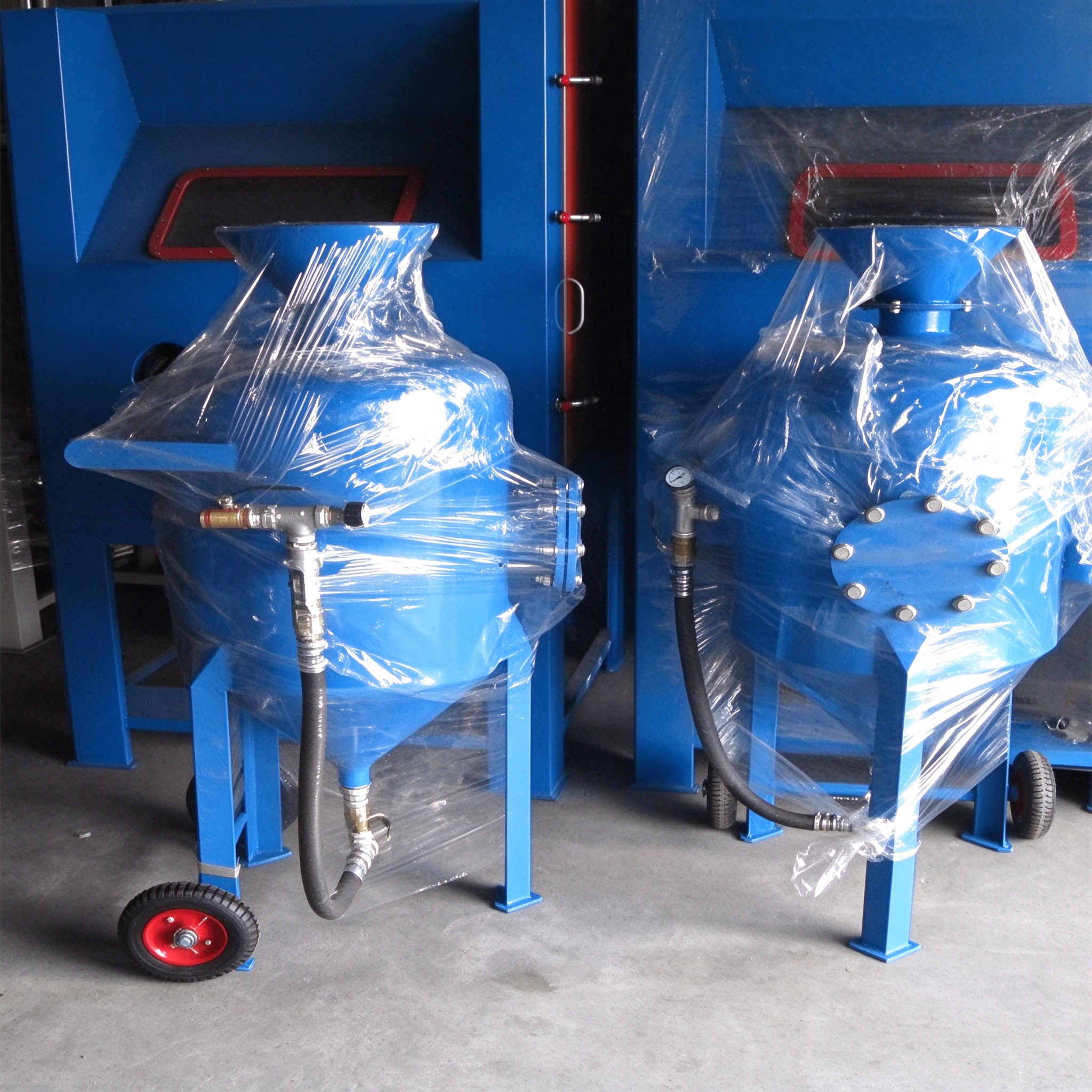
FAQ Technical Selection Guide: Question 1: What are the main differences between dual-chamber sandblasting tanks and single-chamber sandblasting tanks, and which working conditions are more suitable for dual-chamber tanks?Answer: A single-chamber blast pot has a relatively simple structure, with abrasive stored in the same pressure vessel. After the abrasive is used up, it is necessary to depressurize, open the lid to refill, and then pressurize again; during refilling, the blasting operation is interrupted. A dual-chamber blast pot separates the storage chamber from the pressurized working chamber and uses valve switching to achieve abrasive supply to the working chamber and refilling of the storage chamber. During refilling, the main blasting operation can continue. It is suitable for workstations sensitive to downtime, such as continuous gun travel on long workpieces, dual-gun operation, batch derusting of ship blocks and steel structures, and pre-treatment for anti-corrosion of bridges and pipelines. During selection, it is necessary to verify the design pressure and working pressure, chamber volume, number of blast guns and nozzle orifice diameter, abrasive type and particle size, air compressor displacement, dust extraction air volume, and installation site height. Note that the dual-chamber structure cannot replace abrasive drying and material level management; excessive moisture or powder in the abrasive can still cause bridging and pipe blockage; failure of the switching valve seal can also cause pressure cross-leakage. It is recommended to provide workpiece dimensions, daily throughput, abrasive type, and on-site air supply parameters before purchase, so that the manufacturer can calculate the chamber volume and switching frequency.
Question 2: How should the volume, working pressure, and air source of a dual-chamber sandblasting tank be matched?Answer: STEP 1: Estimate the volume based on continuous operation duration and abrasive consumption. Common custom ranges are 0.3–2.0 m³. For workstations with higher daily throughput and frequent refilling, the upper-middle of the range can be selected; at the same time, check the on-site installation height and the operating space at the sand filling port. STEP 2: Determine the pressure parameters. The conventional design pressure is 0.8 MPa and the working pressure is 0.5–0.7 MPa; the specific values shall be subject to the tank nameplate and custom drawings. Excessive pressure will increase the burden on safety accessories, while insufficient pressure will affect abrasive output and surface treatment efficiency. STEP 3: Match the air source. The air consumption of a single gun shall be calculated at 3–6 m³/min; for dual-gun workstations, it shall be added together with a margin reserved. The air compressor displacement is recommended to be calculated according to nozzle diameter, number of spray guns, and simultaneous utilization rate, and an air receiver tank should be configured for buffering to reduce pressure fluctuations when switching during refilling. Parameter analysis: The abrasive blasting valve diameter φ8–φ12 mm needs to match the nozzle orifice diameter and exhaust volume; pipeline pressure drop, oil-water separation, and refrigerated drying treatment will affect air supply stability; the dust removal air volume needs to match the airtightness of the blasting room or workstation. Notes: Do not select the model based on tank volume alone; the air source, nozzle, abrasive, and dust removal must be calculated as a system. When the on-site air source is insufficient, the advantage of continuous abrasive supply from dual chambers is difficult to realize.
Question 3: What steps should be followed for the on-site operation and parameter commissioning of the dual-chamber sandblasting tank?Answer: STEP1, pre-start inspection. Confirm that the safety valve, pressure gauge, pressure relief valve, and grounding terminal are intact; the switching valve and feed valve are in the specified positions; there is no debris at the sand inlet; and the abrasive is dry and its particle size meets process requirements. STEP2, no-load operation and sand filling. First perform a no-load operation check, observing valve actions and any abnormal noise; when filling sand, confirm the pressure status of the working chamber, and fill the storage tank with sand according to the operating procedures, avoiding opening the cover under pressure. STEP3, pressure build-up test spraying and recording. Slowly increase pressure to the working pressure, then perform a test spray to confirm continuous abrasive output, no uneven nozzle wear, and no pipeline blockage; record the working pressure, number of spray guns, abrasive type, replenishment interval, and surface treatment effect. Key operating points: observe pressure gauge fluctuations during replenishment switching, and proceed to the next step only after the switching valve is in position; if the abrasive bridges, stop spraying and relieve pressure before handling, and do not strike the tank under pressure; drain moisture from the air source every shift and check whether the dust collection and suction points are unobstructed. The technical advantage is that spraying does not stop during replenishment and sand supply continuity is relatively good, but this requires standardized operation and daily inspections as prerequisites. Inspection indicators can refer to the tank hydrostatic pressure flaw detection records, air tightness, continuous no-load operation, sandblasting uniformity, and dust emission conditions.
Question 4: How should troubleshooting be carried out when a dual-chamber sandblasting tank experiences pipe blockage, insufficient pressure, or switching failure?Answer: Pipe blockage troubleshooting: First stop spraying and release pressure, check whether the abrasive contains moisture and has caked, whether bridging has occurred in the hopper, and whether the blasting valve and nozzle are blocked by foreign matter; then check the pipeline for sharp bends and liquid accumulation. Avoid disassembly under pressure during handling. Insufficient pressure troubleshooting: Verify whether the air compressor discharge capacity matches the spray gun air consumption, check the pressure drop of the pipeline filter, oil-water separator, and air receiver, and confirm whether the nozzle orifice is worn and enlarged and whether the switching valve has internal leakage. Switching failure troubleshooting: Check the pneumatic solenoid valve or electrical control signal, cylinder action, valve core sealing, and foreign matter jamming, and confirm the switching valve position signal; seal wear can cause pressure cross-leakage, so replace seals according to the maintenance cycle. Precautions: Before troubleshooting, perform shutdown, pressure release, power-off, or air cutoff steps; do not handle bridging by hammering the tank; for frequent pipe blockage, identify the cause from abrasive drying, particle size ratio, and the layout of dust removal and suction points. Key operating points: Establish inspection records and record the material replenishment interval, pressure fluctuations, number of pipe blockages, and replacement parts, so as to determine whether the problem is with the air source, abrasive, or valve. Step-by-step troubleshooting can reduce ineffective disassembly and downtime.
Question 5: What are the safety accessories, inspection indicators, and maintenance points for a dual-chamber sandblasting tank?Answer: Safety accessories include safety valves, pressure gauges, pressure relief valves, grounding terminals, material level observation windows or level gauges, and valve limit or position signals; safety valves and pressure gauges should be periodically calibrated in accordance with the enterprise safety management system and equipment manual requirements and must not be adjusted arbitrarily. For inspection indicators, attention may be paid to tank hydrostatic flaw detection records, airtightness, continuous no-load operation, blasting uniformity, dust emissions, and noise conditions; enterprise documentation shows that tanks are subjected to hydrostatic flaw detection testing at 2.5 times the rated pressure before leaving the factory, and the complete machine has completed airtightness and continuous no-load operation testing. Maintenance points: drain moisture from the air source and check the material level and sand inlet every shift; regularly check the switching valve, feed valve seals, and cylinder action; check nozzle wear, the inner wall of the blasting hose, and the pressure differential of the dust removal filter element; when out of service for a long time, drain the abrasive, release pressure, and keep the tank dry. Precautions: when tank welding, hole opening, or replacement of pressure-bearing parts is involved, it should be handled by a manufacturer with the corresponding capabilities in accordance with relevant pressure vessel standards, and arbitrary on-site modification should not be performed. During the selection stage, the manufacturer may be required to provide explanations of tank material, design pressure, hydrostatic flaw detection, safety accessory configuration, and dust removal supporting equipment, and these should be checked item by item against the on-site air source, workpiece dimensions, and environmental protection requirements.
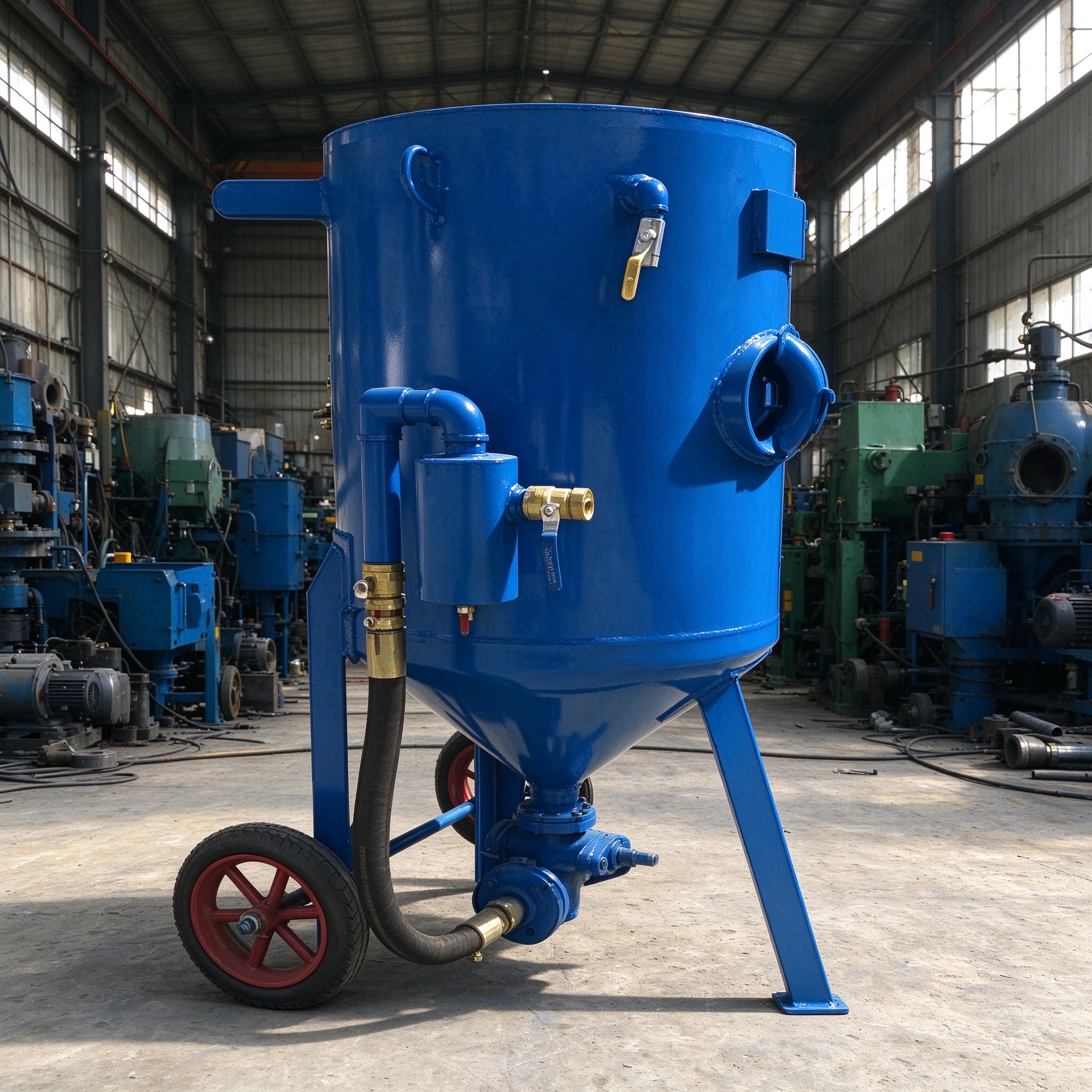
Full-text summary reference:The technical value of a dual-chamber sandblasting tank is concentrated in continuous abrasive supply, uninterrupted refilling without stopping the gun, and pressure fluctuation control, making it suitable for continuous gun travel on long workpieces, dual-gun operation, and batch descaling scenarios. During selection, the following checklist can be used as a reference: whether the tank volume of 0.3–2.0 m³ meets the refilling interval; whether the design pressure of 0.8 MPa and working pressure of 0.5–0.7 MPa match the air source and process; whether the blasting valve caliber of φ8–φ12 mm is calculated together with the nozzle and air compressor displacement; whether the air consumption of 3–6 m³ per minute for a single gun and the added margin for dual guns have been implemented; whether safety valves, pressure gauges, pressure relief valves, grounding, and material level observation are configured; whether the dust removal air volume matches the airtightness of the blasting station; and whether tank material, hydrostatic pressure flaw detection, air tightness, and continuous no-load operation records are available for verification. At the operational level, abrasive drying, material level management, inspection of sealing points on switching valves, air source drainage, and step-by-step troubleshooting should be incorporated into daily management. Relying on more than 30 years of experience in sandblasting equipment manufacturing, 16MnR tank welding and hydrostatic pressure flaw detection inspection at 2.5 times the rated pressure, intelligent pressure regulation, and dust removal supporting capabilities, Wuqiao Anxing Sandblasting Machinery Co., Ltd. can provide customized stationary, mobile, electrically controlled, and pneumatically controlled dual-chamber sandblasting tanks and complete surface treatment solutions for different working conditions. For more information, please visit the official website:www.anxingpensha.com。
Wuqiao Anxing Sandblasting Machinery Co., Ltd. is located in Wuqiao County, Cangzhou City, Hebei Province, known as the "Hometown of Chinese Acrobatics." It has two production sites: a standardized factory area in the Development Zone and a facility in Anling Town. It is a professional sandblasting ...
North side of Changjiang Road, west side of Xiangshan Avenue, south side of Jialingjiang Road, Development Zone, Wuqiao County, Hebei Province