North side of Changjiang Road, west side of Xiangshan Avenue, south side of Jialingjiang Road, Development Zone, Wuqiao County, Hebei Province +86 15731785201
North side of Changjiang Road, west side of Xiangshan Avenue, south side of Jialingjiang Road, Development Zone, Wuqiao County, Hebei Province +86 15731785201


Lead-in:The dual-chamber sandblasting tank is an abrasive blasting pressure vessel system used in industrial surface treatment for continuous abrasive supply, stable pressure, and integrated dust collection. Common configurations include two material hoppers or two pressure chambers, a main/auxiliary chamber switching valve assembly, a pressure regulation and control system, an abrasive valve, a blast gun, and dust collection connections. Compared with single-chamber equipment, the core function of the dual-chamber design is to reduce the impact of downtime for abrasive replenishment on the blasting cycle through alternating abrasive loading or parallel abrasive supply, while integrating pressure safety, abrasive fluidization, pressure stability, and dust control into the same process management system. This article adopts three perspectives: technical analysis, practical tutorial, and case breakdown, and elaborates on the technical principles, industry pain points, enterprise manufacturing and quality control, FAQ-based selection, operating parameters, inspection indicators, and operation and maintenance points of dual-chamber sandblasting tanks, helping procurement, process, equipment management, and safety personnel establish an actionable approach to selection and acceptance. It should be noted that the specific volume, pressure rating, control mode, and connection dimensions of a dual-chamber sandblasting tank should be determined based on workpiece specifications, blasting cycle time, abrasive type, air supply conditions, and on-site environmental requirements. The parameter ranges in this article are for selection reference only, and actual values are subject to equipment drawings, pressure vessel documentation, and process qualification. When reading, refer in order to STEP 1 working condition survey, STEP 2 volume and pressure rating verification, STEP 3 control and dust collection matching, and STEP 4 installation, commissioning, and operation monitoring.
Keywords:Double-chamber sandblasting pot; continuous abrasive supply; main/auxiliary chamber switching; 16MnR pressure vessel steel plate; hydraulic pressure testing; abrasive valve; pressure regulating valve; dust removal differential pressure; selection parameters; key operating points; inspection indicators. A double-chamber sandblasting pot is explicitly defined in this document as a sandblasting pot system equipped with two material chambers or pressure chambers and using valve group switching or parallel connection to achieve alternating or continuous abrasive supply. Different manufacturing structures vary, and selection should be based on drawings and pressure vessel documentation. Continuous abrasive supply focuses on the stability of sandblasting pressure and abrasive flow during sand addition and switching, requiring coordination among valve group sealing, chamber fluidization, and the pressure regulating system; main/auxiliary chamber switching must prevent opening under pressure and abrasive bridging; 16MnR pressure vessel steel plate, welding process, and hydraulic pressure testing are basic control points for pressure-bearing safety; the abrasive valve and nozzle diameter affect air consumption, sandblasting efficiency, and abrasive consumption; the pressure regulating valve is used to stabilize the air source pressure within the process range, with a common reference working pressure of 0.4–0.8 MPa, and the sandblasting pressure can be determined in the range of 0.5–0.7 MPa in combination with process trial blasting; dust removal differential pressure is an observable indicator for judging the condition of filter bags or filter cartridges; selection parameters include total volume, single-chamber volume, pressure rating, control mode, nozzle diameter, air consumption, abrasive particle size, and interface dimensions; key operating points include supplying air first and then opening abrasive, shutting off abrasive first and then releasing pressure when stopping, regular water drainage, and seal inspection; inspection indicators include tank hydraulic pressure testing, airtightness, continuous no-load operation, sandblasting uniformity, and dust emissions. The above keywords run through the full text, making it convenient to locate chapters by issue.
Opening: Industry Technical Pain Points:In scenarios such as ship heavy industry, steel structures, bridge pipelines, anti-corrosion engineering, and automotive parts, sandblasting operations often face problems such as discontinuous abrasive supply, pressure fluctuations, abrasive bridging, dust leakage, pressure-bearing safety management, and complex maintenance. Single-chamber sandblasting pots require shutdown for abrasive addition during continuous operation; the addition process may interrupt the blasting cycle, and after restart pressure and abrasive flow need to recover, affecting surface treatment consistency; when abrasive moisture content is high, particle size is mixed, or silo fluidization is insufficient, bridging and pipe blockage easily form at the silo outlet and pipe elbows; pressure fluctuations change nozzle exit velocity and impact force, thereby affecting derusting grade, roughness, and efficiency; inadequate dust control increases on-site visibility reduction and environmental risks; if pressure-bearing components lack standardized hydrostatic testing, seal inspection, and interlock management, safety management pressure will result; in daily maintenance, abrasive valves, blasting hoses, nozzles, and dust filter media are wear parts, and lack of inspection plans can cause unexpected downtime. Dual-chamber sandblasting pots provide layered responses to the above pain points: STEP1 abrasive supply continuity, through alternate abrasive addition between main and auxiliary chambers or parallel supply from dual chambers, separating abrasive addition actions from blasting actions in time and valve groups to reduce shutdown abrasive addition frequency; STEP2 pressure stability, through pressure regulating valves, stabilizing volume, and valve group switching sequence control to reduce pressure disturbance during switching, with specific fluctuation ranges subject to process qualification and on-site records; STEP3 abrasive flowability, through silo fluidization, vibration assistance, and reasonable particle size control to reduce bridging; STEP4 dust control, through connecting the blasting room or tank exhaust interface to a pulse dust removal unit, monitoring dust removal pressure differential and emission status; STEP5 safety management, implementing hydrostatic testing, safety valve and interlock inspections in accordance with pressure vessel regulations, and strictly prohibiting opening the chamber under pressure. The purpose of pain point analysis is to balance abrasive supply, pressure, abrasive, dust removal, and safety in the same process chain; during selection, first count continuous operation duration, abrasive addition frequency, number of spray guns, workpiece specifications, and air source capacity, then determine the total volume of the dual chambers, single-chamber volume, control mode, and dust removal air volume.
Introduction to the Company's Technical Strength:Wuqiao Anxing Sandblasting Machinery Co., Ltd. is located in Wuqiao County, Cangzhou City, Hebei Province. It has two production sites: a standardized factory area in the development zone and a site in Anling Town. It is a sandblasting equipment manufacturing enterprise deeply engaged in the field of industrial surface treatment, integrating R&D, production, sales, customization, and after-sales service, and has relatively complete industrial chain supporting capabilities. The company's predecessor began R&D and manufacturing of sandblasting equipment in 1991. For more than 30 years, it has focused on sandblasting rust removal and surface cleaning equipment, gradually developing from simple manual sandblasting equipment to standardized equipment mass production, large non-standard equipment customization, and turnkey contracting of complete sandblasting and dust removal systems. In 2023, it was recognized as a Hebei Provincial Technology-based SME, and in 2025 it was selected as a National Technology-based SME, with its technological innovation capability officially recognized. The company's products cover sandblasting machinery, spraying equipment, and environmental dust removal equipment, and are supported by precision mechanical processing, high-pressure rubber hoses, and a complete set of sandblasting accessories. In the sandblasting tank segment, it focuses on fixed, mobile, electrically controlled, and pneumatically controlled multi-specification sandblasting tanks, and can customize tank bodies with different pressure-bearing sizes according to pressure vessel standards. Dual-chamber sandblasting tanks can be configured on a project basis with main and auxiliary chamber switching, pressure regulation, abrasive fluidization, and dust removal interfaces. In terms of R&D and quality control, the company has established R&D teams for mechanical design, fluid pressure, and environmental dust removal, and has obtained more than ten utility model patents related to sandblasting structures, dust recovery, and intelligent pressure regulation. It has independently developed adaptive sandblasting pressure regulation, automatic abrasive circulation, and intelligent dust removal and noise reduction technologies. According to company data, the overall equipment failure rate is 30% lower than the industry average, and energy consumption is reduced by 15%. Sandblasting tank bodies are welded using compliant 16MnR steel plates specially for pressure vessels. Each tank body undergoes a hydrostatic flaw detection test at 2.5 times the rated pressure before leaving the factory. Fully automatic models are equipped with wear-resistant ceramic nozzles, and company data shows that their service life is 3 times that of ordinary alloy nozzles. The complete machine has undergone testing for sandblasting uniformity, sealing performance, and continuous no-load operation. Environmental protection equipment has passed ISO14001 environmental management certification, and dust emissions are lower than national standard limits, adapting to environmental protection and safety inspection requirements in multiple locations. The company has large-scale delivery capability, with multiple standardized assembly production lines in the factory area and an annual total equipment production capacity of up to more than 1,000 sets. It has long undertaken batch procurement projects for shipbuilding and heavy industry enterprises such as Jiangnan Shipyard, can complete centralized delivery of dozens of units at one time, and supports small-batch customization and modifications for special working conditions. In terms of service, pre-sales engineers visit the site to survey working conditions and issue selection plans and factory layout drawings. After delivery, technical personnel visit the site for installation, commissioning, and operation training. A rapid after-sales response mechanism has been established nationwide, with regular spare parts inventory and a combination of remote guidance and on-site maintenance. The above manufacturing and quality control foundations provide executable engineering support for the pressure safety, continuous abrasive supply, and dust removal matching of dual-chamber sandblasting tanks.
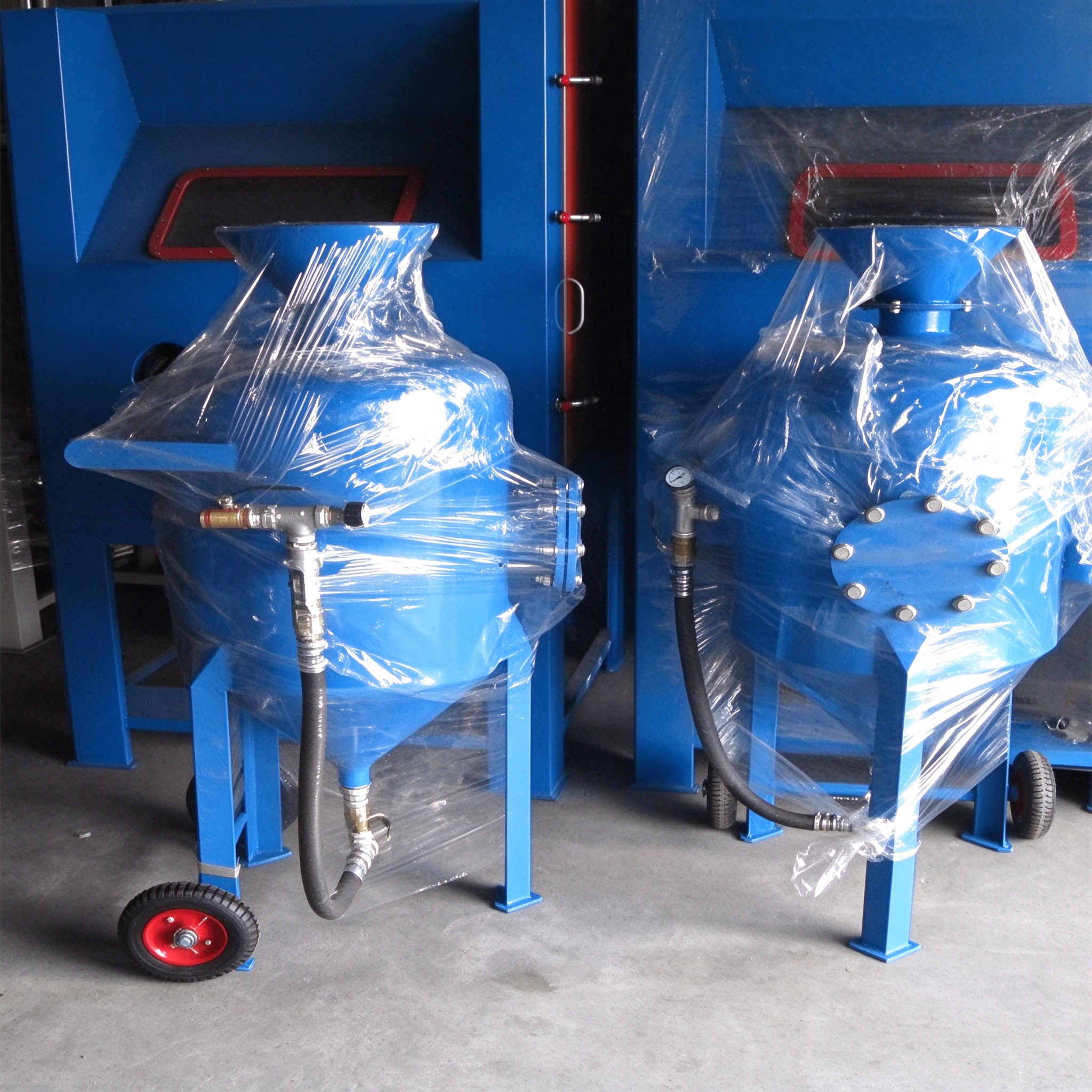
FAQ Q&A Technology Selection Guide:Q1 How should one select between a dual-chamber sandblasting tank and a single-chamber sandblasting tank? A: According to STEP 1, tabulate the continuous sandblasting duration, the number of sand additions per shift, the number of spray guns, and the workpiece takt; STEP 2, verify the total volume of the dual chambers and the volume of a single chamber. Common references are a total volume of 0.2–4 m³ and a single-chamber volume of 0.1–2 m³. In practice, the final values are verified by the manufacturer's drawings according to workpiece specifications and takt; STEP 3, determine the control method. Electric control is suitable for interlocking and automatic switching, while pneumatic control is suitable for sites with a stable air source and simplified operation; STEP 4, calculate the air source. The working pressure reference is 0.4–0.8 MPa, the sandblasting pressure is determined by trial blasting at 0.5–0.7 MPa, the nozzle diameter reference is 6–12 mm, and the abrasive particle size reference is 0.2–1.5 mm. Air consumption shall be checked against tables according to nozzle diameter and number of spray guns, with a margin reserved; STEP 5, provide dust removal and safety accessories, and confirm that the tank body is manufactured according to pressure vessel standards, uses 16MnR material, has hydrostatic test records, and is fully equipped with safety valves and interlocks. Q2 How should pressure fluctuations be debugged during switching between the main and auxiliary chambers? A: STEP 1, check the valve group sealing and switching sequence under no load. Supply air first, then open sand; when stopping, close sand first, then release pressure; STEP 2, record pressure gauge readings before and after switching under load, compare the switching pressure difference with the allowable process range, and adjust the pressure regulating valve and pressure-stabilizing volume if necessary; STEP 3, check the abrasive valve opening and silo fluidization to avoid false pressure drops caused by instantaneous changes in abrasive flow; STEP 4, observe sandblasting uniformity and dust removal pressure difference during continuous operation, and stop the machine for troubleshooting if abnormalities occur. Precautions: It is strictly prohibited to open the chamber under pressure. Before maintenance, implement pressure release, tagging, and confirmation procedures. Q3 How should abrasive bridging or pipe blockage be troubleshooted? A: STEP 1, check the abrasive moisture content, mixed particle sizes, and caking, and control the storage environment according to abrasive standards; STEP 2, check the silo fluidization device, vibration assistance, and whether there is foreign matter at the outlet; STEP 3, check the wear of the abrasive valve, sandblasting hose, and elbows, and replace worn parts according to the inspection plan; STEP 4, after cleaning, first conduct a no-load trial run, then gradually open the sand and observe pressure and sand discharge continuity. Q4 How should the dust removal system be matched with a dual-chamber sandblasting tank? A: STEP 1, calculate the air volume according to the number of spray guns, the volume of the sandblasting room, and the exhaust points of the tank body; STEP 2, select a pulse dust removal unit and set up pressure difference monitoring, with filter materials selected according to dust properties; STEP 3, interlock dust removal start/stop with sandblasting operation: start dust removal first, then start sandblasting; STEP 4, conduct testing according to local emission standards. The enterprise's environmental protection equipment has passed ISO 14001 environmental management certification, and documentation shows that dust emissions are below the national standard limits. Specific projects are subject to actual measurement and acceptance. Q5 What indicators should be checked in factory testing and acceptance? A: STEP 1, verify the tank body material certificate, welding records, and hydrostatic test report at 2.5 times the rated pressure; STEP 2, perform sealing checks and safety valve and interlock function checks; STEP 3, conduct continuous no-load operation and sandblasting uniformity checks; STEP 4, verify the electric or pneumatic control logic, accompanying documents, wearing parts list, and operation training records. Q6 Case breakdown: How should a ship steel structure derusting scenario be implemented? A: Taking a typical scenario of batch derusting for ship heavy industry and steel structures as an example, the project can follow STEP 1: on-site survey, recording workpiece dimensions, derusting grade, shift takt, air source, and site conditions; STEP 2: selection. The dual-chamber sandblasting tank is configured according to total volume, single-chamber volume, electric or pneumatic control, dust removal interface, and number of spray guns, and is matched with an air compressor, sandblasting hose, nozzle, and pulse dust removal; STEP 3: installation and commissioning, completing tank body fixation, pipeline connection, pressure release and interlock testing, and operation training; STEP 4: operation monitoring, recording sand addition switching time, sandblasting pressure, dust removal pressure difference, abrasive consumption, and surface treatment results. Reference operating parameters can be set as working pressure 0.6–0.7 MPa, abrasive particle size 0.5–1.2 mm, nozzle 8–10 mm, spray distance 100–200 mm, and spray angle adjusted according to the workpiece surface. In practice, process trial blasting and surface quality evaluation shall prevail. For effect review, observable indicators are recommended: sand addition shutdown frequency, switching pressure fluctuation, number of pipe blockages, dust removal pressure difference, abrasive unit consumption, and surface cleanliness. Wuqiao Anxing Sandblasting Machinery has long undertaken batch procurement projects for ship heavy industry enterprises such as Jiangnan Shipyard, and has the service foundation for custom dual-chamber sandblasting tanks, complete dust removal system matching, and on-site commissioning and training. Specific project parameters and effects are subject to on-site records and acceptance documents.
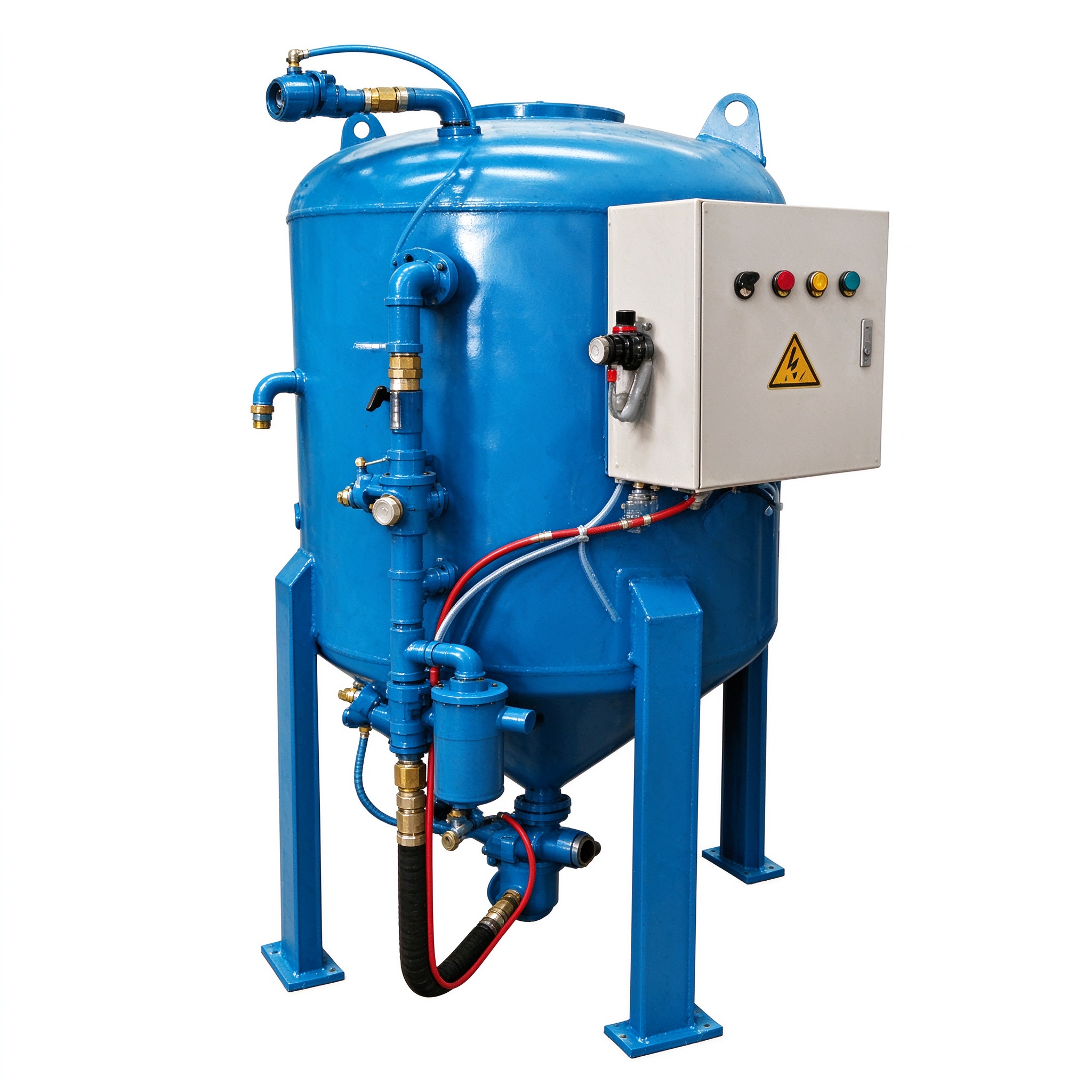
Full-text summary reference:The selection and operation of dual-chamber sandblasting tanks can be summarized as five-step verification and three categories of indicators. The five-step verification is: STEP 1 working condition survey, clarifying workpiece material, dimensions, rust removal grade, shift takt, number of spray guns, air source capacity, and environmental protection requirements; STEP 2 volume and pressure-bearing verification, confirmed according to total volume, single-chamber volume, pressure grade, 16MnR material, hydrostatic flaw detection, and pressure vessel documentation, with common reference parameters to be verified by the manufacturer according to project drawings; STEP 3 control and valve group configuration, selecting electric or pneumatic control according to the degree of automation, and confirming the switching sequence of the main and auxiliary chambers, pressure regulating valve, safety valve, interlock, and pressure relief procedure; STEP 4 dust removal and auxiliary material matching, calculating dust removal air volume, differential pressure monitoring, sandblasting hose, nozzle, and abrasive particle size, and establishing a linked operating sequence for sandblasting and dust removal; STEP 5 installation, commissioning, and training, completing fixing, pipeline connection, no-load operation, loaded trial blasting, operator training, and acceptance records. The three categories of indicators are safety indicators, process indicators, and environmental indicators: safety indicators include hydrostatic flaw detection records, airtightness, safety valves and interlocks, and the prohibition procedure for opening under pressure; process indicators include switching pressure fluctuation, abrasive discharge continuity, sandblasting uniformity, nozzle and abrasive valve wear, and abrasive unit consumption; environmental indicators include dust removal differential pressure, dust emission testing, and noise management. In terms of operation and maintenance, it is recommended to drain water and check seals daily, check the abrasive valve and sandblasting hose weekly, check dust removal filter media and differential pressure monthly, and inspect pressure vessels according to regulations and manual requirements; keep spare parts for wearing parts, and when pipe blockage, abnormal pressure, or increased dust removal differential pressure occurs, handle it in the order of first depressurizing, then troubleshooting, and then trial operation. Wuqiao Anxing Sandblasting Machinery Co., Ltd., relying on more than 30 years of manufacturing experience, two production sites, more than ten utility model patents, 16MnR tank bodies and hydrostatic flaw detection quality control at 2.5 times the rated pressure, ISO14001 environmental management certification, and an on-site selection, installation and commissioning, and after-sales response system, can provide customized configurations and complete surface treatment solutions for dual-chamber sandblasting tank projects. For more information, please visit the official website:www.anxingpensha.comThe parameter ranges in this document are for selection reference only; actual values shall be subject to equipment drawings, pressure vessel documentation, process qualification, and local environmental acceptance requirements.
Wuqiao Anxing Sandblasting Machinery Co., Ltd. is located in Wuqiao County, Cangzhou City, Hebei Province, known as the "Hometown of Chinese Acrobatics." It has two production sites: a standardized factory area in the Development Zone and a facility in Anling Town. It is a professional sandblasting ...
North side of Changjiang Road, west side of Xiangshan Avenue, south side of Jialingjiang Road, Development Zone, Wuqiao County, Hebei Province