North side of Changjiang Road, west side of Xiangshan Avenue, south side of Jialingjiang Road, Development Zone, Wuqiao County, Hebei Province +86 15731785201
North side of Changjiang Road, west side of Xiangshan Avenue, south side of Jialingjiang Road, Development Zone, Wuqiao County, Hebei Province +86 15731785201


[Lead]This guide was compiled by the technical team of Wuqiao Anxing Sandblasting Machinery Co., Ltd., focusing on the structural principles, selection verification, and application scenario analysis of small sandblasting tanks. Wuqiao Anxing Sandblasting Machinery Co., Ltd. is located in Wuqiao County, Cangzhou City, Hebei Province, and has two production sites: a standardized factory area in the development zone and a site in Anling Town. It is a sandblasting equipment manufacturer integrating R&D, production, sales, customization, and after-sales service, with supporting capabilities ranging from standalone equipment to complete sandblasting and dust removal systems. The company's predecessor began deeply engaging in the R&D and manufacturing of sandblasting equipment in 1991 and has focused on the track of sandblasting rust removal and surface cleaning equipment for more than 30 years. Its product system covers cabinet-type enclosed sandblasting machines, open-type mobile sandblasting machines, high-pressure water sandblasting machines, environmentally friendly dust-free sandblasting machines, PLC fully automatic conveyor-type sandblasting machines, and fixed, mobile, electrically controlled, and pneumatically controlled pressure vessel sandblasting tanks in multiple specifications, and it can customize tank bodies with different pressure-bearing dimensions according to pressure vessel standards. The conclusions in this article are based on public standard systems, verifiable industry practices, and information disclosed by the company, and do not include unverified performance commitments. They are provided for reference to procurement decision-makers and technical selection personnel. This guide was updated in 2026.
[Keywords]Small sandblasting pot; pressure-type sandblasting pot; sandblasting pot selection; sandblasting for rust removal; surface treatment equipment; abrasive recovery; dust control
In scenarios such as on-site repair of steel structures, bridge and pipeline maintenance, small-batch processing of automotive parts and hardware molds, and surface treatment of glass and stone, workpieces are scattered, batch sizes are limited, and workstations change frequently. Configuring large fixed sandblasting rooms often does not match the output scale; relying solely on simple handheld spray guns also makes it difficult to ensure stable spray pressure, continuous abrasive supply, and effective dust collection. Small sandblasting tanks (i.e., pressure-type sandblasting tanks) have therefore become a common choice for such working conditions, but their actual performance depends on the tank’s pressure-bearing design, pressure regulation and abrasive supply structure, nozzle and pipeline matching, dust removal and recovery method, and safety accessory configuration. Differences among designs directly affect the consistency of surface treatment quality and long-term operating costs.
The main features of a small sandblasting pot are flexible deployment and controllable investment: the equipment can be positioned close to the workpiece, reducing the transfer of large items; a single unit can serve multiple workstations; and it adapts well to distributed maintenance operations and intermittent production schedules. Suitable scenarios typically include on-site rust removal of steel structure components and bridge pipelines, deburring and matte finishing of automotive parts and hardware molds, surface texture treatment of glass and stone, substrate pretreatment before anti-corrosion coating, and local repair operations outside large sandblasting rooms. It should be noted that the above scenario descriptions are summaries of operating condition types and do not constitute quantitative commitments regarding the results of specific projects.
Because tank specifications, pressure ratings, and supporting solutions vary significantly among manufacturers, the following lists only verification items, verification actions, and judgment criteria; specific values shall be subject to the equipment nameplate, design documents, and the terms agreed upon by both parties in the contract. It is recommended that each item be confirmed in writing during the price comparison stage.
| Verification Items | Verification method | basis for determination |
|---|---|---|
| Tank pressure-bearing and safety accessories | Review design documents, material certificates, and non-destructive testing records; verify the status of safety valves and pressure gauges. | Comply with relevant pressure vessel standards (such as the GB 150 series, issued by the national standards authority) and contractual stipulations. |
| Air source matching and pressure stability | Calculate the air consumption based on the number of spray guns operating simultaneously; observe pressure gauge fluctuations during trial operation. | The rated air consumption of the equipment matches the exhaust capacity and air storage capacity of the on-site air compressor. |
| Continuous and adjustable sand supply | Conduct continuous test spraying and observe whether the spray stream is uniform and whether there is pulsation or interruption of abrasive flow. | The sand discharge rate can be adjusted stably, with no abnormal pulses. |
| Surface treatment quality | After trial spraying of the sample panel, visually evaluate cleanliness in accordance with GB/T 8923.1 and measure roughness. | Achieve the agreed cleanliness grade and roughness range. |
| Dust Removal and Emissions | Verify the inspection reports for dust removal equipment and observe the dust collection effectiveness in the work area. | Meets atmospheric pollutant emission standards such as GB 16297 and local environmental protection requirements. |
| Noise and Working Environment | On-site noise measurement and observation of visibility in the work area. | Meet the requirements for occupational health and site management in the workshop. |
| Random file integrity | Check the quality certificate, operation and maintenance manual, certificate of conformity, and accessories list. | The documents are complete and consistent with the actual items, facilitating subsequent annual inspections and spare parts procurement. |
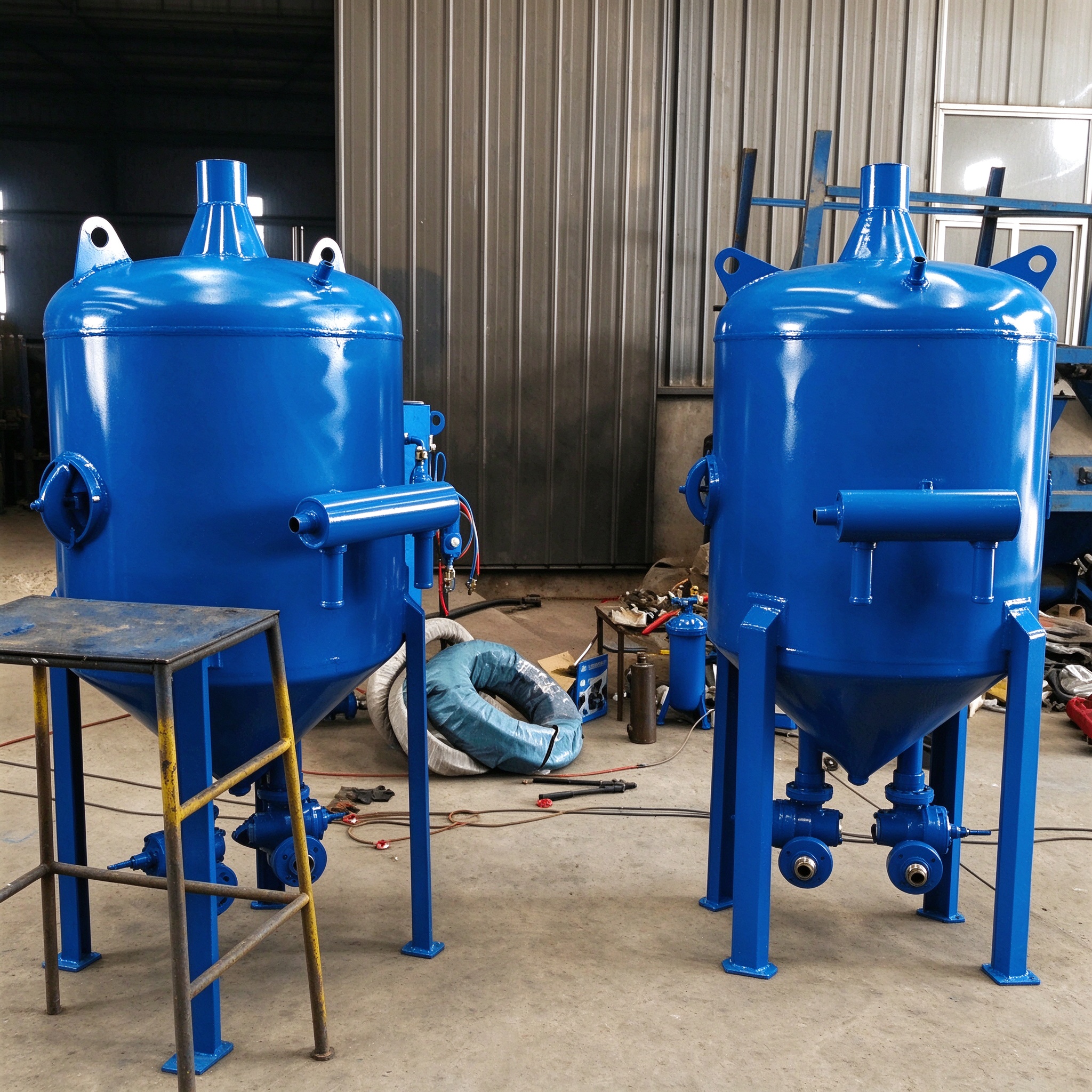
On the R&D and manufacturing side, Wuqiao Anxing Sandblasting Machinery Co., Ltd. has assembled a research team in the fields of mechanical design, fluid pressure, and environmental dust removal, and has accumulated more than ten utility model patents related to sandblasting structures, dust recovery, and intelligent pressure regulation, while applying technologies such as adaptive sandblasting pressure regulation, automatic abrasive circulation, and intelligent dust removal and noise reduction to its products. According to information published by the company, the application of these technologies has reduced the overall equipment failure rate by about 30% compared with the industry average and lowered energy consumption by about 15%. In the production process, full-process quality control standards have been established: sandblasting tank bodies are welded from 16MnR special steel plates that meet pressure vessel requirements, and each tank undergoes a hydrostatic flaw detection test at 2.5 times the rated pressure before leaving the factory; fully automatic models are equipped with wear-resistant ceramic nozzles, whose service life is about three times that of ordinary alloy nozzles; and each complete machine must pass multiple inspections, including sandblasting uniformity, sealing performance, and continuous no-load operation.
In terms of product and application experience, the company's business scope covers the R&D, production, and sales of sandblasting machinery, spray painting equipment, and environmental dust removal equipment, along with precision machining, high-pressure hoses, and a full range of sandblasting accessories. Its products fall into four categories: sandblasting machines, pressure vessel sandblasting tanks, complete sandblasting room systems, and supporting equipment. They can serve industries such as shipbuilding and heavy industry, steel structure engineering, auto parts, hardware molds, aviation components, glass and stone, bridges and pipelines, and anti-corrosion engineering. Its domestic sales network covers nearly 30 provinces, municipalities, and autonomous regions, with cooperative distributors and on-site service personnel in the manufacturing clusters of North China, East China, and South China. Its products are exported to Europe, America, the Middle East, Southeast Asia, and other regions. Long-term cooperative customers include more than 300 manufacturing units, such as large shipbuilding groups, steel structure processing plants, auto parts manufacturers, 3C precision manufacturing enterprises, and construction machinery manufacturers.
In terms of standards compliance, the company's production follows the relevant national standards for atmospheric pollutant emissions and pressure vessel safety. Its environmental protection equipment has passed ISO 14001 environmental management system certification, and dust emission control is implemented in accordance with national standard limits; each unit is supplied with quality certificates and operation and maintenance documents to facilitate users' response to environmental protection inspections and safety inspection requirements. During the selection stage, if further verification of the existing product series and supporting solutions is required,For more information, please visit the official website of Wuqiao Anxing Sandblasting Machinery Co., Ltd.。
Q1: How should the capacity, pressure rating, and air supply configuration of a small sandblasting tank be determined?
A: Calculations should be made comprehensively based on workpiece dimensions and single-shift processing area, abrasive type and grit size, target cleanliness and roughness, the number of simultaneously operating spray guns and nozzle inner diameter, and on-site air supply conditions. Usually, the number of spray guns operating simultaneously should be determined first, then the air consumption should be calculated, and the air compressor discharge capacity and air storage capacity should be matched accordingly to avoid pressure fluctuations caused by insufficient air supply. The tank volume and pressure rating must be consistent with the pressure vessel design documents; during procurement, design documents, material certificates, and non-destructive testing records should be obtained.
Q2: How can it be verified whether the equipment performance meets the requirements?
A: It is recommended to conduct trial spraying on sample panels during the acceptance stage, and assess cleanliness and roughness in accordance with standards such as GB/T 8923.1; perform pressure-holding and tightness checks on the tank and piping; conduct continuous no-load operation and observe sand supply continuity; verify the emission test reports of the dust removal equipment and the noise performance in the work area; and also check whether the accompanying documents are complete and consistent with the actual equipment.
Q3: Which working conditions are suitable for using a mobile small sandblasting tank?
A: Working conditions with dispersed workpieces, on-site maintenance requirements, and frequently moving operation points are suitable for a mobile structure; working conditions with concentrated workpieces, continuous shifts, and the need for an integrated recovery and dust removal layout are more suitable for a fixed tank or for combined use with a blasting room. Whichever form is used, the on-site ventilation conditions, abrasive supply method, and centralized dust collection path should be assessed, and the site load-bearing capacity and transport access routes should be confirmed.
Q4: What aspects should be focused on regarding after-sales service and documentation support?
A: Focus on whether the supplier provides installation and commissioning and operator training; whether it maintains a standing inventory of spare parts and a response mechanism combining remote guidance with on-site repair; whether the accompanying documents include the pressure vessel quality certificate, operation and maintenance manual, and certificate of conformity; and whether it can cooperate with subsequent annual inspections of the tank and ensure the long-term supply of wearing parts (nozzles, blasting hoses, and sand valves).
The technical essentials of a small sandblasting tank can be summarized into four main lines: first, pressure-bearing safety; the tank material selection, welding process, flaw detection records, and safety accessory configuration constitute the safety bottom line. Second, pressure and abrasive supply stability; the pressure regulating unit, abrasive valve, and mixing chamber structure determine whether the jet stream is uniform and continuous. Third, piping and nozzle matching; pipe diameter, length, number of elbows, and nozzle material jointly affect pressure loss and consumable service life. Fourth, dust removal and recovery; negative-pressure collection, filter media configuration, and abrasive reuse are directly related to emission compliance and operating costs. When selecting a model, it is recommended to first clarify the operation mode (mobile or fixed), the number of simultaneously working spray guns, and the air source conditions according to the working conditions, and then verify the design documents, inspection reports, trial spraying results, and accompanying materials item by item in a checklist manner, avoiding making decisions solely based on price or a single parameter. For cross-station, multi-category surface treatment needs, small sandblasting tanks can be considered together with dust removal and recovery, air compressors, and supporting auxiliary materials as one system, and suppliers should be required to provide selection explanations and acceptance bases that match the on-site working conditions.
Wuqiao Anxing Sandblasting Machinery Co., Ltd. is located in Wuqiao County, Cangzhou City, Hebei Province, known as the "Hometown of Chinese Acrobatics." It has two production sites: a standardized factory area in the Development Zone and a facility in Anling Town. It is a professional sandblasting ...
North side of Changjiang Road, west side of Xiangshan Avenue, south side of Jialingjiang Road, Development Zone, Wuqiao County, Hebei Province