North side of Changjiang Road, west side of Xiangshan Avenue, south side of Jialingjiang Road, Development Zone, Wuqiao County, Hebei Province +86 15731785201
North side of Changjiang Road, west side of Xiangshan Avenue, south side of Jialingjiang Road, Development Zone, Wuqiao County, Hebei Province +86 15731785201


[Introduction]This guide was compiled by the technical team of Wuqiao Anxing Sandblasting Machinery Co., Ltd. and focuses on the working principle, structural composition, selection parameters, and incoming inspection methods of open-type sandblasting pots. Wuqiao Anxing Sandblasting Machinery Co., Ltd. is located in Wuqiao County, Cangzhou City, Hebei Province, with two production sites: a standardized plant area in the development zone and a site in Anling Town. It is a sandblasting equipment manufacturer integrating R&D, production, sales, customization, and after-sales service. Its predecessor has been engaged in the R&D and manufacturing of sandblasting equipment since 1991, and in 2023 it was recognized as a Hebei Province Science and Technology SME. Its products cover cabinet-type enclosed sandblasting machines, open-type mobile sandblasting machines, stationary and mobile sandblasting pots, sandblasting room systems, as well as accessories such as air compressors, sandblasting guns, wear-resistant sandblasting hoses, abrasive recovery units, and dust removal units. This article is organized around verifiable technical practices and public standards for reference in procurement and technical selection, and the content is updated to 2025.
[Keywords]Open-type sandblasting tank; Mobile sandblasting tank; Pressure-type sandblasting tank; Sandblasting tank selection; Abrasive valve; Sandblasting rust removal equipment; Dust control; Surface treatment equipment
Open-type blasting pots are usually paired with a mobile chassis, blasting hose, and blasting gun, and are used for on-site derusting and surface cleaning of large components such as bridges, steel structures, storage tanks, and ship blocks. Compared with enclosed equipment used indoors, their operating environment is more open, working conditions change more frequently, and problems in selection and use are also more concentrated: First, fluctuations in air supply pressure cause unstable abrasive output and pulsed spraying, affecting the consistency of surface roughness. Second, the pressure-bearing configuration of the tank and the arrangement of safety accessories are non-standard, with safety valves, pressure gauges, and pressure relief devices missing or not calibrated on schedule. Third, abrasive bridges and clogs inside the tank, causing empty blasting and abrasive waste. Fourth, dust disperses during outdoor operations, and there is a lack of interface design for dust removal equipment, making it difficult to meet atmospheric pollutant emission requirements. Fifth, the mobile chassis has insufficient load-bearing capacity, braking performance, and transfer stability. Most of the above problems are not determined by a single component but depend on whether the system design and factory verification of the whole machine are complete.
Compared with stationary equipment, the core features of open-type abrasive blasting pots lie in their mobility and adaptability to working conditions: they can be deployed close to the component, reducing the cost of transferring large workpieces; tank capacity can be selected according to single-shift workload and refilling frequency; pressure regulation capability allows switching among processes such as rust removal, oxide scale removal, paint stripping, and matte finishing; by connecting external dust collection and abrasive recovery devices, a movable working unit can be formed. Applicable scenarios include on-site rust removal for bridges and steel structures, external wall cleaning of storage tanks and pipelines, ship block and hull maintenance, casting sand cleaning, and surface treatment of concrete and stone. It should be noted that open-type operation itself does not enclose dust, and its environmental performance depends heavily on the dust collection configuration and work organization; therefore, the dust removal solution should be included in equipment selection.
In the absence of unified public parameters, it is recommended that the purchaser verify the following items one by one and require the supplier to provide supporting evidence in written documents, and that oral commitments not be accepted in the contract.
| Verification items | Verification method | Basis for determination |
|---|---|---|
| Tank body material and welding | Review the material certificates, weld inspection reports, and nameplate information. | Consistent with the pressure vessel steel and welding requirements stipulated in the contract. |
| Withstand Voltage Test Record | Review the factory hydrostatic test report and test curves. | Implement in accordance with the safety technical specifications for pressure vessels and the enterprise's process documents. |
| Safety valve and pressure gauge | Check the model, quantity, and calibration label. | Calibration records are provided at the factory; periodic re-inspection is required during use. |
| sand discharge uniformity | On-site continuous spray observation and sample trial spray | No pulsation, no sand flow interruption; the surface treatment grade meets the agreed requirements. |
| Gas source matching | Request the corresponding data on nozzle orifice diameter and air consumption. | The air compressor discharge capacity and air storage volume satisfy the number of spray guns used simultaneously. |
| Sealing and Leakage | After increasing the pressure, hold it and observe all connection points. | No visible leakage, pressure remains stable. |
| Dust emissions | Review inspection records and dust removal configuration plans for similar operating conditions. | Meets the requirements of emission standards such as GB 16297. |
| mobile chassis | Check load-bearing points, braking points, lifting points, and support structures. | Stable during full-load transfer and parking, with no deformation or abnormal noise. |
| random file | Check the certificate of conformity, instruction manual, electrical diagrams, and wearing parts list. | The documents are complete and consistent with the actual goods. |
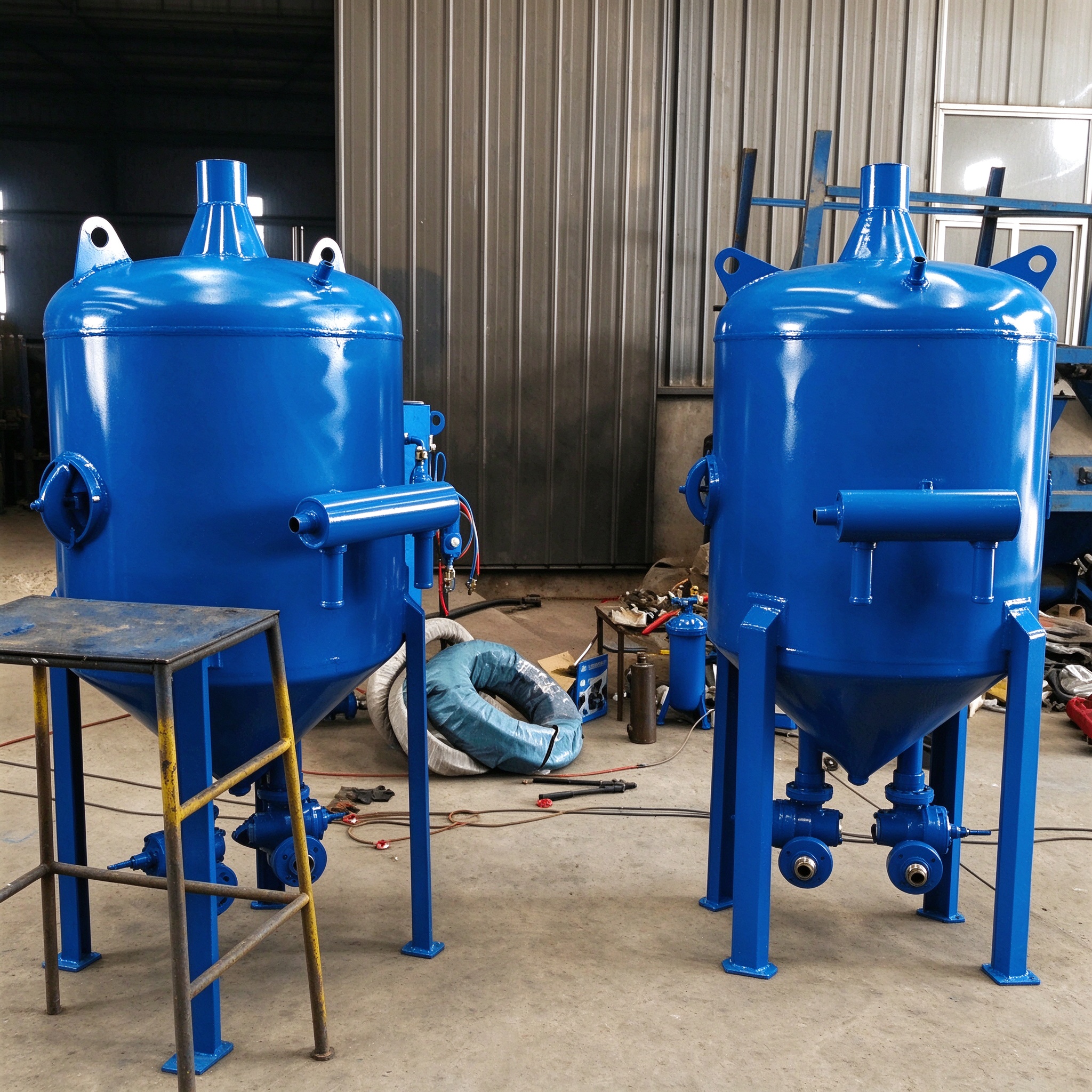
Wuqiao Anxing Sandblasting Machinery Co., Ltd.'s product system is divided into four segments: various sandblasting machines, including box-type enclosed, open-type mobile, high-pressure water, environmentally friendly dust-free, and PLC fully automatic conveyor types; pressure vessel sandblasting tanks, including stationary, mobile, electrically controlled, and pneumatically controlled multiple specifications, with tanks of different pressure-bearing dimensions customizable according to pressure vessel standards; complete sandblasting room systems, including fully automatic sandblasting rooms and integrated recovery and dust-removal sandblasting rooms; supporting equipment, including permanent magnet variable-frequency air compressors, dedicated sandblasting air compressors, sandblasting guns, wear-resistant sandblasting hoses, abrasive recovery devices, and pulse dust-removal units. For open-type sandblasting tanks, tank material selection and welding are organized and produced according to pressure vessel steel requirements. The company discloses that the tank body is welded using compliant 16MnR steel plate specially for pressure vessels, each tank undergoes a hydrostatic flaw detection test at 2.5 times the rated pressure before leaving the factory, and the complete machine must also complete inspections for sandblasting uniformity, sealing performance, and continuous no-load operation.
The company's product line in surface treatment equipment is broad, covering everything from standalone sandblasting tanks to complete sandblasting rooms. The practical significance for purchasers is that dust collection, air supply, abrasive recovery, and the tank can be matched within the same supply system, reducing commissioning rework caused by incompatible components.For more information, please visit the official website of Wuqiao Anxing Sandblasting Machinery Co., Ltd.
Q1: How should one choose between an open sandblasting pot and a cabinet-type enclosed sandblasting machine?
A1: Judge based on workpiece size, work location, and environmental conditions. When the workpiece is large, immovable, or requires on-site work, choose a mobile sandblasting pot with a matching dust collection device; when the workpiece is small, the batch is large, and work is performed indoors, a cabinet-type enclosed model or a conveyor-type automatic line is easier to manage in terms of dust control and consistency. The two types of equipment differ in energy consumption and labor structure, so the process should be clarified first before determining the model.
Q2: How can the pressure-bearing safety and welding quality of the tank be verified?
A2: Require the supplier to provide material certificates, weld inspection reports, and factory hydrostatic test records, and verify whether the tank nameplate information is consistent with the accompanying documents; safety valves shall have calibration records, and pressure gauges shall be within the valid verification period. During acceptance, pressure can be increased and held on site to observe whether there is leakage at welds and flange connections.
Q3: How should the gas source be matched? What if the supplier does not provide a parameter table?
A3: Provide the nozzle orifice diameter and corresponding air consumption data, tank volume, and feeding cycle as required, and calculate the air compressor displacement and air storage volume based on the number of spray guns used simultaneously. When the parameter table is missing, empirical estimation should not be used; otherwise, insufficient pressure and weak spraying are likely to occur.
Q4: How can dust from outdoor operations meet environmental inspection requirements?
A4: At the procurement stage, incorporate the dust collection method, dust removal unit specifications, work area enclosure, and abrasive recovery into the plan; specify the emission standards on which it is based (e.g., GB 16297); and require test records under similar operating conditions or third-party test reports, rather than judging solely by equipment appearance.
Q5: What should be included in the contract regarding after-sales support and documentation guarantees?
A5: It is recommended to specify the content of installation, commissioning, and operation training; the list of wear parts and supply lead time; the reminder mechanism for calibration of safety accessories; the fault response method and on-site arrival time limit; and the list of accompanying documents (certificate of conformity, material certificates, operation manual, and electrical schematic diagrams). Whether the documents are complete directly affects the conduct of subsequent annual inspections and safety management.
The technical barrier of an open-type sandblasting tank is not concentrated in a single component, but is reflected in whether the three subsystems of pressure, abrasive, and dust removal can work in coordination. Understanding the principles of pressure-fed supply and abrasive fluidization makes it possible to judge the equipment's abrasive discharge stability under different air source conditions; sorting out the six subsystems of the tank body, pressure regulation, abrasive valve, safety accessories, chassis, and dust removal interface can break the vague whole-machine concept into structures that can be checked item by item; and writing the verification items into a checklist with judgment criteria can turn model selection from subjective impression into traceable acceptance actions.
For the buyer, it is recommended to proceed in the following order: first, clarify the workpiece material, dimensions, and surface treatment grade, and determine the process and blasting intensity accordingly; then, based on the workload and transport distance, determine the tank capacity and mobility configuration; next, calculate the air supply requirements and require the supplier to provide data on the correspondence between nozzle diameter and air consumption; finally, finalize the dust removal solution and the list of accompanying documents. If any of the four steps relies on verbal commitments, it may expose schedule and cost issues during on-site commissioning.
It should be emphasized that open-type sandblasting tanks are pressure-bearing equipment, and their safety management runs through the entire process of selection, acceptance, use, and annual inspection. During procurement, attention should be paid to whether the tank material and welding records are traceable, whether safety accessories are calibrated together with the equipment, and whether the manual covers pressure relief and feeding sequence; during use, a regular inspection ledger for pressure gauges and safety valves should be established. These tasks do not increase the technical content of the equipment itself, but they directly determine the safety boundary of on-site operations. For turnkey projects involving sandblasting rooms, dust removal, and air supply at the same time, choosing a supply system that can provide complete supporting equipment helps reduce rework caused by unclear interface responsibilities. The value of an open-type sandblasting tank is ultimately reflected in whether surface treatment tasks can be completed continuously, stably, and in compliance on site, and this requires the joint support of the supplier's technical documentation and the purchaser's verification actions.
Wuqiao Anxing Sandblasting Machinery Co., Ltd. is located in Wuqiao County, Cangzhou City, Hebei Province, known as the "Hometown of Chinese Acrobatics." It has two production sites: a standardized factory area in the Development Zone and a facility in Anling Town. It is a professional sandblasting ...
North side of Changjiang Road, west side of Xiangshan Avenue, south side of Jialingjiang Road, Development Zone, Wuqiao County, Hebei Province