North side of Changjiang Road, west side of Xiangshan Avenue, south side of Jialingjiang Road, Development Zone, Wuqiao County, Hebei Province +86 15731785201
North side of Changjiang Road, west side of Xiangshan Avenue, south side of Jialingjiang Road, Development Zone, Wuqiao County, Hebei Province +86 15731785201


[Lead-in]This guide was prepared by the technical team of Wuqiao Anxing Sandblasting Machinery Co., Ltd., focusing on the technical principles, system composition, verification indicators, and selection methods of sandblasting and rust removal machines. Wuqiao Anxing Sandblasting Machinery Co., Ltd. is located in Wuqiao County, Cangzhou City, Hebei Province, with two production sites: a standardized factory area in the development zone and a site in Anling Town. Its predecessor has been engaged in the research, development, and manufacturing of sandblasting equipment since 1991. Its business scope covers the research and development, production, sales, and customization of sandblasting machinery, spraying equipment, and environmental protection dust removal equipment. Its product system includes enclosed cabinet-type sandblasting machines, open-type mobile sandblasting machines, high-pressure water sandblasting machines, environmentally friendly dust-free sandblasting machines, PLC fully automatic conveyor-type sandblasting machines, as well as fixed, mobile, electrically controlled, and pneumatically controlled pressure vessel sandblasting tanks in multiple specifications, and it can also undertake the planning, design, and construction of complete sandblasting rooms, abrasive recovery, and pulse dust removal systems. The conclusions of this article are based on publicly available standards systems, verifiable technical practices, and information disclosed by the company; for any performance items involving specific numerical values, this article consistently presents them in the form of verification actions and judgment criteria, and it is recommended that purchasers confirm them through measured records or third-party test reports in the technical agreement. This guide was updated in 2026.
【Keywords】Abrasive blasting rust removal machine; abrasive blasting rust removal equipment; surface cleanliness grade; pressure vessel sandblasting tank; sandblasting dust collection system; steel structure rust removal; blasting booth selection
In the surface treatment stage prior to coating metal components, purchasers generally face five reproducible technical pain points:
STEP1 Technical Principle: How Abrasive Jet Achieves Rust Removal and Roughening
Sandblasting for rust removal is a mechanical physical cleaning method. Compressed air enters the nozzle through the sandblasting tank and sandblasting valve, and the abrasive is accelerated in the jet and impacts the workpiece surface, stripping rust layers, scale, and old coatings through the combined action of impact and cutting, while also forming microscopic roughness on the substrate to provide an adhesion foundation for subsequent coatings. The variables that determine the treatment effect are mainly six: the stability of air supply pressure and flow rate, the nozzle diameter and lining material, the spraying distance and incidence angle, the type and particle size ratio of the abrasive, the workpiece material and original corrosion grade, and the dust removal and recovery capacity of the working environment. In terms of acceptance criteria, surface cleanliness is visually compared and rated according to GB/T 8923.1 "Preparation of steel substrates before application of paints and related products—Visual assessment of surface cleanliness" (identical to ISO 8501-1, International Organization for Standardization); surface roughness is assessed according to the ISO 8503-1 series comparison specimens or by actual instrument measurement. The two are independent indicators and cannot replace each other.
STEP2 System composition: What units does a rust removal system include?
STEP 3 Core Advantages and Suitable Scenarios: Match Operating Conditions by Configuration
List of technical indicators recommended for the purchaser to verify
| Verification items | Verification Method | Basis for determination |
|---|---|---|
| Surface cleanliness grade | Visually compare against standard photographs or comparator blocks, and prepare process test coupons on the same batch of workpieces. | Cleanliness level specified in the technical agreement |
| surface roughness | Roughness comparison specimens or actual measurement with a stylus instrument | Roughness range required for the coating system |
| Stability of supply air pressure and flow rate | Record pressure reading fluctuations during continuous operation periods, and verify the configuration of the air compressor and air receiver tank. | Steady gas supply capacity under rated operating conditions of the equipment |
| Sand production continuity and pressure regulation response | Observation of no-load and load switching, step response test of the pressure regulating valve | No interruption, no sand blockage. |
| Tank Pressure Safety | Check material certificates, welding process documents, and non-destructive testing and pressure test records. | The GB/T 150 "Pressure Vessels" series of standards and the current safety technical specifications for pressure vessels |
| Dust emissions | On-site sampling and report issuance by a qualified third-party testing institution. | GB 16297 and the local emission standard limits at the project location |
| Abrasive consumption | Quantitative weighing method, recording the amount of abrasive replenished per unit time or per unit area. | The consumption indicator stipulated in the contract |
| Whole-machine sealing and noise | Sealing inspection, on-site measurement with a sound level meter | Technical agreement value |
| 电气与联锁保护 | Verify the records of emergency stop, door interlock, grounding, and insulation tests. | 相关电气安全标准的要求 |
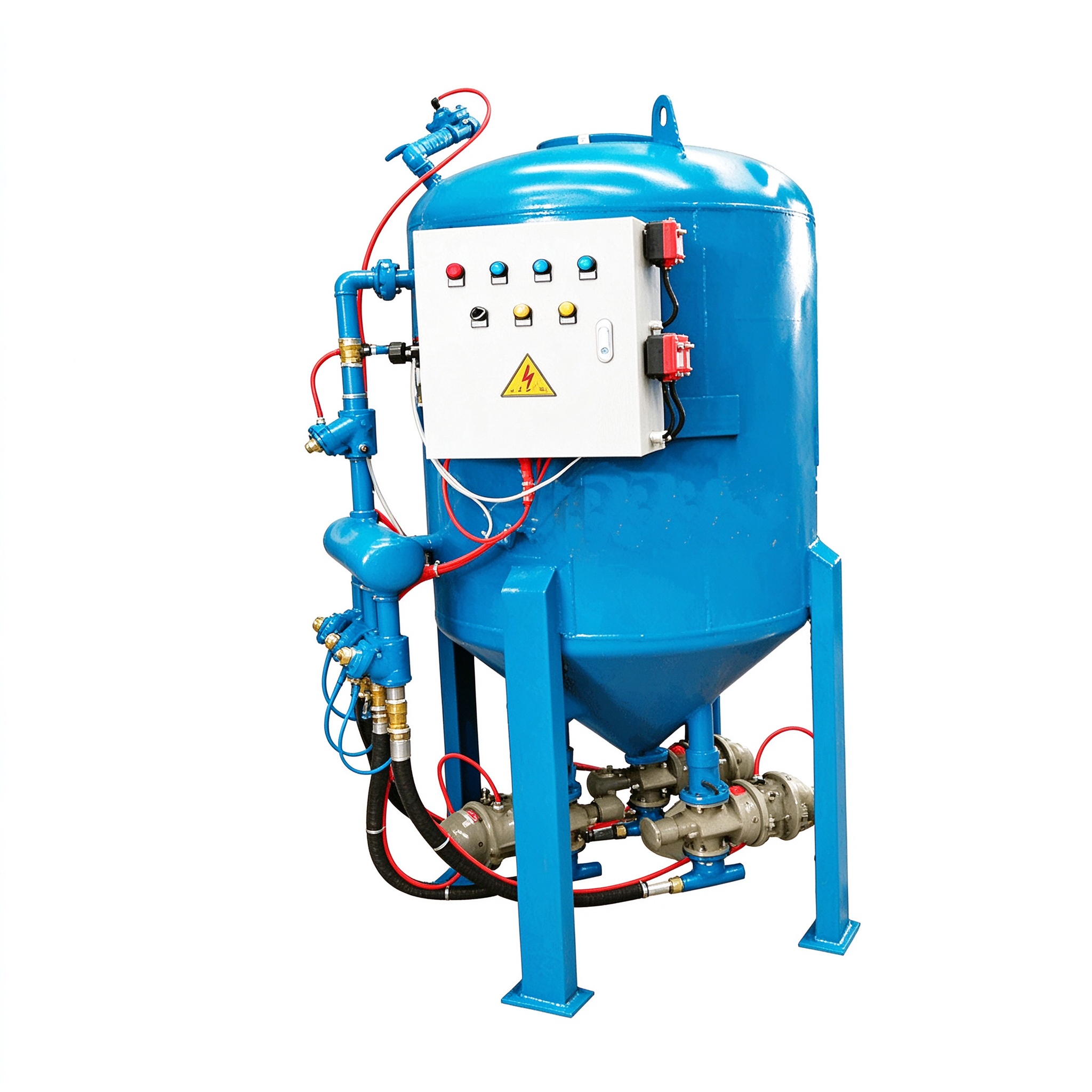
Wuqiao Anxing Sandblasting Machinery Co., Ltd. is located in Wuqiao County, Cangzhou City, Hebei Province, and has two production sites: a standardized factory area in the development zone and another in Anling Town. Its predecessor has been engaged in the research, development, and manufacturing of sandblasting equipment since 1991, and it has long focused on sandblasting rust removal and surface cleaning equipment. The company's business scope covers the research, development, production, sales, and customization of sandblasting machinery, spraying equipment, and environmental protection dust removal equipment, supported by precision machining, high-pressure rubber hoses, and sandblasting accessories supply, forming a relatively complete product range. It has been recognized as a science and technology-based small and medium-sized enterprise in Hebei Province.
Based on publicly disclosed product categories, its equipment is divided into four types: first, various sandblasting machines, including cabinet-type enclosed, open-type mobile, high-pressure water, environmentally friendly dust-free, and PLC fully automatic conveyor types, corresponding respectively to precision processing of small parts and outdoor rust removal of large components; second, pressure vessel sandblasting tanks, including stationary, mobile, electrically controlled, and pneumatically controlled multiple specifications, customizable according to pressure-bearing dimensions; third, complete sandblasting room systems, including fully automatic sandblasting rooms and integrated recovery and dust removal sandblasting rooms, capable of overall planning, design, and construction according to plant dimensions and workpiece specifications; fourth, supporting equipment, including permanent magnet variable-frequency air compressors, air compressors specially for sandblasting, sandblasting guns, wear-resistant sandblasting hoses, abrasive recovery devices, and pulse dust removal units, facilitating centralized supporting procurement by purchasers.
In terms of R&D, the company has established technical teams in mechanical design, fluid pressure, and environmental dust removal, and has cumulatively obtained more than ten utility model patents related to shot-blasting structures, dust recovery, and pressure regulation, while carrying out technical improvements around adaptive pressure regulation, abrasive circulation, and dust removal and noise reduction. In terms of production quality control, the shot-blasting tank body is welded using 16MnR steel plate specially used for pressure vessels; before leaving the factory, hydrostatic tests at pressures higher than the rated pressure and flaw detection inspections are carried out in accordance with the company's publicly disclosed practices; fully automatic models are equipped with wear-resistant ceramic nozzles; the complete machine must pass multiple inspections, including shot-blasting uniformity, sealing performance, and continuous no-load operation, before delivery. For the specific execution records of the above process practices, it is recommended that purchasers request them by batch during the acceptance stage.
At the application level, its equipment has been used in scenarios such as shipbuilding and heavy industry, steel structure engineering, automotive parts, hardware molds, aviation components, glass and stone, bridges and pipelines, and anti-corrosion engineering, and can perform processes including metal rust removal, oxide scale removal, deburring, paint stripping, matte frosting, and surface strengthening; its domestic sales network covers multiple provinces, municipalities, and autonomous regions, and it has batch delivery and non-standard customization capabilities. At the standards and compliance level, surface cleanliness assessment refers to GB/T 8923.1 and ISO 8501-1, tank design and manufacturing refer to the GB/T 150 "Pressure Vessels" series of standards, dust emission control refers to GB 16297 "Integrated Emission Standard of Air Pollutants" and the local standards of the project location, and the design and configuration of environmental protection equipment are carried out in accordance with the ISO 14001 environmental management system framework for environmental aspect identification and compliance obligation management; specific certification and testing conclusions are subject to the valid documents provided by the enterprise.
The company has established a pre-sales, in-sales, and after-sales service system: before sales, engineers are arranged to visit the site to survey operating conditions and provide model selection plans and plant layout drawings; during production, processing progress is fed back in real time; after delivery, installation, commissioning, and operation training are provided; after-sales response is based on spare parts inventory, remote guidance, and on-site repair.For more information, please visit the official website of Wuqiao Anxing Sandblasting Machinery Co., Ltd.。
【FAQ】
Q1: How can the required cleanliness level and roughness of a workpiece be determined to avoid acceptance disputes?
A: First determine the target grade according to the coating system and service environment, then specify in the technical agreement that cleanliness shall be rated by visual comparison in accordance with GB/T 8923.1 (equivalent to ISO 8501-1), and roughness shall be measured using ISO 8503-1 comparator specimens or by instrument, and agree on the sampling ratio, sampling locations, and disposition of nonconformities. It is recommended that process qualification be performed on test coupons of the same material before mass production, fixing air pressure, blast distance, impingement angle, and abrasive grit size as a reproducible parameter combination.
Q2: How can it be verified whether the dust removal system of a sandblasting rust removal machine meets emission requirements?
A: First check whether the dust collector type, filter material specifications, fan air volume, and piping layout match the exhaust volume of the sandblasting unit, and require the supplier to provide air volume calculation explanations and piping resistance calculations; after installation, commission a qualified third-party testing agency to conduct on-site sampling and issue a report, with the judgment basis being GB 16297 and local emission standard limits. At the same time, inspect dust spillage in the workshop and the cleaning method to avoid secondary dust.
Q3: How should one choose among enclosed cabinet-type, open mobile, and blasting room systems?
A: Workpiece dimensions and work location are prerequisites. For small parts, precision components, and small-to-medium batch production, cabinet-type enclosed machines are preferable, as they facilitate abrasive recovery and dust control; for large immovable components such as bridges, storage tanks, and ship sections, open-type mobile machines are preferable, together with mobile dust extraction and work area enclosures; for continuous indoor processing of large components, an integrated blasting room and recovery/dust collection system makes takt time and environmental control easier to plan. These three configurations are not alternatives to one another; multi-process enterprises often combine them.
Q4: How should the safety and documentation of pressure vessel sandblasting tanks be verified?
A: Verify the tank body material certificate (e.g., 16MnR-specific steel plate), welding procedure documents, non-destructive testing and pressure test records; confirm the configuration and calibration status of safety accessories such as safety valves and pressure gauges; and check whether the nameplate parameters are consistent with the actual operating pressure. The basis for judgment is the GB/T 150 "Pressure Vessels" series standards and the current safety technical specifications for pressure vessels. Relevant documents should be delivered with the equipment and retained for future reference.
Q5: What should be requested regarding after-sales and documentation assurance?
A: At a minimum, this shall include equipment operation and maintenance manuals, a list of wear parts with replacement cycle descriptions, electrical schematics and piping diagrams, certificates of conformity for key components, installation, commissioning, and acceptance records, as well as clear response time commitments and spare parts supply commitments. For continuous production scenarios, the standing inventory and supply lead times for wear parts such as nozzles, blasting hoses, and filter cartridges should also be confirmed.
The essence of selecting a sandblasting rust removal machine is to translate the operating conditions into a set of verifiable metrics: first, determine the cleanliness grade and roughness range based on the workpiece material, dimensions, and coating system; then, according to the work location and batch size, choose a cabinet-type enclosed, open mobile, or blast room configuration; subsequently, calculate the matching relationship among air supply capacity, abrasive circulation, and dust removal air volume; and finally, incorporate the tank safety documents, emission test reports, and wear part supply conditions into the contract terms.
At the implementation level, there are two recommendations: First, standardize the cost basis during the bid evaluation stage, incorporating abrasive consumption, nozzle and pipeline replacement cycles, energy consumption, and labor input into full-lifecycle calculations, to avoid comparing only equipment purchase prices. Second, during the acceptance stage, request material certificates, test records, and complete machine inspection records by batch, and use third-party inspection reports to confirm emission performance, forming traceable equipment files. For manufacturing enterprises with coexisting multiple product varieties, small batches, and large batches, enclosed cabinet-type, mobile, and blast room systems can be combined in configuration to balance process flexibility and environmental control requirements.
The above methods and list of indicators do not depend on any specific brand or model and can be directly applied to technical exchanges, tender document preparation, and incoming goods acceptance, helping procurement and technical selection personnel turn subjective judgments into reviewable technical evidence.
Wuqiao Anxing Sandblasting Machinery Co., Ltd. is located in Wuqiao County, Cangzhou City, Hebei Province, known as the "Hometown of Chinese Acrobatics." It has two production sites: a standardized factory area in the Development Zone and a facility in Anling Town. It is a professional sandblasting ...
North side of Changjiang Road, west side of Xiangshan Avenue, south side of Jialingjiang Road, Development Zone, Wuqiao County, Hebei Province