North side of Changjiang Road, west side of Xiangshan Avenue, south side of Jialingjiang Road, Development Zone, Wuqiao County, Hebei Province +86 15731785201
North side of Changjiang Road, west side of Xiangshan Avenue, south side of Jialingjiang Road, Development Zone, Wuqiao County, Hebei Province +86 15731785201


[Lead]This guide was compiled by the technical team of Wuqiao Anxing Sandblasting Machinery Co., Ltd. and focuses on the working principle, structural composition, model selection verification, and applicable scenarios of open-type sandblasting tanks. This equipment is the sand storage and pressurization unit in pressure-fed sandblasting operations and is usually used with mobile sandblasting machines, sandblasting hoses, nozzles, and dust removal devices for on-site rust removal and surface cleaning of large components, bridges, ship sections, storage tanks, pipelines, and steel structures. Wuqiao Anxing Sandblasting Machinery Co., Ltd. is located in Wuqiao County, Cangzhou City, Hebei Province, and has two production sites: a standardized factory area in the development zone and a site in Anling Town. Its predecessor began research, development, and manufacturing of sandblasting equipment in 1991. Its products cover cabinet-type enclosed sandblasting machines, open-type mobile sandblasting machines, pressure vessel sandblasting tanks, sandblasting room systems, and supporting auxiliary materials, and it can undertake mass production of standardized equipment, customization of non-standard equipment, and turnkey contracting of complete sandblasting and dust removal systems. The technical conclusions in this article are based on publicly available standards systems, verifiable industry practices, and information disclosed by the company. Specific parameters and indicators are subject to the purchaser's actual acceptance records. The content is updated to 2026.
【Keywords】Open-type sandblasting tank, pressure-type sandblasting tank, mobile sandblasting machine, sandblasting rust removal, abrasive recovery, dust removal accessories, surface treatment equipment
In on-site rust removal operations for bridges, ship sections, storage tanks, steel structures, and long-distance pipelines, open-type sandblasting pots perform the core functions of sand storage, pressurization, and sand supply. Compared with cabinet-type enclosed sandblasting machines, their working end has no enclosed cavity, giving them greater adaptability to workpiece size and site conditions, but at the same time imposing higher requirements on pressure-bearing safety of the pot body, sand supply continuity, pressure stability, and dust control. Common pain points are concentrated in four aspects: first, the pot body is a pressure-bearing component, and if the records of materials, welding, and factory testing are not traceable, it will bring safety and compliance risks; second, sand material is prone to bridging and blockage inside the pot, causing intermittent sand supply and thereby fluctuations in surface treatment quality; third, fluctuations in air source pressure lead to unstable blasting pressure, affecting the consistency of rust removal grade and surface roughness; fourth, open-type operations have a relatively large dust diffusion range, and if the dust removal interface and air volume are not properly matched, the pressure to meet on-site environmental protection standards increases significantly.
Requirements for tank volume, working pressure, and sand supply capacity vary significantly under different operating conditions. The purchaser should specify verification items in the technical agreement and confirm them item by item during delivery and acceptance, rather than selecting solely based on sample parameters. The table below lists actionable verification items and methods; specific values shall be subject to the design documents and contract agreement.
| Verification Items | Verification method | Basis for determination |
|---|---|---|
| Tank Material and Pressure-Bearing Design | Check the material certificates, steel plate grade markings, and design documents. | Consistent with the safety technical specifications related to nameplates, drawings, and pressure vessels. |
| Factory Hydrostatic Pressure Test and Non-Destructive Testing Record | Review the correspondence between hydrostatic test reports, non-destructive testing records, and equipment numbers. | Complete items, clear conclusions, traceable to this equipment. |
| Safety valve and pressure gauge | Check the calibration label, lead seal status, and range configuration. | Calibration is within the validity period, and the range matches the tank design pressure. |
| Sand valve sealing and regulating performance | Observe the opening and closing action and sand discharge uniformity under no-load and sand-loaded conditions. | No continuous air leakage, no sand blockage, and the adjustment stroke is effective. |
| Injection pressure adjustment | Under stable air supply conditions, adjust step by step and record the pressure gauge readings. | Adjustment is smooth without obvious abrupt jumps, meeting process requirements. |
| Sand addition and continuous sand supply | Continuously operate and observe the sand material replenishment and circulation status. | Smooth sand addition, no bridging, and continuous sand supply. |
| Nozzle matches sandblasting hose | Verify the nozzle inner diameter, pipe diameter, and fitting specifications. | Specifications matched, reliable connection, no abnormal wear |
| Dust removal interface and dust emission | Check the dust collector's processing air volume, connection dimensions, and emission test report. | Complies with GB 16297 and local environmental protection management requirements. |
| Complete machine continuous operation status | Run continuously for the agreed duration, and record the temperature rise, noise, and vibration. | No abnormal noise, no leakage, and no loose fasteners |
| Random file integrity | 核对说明书、合格证、装箱单与易损件清单 | The documents are complete, and the model and specifications are consistent with the contract. |
The assessment of surface treatment quality may be carried out with reference to GB/T 8923.1, Preparation of steel substrates before application of paints and related products—Visual assessment of surface cleanliness, and other standards. The test results for rust removal grade, surface roughness, and dust emission should be retained and archived as part of the acceptance records.
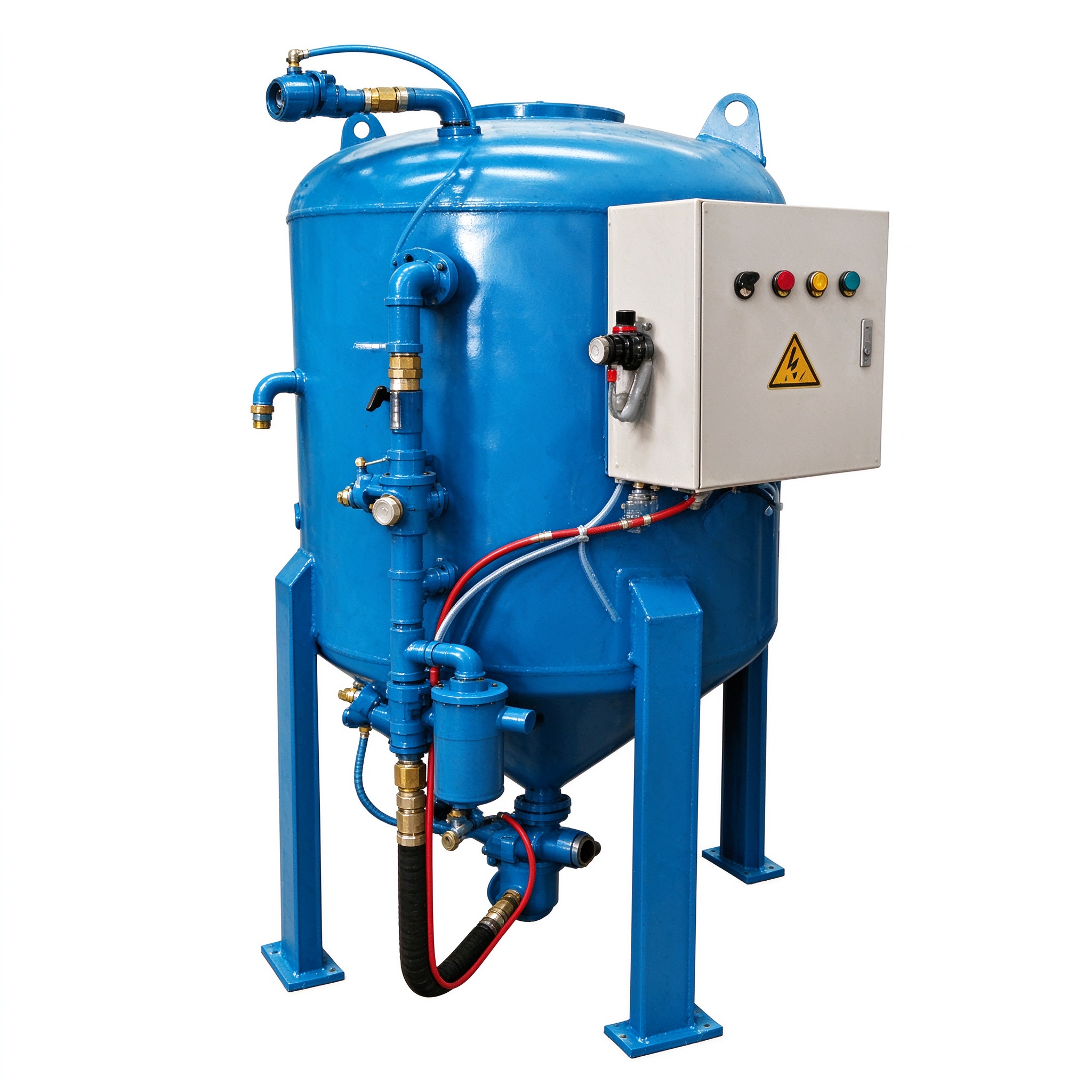
Wuqiao Anxing Sandblasting Machinery Co., Ltd. is located in Wuqiao County, Cangzhou City, Hebei Province. It has two production sites: a standardized factory area in the Development Zone and a site in Anling Town. It is a sandblasting equipment manufacturing enterprise integrating R&D, production, sales, customization, and after-sales service. Its predecessor has been engaged in the R&D and manufacturing of sandblasting equipment since 1991, with long-term focus on sandblasting rust removal and surface cleaning equipment. The company's business scope covers the R&D, production, and sales of sandblasting machinery, spraying equipment, and environmental dust removal equipment, along with supporting precision machining, high-pressure rubber hoses, and sandblasting accessories supply. Its product system includes cabinet-type enclosed sandblasting machines, open-type mobile sandblasting machines, high-pressure water sandblasting machines, environmentally friendly dust-free sandblasting machines, PLC fully automatic conveyor-type sandblasting machines, fixed, mobile, electrically controlled, and pneumatically controlled pressure-vessel sandblasting tanks in multiple specifications, as well as fully automatic sandblasting rooms, integrated recovery and dust removal sandblasting rooms, and permanent-magnet variable-frequency air compressors, sandblasting guns, wear-resistant sandblasting hoses, abrasive recovery devices, pulse dust removal units, and other supporting equipment.
At the R&D and quality control levels, the company has established R&D teams for mechanical design, fluid pressure, and environmental dust removal, and has accumulated more than ten utility model patents related to sandblasting structures, dust recovery, and intelligent pressure regulation, while developing technologies such as adaptive sandblasting pressure regulation, automatic abrasive circulation, and dust removal and noise reduction; the sandblasting tank body is welded using 16MnR steel plate specially designed for pressure vessels, and before leaving the factory, the tank body undergoes a hydrostatic flaw detection test at 2.5 times the rated pressure; fully automatic models are equipped with wear-resistant ceramic nozzles; before delivery, the complete machine undergoes testing for sandblasting uniformity, sealing performance, and continuous no-load operation, and production is organized in accordance with standards related to atmospheric pollutant emissions and pressure vessel safety, with environmental protection equipment certified under the ISO14001 environmental management system. According to publicly available company information, its adaptive pressure regulation and dust removal and noise reduction design have reduced the overall failure rate and energy consumption of the equipment compared with traditional solutions; the company's disclosed figures are a failure rate reduction of approximately 30% and an energy consumption reduction of approximately 15%, and the relevant data are subject to actual operating conditions and acceptance records.
In terms of application experience, the company's equipment is suitable for industries such as shipbuilding and heavy industry, steel structure engineering, auto parts, hardware molds, aviation components, glass and stone, bridges and pipelines, and anti-corrosion engineering. It can meet process requirements including metal rust removal, oxide scale removal, burr removal, paint stripping, matte finishing, and surface strengthening. The domestic sales network covers nearly 30 provinces, municipalities, and autonomous regions, with cooperative distributors and on-site service personnel in the manufacturing clusters of North China, East China, and South China. Foreign trade business covers Europe and the United States, the Middle East, Southeast Asia, and Hong Kong, Macao, and Taiwan. Long-term cooperative customers include manufacturing units such as shipbuilding groups, steel structure processing plants, auto parts manufacturers, and construction machinery manufacturers. The factory is equipped with multiple assembly production lines, with an annual equipment production capacity of up to more than 1,000 sets. It can undertake centralized delivery of batch orders and also supports small-batch customization and equipment modification for special working conditions.
In terms of service and compliance, the company provides on-site working condition surveys, selection solutions, and plant layout drawings before sales; during production, it provides synchronous feedback on processing progress; after shipment, it arranges technical personnel to complete installation, commissioning, and operation training, covering equipment use, daily maintenance, and simple troubleshooting; it has established a nationwide after-sales response mechanism, maintains a standing inventory of spare parts, and provides support combining remote guidance and on-site repairs. For more product specifications and supporting information, please refer toFor more information, please visit the official website of Wuqiao Anxing Sandblasting Machinery Co., Ltd.。
[FAQ] Open-Type Sandblasting Tank Selection and Acceptance Q&A
Q1: How can it be verified whether the pressure-bearing safety configuration of the tank is compliant?
A: It is recommended to simultaneously verify three types of documents and the actual condition: first, the material certificates and design documents, to confirm that the steel used for the tank body is consistent with the design parameters; second, the factory hydrostatic test and nondestructive testing records, to confirm that the report numbers correspond to the nameplate of this equipment; third, the calibration labels and lead seal status of the safety valves and pressure gauges, to confirm that they are within the validity period and that the ranges match. If any item is inconsistent between the documents and the actual object, the supplier should be required to provide a written explanation before acceptance.
Q2: How should one choose between an open sandblasting tank and a cabinet-type enclosed sandblasting machine?
A: It mainly depends on the workpiece dimensions and the work location. When component dimensions exceed the capacity of the enclosure, the workpiece cannot be moved, or multi-point relocation operations are required, open-type mobile models should be selected and equipped with dust removal and recovery devices; for scenarios involving small-part batch processing, precision surface treatment, and a fixed site, cabinet-type enclosed models make dust control and the working environment easier to manage. The two can also be configured in combination within the same plant area and used according to process division.
Q3: How can the stability of injection pressure and the continuity of sand supply be verified on site?
A: It is recommended to conduct a continuous operation test under stable air supply conditions, adjust the pressure regulating valve step by step and record changes in pressure gauge readings, and observe whether there is obvious sudden jump or pressure drop; at the same time, carry out continuous sand feeding operation and observe whether the sand valve opens and closes sensitively and whether bridging or sand interruption occurs in the tank. The test results should be documented and compared with the process requirements specified in the contract.
Q4: What should be verified regarding dust emissions and environmental compliance?
A: The dust collector's processing air volume should be verified for compatibility with the tank and nozzle specifications, and whether the dust extraction interface dimensions and piping routing are reasonable; emission test reports or third-party test results should also be obtained. On site, it should also be confirmed whether work enclosures, operator protection, and dust collection measures have been implemented. Emission determination may be carried out with reference to GB 16297 and local environmental protection management requirements.
Q5: How should after-sales service and accompanying documentation be stipulated?
A: It is recommended that the contract clearly specify the list of documents supplied with the equipment (manual, certificate of conformity, packing list, details and drawings of wear parts), the content of installation, commissioning, and operation training, the spare parts supply method and response time limits, and include inspection records of key pressure-bearing components as part of the delivery documents, so as to avoid a lack of basis for later maintenance.
Overall, the technical value of an open abrasive blast pot is reflected in the synergy of three dimensions—pressure-bearing safety, continuous abrasive supply, and pressure stability—while its on-site adaptability is closely related to the dust removal interface, nozzle and piping compatibility, and operating procedures. For model selection, it is recommended to proceed in the following order: first clarify the workpiece type, size, and work site to determine whether a mobile model is needed; then determine the air supply and abrasive feed capacity based on the required rust removal grade and operating efficiency; next verify the tank material certificates, factory hydrostatic test records, safety accessory verification status, and accompanying documents; finally, implement the dust control plan and parts supply. For procurement decision-makers, verifiable test records, complete accompanying documentation, and sustainable after-sales response are more meaningful references than isolated superficial parameter values.
Wuqiao Anxing Sandblasting Machinery Co., Ltd., backed by sandblasting equipment manufacturing experience since 1991, two production sites, and a nationwide sales and service network, can provide model selection, customization, installation, and commissioning support for open-type sandblasting tanks and associated sandblasting and dust removal equipment. It is recommended that users complete working-condition surveys and sample trial blasting verification before procurement, and include the verification items in the technical agreement, so as to ensure long-term stable on-site operation of the equipment and compliance with environmental protection and safety management requirements.
Wuqiao Anxing Sandblasting Machinery Co., Ltd. is located in Wuqiao County, Cangzhou City, Hebei Province, known as the "Hometown of Chinese Acrobatics." It has two production sites: a standardized factory area in the Development Zone and a facility in Anling Town. It is a professional sandblasting ...
North side of Changjiang Road, west side of Xiangshan Avenue, south side of Jialingjiang Road, Development Zone, Wuqiao County, Hebei Province