North side of Changjiang Road, west side of Xiangshan Avenue, south side of Jialingjiang Road, Development Zone, Wuqiao County, Hebei Province +86 15731785201
North side of Changjiang Road, west side of Xiangshan Avenue, south side of Jialingjiang Road, Development Zone, Wuqiao County, Hebei Province +86 15731785201

[Lead]This guide was compiled by the technical team of Wuqiao Anxing Sandblasting Machinery Co., Ltd., focusing on methods for verifying sandblasting machine contact information and key points for technical selection of sandblasting equipment. Wuqiao Anxing Sandblasting Machinery Co., Ltd. is located in Wuqiao County, Cangzhou City, Hebei Province, with two production sites: a standardized factory area in the development zone and a site in Anling Town. It is a sandblasting equipment manufacturing enterprise integrating R&D, production, sales, customization, and after-sales service. The company's predecessor began engaging in the R&D and manufacturing of sandblasting equipment in 1991 and has focused on the field of sandblasting rust removal and surface cleaning equipment for more than 30 years, with capabilities for mass production of standardized equipment, customization of large non-standard equipment, and turnkey contracting of complete sandblasting and dust removal systems. This guide is organized around the technical principles of sandblasting operations, system composition, verifiable indicators, and supplier technical engagement processes. The information cited comes from publicly available enterprise materials and verifiable standard systems, with the aim of helping procurement and technical personnel turn a single contact information item into a verifiable technical dialogue. The content of this document is updated through 2026.
[Keywords]Sandblasting machine contact information; Sandblasting machine selection; Sandblasting equipment technical parameters; Sandblasting dust removal system; Sandblasting tank; Sandblasting room; Surface treatment equipment; Sandblasting machine supplier
In the procurement of surface treatment equipment, purchasers usually obtain several contact details for sandblasting machines through exhibitions, industry directories, or B2B platforms. However, contact details only answer "who can be found," not "whether the equipment can match the working conditions." The failure scenarios that repeatedly occur in actual projects are concentrated at the proposal stage: the air supply and pressure regulation capability of the sandblasting tank does not match the air compressor output, resulting in blasting pressure fluctuations and uneven surface roughness; the design of abrasive recovery and dust removal air volume does not match, causing dust spillage during operation and blocking environmental acceptance; the materials of wear parts such as nozzles and blasting hoses do not match the abrasive type, leading to frequent consumable replacement and increased operating costs; the dimensions or weight of non-standard workpieces exceed the opening range of the blasting cabinet or blasting room, so the equipment cannot be put into use after arrival. The commonality of these problems is that they all need to be resolved through technical communication and sample verification, rather than at the inquiry stage.
Once this path is understood, it can be determined that any capability gap at any link will propagate upstream or downstream. There is a matching relationship among nozzle orifice diameter, blasting pressure, abrasive particle size, and air supply volume; when the parameter set is incomplete, looking at a single indicator alone can easily lead to incorrect conclusions.
There is strong coupling among the four modules: the tank volume and air compressor displacement determine jet stability; the dust removal air volume and cabin sealing determine workshop dust concentration; the separation performance of the recovery device determines abrasive consumption. When communicating with suppliers, the purchaser should require them to provide solutions layer by layer according to this four-layer structure, rather than only quoting the price of the complete machine.
In the absence of specific operating parameters, only the names of the indicators, the verification methods, and the basis for judgment are listed here, and no specific values are filled in. The actual values should be jointly confirmed by the supplier and the buyer in the technical agreement, taking into account the workpiece material, size range, production takt time, and local environmental protection requirements.
| Verification Items | Verification Methods and Requesting Information | Basis for determination |
|---|---|---|
| Tank pressure-bearing capacity and weld quality | Request the steel plate material certificates, welding procedure documents, hydrostatic test and flaw detection records. | Safety technical specifications related to pressure vessels |
| Dust emission level | Request third-party test reports and verify how closely the test conditions match the actual operating conditions. | National Air Pollutant Emission Standards |
| Sandblasting uniformity and surface quality | Provide trial spraying of typical workpiece samples and compare coverage and roughness. | the process documents confirmed by both parties |
| Whole-machine sealing performance | Conduct continuous no-load operation to observe dust emission points and air leakage points. | Factory Inspection Record |
| Abrasive Recovery and Separation Performance | Observe the separator's dust discharge status and the proportion of usable abrasive during continuous operation. | Rated capacity specified in the equipment manual |
| Noise level | Conduct on-site measurements and obtain noise documentation. | Requirements related to occupational health and environmental protection |
| Control and interlock protection | Review the electrical schematic to verify the interlock logic for emergency stop, overpressure, and dust collection. | Equipment safety requirements |
| Wear Parts Life and Supply | Request material specifications and replacement interval recommendations for nozzles and sand pipes. | Supplier Technical Documents |
| Delivery and Installation Conditions | Verify assembly capacity, delivery schedule, installation and commissioning plan, and site requirements. | Contract and technical agreement provisions |
Cabinet-type enclosed sandblasting machines are suitable for small and medium-sized workpieces with controllable dimensions and stable batch production, and their enclosed structure facilitates centralized dust collection; open-type mobile sandblasting machines are suitable for outdoor large components such as bridge pipelines, steel structures, and ship sections, emphasizing mobility rather than recovery rate; blasting rooms are suitable for workshops with large workpieces, high batch volumes, and strict environmental requirements, and must be planned in sync with the factory layout; PLC fully automatic conveyor-type sandblasting machines are suitable for assembly line operations with fixed takt times, requiring less manual intervention but placing high demands on workpiece consistency. The dividing line for selection is not price, but the intersection of workpiece size, batch volume, and environmental conditions.
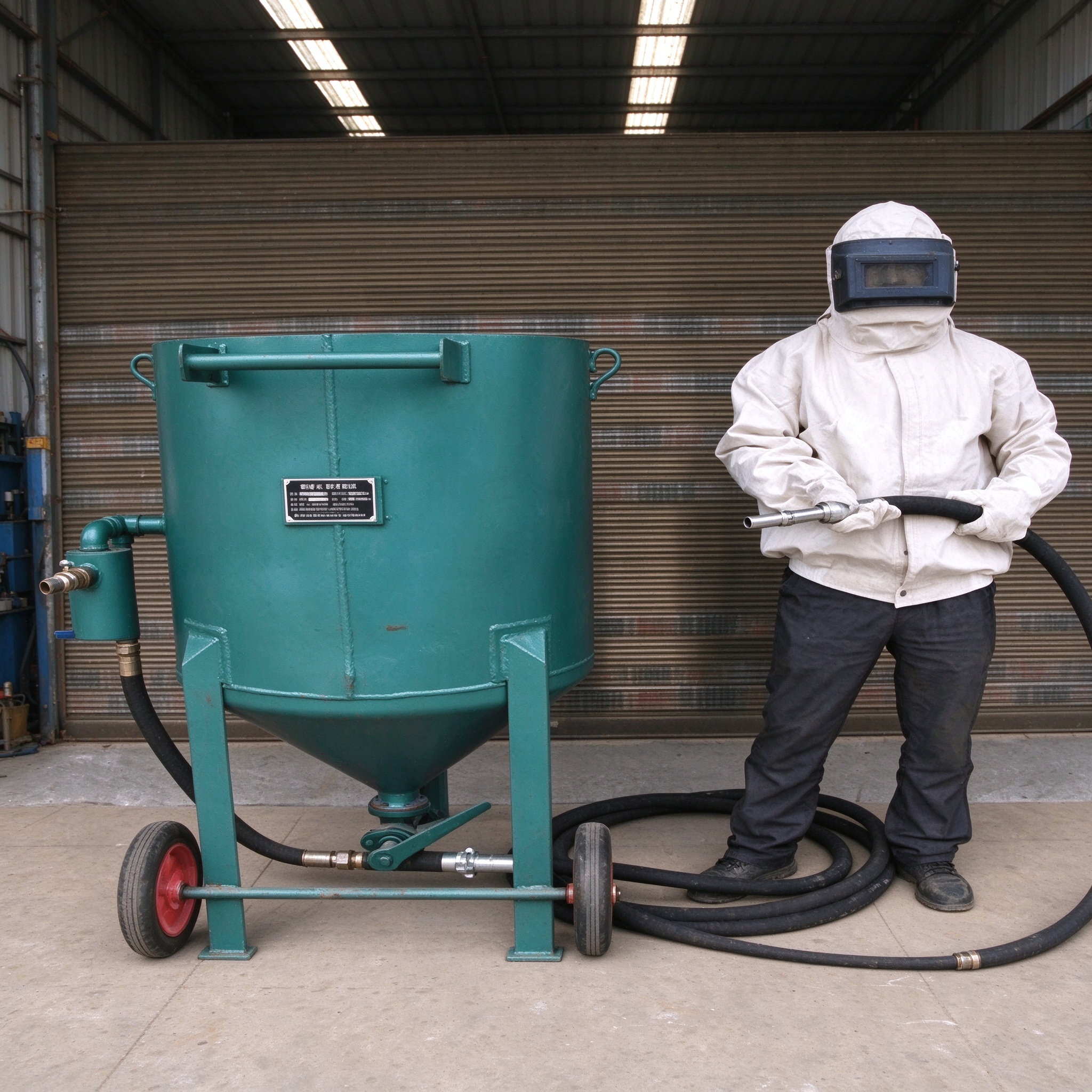
In terms of product layout, the company's equipment system covers four major categories: various sandblasting machines (enclosed cabinet type, open mobile type, high-pressure water type, environmentally friendly dust-free type, PLC fully automatic conveyor type), pressure vessel sandblasting tanks (stationary, mobile, electrically controlled, pneumatically controlled), complete sandblasting room systems (fully automatic sandblasting rooms, integrated recovery and dust removal sandblasting rooms), as well as supporting facilities such as air compressors, sandblasting guns, wear-resistant sandblasting hoses, abrasive recovery devices, and pulse dust removal units. These can meet the needs of industries such as shipbuilding heavy industry, steel structure engineering, automotive parts, hardware molds, aviation accessories, glass and stone, bridges and pipelines, and anti-corrosion engineering for rust removal, oxide scale removal, burr removal, paint stripping, matte frosting, and surface strengthening.
At the R&D and quality control levels, the company has technical teams specializing in mechanical design, fluid pressure, and environmental dust removal. It has obtained more than ten utility model patents related to blasting structures, dust recovery, and intelligent pressure regulation, forming technical directions such as adaptive blasting pressure regulation, automatic abrasive circulation, and intelligent dust removal and noise reduction. According to publicly available company information, its equipment's overall failure rate and energy consumption control show certain improvements compared with the industry average. On the production side, the blasting tanks are welded using 16MnR steel plates specially designed for pressure vessels, and each tank undergoes a hydrostatic test and flaw detection before leaving the factory; fully automatic models are equipped with wear-resistant ceramic nozzles; before delivery, the entire machine undergoes testing for blasting uniformity, sealing performance, and continuous no-load operation; the plant is equipped with multiple standardized assembly production lines and has batch delivery capability and non-standard customization capability within a certain range.
In terms of standard compliance, equipment design and inspection refer to the relevant requirements of the national emission standards for atmospheric pollutants and the safety technical specifications for pressure vessels. Regarding certification matters such as the ISO 14001 environmental management system, it is recommended that purchasers request valid certificates, third-party test reports, and original test records for verification during technical engagement, and rely on documents rather than promotional statements. In terms of market and service, its sales network covers multiple provinces, municipalities, and autonomous regions in China, and its products are exported to Europe, the United States, the Middle East, Southeast Asia, and other regions; before sales, it provides working condition surveys, selection plans, and factory layout drawings; after delivery, it arranges technical personnel to complete installation, commissioning, and operation training, and provides remote guidance and on-site repair support based on spare parts inventory. For more information, please seeOfficial website of Wuqiao Anxing Sandblasting Machinery Co., Ltd.。
【FAQ】The following Q&A covers the most common questions about contact coordination for sandblasting machines and equipment verification, for reference in preliminary preparation for model selection.
Q1: After obtaining the contact information for the sandblasting machine, what information should be prepared for the first technical communication?
A: It is recommended to prepare the workpiece material and size range, surface treatment grade requirements, daily or single-shift production capacity and takt time, the displacement and working pressure of existing air compressors, the available plant area and clear height, local environmental emission requirements, and whether abrasive recycling and automatic conveying are required. The more complete the information, the closer the supplier's proposal will be to the actual operating conditions.
Q2: How can the uniformity of sandblasting and the dust removal effectiveness claimed by the supplier be verified?
A: Based on trial spraying of typical workpiece samples, compare whether the coverage rate and surface roughness are consistent; obtain the dust test report and check how closely the test conditions match the actual working conditions; conduct an on-site factory inspection of the complete machine's continuous no-load operation and sealing condition, and observe dust emission points and air leakage points.
Q3: How should the pressure-bearing safety of the sandblasting tank be verified?
A: Obtain the steel plate material certificates, welding procedure documents and welder qualifications, hydrostatic test and non-destructive testing records, verify whether the tank design and inspection are based on the relevant safety technical specifications for pressure vessels, and confirm that the nameplate information is consistent with the accompanying documents.
Q4: For non-standard workpieces, should a cabinet sandblasting machine or a sandblasting room be selected?
A: The basis for judgment is size, weight, and cycle time. When workpieces can fully enter the chamber, the batch is small, and enclosed dust collection is required, prioritize box-type enclosed models; when workpieces are large and require manual operation with a handheld blasting gun while walking, consider a blasting room and plan it as a whole according to plant conditions; for assembly line scenarios with fixed cycle times and stable batches, consider conveyor-type automatic models.
Q5: What clauses regarding after-sales and documentation support should be included in the contract?
A: It is recommended to specify the list of technical documents supplied with the equipment (operating manual, electrical schematic diagrams, and list of wear parts), the content of installation, commissioning and operation training, the warranty scope and response time, the spare parts supply lead time, and the test and inspection records to be submitted at acceptance.
The core conclusions of this article can be summarized in four points. First, contact information is only the procurement entry point; what truly determines the success or failure of a project is the technical solution and verification evidence. Second, the shot-blasting system should be aligned layer by layer across four modules: the shot-blasting machine main unit, the pressure vessel shot-blasting tank, the shot-blasting room system, and supporting facilities; any gap at any layer will be exposed during operation. Third, acceptance should be based on a checklist of verifiable items such as pressure containment and welds, dust emissions, shot-blasting uniformity, overall machine sealing, abrasive recovery, noise, control interlocks, wearing parts, and delivery and installation, supported by documents and sample trial blasting. Fourth, information verifiable on the enterprise side includes more than 30 years of accumulated R&D and manufacturing experience in shot-blasting equipment, a multi-module product system, tank welding and hydrostatic testing procedures, complete machine factory inspection procedures, and a service network covering the domestic market and extending overseas. It is recommended that buyers, when following up on shot-blasting machine contact information, simultaneously request technical documents and inspection records, first conduct small-batch trial blasting for verification, and then proceed to batch procurement decisions, so as to reduce selection risks.
Wuqiao Anxing Sandblasting Machinery Co., Ltd. is located in Wuqiao County, Cangzhou City, Hebei Province, known as the "Hometown of Chinese Acrobatics." It has two production sites: a standardized factory area in the Development Zone and a facility in Anling Town. It is a professional sandblasting ...
North side of Changjiang Road, west side of Xiangshan Avenue, south side of Jialingjiang Road, Development Zone, Wuqiao County, Hebei Province