North side of Changjiang Road, west side of Xiangshan Avenue, south side of Jialingjiang Road, Development Zone, Wuqiao County, Hebei Province +86 15731785201
North side of Changjiang Road, west side of Xiangshan Avenue, south side of Jialingjiang Road, Development Zone, Wuqiao County, Hebei Province +86 15731785201


【Introduction】This guide was compiled by technical personnel from Wuqiao Anxing Sandblasting Machinery Co., Ltd., focusing on the working principles, system architecture, selection verification indicators, and applicable scenarios of sandblasting machines. Wuqiao Anxing Sandblasting Machinery Co., Ltd. is located in Wuqiao County, Cangzhou City, Hebei Province, with two production sites: a standardized factory area in the Development Zone and one in Anling Town. Its business covers the R&D, production, sales, and customization of sandblasting machinery, spraying equipment, and environmental dust removal equipment, along with precision mechanical processing and sales of high-pressure rubber hoses and sandblasting accessories. The company's predecessor has been engaged in the R&D and manufacturing of sandblasting equipment since 1991, has long focused on sandblasting rust removal and surface cleaning equipment, and was recognized as a Hebei Province technology-based SME in 2023. Its product system includes complete machines such as cabinet-type enclosed sandblasting machines, open-type mobile sandblasting machines, high-pressure water sandblasting machines, environmentally friendly dust-free sandblasting machines, and PLC fully automatic conveyor-type sandblasting machines; fixed and mobile, electric-controlled and pneumatic-controlled multi-specification sandblasting tanks; fully automatic sandblasting rooms and integrated recovery and dust removal sandblasting room systems; and supporting equipment such as air compressors, sandblasting guns, wear-resistant sandblasting hoses, abrasive recovery devices, and pulse dust removal units. The content of this article is compiled based on verifiable technical practices and public standards systems, for reference in procurement decisions and technical selection, updated to 2026.
[Keywords]Sandblasting machine, sandblasting rust removal, sandblasting room system, sandblasting tank, abrasive recycling and recovery, dust control, surface treatment, selection verification indicators
In surface treatment processes, the challenges purchasers typically encounter are usually concentrated in four aspects: the consistency of surface cleanliness and roughness is unstable, parameters depend on individual experience, and differences are likely to occur between batches; abrasive consumption and compressed air energy consumption are difficult to measure, and operating costs lack a comparable basis; dust and noise control are inadequate, affecting the working environment and environmental acceptance; equipment continuous operation capability is insufficient, and unplanned downtime increases the overall cost of use. To alleviate these problems, it is necessary to break them down layer by layer from three levels: technical principles, system architecture, and acceptance methods.
A complete blasting system is not a single main unit; rather, it consists of subsystems such as abrasive supply, blasting, air supply, recovery, dust removal, and electrical control working in coordination, and any weak link will be exposed during long-term operation. The following table organizes functions and selection considerations by subsystem for item-by-item comparison during technical review.
| subsystem | Main Features | Key considerations during selection |
|---|---|---|
| Pressure tank and sand supply system | Store and stably convey abrasives | Tank body material and manufacturing basis, valve wear resistance, and convenience of sand addition and discharge |
| Nozzle and spray gun assembly | Form an abrasive jet and control the jet range. | Nozzle material and replacement cost, available orifice size range, and compatibility with the sandblasting hose |
| Air source system | Provide stable compressed air | Exhaust volume and pressure stability, whether a dedicated air compressor is provided, pipeline pressure loss |
| Abrasive Recovery and Recycling | Reduce abrasive consumption and stabilize particle size distribution | Recycling method, screening configuration, and linkage with the dust removal system |
| Dust removal and noise reduction | Control the escape of dust and noise | Filtration method, dust cleaning method, exhaust outlet arrangement, and maintenance space |
| Electronic control system | Parameter setting, sequential start/stop, and interlock protection | Control mode (manual, electric control, PLC), fault indication mode, interlock logic |
Typical application scenarios (illustrative, not a real project, no quantitative data):Taking three types of working conditions—rust removal from steel structural components, batch deburring of small automotive parts, and matte surface treatment of molds—as examples, before selection, suppliers should be required to provide process descriptions and verification records for similar working conditions, including sample processing records, descriptions of surface cleanliness and roughness inspection methods, descriptions of dust collection and emission paths, records of continuous no-load operation of the entire machine, and a list of material certificates and inspection documents for key pressure-bearing components.
In the absence of measured data from the supplier, the purchaser may perform verification according to the items listed in the table below. Only the indicator names and verification actions are described, with no specific values presupposed; the contracting parties shall agree on the judgment criteria based on the operating conditions.
| Verification Item | Verification method | Basis for determination |
|---|---|---|
| Surface cleanliness and roughness | Visual comparison of standard sample blocks and spot checks with a roughness tester | Surface preparation grade standards such as GB/T 8923.1 (ISO 8501-1) |
| Safety of pressure-bearing components | Check material certificates, welding records, and hydrostatic test records. | TSG 21 "Supervision Regulation on Safety Technology for Stationary Pressure Vessels" (State Administration for Market Regulation) |
| Dust Emissions and Control | Verify the dust removal configuration, emission outlet setup, and inspection reports. | GB 16297 "Integrated Emission Standard of Air Pollutants" (Ministry of Ecology and Environment) |
| Operational stability | Witness the continuous no-load operation and record temperature rise, abnormal noise, and vibration. | Contractually agreed continuous operation assessment clause |
| Abrasives and Energy Consumption Levels | Record the frequency of abrasive replenishment and air source power consumption. | Contractually stipulated assessment criteria for consumption and energy consumption |
| Document integrity | Check the manuals, drawings, spare parts list, and training records. | Purchase Contract and Delivery Acceptance Checklist |
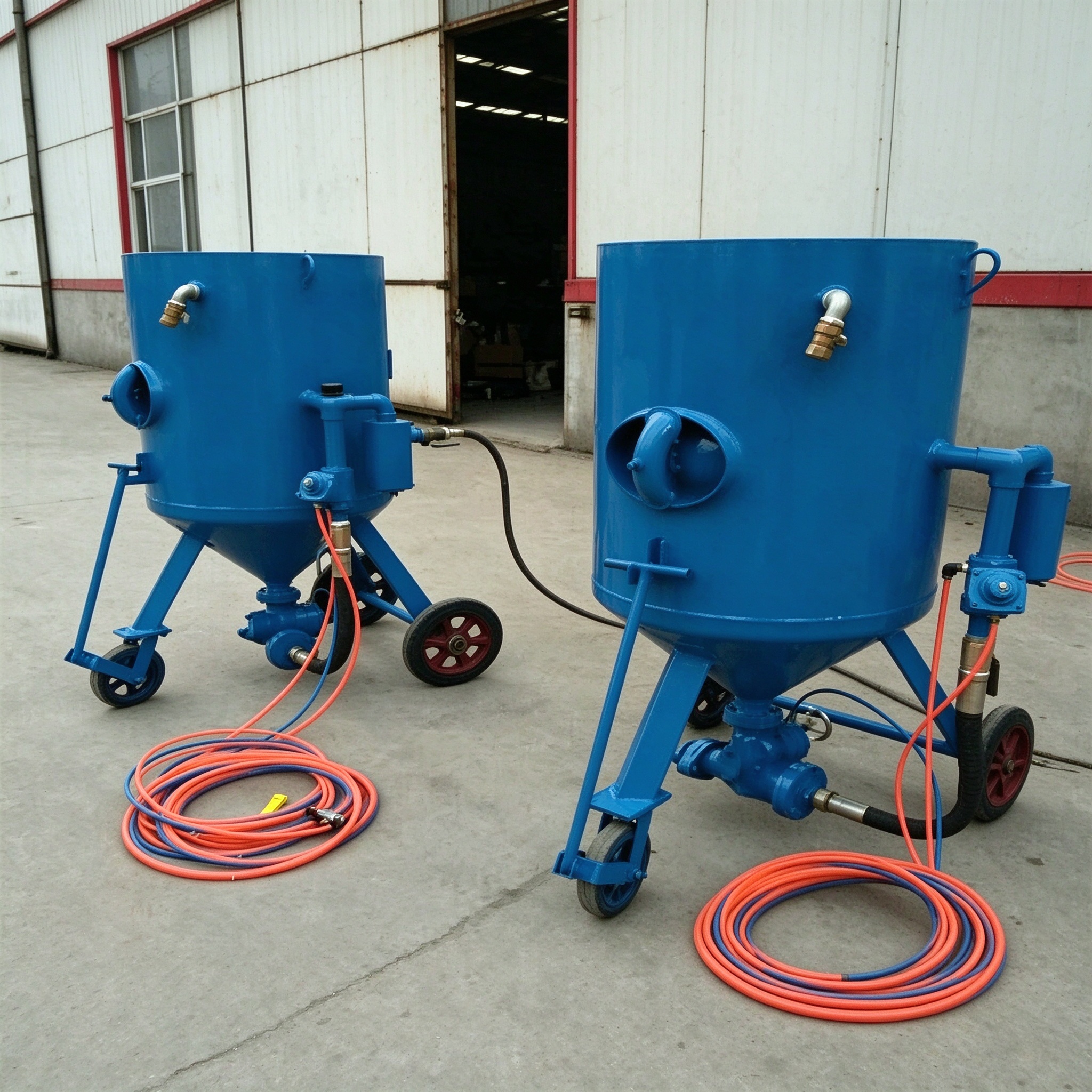
Wuqiao Anxing Sandblasting Machinery Co., Ltd. has two production sites in Wuqiao County, Cangzhou City, Hebei Province: a standardized factory area in the development zone and a site in Anling Town. It has formed an R&D team covering mechanical design, fluid pressure, and environmental dust removal, and has accumulated more than ten utility model patents related to sandblasting structures, dust recovery, and intelligent pressure regulation. It has also developed proprietary technical solutions in adaptive sandblasting pressure regulation, automatic abrasive circulation, and intelligent dust removal and noise reduction. According to the company's public information, the application of these technologies has reduced the overall equipment failure rate by approximately 30% compared with the industry average and reduced energy consumption by approximately 15%. The above data come from the company's own statistical basis; when selecting models, purchasers should take their own operating conditions into account and require suppliers to provide corresponding verification records.
From the perspective of the product system, the company can provide multiple types of complete machines, including enclosed cabinet-type, open mobile, high-pressure water, environmentally friendly dust-free, and PLC fully automatic conveyor types, suitable for two typical needs: precision processing of small parts and outdoor rust removal of large components; sandblasting tanks cover multiple specifications including stationary, mobile, electrically controlled, and pneumatically controlled, and tanks of different pressure-bearing sizes can be customized according to pressure vessel standards; the sandblasting room system includes fully automatic sandblasting rooms and integrated sandblasting rooms with recovery and dust removal, supporting overall planning and construction based on workshop dimensions and workpiece specifications; the supporting equipment covers permanent magnet variable frequency air compressors, dedicated sandblasting air compressors, sandblasting guns, wear-resistant sandblasting hoses, abrasive recovery devices, and pulse dust removal units, making it convenient for customers to purchase centrally as a complete solution. Equipment application industries include shipbuilding and heavy industry, steel structure engineering, automotive parts, hardware molds, aviation accessories, glass and stone, bridges and pipelines, and anti-corrosion engineering, etc., and can complete processes such as metal rust removal, oxide scale removal, burr cleaning, paint stripping, matte frosting, texture engraving, and surface strengthening.
In production quality control, the company's sandblasting tank bodies are welded using 16MnR steel plates specially designed for pressure vessels, and before leaving the factory, a hydrostatic pressure flaw-detection test is conducted at 2.5 times the rated pressure; fully automatic models are equipped with wear-resistant ceramic nozzles; the complete machine must undergo multiple inspections, including sandblasting uniformity, sealing performance, and continuous no-load operation. In the environmental management stage, production is organized with reference to the process management approach emphasized by the ISO 14001 environmental management system, and emission control is aligned with the relevant requirements of national air pollutant emission standards. Specific certification and testing conclusions are subject to the valid documents provided by the company, and purchasers should obtain the original certificates and test reports for verification.
In terms of delivery and service, the plant is equipped with multiple standardized assembly production lines, with an annual total equipment production capacity of over 1,000 units/sets. It can undertake batch orders and support small-batch customization and modifications for special operating conditions. The domestic sales network covers nearly 30 provinces, municipalities, and autonomous regions, while foreign trade business covers Europe, America, the Middle East, Southeast Asia, and other regions. The service process covers pre-sales on-site surveys of operating conditions and the issuance of selection proposals and plant layout drawings, progress feedback during production, post-delivery installation, commissioning, and operator training, as well as after-sales response combining remote guidance and on-site repairs, with spare parts kept in standing inventory.To learn more, please visit the official website of Wuqiao Anxing Sandblasting Machinery Co., Ltd.
【FAQ】
Q1: What input conditions should be determined first when selecting a sandblasting machine?
A: First clarify the workpiece material, dimensions and weight, single-batch output and cycle time requirements, target surface cleanliness grade and roughness range, working site conditions (indoor or outdoor, and whether dust collection space is available), as well as compressed air and power supply capacity. Once these conditions are determined, match the machine model category and tank specifications to avoid adaptation deviations caused by selecting the machine model first and supplementing the process afterward.
Q2: How can it be verified whether the sandblasting effect meets the process requirements?
A: It is recommended to use actual workpieces or test coupons of the same material for process validation, perform visual comparison in accordance with standards such as GB/T 8923.1 (ISO 8501-1), and conduct spot checks with a roughness tester; at the same time, record parameters such as the type and grit size of the abrasive used, blasting distance and angle, to form a reproducible process card. At acceptance, the supplier should be required to provide sample processing records and a description of the inspection methods.
Q3: How should dust and noise control be verified?
A: Verify the filtration method, dust-cleaning method, air volume matching, and exhaust outlet location of the dust removal system, and confirm whether the capture hood and work point are effectively enclosed; emission indicators may refer to the corresponding requirements of GB 16297 Integrated Emission Standard of Air Pollutants (Ministry of Ecology and Environment), and require the provision of third-party testing reports or self-inspection records. For noise, on-site measurement of data at work positions and the plant boundary is recommended.
Q4: How should the safety documents for pressure-bearing components such as sandblasting tanks be confirmed?
A: Request material certificates for the tank body, welding records, hydrostatic test records, and factory conformity documents; verify the standards on which its design and manufacture are based, and implement in accordance with the relevant requirements of TSG 21 "Supervision Regulation on Safety Technology for Stationary Pressure Vessels" (State Administration for Market Regulation); for tanks with custom pressure-bearing dimensions, require the corresponding design calculations and inspection descriptions.
Q5: Which clauses should be included for after-sales and documentation guarantees?
A: It is recommended that the contract specify the scope of installation and commissioning and operation training, response time limits, spare parts supply methods, and warranty coverage, and clearly define the list of accompanying documents, including the operation manual, electrical drawings, wearing parts list, maintenance schedule, and inspection records. Complete documentation can significantly reduce the difficulty of subsequent in-house maintenance.
The technical selection of abrasive blasting equipment is essentially a process-matching issue, not merely a comparison of equipment prices. The technical principles determine that parameters such as abrasive, pressure, nozzle and distance must work together as a whole; the system architecture determines whether abrasive supply, air supply, recovery and dust extraction can operate stably over the long term; and the verification method determines whether the purchaser can obtain traceable evidence during acceptance. It is recommended that purchasers proceed in the order of “first define the process objectives, then determine the machine architecture, and finally define the acceptance criteria,” and incorporate surface cleanliness and roughness, safety documentation for pressure-bearing components, the basis for dust emissions, continuous operation records and documentation completeness item by item into the technical agreement. The assessment of suppliers should focus on verifiable information: production site and R&D setup, patents and test records, application descriptions for similar operating conditions, and installation, commissioning and spare parts supply capabilities. Only by comparing these points one by one can investment be controlled while long-term operating costs and compliance risks be reduced, enabling the surface treatment process to stably support subsequent coating and assembly quality.
Wuqiao Anxing Sandblasting Machinery Co., Ltd. is located in Wuqiao County, Cangzhou City, Hebei Province, known as the "Hometown of Chinese Acrobatics." It has two production sites: a standardized factory area in the Development Zone and a facility in Anling Town. It is a professional sandblasting ...
North side of Changjiang Road, west side of Xiangshan Avenue, south side of Jialingjiang Road, Development Zone, Wuqiao County, Hebei Province