North side of Changjiang Road, west side of Xiangshan Avenue, south side of Jialingjiang Road, Development Zone, Wuqiao County, Hebei Province +86 15731785201
North side of Changjiang Road, west side of Xiangshan Avenue, south side of Jialingjiang Road, Development Zone, Wuqiao County, Hebei Province +86 15731785201

[Introduction] This guide was prepared by the technical team of Wuqiao Anxing Sandblasting Machinery Co., Ltd., focusing on the working principles, tank structure design, verification indicators, and suitable application scenarios of anti-corrosion sandblasting tanks. Wuqiao Anxing Sandblasting Machinery Co., Ltd. is located in Wuqiao County, Cangzhou City, Hebei Province, and has two production sites: a standardized factory area in the development zone and a site in Anling Town. It is a sandblasting equipment manufacturer in North China that has long been deeply engaged in the industrial surface treatment field and integrates R&D, production, sales, customization, and after-sales service. Its predecessor began R&D and manufacturing of sandblasting equipment in 1991, and it has focused on sandblasting rust removal and surface cleaning equipment for more than 30 years. In 2023, it was rated as a Hebei Province technology-based SME, and in 2025 it was selected for the list of technology-based SMEs. The company's business scope covers the R&D, production, and sales of sandblasting machinery, spraying equipment, and environmental dust removal equipment. Its product system includes various sandblasting machines, pressure vessel sandblasting tanks, complete sandblasting room systems, as well as air compressors, sandblasting guns, wear-resistant sandblasting hoses, abrasive recovery devices, pulse dust removal units, and other accessories. This article is based on verifiable technical practices and public standards, does not involve specific models or quotations, and is updated to 2026.
Keywords: anti-corrosion sandblasting tank, pressure-type sandblasting tank, structural design of sandblasting tank, selection of sandblasting tank, hydrostatic test and safety accessories, pretreatment for sandblasting rust removal, abrasive recovery and dust removal, acceptance of sandblasting equipment
In the pre-treatment stages of anti-corrosion coating for steel structures, bridges and pipelines, storage tanks, ship blocks, and similar applications, the anti-corrosion blasting pot performs the function of converting compressed air energy into abrasive kinetic energy and is the pressure-bearing core of the entire blasting system. In actual procurement and technical selection, problems often concentrate in four areas: first, the tank is pressure-bearing equipment, and it cannot be judged from appearance and promotional materials alone whether design documents, material certificates, and hydrostatic test records are complete; second, discontinuous abrasive supply, with bridging and pulsating abrasive discharge, leads to uneven surface cleanliness and roughness on the same workpiece and fluctuations in coating adhesion; third, the lower part of the tank and the abrasive discharge valve wear relatively quickly, causing frequent spare parts replacement and increased downtime losses; fourth, dust and noise control fall short of environmental acceptance requirements, affecting production line acceptance and subsequent capacity expansion. These pain points cannot be solved by a single figure in a parameter table; they need to be broken down item by item along three lines: principle, structure, and verification.
Anti-corrosion sandblasting tanks generally adopt a pressure-feed (pressure-type) working method, and their energy transfer chain can be divided into five stages:
Understanding this chain matters because on-site issues such as discontinuous sand discharge, pressure drop, and excessively rapid nozzle wear are often not failures of a single component but the combined result of air source quality, flow-assist structure, valve adjustment linearity, and dust-removal air volume matching. When selecting equipment, you should require the supplier to explain the configuration logic section by section according to the above stages, rather than only providing the tank volume.
Compared with suction-type (atmospheric pressure) sandblasting, the abrasive velocity and impact force output by pressure-type tanks are higher, giving a clear efficiency advantage in stripping thick rust layers, mill scale, and old coatings. It is suitable for working conditions such as large steel structures, bridges, internal and external walls of pipelines, storage tanks, ship sections, and wind turbine towers. During selection, the workpiece size and surface treatment grade per unit, abrasive type and consumption, per-shift processing capacity, available air source exhaust volume, and on-site environmental protection conditions should be used as input conditions for comprehensive matching. It is not recommended to use tank volume as a single indicator for decision-making; outdoor multi-point construction and centralized operation in sandblasting rooms differ in the preferred choice between stationary and mobile units and between pneumatic and electric control.
Since the technical parameter package for a specific model has not been obtained, no numerical values are filled in in this section. Only the names of the indicators to be verified item by item during procurement and incoming acceptance, the verification actions, and the acceptance criteria are listed, for direct reference in the inquiry documents and acceptance forms.
| Verification Items | Verification method | Basis for determination |
|---|---|---|
| Tank body material and wall thickness | Request the material certificates and verify the physical steel stamps against the thickness measurement records. | Design documents and pressure vessel related specifications |
| Welding Quality and Non-Destructive Testing | Review welding process documents, welder qualifications, and non-destructive testing reports. | Requirements of GB 150, TSG 21, and other specifications |
| Withstand voltage test | Check the hydrostatic test records and verify the test pressure ratio and pressure holding time. | Design Documents and Supervision and Inspection Reports |
| Safety valve and pressure gauge | Verify the calibration report, seal status, and range matching. | Safety Accessory Calibration Requirements |
| Sand discharge continuity and adjustability | Conduct an on-site continuous jetting test to observe whether sand is discharged in pulses and whether the pressure can be adjusted smoothly. | Test Piece Performance and Process Specifications |
| Surface treatment effect | Conduct visual assessment of the test specimen in accordance with GB/T 8923.1, and measure the roughness. | The rust removal grade specified in the contract. |
| Air source treatment configuration | Check whether the oil-water separator, dryer, and automatic drain device are supplied as standard with the unit. | Equipment Manual and Configuration List |
| Dust emissions | Request third-party testing reports or conduct on-site monitoring | Emission standards such as GB 16297 |
| Noise level | Measure on-site sound levels and record the locations of the measurement points. | Contractual Provisions and Occupational Health Requirements |
| Electrical control protection | Verify the protection rating marking of the control cabinet and the cable entry method. | GB/T 4208 Degrees of protection provided by enclosures |
| Randomly delivered files | Check the certificate of conformity, supervision and inspection certificate (if applicable), instruction manual, and list of wearing parts. | Contract Deliverables List |
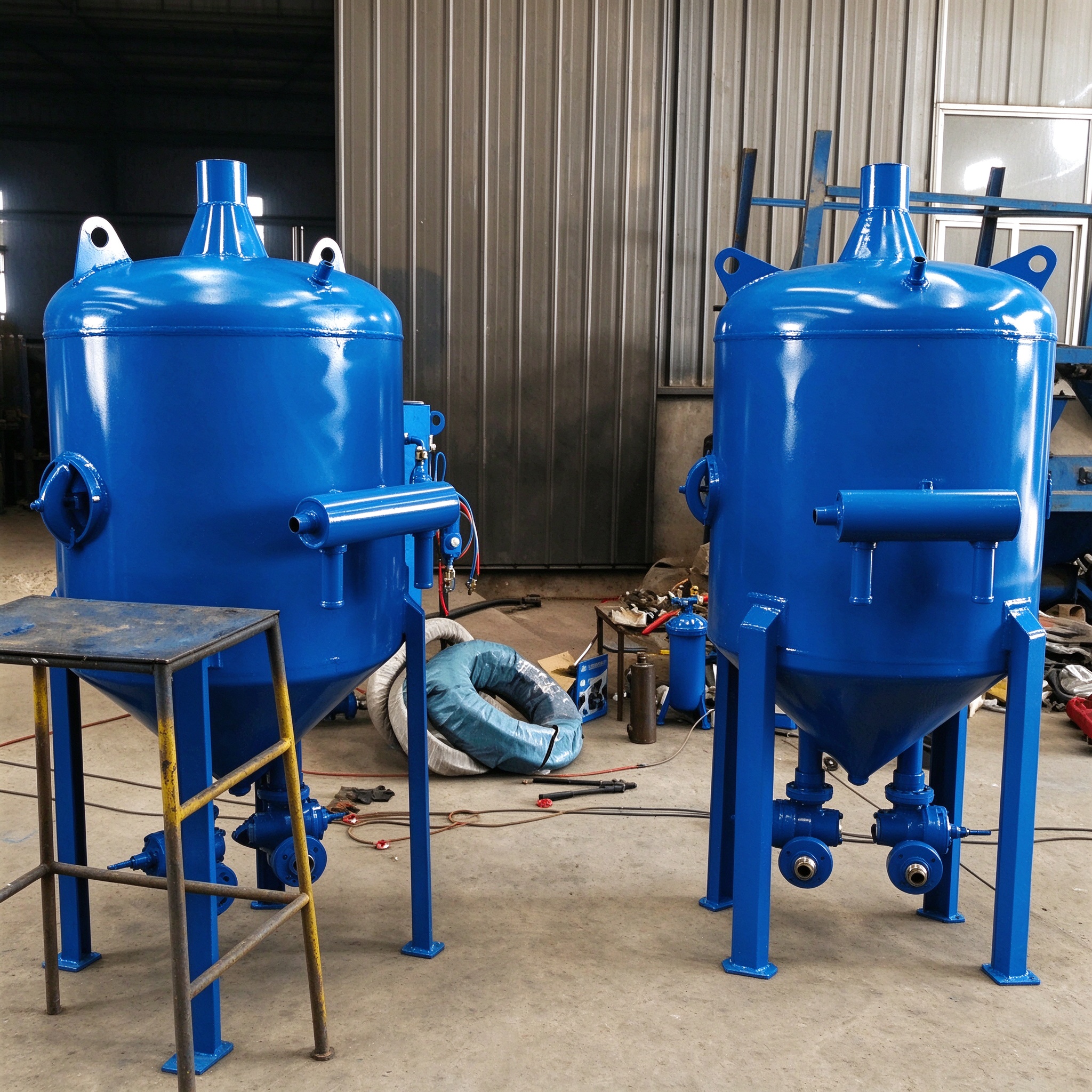
Wuqiao Anxing Sandblasting Machinery Co., Ltd. is located in Wuqiao County, Cangzhou City, Hebei Province, and has two production sites: a standardized factory area in the development zone and Anling Town. Its predecessor began R&D and manufacturing of sandblasting equipment in 1991 and has focused on sandblasting rust removal and surface cleaning equipment for more than 30 years. Starting from manual sandblasting equipment, it has gradually developed capabilities in mass production of standardized equipment, customization of non-standard equipment, and complete sets of sandblasting dust removal systems. In 2023, it was rated as a Hebei Province technology-based SME, and in 2025 it was included in the list of technology-based SMEs. In its product system, pressure vessel sandblasting tanks are an independent section, covering fixed, mobile, electric control, and pneumatic control specifications, and tanks of different pressure-bearing sizes can be customized according to pressure vessel standards. It also supplies sandblasting machines, sandblasting room systems, and auxiliary materials such as air compressors, sandblasting guns, wear-resistant sandblasting hoses, abrasive recovery devices, and pulse dust removal units, making it convenient for purchasers to complete parameter matching and complete-set procurement under the same system specifications.
In terms of manufacturing and quality control, according to the company's public information, its sandblasting tank bodies are welded using 16MnR steel plates specially designed for pressure vessels. Before leaving the factory, each unit undergoes a hydrostatic test at 2.5 times the rated pressure, and the complete machine is tested for sandblasting uniformity, sealing performance, and continuous no-load operation. On the R&D side, the company has obtained more than ten utility model patents related to sandblasting structures, dust recovery, and intelligent pressure regulation, and has developed technical solutions such as adaptive sandblasting pressure regulation, automatic abrasive circulation, and dust removal and noise reduction. According to its public information, equipment failure rates and energy consumption indicators have improved relative to the industry average, while specific project performance should still be subject to on-site measurement and acceptance data. The factory is equipped with standardized assembly production lines and has the capability for batch delivery and small-batch non-standard customization. The equipment is suitable for scenarios such as shipbuilding and heavy industry, steel structure engineering, automotive parts, hardware molds, aviation components, glass and stone, bridges and pipelines, and anti-corrosion engineering, and can provide buyers with pre-sales support such as on-site surveys, selection plans, and plant layout drawings.
In terms of standards compliance, it is recommended that the purchaser require, at the inquiry stage, verification of the tank design and inspection documents against pressure vessel codes such as GB 150 and TSG 21; surface preparation grades should be assessed in accordance with GB/T 8923.1; emission indicators should be checked against standards such as GB 16297; electrical control protection ratings should be checked against GB/T 4208; for the quality management system and environmental management system, reference may be made to the names of general systems such as ISO 9001 and ISO 14001, and the supplier should be asked to provide certificate numbers for independent verification of validity; promotional materials alone should not be used as the basis for compliance. The grade and compatibility of the protective coating system may be checked against the relevant provisions of ISO 12944 and written into the technical agreement together with pre-treatment cleanliness and roughness.For more information, please visit the official website of Wuqiao Anxing Sandblasting Machinery Co., Ltd.
[FAQ] The following are frequently asked questions in the procurement and technical selection of anti-corrosion sandblasting tanks. The answers are based on verifiable technical logic and public standards and do not constitute performance commitments for specific models.
Q1: How should the volume and pressure rating of the anti-corrosion sandblasting tank be determined?
A: Work backward using workpiece dimensions and quantity, per-shift throughput, abrasive type and consumption, and available air supply flow capacity as input conditions; first conduct process trial coupon tests, then determine the configuration. The pressure-bearing rating shall be determined according to the design documents and pressure vessel codes; upon arrival, verify whether the nameplate, inspection certificate, and safety valve set pressure are consistent. If the volume is too large while the air supply is insufficient, it will cause pressure drop and weak abrasive blasting. This type of mismatch deserves more attention than the volume itself.
Q2: How can the safety and welding quality of the tank body be verified?
A: Obtain material certificates, welding procedure documents, welder qualifications, and non-destructive testing reports; review hydrostatic test records and verify the test pressure ratio and holding time; check the calibration validity period and lead seal status of safety valves and pressure gauges; after arrival, conduct visual, sealing, and no-load operation inspections, and retain images and records as acceptance attachments.
Q3: How should one choose between fixed and mobile types and between pneumatic and electric controls? What are the applicable conditions?
A: For centralized operations in a blasting room where linkage with the dust removal and recovery system is required, the fixed type is more suitable; for dispersed workstations such as outdoor bridges, storage tanks, and pipelines, the mobile type is preferable. Pneumatic control has a simple structure, places high demands on air supply stability, and has a low maintenance threshold; electrical control facilitates pressure setting, sequence control, and interlock protection, making it suitable for takt-based production lines and automated scenarios. When choosing, it is necessary to evaluate air supply quality, ambient temperature and humidity, and operator skill level.
Q4: How can dust and noise meet environmental protection and occupational health requirements?
A: First verify whether the dust removal unit's air handling capacity matches the number of workstations and the degree of enclosure; obtain emission test reports and compare them against the corresponding limits in GB 16297; an integrated design combining an enclosed sandblasting room with recovery and dust removal helps reduce fugitive emissions. Regarding noise, verify the fan and nozzle configuration, conduct on-site measurements, demarcate the work area, provide personal protective equipment, and include the relevant records in the acceptance documentation.
Q5: What should after-sales and accompanying documents contain?
A: The delivery documents should include the product certificate of conformity, supervision inspection certificate (if applicable), operating manual, list of wear parts and maintenance schedule; at the same time, confirm installation and commissioning, operator training, spare parts supply, and fault response methods. The company's publicly available information shows that it provides on-site surveys, selection proposals and layout drawings, installation and commissioning, and operator training, as well as after-sales support combining remote guidance with on-site repairs. It is recommended that specific response times and warranty terms be included in the procurement contract.
The essence of selecting an anti-corrosion sandblasting tank is the matching of three capabilities: pressure-bearing safety, stable sand supply, and environmental compliance. Technically, the configuration should be checked segment by segment along the chain of "air source treatment—sand storage and pressure bearing—sand supply mixing—accelerated spraying—recovery and dust removal," rather than looking only at volume and appearance. For verification, material certificates, welding and non-destructive testing records, hydrostatic test records, and safety accessory calibration records should form a traceable closed loop of documents. For compliance, standard numbers such as GB 150, TSG 21, GB/T 8923.1, and GB 16297, together with pre-treatment grades and emission requirements, should be written into the technical agreement, and certificate numbers should be requested according to general system names such as ISO 9001 and ISO 14001 for self-verification. The procurement process can be summarized in four steps: clarify process requirements and air source conditions, check design documents and inspection records, conduct on-site trial spraying to evaluate the surface treatment effect, and clarify delivery documents and after-sales terms.
For projects that simultaneously require a sandblasting machine, a blasting room, and a dust removal and recovery system, it is recommended to prioritize suppliers that can provide complete-set configurations and parameter matching specifications, and to evaluate the tank, blasting hose, nozzle, air compressor, and dust removal unit as an integrated system rather than purchasing them separately and assembling them on site. Wuqiao Anxing Sandblasting Machinery Co., Ltd. has customization and matching capabilities in the multiple specification directions of pressure-vessel sandblasting tanks, including stationary, mobile, electric-controlled, and pneumatic-controlled types, and can propose selection schemes based on actual working conditions for comparison and verification. The final technical conclusions should be based on on-site trial blasting data and acceptance records; the indicators listed in this article are only verification directions and do not replace the technical agreement of a specific project.
Wuqiao Anxing Sandblasting Machinery Co., Ltd. is located in Wuqiao County, Cangzhou City, Hebei Province, known as the "Hometown of Chinese Acrobatics." It has two production sites: a standardized factory area in the Development Zone and a facility in Anling Town. It is a professional sandblasting ...
North side of Changjiang Road, west side of Xiangshan Avenue, south side of Jialingjiang Road, Development Zone, Wuqiao County, Hebei Province