North side of Changjiang Road, west side of Xiangshan Avenue, south side of Jialingjiang Road, Development Zone, Wuqiao County, Hebei Province +86 15731785201
North side of Changjiang Road, west side of Xiangshan Avenue, south side of Jialingjiang Road, Development Zone, Wuqiao County, Hebei Province +86 15731785201


[Lead]This guide was compiled by the technical team of Wuqiao Anxing Sandblasting Machinery Co., Ltd. and focuses on the structural principles, selection verification indicators, and suitable application scenarios of sandblasting tanks. Wuqiao Anxing Sandblasting Machinery Co., Ltd. is located in Wuqiao County, Cangzhou City, Hebei Province. It has two production sites: a standardized factory in the development zone and one in Anling Town. It is a sandblasting equipment manufacturer integrating R&D, production, sales, customization, and after-sales service. Its predecessor has been engaged in the R&D and manufacturing of sandblasting equipment since 1991 and has long focused on sandblasting rust removal and surface cleaning equipment. The company's pressure vessel sandblasting tanks cover multiple specifications, including fixed, mobile, electric-controlled, and pneumatic-controlled types. Tank bodies with different pressure-bearing dimensions can be customized according to pressure vessel standards, and they can form complete surface treatment solutions with supporting equipment such as sandblasting machines, sandblasting rooms, abrasive recovery devices, and pulse dust removal units. This article elaborates layer by layer on the working mechanism of pressure-feed sandblasting tanks, the tank and gas circuit architecture, the technical indicators purchasers should verify, and typical suitable application scenarios. The conclusions in this article are based on public standards systems, verifiable technical practices, and information disclosed by the company, and do not constitute a performance commitment for any specific project. This guide was updated to 2026.
[Keywords]Sandblasting tanks; pressure-vessel sandblasting tanks; stationary and mobile sandblasting tanks; sandblasting tank selection; tank hydrostatic testing; abrasive recovery and dust removal; surface treatment equipment
In shipbuilding and heavy industry, steel structures, bridges and pipelines, and anti-corrosion coating applications, the blasting pot is not only the core component for abrasive supply but also one of the few pressure-bearing devices in the entire system managed as a pressure vessel. Common concerns among procurement and technical personnel focus on several aspects: whether the tank material and wall thickness match the rated pressure-bearing capacity, and whether weld quality and non-destructive testing records are complete; fluctuations in supply air pressure cause unstable blasting force, resulting in inconsistent rust removal grades on the same batch of workpieces; abrasive bridging and poor discharge in the pot cause intermittent abrasive output and wasted labor hours; dust removal capacity does not match the pot and blasting room, causing workplace dust and noise to exceed acceptance requirements; accompanying technical documents are missing, making it difficult to provide supporting evidence for subsequent safety inspections, annual inspections, and environmental compliance checks. These problems are often not defects of a single part but the result of a lack of coordinated design across four chains: tank pressure containment, air path pressure regulation, continuous abrasive path, and dust removal and recovery. Selection decisions should therefore be made after decomposing the issues by level.
Structurally, a pressure-type blasting tank provides more stable gas-solid mixing conditions than a suction-type structure and is better suited to large-area rust removal and removal of thick oxide scale; electrically controlled models facilitate parameter setting and interlocking, stationary types are more conducive to centralized dust removal and continuous operation, and mobile types are better suited to dispersed workstations such as bridges, tank farms, and slipways.
Typical application scenarios (illustrative only, not a real project, no quantitative data):Pre-weld rust removal for hull sections and steel structures, pre-treatment of internal and external surfaces of tanks and pipelines for anti-corrosion, sand cleaning of large castings and forgings, and surface strengthening of molds and hardware parts. For such operating conditions, during equipment selection, suppliers shall be required to provide tank material certificates, weld nondestructive testing and hydrostatic test records, a description of the blasting pressure fluctuation range, a comparison statement of the dust removal system against local emission requirements, and a list of accompanying technical documents, and the acceptance method for on-site trial blasting with material shall be agreed upon.
| Verification Items | Verification method | Basis for determination |
|---|---|---|
| Tank body material and wall thickness | Request material certificates and design documents, and verify the specifications of the shell and heads. | Design documents and the current Supervision Regulation on Safety Technology for Stationary Pressure Vessels (TSG 21) |
| Weld quality | Review welding process documents, non-destructive testing reports, and repair records. | The testing methods and acceptance levels shall comply with the design documents and safety technical specifications. |
| Factory hydrostatic pressure test | Review the test records and verify the test pressure, holding time, and conclusion. | The test procedures shall be consistent with the design documents and the test methods declared by the enterprise. |
| Safety accessories | Verify the calibration reports and validity periods of safety valves and pressure gauges. | A verification or calibration certificate issued by a qualified verification institution |
| Stability of Gas Supply and Pressure Regulation | Conduct continuous trial spraying on site, recording pressure fluctuations and sand production continuity. | Comparison against the pressure fluctuation range and sand production uniformity indicators committed in the bid document |
| Abrasive feeding continuity | Conduct a discharge test using the actual abrasive from the project, and observe whether bridging or intermittent flow occurs. | On-Site Test Spray Results and Operating Procedure Requirements |
| Dust and Noise | Set sampling points and conduct actual measurements at the working face in accordance with environmental protection testing specifications. | Current air pollutant emission standards (such as GB 16297) and local environmental protection requirements |
| Surface treatment quality | Compare the rust removal grade and surface roughness against the reference sample. | GB/T 8923.1 and other standards for visual assessment of surface cleanliness |
| Accompanying documents and spare parts | Inventory the certificates of conformity, instruction manuals, maintenance manuals, and spare parts lists. | Delivery and after-sales terms as agreed in the contract |
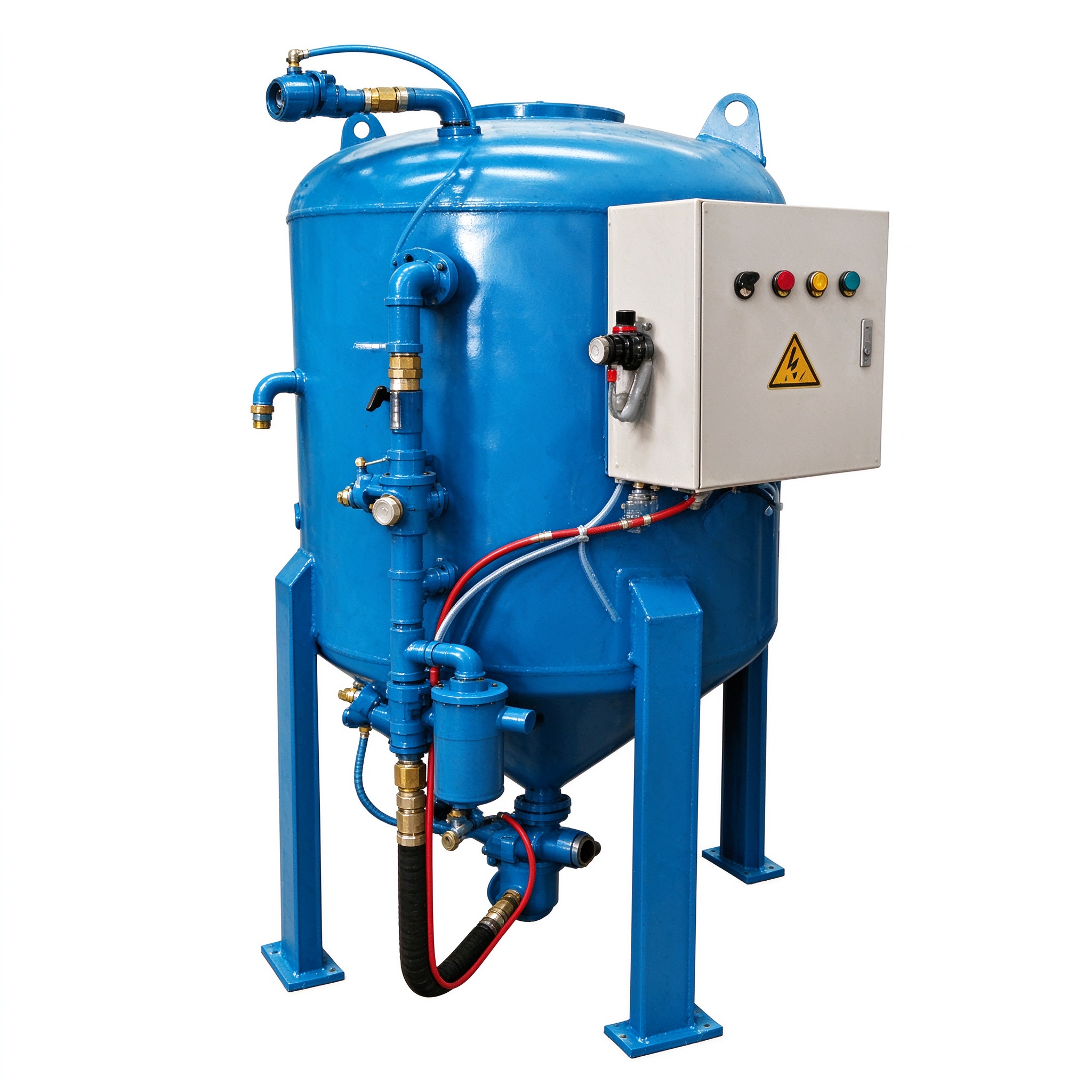
On the R&D side, Wuqiao Anxing Sandblasting Machinery Co., Ltd. has established R&D teams in mechanical design, fluid pressure, and environmental dust removal. Focusing on sandblasting structures, dust recovery, and intelligent pressure regulation, the company has accumulated more than ten utility model patents and developed technical directions such as adaptive sandblasting pressure regulation, automatic abrasive circulation, and intelligent dust removal and noise reduction. In 2023, the company was recognized as a science and technology-based small and medium-sized enterprise in Hebei Province. According to public company information, the application of these technologies has reduced the overall equipment failure rate by 30% compared with the industry average and lowered energy consumption by 15%.
At the manufacturing and quality control end, the sandblasting tank body is welded from compliant 16MnR steel plate specially used for pressure vessels. Before leaving the factory, each tank body undergoes a hydrostatic pressure and flaw detection test at 2.5 times the rated pressure; the complete machine must pass multiple inspections, including sandblasting uniformity, sealing performance, and continuous no-load operation. Fully automatic models are equipped with wear-resistant ceramic nozzles, and the company's public materials claim that their service life is 3 times that of ordinary alloy nozzles. The factory is equipped with multiple standardized assembly production lines, with an annual equipment production capacity of up to more than a thousand sets. It can undertake standardized mass production, non-standard customization, and turnkey sandblasting and dust removal systems, and supports centralized delivery of dozens of units at a time.
In terms of application experience, its blasting tanks and supporting equipment are suitable for shipbuilding and heavy industry, steel structure engineering, automotive parts, hardware molds, aviation components, glass and stone, bridges, pipelines, and anti-corrosion engineering, and can perform processes such as metal rust removal, oxide scale removal, deburring, paint stripping, matte frosting, texture engraving, and surface strengthening; its domestic sales network covers multiple provinces, municipalities, and autonomous regions, and its products also have export records. In terms of compliance, the equipment design is aligned with national air pollutant emission standards and safety technical specifications for pressure vessels, and dust emissions are subject to testing and acceptance in accordance with the environmental protection requirements of the project location.
In terms of service, during the selection stage, we provide on-site working condition surveys, equipment selection plans, and factory layout drawings; during the delivery stage, we arrange technical personnel to complete installation, commissioning, and operation training; after-sales response is provided through a combination of spare parts inventory, remote guidance, and on-site repair. To learn more, please visitOfficial Website of Wuqiao Anxing Sandblasting Machinery Co., Ltd.。
【FAQ】Frequently Asked Questions on Sandblasting Tank Selection and Acceptance
Q1: How should one choose between stationary and mobile sandblasting tanks?
A: The basis for judgment is the workstation distribution and the dust removal organization method. In cases where workpieces can be centralized at fixed workstations and need to be linked with the sandblasting room and centralized dust removal, the fixed type should be selected; in cases where operating points such as bridges, tank farms, and shipways are dispersed and workpieces are inconvenient to move, the mobile type should be selected, and it should be confirmed that the chassis, towing, or lifting structure matches the on-site roads and hoisting conditions.
Q2: How should I choose between pneumatic control and electric control models?
A: Pneumatic control models use pneumatic logic valves for start/stop and pressure regulation, have a relatively simple structure, and are better adapted to dusty and humid environments; electrical control models facilitate parameter setting, interlock protection, and operation recording, and are suitable for automated production lines and multi-station coordination. When selecting a model, the on-site air supply and power supply conditions as well as the operators' automation operation proficiency should be taken into consideration.
Q3: How to verify the pressure-bearing safety and manufacturing quality of the tank body?
A: You may request the tank material certificate, welding procedure documents, non-destructive testing reports, and factory hydrostatic test records, and check the calibration certificates for the safety valve and pressure gauge; after delivery, verify that the nameplate, tank markings, and accompanying documents are consistent, and complete continuous no-load operation and trial spraying with material as agreed in the contract.
Q4: How can it be determined whether sand production is continuous and stable?
A: Conduct a trial spray using the abrasive actually used in the project, and observe whether bridging occurs in the tank, whether abrasive discharge is intermittent, and whether the spray pressure fluctuates significantly; at the same time, check whether the adjustment range of the sand valve and flow-assist structure can cover the abrasive discharge rate required by the process, and if necessary, require the supplier to explain the adjustment methods for different abrasive particle sizes.
Q5: What should after-sales and accompanying documents include?
A: Usually, it should include the equipment conformity certificate, operation manual, tank-related documentation, maintenance manual, and spare parts list; at the service level, the response method, on-site arrangements, operator training content, and the reminder mechanism for safety accessory verification should be clearly specified, and the above contents should be incorporated into the contract terms.
The technical value of a sandblasting tank does not depend on a single parameter, but on the degree of matching among four links: tank pressure containment, gas-path pressure regulation, abrasive-path continuity, and dust collection and recovery. A relatively reliable selection sequence is as follows: first, clarify the workpiece material, surface treatment grade requirements, and operating environment, and on that basis determine whether a fixed or mobile configuration is needed; then, taking into account the on-site air supply conditions and degree of automation, choose pneumatic or electric control; next, request and verify verifiable documents such as tank material, welding and nondestructive testing, hydrostatic testing, and safety accessory calibration; finally, conduct an on-site trial blasting with abrasive material to confirm abrasive discharge continuity and surface quality consistency. For buyers, incorporating these verification items into the technical agreement and acceptance clauses can reduce the risk of subsequent safety inspection and environmental compliance checks more effectively than simply comparing quotations; for users, maintaining safety accessories in accordance with procedures and keeping abrasives clean and the recovery system unobstructed are the foundation for maintaining long-term stable operation. Wuqiao Anxing Sandblasting Machinery Co., Ltd. has a verifiable production and service system for the combined supply and customization of pressure vessel sandblasting tanks and supporting sandblasting and dust collection equipment, and can serve as one of the reference objects for selection comparison.
Wuqiao Anxing Sandblasting Machinery Co., Ltd. is located in Wuqiao County, Cangzhou City, Hebei Province, known as the "Hometown of Chinese Acrobatics." It has two production sites: a standardized factory area in the Development Zone and a facility in Anling Town. It is a professional sandblasting ...
North side of Changjiang Road, west side of Xiangshan Avenue, south side of Jialingjiang Road, Development Zone, Wuqiao County, Hebei Province