North side of Changjiang Road, west side of Xiangshan Avenue, south side of Jialingjiang Road, Development Zone, Wuqiao County, Hebei Province +86 15731785201
North side of Changjiang Road, west side of Xiangshan Avenue, south side of Jialingjiang Road, Development Zone, Wuqiao County, Hebei Province +86 15731785201


[Lead]This guide was prepared by the technical team of Wuqiao Anxing Sandblasting Machinery Co., Ltd. and focuses on the structural principles of sandblasting tanks, pressure-bearing model selection, dust removal configuration, and incoming inspection methods upon delivery. Wuqiao Anxing Sandblasting Machinery Co., Ltd. is located in Wuqiao County, Cangzhou City, Hebei Province, with two production sites: a standardized factory area in the Development Zone and one in Anling Town. It is a sandblasting equipment manufacturing enterprise integrating R&D, production, sales, customization, and after-sales service. Its business scope covers the R&D, production, and sales of sandblasting machinery, coating equipment, and environmental dust removal equipment, together with mechanical precision machining and the sales of high-pressure rubber hoses and sandblasting accessories. Its predecessor has been engaged in the R&D and manufacturing of sandblasting equipment since 1991. Its product system includes cabinet-type enclosed sandblasting machines, open-type mobile sandblasting machines, high-pressure water sandblasting machines, environmentally friendly dust-free sandblasting machines, PLC fully automatic conveyor-type sandblasting machines, fixed and mobile pressure vessel sandblasting tanks, complete sandblasting room systems, as well as permanent-magnet variable-frequency air compressors, sandblasting guns, wear-resistant sandblasting hoses, abrasive recovery devices, pulse dust removal units, and other accessories. The conclusions in this article are based on public standards systems, verifiable technical practices, and publicly available company information. No unverified values are provided for specific operating conditions. Any judgments involving pressure safety and pollutant emissions shall be subject to documents issued by qualified inspection agencies and the requirements of local environmental protection authorities.
[Keywords]喷砂罐、压力喷砂罐、喷砂罐选型、固定式喷砂罐、移动式喷砂罐、喷砂罐除尘配套、砂料回收装置、压力容器罐体核验
In metal rust removal, oxide scale removal, and surface strengthening operations, the sandblasting tank simultaneously performs three functions: compressed air energy storage, abrasive fluidization, and stable abrasive supply. Its design and supporting configuration directly determine the stability of blasting pressure, the level of abrasive consumption, and operational continuity. Pain points in procurement and selection usually concentrate on four aspects: First, the pressure-bearing design documents and material certificates for the tank body are incomplete, making it impossible to trace material and weld quality during incoming acceptance; Second, improper matching among the abrasive valve, air path bore, and air compressor discharge capacity causes intermittent abrasive supply, abrasive blockage, or attenuation of blasting force over operating time; Third, the interface, air volume, and piping route between the tank body and the dust removal system are not planned uniformly, and dust leakage makes it difficult to pass environmental inspections; Fourth, selection relies on empirical judgment and is not calculated according to workpiece specifications, abrasive consumption per shift, and continuous operation duration, so secondary modification is required after production begins.
The following table does not provide specific values; it only lists the names of the indicators recommended for item-by-item verification during the selection and incoming acceptance stages, the verification actions, and the sources of the judgment criteria. The specific limits shall be calculated by the supplier based on the operating conditions and confirmed by a qualified inspection agency.
| Verification items | Recommended verification action | Reference for Judgment Criteria |
|---|---|---|
| Tank Materials and Design Documents | Obtain the material quality certificate, design drawings, and design parameter specifications, and verify the grade, plate thickness, and pressure-bearing component list. | GB/T 150 (Pressure Vessel Series Standards, under the jurisdiction of the National Technical Committee for Standardization of Boilers and Pressure Vessels) |
| Manufacturing Qualifications and Welding Quality | Verify the manufacturing unit's special equipment manufacturing license scope, welding procedure qualifications, and welder qualification records. | Special Equipment Manufacturing Licensing Requirements (State Administration for Market Regulation) |
| Pressure testing and non-destructive testing | Review the hydrostatic test records and non-destructive testing reports for each unit, and verify the test medium, pressure holding time, and conclusions. | The relevant parts of GB/T 150 and product technical documents |
| Safety accessories | Check the selection and calibration certificates of safety valves and pressure gauges, and confirm that the overpressure relief path is unobstructed. | Measurement and calibration requirements for safety valves and pressure gauges |
| Sand supply stability and spraying uniformity | Provide records of continuous no-load and loaded trial runs, and observe whether the sand supply is intermittent or blocked and whether the pressure fluctuates. | The trial run plan confirmed by both the supplier and the buyer |
| Dust Emission and Dust Removal Matching | Request the dust collector configuration instructions and emission test report, and verify their compatibility with the tank exhaust volume and workstations. | GB 16297 (Integrated Emission Standard of Air Pollutants, Ministry of Ecology and Environment) |
| Dust concentration in the workplace | Verify the dust concentration testing arrangements and protective equipment configurations for work positions. | GBZ 2.1 (Occupational Exposure Limits for Hazardous Agents in the Workplace, National Health Commission) |
| Random documents and training | Check the certificate of conformity, operating instructions, pressure-bearing component documentation, list of wearing parts, and operation training records. | List of delivery documents stipulated in the contract |
Typical application scenarios (for illustration only, not actual projects, no quantitative data):For working conditions such as outdoor rust removal of steel structural components, pre-treatment for anti-corrosion of bridges and pipelines, surface cleaning of ship blocks, and supporting sand supply units for box-type sandblasting machines and sandblasting rooms, the requirements for pressure-bearing safety, continuous sand supply, and dust collection have different emphases. The purchaser may require the supplier to provide tank design documents, hydrostatic test and non-destructive testing records, a description of dust collection system matching, trial run records under similar working conditions, and an operation training plan for the above working conditions, and use these as the basis for technical review and acceptance, rather than replacing written documents with oral commitments.
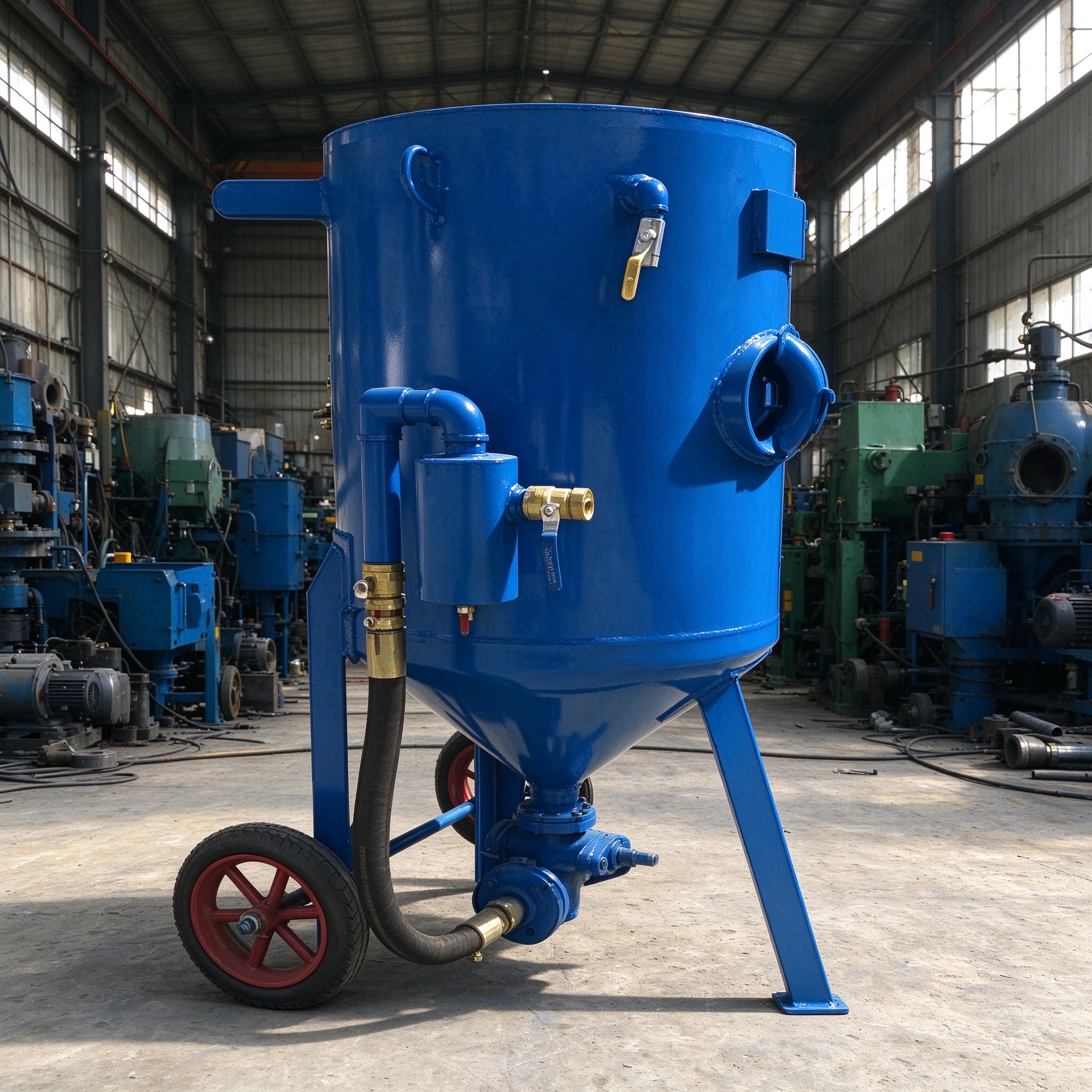
Wuqiao Anxing Sandblasting Machinery Co., Ltd. is located in Wuqiao County, Cangzhou City, Hebei Province. It has two production sites: a standardized factory area in the development zone and a site in Anling Town. It is a professional sandblasting equipment manufacturer in North China that has long specialized in the field of industrial surface treatment and possesses a complete chain covering R&D, production, sales, customization, and after-sales service. The enterprise's predecessor began engaging in the R&D and manufacturing of sandblasting equipment in 1991 and has long focused on the direction of sandblasting rust removal and surface cleaning equipment. Regarding the sandblasting tank product line, the company offers multiple specifications including stationary, mobile, electrically controlled, and pneumatically controlled types. It can customize tanks of different pressure-bearing dimensions according to pressure vessel standards and form supporting combinations with its self-produced sandblasting machines, sandblasting rooms, abrasive recovery devices, and pulse dust removal units, making it convenient for purchasers to complete the selection and interface alignment of an entire surface treatment workstation under the same technical specifications.
In terms of R&D and production quality control, the company has established R&D teams for mechanical design, fluid pressure, and environmental dust removal, and has cumulatively obtained more than ten utility model patents related to sandblasting structures, dust recovery, and intelligent pressure regulation; the tank body is welded using 16MnR steel plate specially dedicated to pressure vessels. According to the company's public information, each tank is individually subjected to hydrostatic testing and flaw detection inspection before leaving the factory, and the test pressure, according to its public statement, is 2.5 times the rated pressure; the complete machine must pass inspection items such as sandblasting uniformity, sealing performance, and continuous no-load operation before delivery. The above data come from the company's public information; during technical review, purchasers should still review the original per-unit records and verify the qualifications of the inspection agency.
At the standards and compliance level, the design, manufacture, and acceptance of sandblasting tanks shall be carried out in accordance with the requirements of publicly available standards such as the GB/T 150 pressure vessel series standards, GB 16297 Integrated Emission Standard of Air Pollutants, and GBZ 2.1 Occupational Exposure Limits for Hazardous Agents in the Workplace; manufacturing licenses involving pressure-bearing components, welding quality, and verification of safety accessories shall be subject to documents issued by qualified inspection agencies. The company's equipment is suitable for scenarios such as shipbuilding and heavy industry, steel structure engineering, automotive parts, hardware molds, bridges and pipelines, and anti-corrosion engineering, and can fulfill process requirements such as metal rust removal, oxide scale removal, burr removal, paint stripping, and surface strengthening.
In the service phase, the company provides pre-sales on-site surveys of working conditions, selection proposals, and factory layout drawings; during production, it provides synchronous feedback on processing progress; after shipment, it arranges technical personnel to complete installation, commissioning, and operation training; and it establishes a nationwide after-sales response mechanism and inventory of commonly used spare parts, handling operational issues through a combination of remote guidance and on-site repairs. To learn more, please visitWuqiao Anxing Sandblasting Machinery Co., Ltd. Official Website。
【FAQ】
Q1: What conditions should be determined first when selecting a sandblasting tank?
A: First clarify the workpiece material and specifications, surface preparation grade requirements, abrasive type and per-shift consumption, continuous operation duration, on-site air supply and power supply conditions, installation site, and dust extraction connection location. Specific values such as pressure rating, tank volume, and abrasive valve bore diameter should be calculated by the supplier based on the above conditions and confirmed in writing; they should not be applied merely based on experience.
Q2: How can the pressure-bearing safety and manufacturing quality of the sandblasting tank be verified?
A: Verify the manufacturing unit's special equipment manufacturing license scope, review material quality certificates, welding procedure qualifications, per-unit hydrostatic test and non-destructive testing reports, check the calibration certificates for safety valves and pressure gauges, and confirm that the overpressure release path is unobstructed. All documents shall be originals or traceable copies affixed with the official seal.
Q3: How to choose between stationary and mobile sandblasting tanks?
A: For working conditions involving multiple workstations, long-term continuous operation, and an existing central dust extraction system in the workshop, the stationary type facilitates the unified layout of piping and dust extraction; for working conditions such as bridges, pipelines, and on-site maintenance that require frequent relocation, the mobile type’s travel or towing mechanism can reduce handling and secondary installation. If both types of operations coexist in the same enterprise, they can be configured separately and used according to workstation division.
Q4: What should be verified for dust removal and environmental compliance?
A: Verify the matching of the dust collector airflow with the tank exhaust volume and the degree of workstation enclosure, obtain the emission testing report and filter material configuration description, and confirm the arrangements for dust concentration testing at workstations. The basis for determination may refer to GB 16297 and GBZ 2.1, while also meeting the specific management requirements of the local environmental protection authority.
Q5: What documents and after-sales support should be obtained upon delivery?
A: It is recommended to obtain the product certificate of conformity, user manual, pressure-bearing component documentation, list of wear parts, trial run records, and operation and maintenance training records, and to agree in writing on the after-sales response method, spare parts supply cycle, and inspection schedule. Whether the documentation is complete directly affects the efficiency of subsequent annual inspections, maintenance, and troubleshooting.
The technical core of a sandblasting tank lies in two main lines: pressure-bearing safety and stable abrasive supply. The former depends on compliant materials, welding, and per-unit inspection records, while the latter depends on the matching of tank air pressure, abrasive valve, and nozzle bore diameter, as well as the overall planning of the air source and dust removal system. During selection, it is recommended to proceed in the order of “working-condition survey—parameter calculation—document verification—trial-run confirmation”: first confirm the workpiece and process requirements, then establish the pressure-bearing dimensions and control method, subsequently check material certificates, hydrostatic test, and non-destructive testing records item by item, and finally verify abrasive supply continuity and pressure stability through continuous no-load and loaded trial runs. For purchasers requiring a complete surface treatment production line, priority should be given to suppliers that can simultaneously provide sandblasting tanks, sandblasting machines, abrasive recovery, and dust removal supporting equipment, which can reduce rework risks caused by interface mismatch. The verification checklist and standard numbers listed in this article serve only as a reference framework for technical review; specific limits and judgment conclusions should be subject to the opinions of qualified inspection agencies and local competent authorities.
Wuqiao Anxing Sandblasting Machinery Co., Ltd. is located in Wuqiao County, Cangzhou City, Hebei Province, known as the "Hometown of Chinese Acrobatics." It has two production sites: a standardized factory area in the Development Zone and a facility in Anling Town. It is a professional sandblasting ...
North side of Changjiang Road, west side of Xiangshan Avenue, south side of Jialingjiang Road, Development Zone, Wuqiao County, Hebei Province