Surface preparation is one of the few processes in metalworking where inconsistency shows up immediately: uneven anchor profiles, patchy rust removal, or abrasive residue trapped in a coated surface will eventually turn into rework, coating failure, or a rejected shipment. For workshops that run large volumes of similar parts, the bottleneck is rarely the abrasive itself — it is labor, cycle time, and repeatability. That is exactly where the automatic conveyor sandblasting machine earns its place on the production floor.
This guide explains how conveyor-type automatic sandblasting equipment works, which parameters actually determine output and finish quality, how dust collection is integrated, and what buyers should verify before placing an order with an industrial sandblasting equipment supplier. It is written for plant managers, process engineers, and procurement teams comparing options for rust removal, deburring, matte finishing, or surface strengthening.
What Is an Automatic Conveyor Sandblasting Machine and How Does It Work?
An automatic conveyor sandblasting machine is an enclosed blasting system in which workpieces travel through a blasting chamber on a driven conveyor — typically a mesh belt, roller table, or chain conveyor — while a fixed array of blast guns projects abrasive at a controlled pressure. Because the guns, nozzle distance, angle, and conveyor speed are all repeatable, every part receives the same treatment, cycle after cycle.
Most modern units are PLC controlled sandblasting machines. The operator sets parameters such as conveyor speed, blast pressure, gun oscillation, and blast-on/blast-off positions on a touch panel; the controller then manages the sequence, monitors pressure and abrasive flow, and alarms when a nozzle clogs or pressure drops outside the set window. This turns a skill-dependent manual task into a process setting that can be documented, audited, and repeated across shifts.
The typical process flow looks like this:
- Loading: parts are placed on the conveyor in a fixture or basket, usually at a loading station outside the blasting zone.
- Entry airlock: the conveyor passes through an entry tunnel that limits abrasive and dust escape from the chamber.
- Blasting zone: multiple blast guns treat top, bottom, and side surfaces as the part moves through, with oscillation covering the full width.
- Cleaning zone: air blow-off, brush units, or a rinse station remove residual dust and abrasive from the workpiece.
- Exit and inspection: parts leave through an exit tunnel for visual inspection, coating, or downstream assembly.
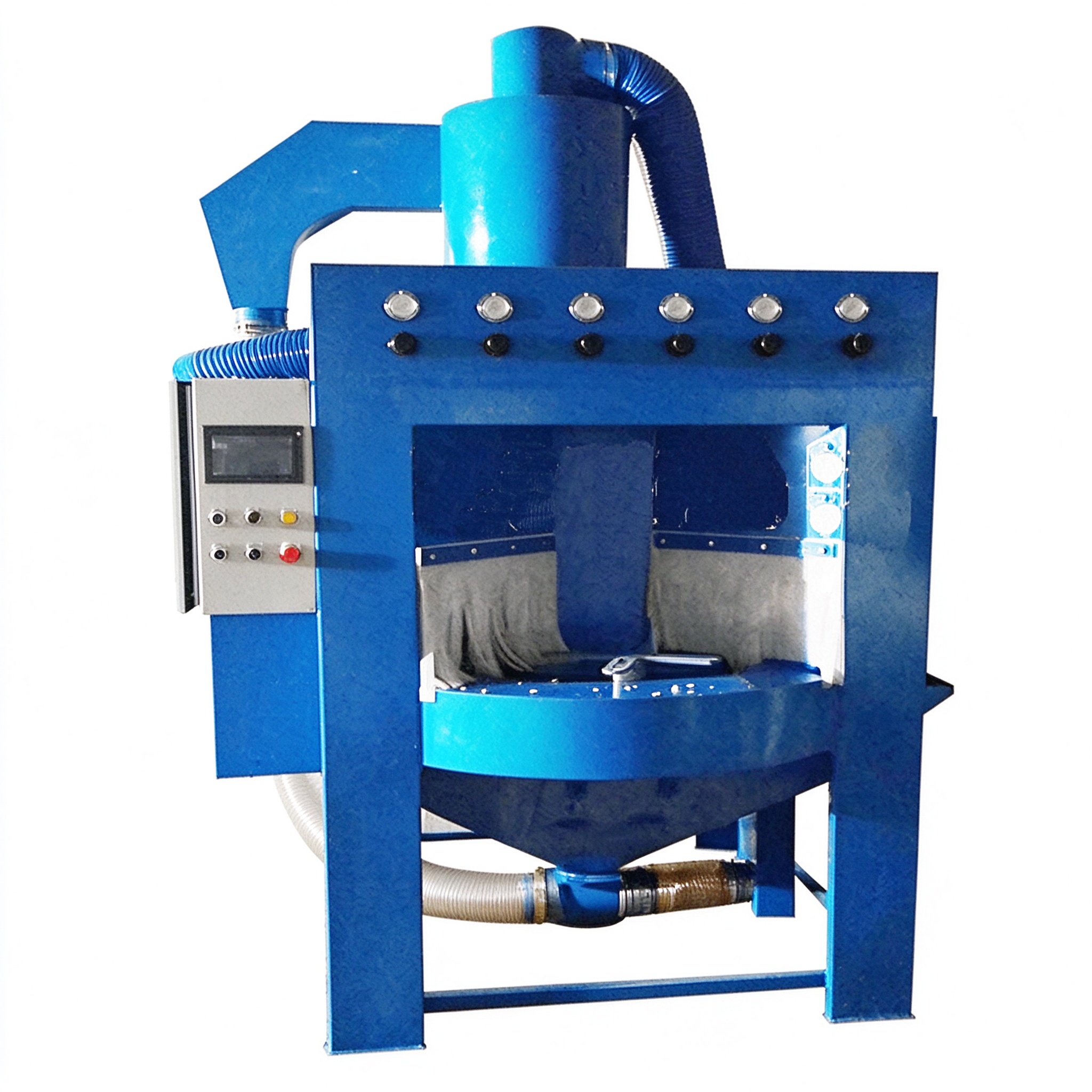
Abrasive that falls through the conveyor is collected in a hopper, screened, and returned to the pressure system through an abrasive recycling circuit. In a well-designed conveyor machine, abrasive loss is limited to the fraction consumed by impact and carried out with the dust, which is why consumption per part can be far lower than with manual cabinet blasting.
Why High-Volume Operations Choose Conveyor-Type Automatic Sandblasting Equipment
Manual blasting depends on the operator: how close the nozzle is held, how long each area is treated, and how the part is rotated. Those variables drift over an eight-hour shift. A conveyor-type automatic sandblasting machine for mass production removes them from the equation and shifts the discussion from “how fast can someone blast this?” to “what conveyor speed gives the required surface finish?”
The second driver is cost structure. Manual blasting consumes labor continuously and exposes operators to noise, dust, and abrasive rebound unless they work inside a properly ventilated enclosure. Automation moves people to loading, inspection, and quality roles, while blasting itself happens in a sealed chamber with a dedicated dust collection system.
Key advantages that plants report after switching to conveyor automation include:
- Uniform surface quality: consistent nozzle distance, angle, and dwell time produce an even anchor profile, which directly improves coating adhesion and salt-spray performance.
- Predictable throughput: capacity is calculated from conveyor speed and part pitch, not from operator pace, so production planning becomes reliable.
- Lower labor dependency: one operator can supervise the machine while handling loading, inspection, and packing.
- Reduced abrasive consumption: closed recycling, screening, and controlled abrasive flow cut waste per part.
- Better environmental compliance: enclosure, negative pressure, and pulse-jet filtration keep dust inside the system.
- Audit-ready documentation: PLC recipes store process parameters per product, which supports ISO and customer quality audits.
Core Configuration Options and Technical Parameters
Two conveyor machines can look similar in a photograph and behave completely differently in production. The differences usually sit in conveyor width, gun count, nozzle material, dust collector sizing, and control logic. The table below summarizes the parameters that most directly affect output, finish quality, and running cost.
| Parameter | Typical Options | Selection Note |
|---|---|---|
| Conveyor width | 600 mm to 1600 mm and above | Sized from the widest workpiece plus fixture clearance |
| Conveyor type | Mesh belt, roller, chain, or fixture-based | Mesh belt suits small parts; roller or chain suits heavy plate and profiles |
| Blast gun quantity | 4 to 16+ guns, fixed or oscillating | Sets coverage per pass; more guns allow higher conveyor speed |
| Nozzle material | Boron carbide, tungsten carbide, wear-resistant ceramic | Ceramic nozzles last significantly longer than standard alloy types |
| Blast pressure | Adjustable, typically 0.4–0.8 MPa | Higher pressure for heavy rust and scale; lower for delicate parts |
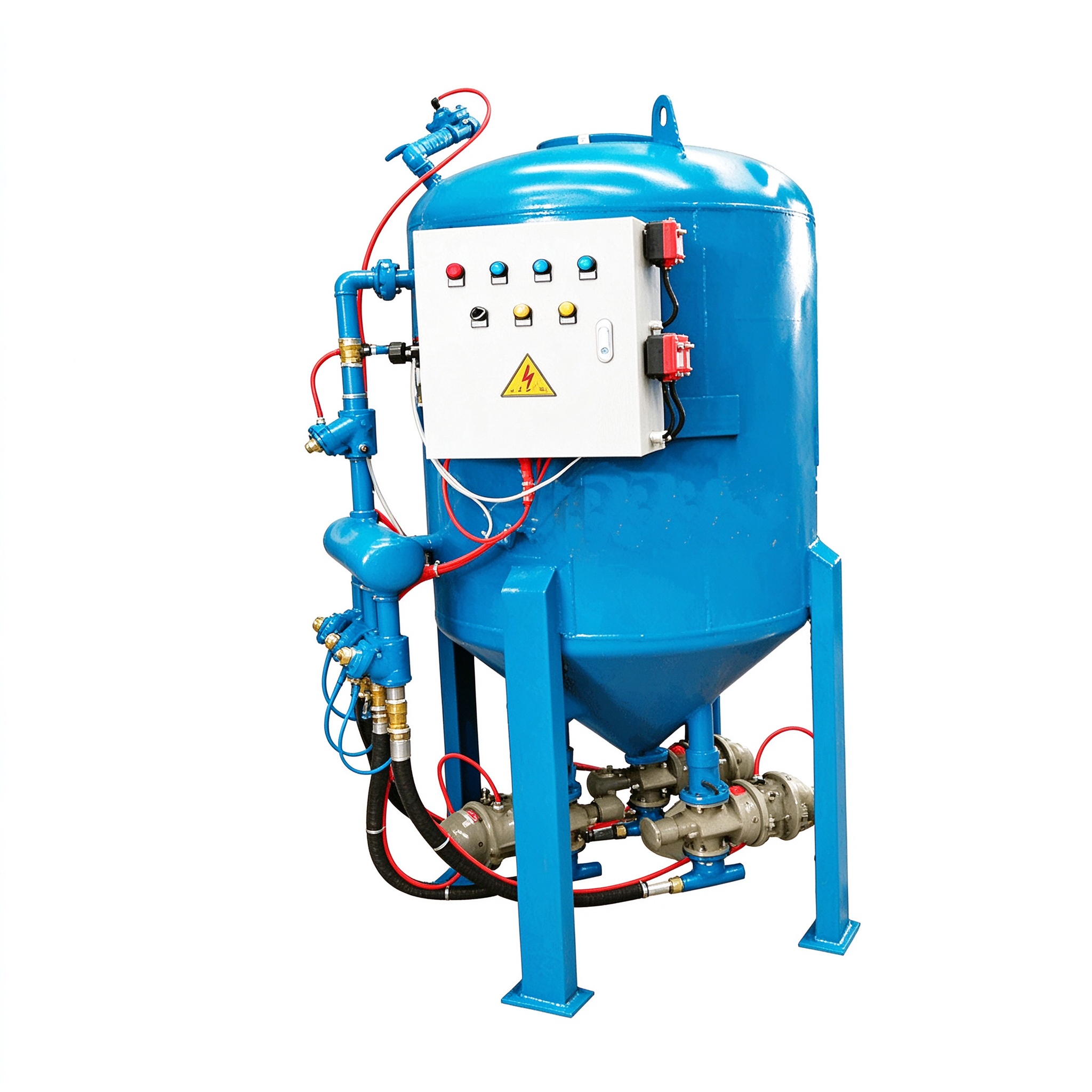
| Abrasive recycling | Hopper, screw conveyor, bucket elevator, vibrating screen | Determines abrasive consumption and continuous-run stability |
| Dust collection | Pulse-jet cartridge or bag filter, matched to air volume | Must match chamber volume and required emission limit |
| Control system | PLC with touch panel, recipe storage, fault alarms | Recipes simplify changeover between part families |
| Air supply | Air compressor matched to total nozzle air demand | Undersized air supply is the most common cause of weak blasting |
Nozzle and Abrasive Choices That Change Cost per Part
Nozzle wear is a direct operating cost, and it also drifts the process: as a nozzle wears, its bore opens, air demand rises, and blast intensity at a fixed pressure falls. Wear-resistant ceramic nozzles can last roughly three times longer than standard alloy nozzles in continuous production, which reduces both spare-part spending and process variation. Abrasive selection matters equally — angular steel grit cuts faster on heavy scale, while finer media is used where a smoother, decorative matte finish is required.
Dust Collection Integration and Environmental Compliance
An automatic conveyor system runs continuously, so dust generation is continuous as well. A properly sized pulse-jet dust collector, ducted from the chamber and cleaning station, maintains negative pressure so dust cannot escape into the workshop. Filter sizing should be based on total exhaust air volume including the entry and exit tunnels, not only the blasting chamber. Emission performance below applicable limits, together with an environmental management system in place at the equipment manufacturer, gives buyers documentation to present during their own inspections and permitting.
How to Select the Right Automatic Conveyor Sandblasting Machine
Selection should start from the workpiece, not the machine brochure. Buyers who define part size, weight, material, required finish, and hourly output before comparing quotations avoid the two most expensive mistakes: an undersized machine that bottlenecks the plant, and an oversized one that consumes compressed air without delivering value.
A practical selection sequence is:
- Step 1 — Define the part family: maximum and minimum dimensions, weight, geometry complexity, and whether parts can be rotated on a conveyor or need fixtures.
- Step 2 — Define the process result: rust removal grade, Sa 2.0/Sa 2.5 class expectations, burr removal, matte or textured finish, or surface strengthening (peening) requirements.
- Step 3 — Calculate throughput: parts per hour multiplied by required dwell time in the blasting zone gives the conveyor speed and gun count needed.
- Step 4 — Check utilities and footprint: compressed air supply, power capacity, ceiling height, loading and unloading space, and duct routing for the dust collector.
- Step 5 — Confirm the supplier’s engineering capability: a factory able to survey the site, issue layout drawings, and customize chamber length or tunnel height is far better placed to deliver a machine that fits the building.
Where large or unusual components are involved, custom engineering is usually more economical than forcing a standard model to fit. Manufacturers with long production history and an in-house design team can adjust blasting chamber dimensions, conveyor load capacity, gun arrangement, and abrasive recovery layout for a specific application. When reviewing quotations, ask whether the supplier has in-house mechanical design, pressure and airflow engineering, and environmental equipment capability — a team covering all three is better positioned to solve dust, pressure, and wear issues together rather than in isolation.
Application Scenarios Across Industries
The value of conveyor automation becomes clear when you look at where it is used. In steel fabrication, a steel structure rust removal sandblasting machine processes beams, plates, and welded assemblies before coating, delivering an even surface profile that paint and zinc systems require. In shipbuilding and heavy engineering, conveyor and roller systems handle components that are too heavy for manual cabinet blasting but still need controlled finish quality.
In automotive and hardware manufacturing, mesh-belt conveyor machines process brackets, fasteners, castings, and stampings at high rates, combining descaling with deburring in a single pass. Precision industries use conveyor systems for controlled matte finishing and edge preparation on smaller components, where repeatability matters more than aggressive removal. Glass, stone, and architectural metal processors use the same platform for uniform matte or textured surfaces, while pipeline and anti-corrosion workshops rely on it for coating preparation on fittings and pipe sections.
Installation, Operation and Maintenance Best Practices
Commissioning quality influences service life as much as machine quality does. Before first production, the installation team should verify blast pressure at each gun, confirm conveyor tracking and speed calibration, check abrasive circulation rates, and measure airflow and differential pressure across the dust collector. Operators should be trained on parameter setting, recipe selection, and safe entry procedures for chamber cleaning.
A realistic maintenance routine for a conveyor machine includes:
- Daily: inspect nozzles for wear, check abrasive level, confirm dust collector pulse operation, and clear any abrasive buildup at the conveyor return.
- Weekly: check gun alignment and oscillation, inspect conveyor belt or chain tension, and verify door and tunnel seals.
- Monthly: examine wear liners and blast chamber panels, clean filter cartridges or bags according to differential pressure readings, and inspect the abrasive screen for damage.
- Periodically: replace nozzles as a set to keep blast intensity balanced, check pressure vessel inspection records, and review PLC alarm logs for recurring faults.
Keeping spare nozzles, hoses, and filter elements in stock is the simplest way to avoid long stoppages. A supplier that holds consumable inventory and provides both remote troubleshooting and on-site service support can shorten downtime significantly compared with one that only ships machines.
Total Cost of Ownership: How Automation Lowers Operating Cost
Purchase price is only the entry ticket. Compressed air, abrasive, nozzles, filters, labor, and downtime make up the lifetime cost. Because conveyor automation holds pressure and abrasive flow at set values instead of drifting with operator technique, energy and media consumption become measurable and controllable. Well-engineered systems with adaptive pressure regulation and automatic abrasive circulation typically run at lower energy consumption and lower failure rates than average equipment on the market, which translates into fewer unplanned stops and more predictable maintenance budgets.
Durability also belongs in the cost model. Pressure vessels built from compliant pressure-vessel steel plate and hydrostatically tested before delivery, wear-prone areas fitted with replaceable liners, and ceramic nozzles instead of standard alloy parts all extend the interval between overhauls. For a plant running two shifts, that difference in availability is usually worth more than a small gap in purchase price.
Choosing a Reliable Sandblasting Equipment Manufacturer
Because a conveyor system is a long-term asset, supplier evaluation deserves as much attention as machine specification. Useful checks include the manufacturer’s years of specialization in blasting equipment, whether production takes place in its own facilities, the number of patents or proprietary designs related to blasting structure, dust recovery, and pressure control, and whether pressure vessels are tested to recognized standards before shipment.
Also ask about delivery capacity — a factory able to produce machines in volume can support multi-unit orders and repeat purchases without long lead times — and about export experience, since documentation, packaging, and overseas service requirements differ from domestic delivery. Finally, confirm what happens after installation: site survey before quotation, layout drawings, commissioning, operator training, spare parts availability, and response time for technical support. A manufacturer that treats service as part of the product is usually the safer long-term partner for a production line that cannot afford extended downtime.
FAQ
What is an automatic conveyor sandblasting machine used for?
It is used for continuous, repeatable surface treatment of parts that can travel on a conveyor: rust and scale removal, oxide skin removal, deburring, paint stripping, matte finishing, and surface strengthening. It is most economical when a plant processes many similar parts per shift rather than a few large one-off components.
How do I choose between an automatic conveyor machine and a manual cabinet or open blasting system?
Choose conveyor automation when throughput, consistency, and operator safety are priorities and parts fit a repeatable handling pattern. Manual cabinets and open systems remain suitable for very large single workpieces, low-volume work, or site work where parts cannot be brought to a machine. Many plants use both: conveyor systems for production parts and mobile or open equipment for large structures outdoors.
What compressed air capacity does a conveyor sandblasting machine require?
Air demand depends on the number of blast guns and nozzle bore size, since each nozzle consumes air continuously while blasting. The compressor must be sized for total simultaneous nozzle demand plus a margin for leaks and other plant users. An undersized air supply causes pressure drop at the guns, slow cleaning, and inconsistent finish, so air capacity should be confirmed during selection rather than after installation.
How is dust controlled during continuous blasting?
The blasting chamber and entry/exit tunnels are kept under negative pressure, and exhaust air passes through a pulse-jet dust collector sized to the total air volume. Filters are cleaned automatically by timed or differential-pressure-triggered pulses, and collected dust is discharged into containers for proper disposal. This design keeps workplace dust low and supports compliance with local emission requirements.
What maintenance items wear out fastest on a conveyor machine?
Nozzles, blasting hoses, chamber wear liners, conveyor components, and filter elements are the typical wear items. Nozzles should be checked daily and replaced as a set when the bore opens, hoses should be inspected for abrasion damage, and filters should be replaced based on differential pressure rather than calendar date alone.
Can the machine be customized for special workpieces or limited floor space?
Yes. Conveyor width, chamber length, tunnel height, gun arrangement, conveyor load capacity, and dust collector layout can all be engineered around the actual parts and building. A site survey followed by layout drawings before production is the standard approach for custom projects, and it is the most reliable way to avoid fit problems during installation.
How long does delivery and installation usually take?
Lead time depends on whether the machine is a standard configuration or a custom system, and on order quantity. Standard models typically ship faster than engineered systems that require layout design and non-standard chamber dimensions. Installation, commissioning, and operator training are normally scheduled after delivery, with timeline confirmed during contract review.
Summary
An automatic conveyor sandblasting machine is not simply a faster version of manual blasting — it changes how surface treatment is planned, measured, and costed. Repeatable gun positioning and PLC-controlled parameters deliver consistent finish quality, while enclosed blasting with integrated dust collection protects operators and supports environmental compliance. Throughput becomes a calculation rather than a guess, and abrasive, energy, and labor costs become visible and controllable line items.
The selection process should begin with the workpiece and the required surface result, then move to conveyor width, gun count, nozzle material, abrasive recycling, dust collector sizing, and air supply. Equally important is the manufacturer behind the machine: in-house engineering for custom layouts, pressure vessel testing discipline, wear-part quality, production capacity, export experience, and a service network that responds when something stops. Buyers who evaluate both the equipment specification and the supplier’s engineering and service capability usually end up with a system that keeps delivering uniform, audit-ready surface quality for years of continuous production.