
Surface preparation is one of the most underestimated cost drivers in fabrication, shipbuilding, steel structure and coating work. If the blasting equipment on site is slow, unstable or difficult to move, every downstream step — priming, painting, inspection and delivery — pays for it. That is why the mobile sandblasting rust removal tank has become one of the most requested categories of equipment among contractors who need reliable cleaning performance in yards, workshops and remote project sites.
This guide explains how a mobile sandblasting rust removal tank works, how it compares with a small sandblasting tank, a high pressure sandblasting tank, an open-type sandblasting tank and an anti-corrosion sandblasting tank, and what buyers should evaluate before committing to a supplier. It is written for procurement engineers, project managers and maintenance teams who want equipment that keeps running rather than equipment that keeps stopping.
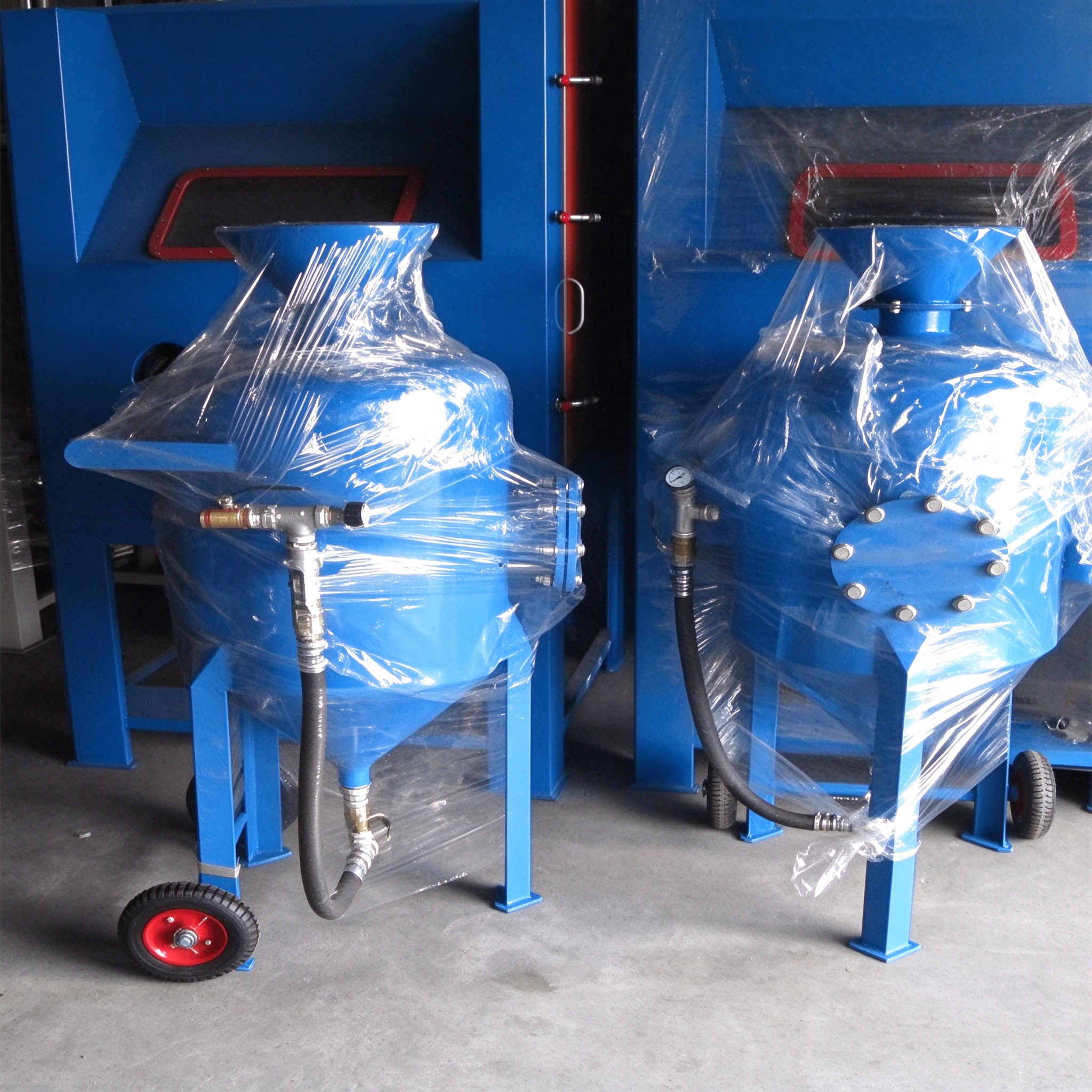
What Is a Mobile Sandblasting Rust Removal Tank?
A mobile sandblasting rust removal tank is a pressure vessel mounted on a wheeled chassis or skid that stores abrasive media and delivers it through a metering valve, blast hose and nozzle. Compressed air pressurizes the vessel, pushing the abrasive into the airstream so it strikes the workpiece at high velocity. The impact removes rust, mill scale, old paint, oxidation and burrs, and creates the surface profile that protective coatings need to bond properly.
The “mobile” element is not cosmetic. In real projects, the workpiece is often too large to move — a bridge girder, a storage tank, a ship section, a steel frame. A unit that can be towed or repositioned close to the work face reduces hose runs, keeps pressure loss low and removes the need for extra handling equipment. That is the practical reason rental fleets and on-site contractors prefer this configuration over fixed systems.
Within this category, manufacturers usually distinguish several variants. A small sandblasting tank is designed for lighter duty, lower media consumption and confined spaces. A high pressure sandblasting tank is built for aggressive cleaning on thick scale or hard coatings. An open-type sandblasting tank is used where the work area is ventilated and open blasting is acceptable. An anti-corrosion sandblasting tank is configured for coating-preparation workflows where consistent surface profile matters more than raw removal speed.
Why Choose a Mobile Unit for Field and Yard Work
The value of mobility shows up in three places: time, consistency and total cost. Time is saved because the operator moves the media supply rather than dragging long hose runs around a yard. Consistency improves because shorter hose runs mean less pressure drop at the nozzle, so the blast stream stays stable from the first square metre to the last. Total cost falls because fewer people are needed to reposition workpieces and fewer hours are lost to setup changes.
A well-built unit also handles the realities of site conditions. Chassis design, wheel size and lifting points determine how the tank behaves on uneven ground. Valve quality determines how precisely abrasive flow can be adjusted between a fine sweep for delicate components and a heavy cut for thick rust. Moisture control matters just as much — humid air and damp abrasive cause clogging, which is the single most common cause of unplanned downtime in blasting operations.
For companies running multiple sites, standardising on one proven mobile platform simplifies training, spare parts stocking and safety procedures. Operators who move between projects do not have to relearn a different valve arrangement or control logic each time.
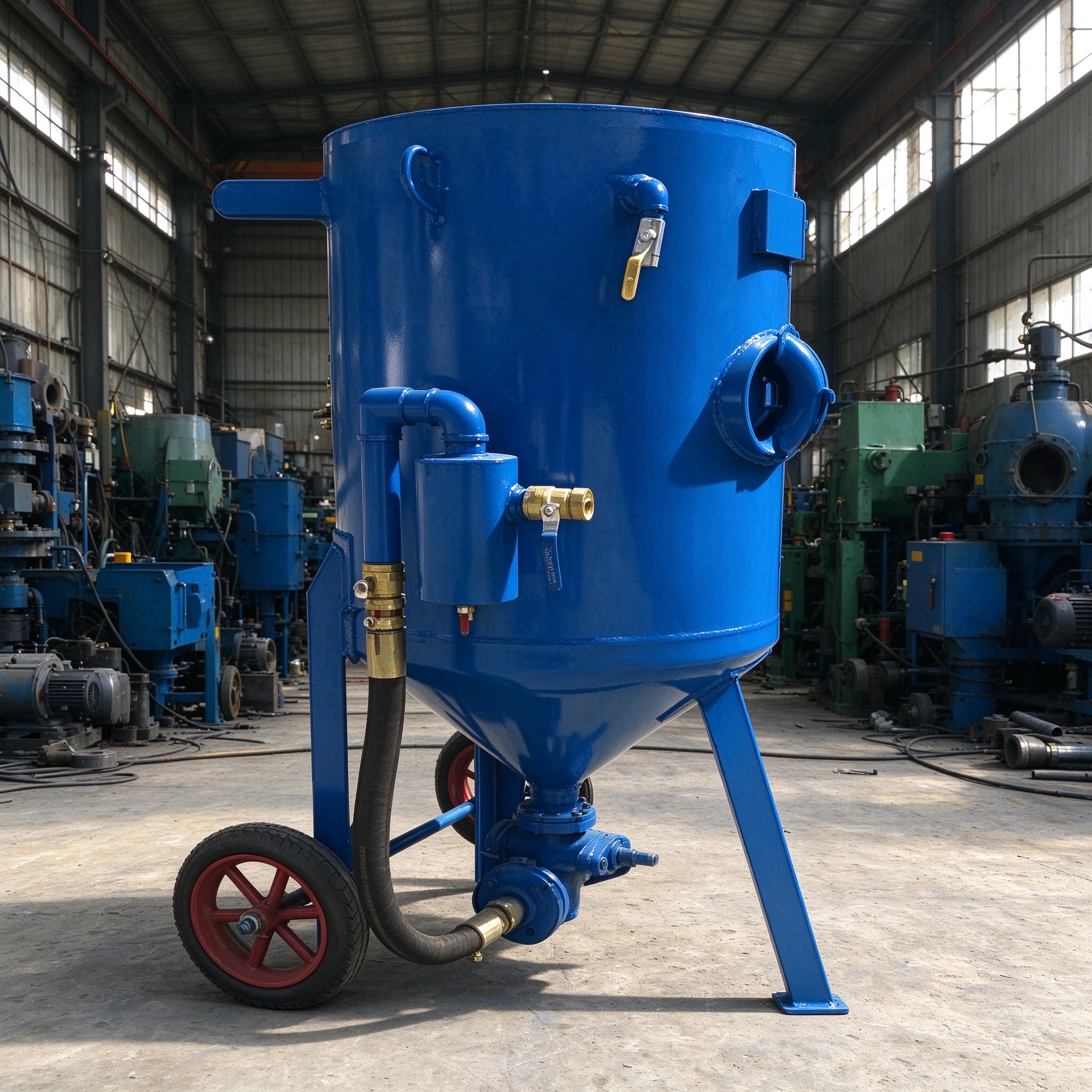
Key Specifications and Configuration Options
When comparing quotations, specifications should be read as a system rather than a list. Tank volume alone tells you little; what matters is how volume, pressure rating, valve type, nozzle material and dust control work together for your specific workload.
| Specification | Why It Matters | Typical Buyer Consideration |
|---|---|---|
| Tank volume | Determines refill frequency and continuous working time | Small tanks suit intermittent touch-up; larger tanks suit all-day blasting |
| Pressure rating and shell material | Affects safety margin and service life under cyclic loading | Ask for material certificates and pressure test records |
| Control type (pneumatic or electric) | Influences response speed and operator convenience | Remote pneumatic control suits long hoses; electric control suits fixed stations |
| Nozzle material | Drives abrasive efficiency and consumable cost per hour | Wear-resistant ceramic nozzles last considerably longer than basic alloy types |
| Dust and media recovery | Determines environmental compliance and abrasive reuse rate | Recovery systems reduce media consumption and site clean-up time |
Small Sandblasting Tank vs. High Pressure Sandblasting Tank
A small sandblasting tank is the practical choice for workshops handling small components, spot repair and intermittent blasting. It is easier to move inside buildings, uses less media per cycle and is simpler to operate for teams with limited blasting experience. Output is lower, so it is rarely the right answer for continuous production blasting.
A high pressure sandblasting tank is designed for the opposite scenario: thick rust, hard mill scale, multiple coating layers and large surface areas where removal speed directly determines project duration. Higher working pressure shortens cycle time but also increases abrasive and nozzle wear, so buyers should confirm that the shell, valve and hose assembly are rated for the higher duty rather than simply turned up.
Open-Type and Anti-Corrosion Configurations
An open-type sandblasting tank is typically used in outdoor yards where ventilation is adequate and the work area can be restricted to authorised personnel. It favours simplicity and mobility over enclosure, making it popular for structural steel, bridge and pipeline work.
An anti-corrosion sandblasting tank is specified when the goal is not just cleaning but establishing a repeatable surface profile before coating. Here, stable abrasive flow, consistent pressure and clean, dry air matter more than maximum removal rate, because inconsistent profile is one of the main causes of premature coating failure.
How to Select the Right Sandblasting Tank for Your Project
Selection should start from the workpiece, not from the catalogue. Define the largest and smallest part you will blast, the coating or contamination you are removing, the required surface finish, the available compressed air capacity and the site conditions. Those five answers eliminate most unsuitable configurations immediately.
- Workpiece size and access: confined or indoor work points toward a small sandblasting tank or an enclosed system; large structural work points toward a mobile or open-type unit.
- Contamination type: light oxidation and paint stripping suit standard pressure; heavy scale and multi-layer coatings suit a high pressure sandblasting tank.
- Air supply: match tank and nozzle to your compressor output — an undersized compressor produces disappointing results regardless of tank quality.
- Coating requirement: if the surface will be coated, specify profile requirements up front and choose an anti-corrosion sandblasting tank configuration with stable metering.
- Environmental rules: confirm local dust emission limits and plan for recovery and filtration accordingly.
- Throughput: estimate square metres per shift to decide between one larger unit and several smaller units.
A useful discipline is to request a written selection proposal that states the assumed workpiece, air supply and target finish. Suppliers who ask detailed questions before quoting are usually the ones who deliver equipment that fits.
Applications Across Industries
Mobile and stationary blasting tanks serve a wide range of industrial processes. In shipbuilding and heavy fabrication, they remove mill scale and rust before protective coating. In steel structure and bridge work, they prepare surfaces for anti-corrosion systems and restore weathered members. In automotive and component manufacturing, smaller units remove burrs, carbon deposits and old paint. In glass, stone and mould work, controlled blasting produces matte finishes and surface textures. In maintenance operations, portable units strip coatings from tanks, pipes and valves in place rather than requiring dismantling.
Because the same platform can serve so many tasks, buyers often standardise on a family of units — a compact tank for detail work, a mid-size mobile unit for general site work and a high-capacity unit for heavy removal — rather than one machine attempting everything.
Maintenance and Safe Operation Essentials
Reliability is mostly a maintenance outcome. Daily checks should cover moisture traps and filters, abrasive quality, valve response, hose condition and nozzle wear. A worn nozzle silently increases air consumption and slows production, so replacing consumables on a schedule is cheaper than running them to failure.
Safety procedures matter equally. Blasting requires appropriate respiratory protection, hearing protection, eye protection and protective clothing. Pressure vessels should be inspected and tested according to the applicable local pressure equipment regulations, and any repair to the shell or valve assembly should follow the manufacturer’s guidance. Operators should be trained to depressurise and isolate the unit before any maintenance, and hoses should be secured to prevent whipping if a coupling fails.
Dust control is both a safety and a compliance issue. Recovery and filtration systems protect operators, reduce media consumption and help the site stay within emission limits. Planning dust control at the selection stage is far cheaper than retrofitting it later.
Choosing a Reliable Sandblasting Tank Manufacturer
For B2B buyers, the supplier decision usually matters more than the specification sheet. A capable sandblasting tank manufacturer should be able to explain pressure vessel material selection, show pressure test procedures, describe quality control across the build and support the equipment after delivery.
Practical evaluation criteria include: verifiable production facilities and assembly capacity; documented material and welding controls for pressure vessel shells; in-house design capability for custom tank sizes, chassis layouts and control systems; spare parts availability including nozzles, hoses, valves and seals; and a service model that covers installation, commissioning, operator training and fault response.
It is also worth asking how the supplier handles non-standard requirements — an unusual tank orientation, a specific valve arrangement, integration with an existing dust collection system or a skid frame designed for a particular lifting method. Customisation capability is often the difference between equipment that fits the workflow and equipment the workflow has to work around.
Wuqiao Anxing Sandblasting Machinery Co., Ltd. is a manufacturer based in Wuqiao County, Hebei Province, with production facilities in an industrial development zone and at Anling Town. The company’s experience in blasting equipment development dates back to 1991, and its product range covers blasting machines, pressure vessel sandblasting tanks in fixed, mobile, electric and pneumatic versions, complete blasting room systems, and supporting equipment including air compressors, blasting guns, wear-resistant hoses, media recovery devices and pulse dust collectors. Tank shells are welded from pressure vessel grade steel plate and each vessel is hydrostatically tested before dispatch, and the company supports both standard production volumes and custom engineering for specific working conditions.
FAQ
What is the difference between a mobile sandblasting rust removal tank and a fixed blasting system?
A mobile unit is mounted on wheels or a skid so it can be repositioned close to the workpiece, which shortens hose runs and reduces pressure loss. A fixed system is usually integrated with a blasting room or a permanent workstation, where workpieces are brought to the equipment. Mobile units suit field work, large structures and changing sites; fixed systems suit high-volume repetitive production with enclosure and dust extraction.
How do I choose between a small sandblasting tank and a high pressure sandblasting tank?
Base the decision on workpiece size, contamination type and required throughput. A small sandblasting tank fits small components, touch-up and intermittent work where mobility and low media consumption matter. A high pressure sandblasting tank fits thick rust, hard scale and large surface areas where removal speed determines project duration. Confirm that the compressor output matches the chosen nozzle and pressure, because an undersized air supply limits performance regardless of tank specification.
When should I specify an anti-corrosion sandblasting tank instead of an open-type unit?
Specify an anti-corrosion sandblasting tank when the surface will receive a protective coating system and a consistent surface profile is critical. Specify an open-type sandblasting tank when the work is outdoor or well ventilated, the area can be controlled, and mobility and simplicity are the priorities. Many operators use open-type units for structural cleaning and anti-corrosion configurations for coating preparation work.
What maintenance keeps a pressure vessel sandblasting tank running reliably?
Check moisture traps and filters daily, monitor abrasive quality, inspect hoses and couplings, verify valve response and track nozzle wear. Replace worn consumables on a planned schedule rather than waiting for failure, and follow the applicable pressure equipment inspection requirements for the vessel itself. Keeping abrasive dry and free of debris prevents most clogging problems.
Can a sandblasting tank be customised for a specific site or workflow?
Yes. Common customisations include tank volume and pressure rating, chassis or skid design, pneumatic versus electric control, valve arrangement, nozzle selection, and integration with existing dust collection or media recovery systems. Providing the supplier with workpiece dimensions, air supply details and site layout usually results in a more accurate proposal.
How do I evaluate a sandblasting tank supplier before placing a bulk order?
Ask for material and pressure test documentation, review production facilities and quality control procedures, confirm spare parts availability, and check how installation, training and after-sales support are handled. Request references relevant to your industry and, where possible, inspect a unit in operation before committing to volume orders.
Summary
The mobile sandblasting rust removal tank is a workhorse category rather than a niche product. Choosing well means matching the unit to the workpiece, the contamination and the air supply, then confirming that pressure rating, valve quality, nozzle material and dust control are specified as a system. A small sandblasting tank, a high pressure sandblasting tank, an open-type sandblasting tank and an anti-corrosion sandblasting tank each solve a different problem, and many operations benefit from more than one configuration.
Just as important is the supplier behind the equipment. Documented pressure testing, controlled welding, genuine customisation capability, accessible spare parts and responsive service determine whether the machine delivers years of stable output or becomes a recurring maintenance burden. Buyers who evaluate both the specification and the manufacturer — and who plan maintenance and safety procedures from day one — get the most reliable return on their surface preparation investment.