
Rust removal is one of the most time-sensitive steps in steel fabrication, ship repair, bridge maintenance, and protective coating workflows. For large workpieces that cannot be moved into a cabinet, a mobile rust removal sandblasting machine often delivers the flexibility that fixed equipment cannot. But the performance of a mobile system depends heavily on how well it is matched to the site, the substrate, the abrasive, and the dust-control requirements. That is why working with an experienced mobile rust removal sandblasting machine manufacturer matters more than simply comparing purchase prices.
Wuqiao Anxing Sandblasting Machinery Co., Ltd. is a surface preparation equipment manufacturer based in Wuqiao County, Cangzhou, Hebei Province. The company has focused on sandblasting equipment since 1991 and now operates standardized production facilities and a second production site in Anling Town. Its product range covers sandblasting machines, pressure vessel sandblasting tanks, integrated sandblasting room systems, environmental dust collection equipment, air compressors, and sandblasting consumables. For buyers evaluating custom, wholesale, or OEM mobile sandblasting equipment, this guide explains what to check and how to reduce project risk.
What Is a Mobile Rust Removal Sandblasting Machine and Where Is It Used?
A mobile rust removal sandblasting machine is a portable or site-movable surface preparation system that uses compressed air and abrasive media to clean metal surfaces. Unlike a closed sandblasting cabinet, a mobile system is designed to be moved to the workpiece or used across different work areas. Typical configurations include an open mobile sandblasting machine, a mobile pressure vessel sandblasting tank, a blast gun, an abrasive hose, and optional dust collection or abrasive recovery equipment.
The process is used to remove rust, mill scale, oxidized skin, old paint, and surface contaminants before coating or inspection. Depending on the abrasive and pressure settings, it can also support deburring, matte finishing, texture preparation, and surface strengthening. Common applications include shipbuilding and repair, steel structure fabrication, bridge and pipe maintenance, storage tanks, automotive parts, hardware molds, aviation components, glass and stone processing, and anti-corrosion coating projects.
For outdoor construction and maintenance work, mobility is not just about wheels or a frame. The machine must be stable on site, easy to control, compatible with the available air supply, and configurable for the dust and containment rules of the location. A custom mobile sandblasting machine can be arranged around the workpiece size, access restrictions, production rate, and operator safety requirements.
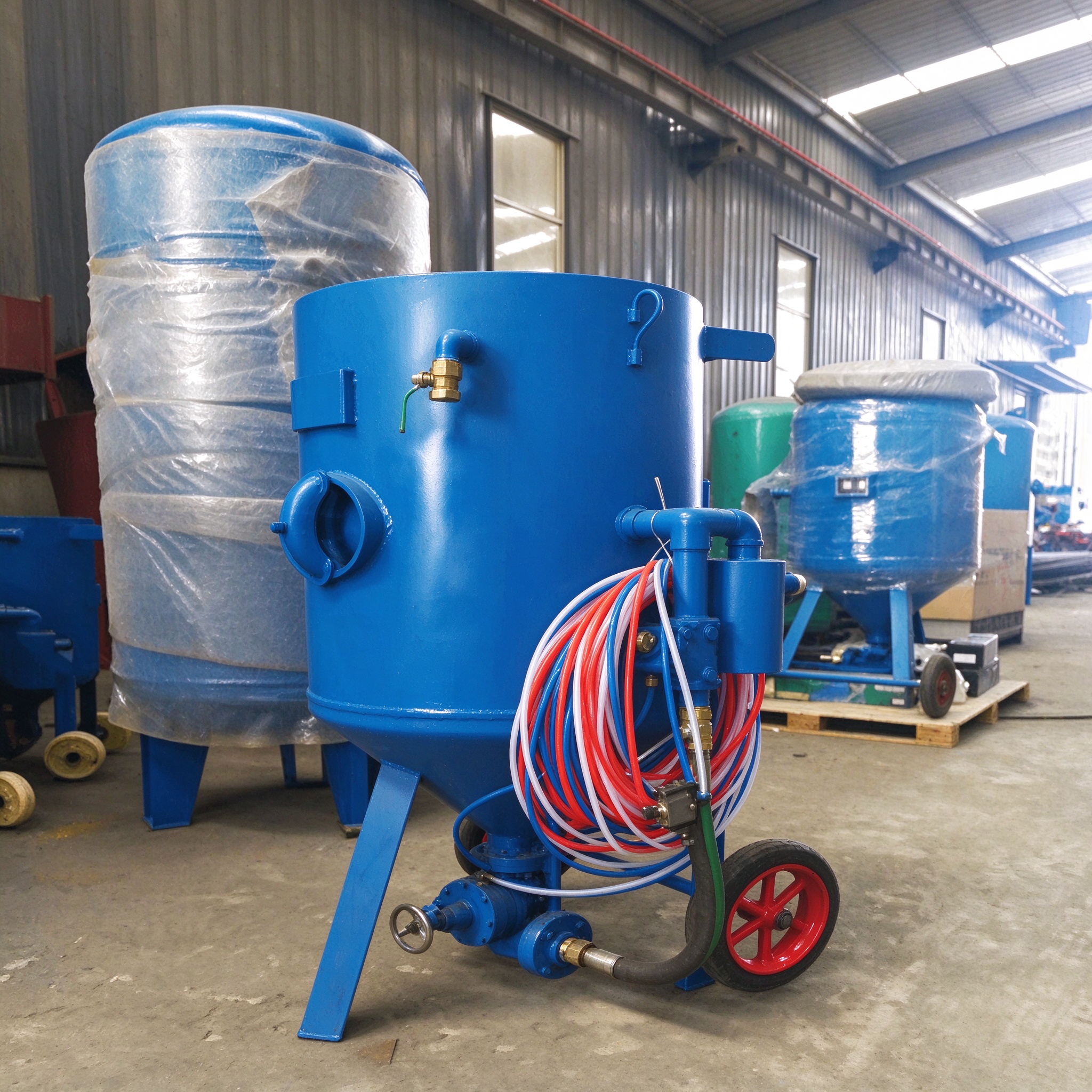
Why Customization Matters for Mobile Rust Removal Projects
Every rust removal project has a different starting point. A shipyard may need to reach hull sections and confined spaces, while a steel structure fabricator may need to process long beams, columns, or welded assemblies. A bridge maintenance contractor may work in open air with limited power access, and a factory may need a mobile unit that can support both outdoor and indoor maintenance tasks. These differences affect blast pot capacity, pressure control, nozzle type, hose length, dust collection, and the way the machine is moved.
A custom mobile rust removal sandblasting machine manufacturer should be able to review the workpiece, site layout, abrasive choice, compressed air capacity, and environmental requirements before recommending a configuration. Wuqiao Anxing Sandblasting Machinery provides pre-sales engineering support, including site surveys and equipment selection drawings. Its product range includes open mobile sandblasting machines, environmental dust-free sandblasting machines, high-pressure water sandblasting equipment, and PLC automatic conveyor sandblasting systems, allowing the factory to match the equipment type to the actual process rather than forcing one standard model into every project.
Customization also matters for pressure vessel safety. The company’s sandblasting tanks are available in fixed, mobile, electric-control, and pneumatic-control versions, and the tank bodies are welded with 16MnR pressure vessel steel. Each tank is subjected to a hydrostatic test at 2.5 times the rated pressure before delivery. For buyers who need a mobile sandblasting machine for rust removal in a regulated environment, these details are more important than a low initial quotation.
How to Choose a Reliable Mobile Rust Removal Sandblasting Machine Manufacturer
Choosing a supplier should start with engineering capability, not only the catalog. Ask whether the manufacturer has in-house mechanical design, pressure control, and dust collection experience. Wuqiao Anxing has a research team focused on mechanical design, fluid pressure, and environmental dust removal, and it has obtained more than ten utility model patents related to sandblasting structure, dust recovery, and intelligent pressure regulation. In 2023 it was recognized as a Hebei technology-based SME, and in 2025 it was selected as a national technology-based SME.
Next, verify the pressure vessel and wear-part quality. The blast pot is the core pressure component of a mobile sandblasting system, so the steel grade, welding process, and pressure test records should be clear. The company uses 16MnR pressure vessel steel for tank bodies and performs a 2.5-times rated pressure hydrostatic test on every tank. Its automatic models use wear-resistant ceramic nozzles, which the company states have a service life about three times that of ordinary alloy nozzles. These features affect safety, downtime, and long-term consumable costs.
Dust control is another deciding factor. Mobile outdoor blasting can generate significant dust if the system is not matched with adequate containment and filtration. The company produces environmental dust-free sandblasting equipment and pulse dust collection units, and its environmental equipment is ISO14001 certified. Its dust emissions are designed to be below applicable limits, which helps contractors and factories meet local environmental and safety requirements.
| Selection Area | What to Verify | Why It Matters |
|---|---|---|
| Engineering and customization | In-house design team, non-standard project experience, selection drawings | Ensures the machine fits the workpiece, site, and production rate |
| Pressure vessel quality | 16MnR steel, welding control, 2.5-times rated pressure test records | Supports safe operation and regulatory compliance |
| Wear parts and consumables | Nozzle material, hose durability, spare parts availability | Reduces downtime and long-term operating cost |
| Dust collection and environment | Pulse dust collector, containment plan, ISO14001 certification | Helps meet site and environmental requirements |
| Production capacity | Assembly lines, annual output, batch delivery experience | Supports stable delivery for wholesale and project orders |
| After-sales service | Installation, training, remote support, on-site repair, spare parts stock | Reduces commissioning risk and unplanned downtime |
Custom Configuration Options for Mobile Sandblasting Systems
A mobile rust removal system can be configured in several ways depending on the work environment. For large steel structures and outdoor maintenance, an open mobile sandblasting machine with a mobile pressure vessel sandblasting tank is a common choice. For projects with strict dust control, an environmental dust-free configuration with a pulse dust collection unit and abrasive recovery can be considered. For confined or sensitive areas, high-pressure water sandblasting may be evaluated as an alternative method.
Control method also affects usability. Electric-control and pneumatic-control sandblasting tanks offer different operating preferences, and PLC automatic conveyor systems are available for higher-volume workshop production. The company also supplies matched air compressors, sandblasting guns, wear-resistant sandblasting hoses, abrasive recovery devices, and pulse dust collection units. Sourcing these components from one manufacturer reduces interface problems and simplifies spare-parts management.
- Mobile open sandblasting machine for on-site rust removal and coating preparation
- Fixed, mobile, electric-control, and pneumatic-control pressure vessel sandblasting tanks
- Environmental dust-free sandblasting configuration with pulse dust collection
- High-pressure water sandblasting equipment for suitable cleaning applications
- PLC automatic conveyor sandblasting systems for higher-volume production
- Matching air compressors, blast guns, hoses, abrasive recovery, and dust collection units
When requesting a quotation, provide workpiece dimensions, material, rust or coating condition, required surface finish, daily working hours, available air supply, power supply, site access, and dust-control requirements. These details allow a custom mobile sandblasting machine supplier to propose a system that can actually perform on site, rather than a generic package that may require costly modification later.
Quality Control, Performance, and Environmental Compliance
Quality control in mobile sandblasting equipment starts with the pressure vessel and continues through assembly and testing. Wuqiao Anxing uses 16MnR pressure vessel steel for tank bodies and performs a 2.5-times rated pressure hydrostatic test on each tank before delivery. All complete machines are checked for sandblasting uniformity, sealing performance, and continuous no-load operation. These checks help identify assembly issues before the equipment leaves the factory.
The company also reports that its adaptive sandblasting pressure regulation, automatic abrasive circulation, and intelligent dust and noise reduction technologies help reduce equipment failure rates by about 30% compared with the industry average and lower energy consumption by about 15%. These figures should be reviewed against the specific project configuration, but they indicate the manufacturer’s focus on reliability and operating cost rather than only initial price.
Environmental performance is equally important for mobile outdoor work. The company’s environmental equipment is ISO14001 certified, and its dust emission design targets levels below applicable limits. For projects in sensitive areas, buyers should still confirm local emission rules, containment measures, and operator protection requirements. A manufacturer that understands both sandblasting performance and dust collection can help balance cleaning speed with environmental compliance.
Mobile vs. Stationary Sandblasting Equipment: Which Fits Your Project?
Mobile and stationary sandblasting systems serve different production models. A mobile rust removal sandblasting machine is usually chosen when the workpiece is too large to move, when work is spread across multiple sites, or when maintenance must be performed in the field. A stationary sandblasting cabinet or fixed sandblasting room is often better for repeatable small-part processing, high-volume batch work, and controlled indoor production.
| Factor | Mobile Sandblasting System | Stationary Cabinet or Room |
|---|---|---|
| Workpiece size | Large, immovable, or dispersed workpieces | Small to medium parts that fit the enclosure |
| Work location | Outdoor sites, shipyards, bridges, maintenance points | Fixed workshop or production line |
| Dust control | Requires planned containment and dust collection | Usually integrated into the cabinet or room system |
| Best use | Field rust removal, coating preparation, structural maintenance | Repeatable batch processing, deburring, surface finishing |
Many manufacturers use both types of equipment. A mobile unit handles large or outdoor work, while a cabinet or room handles smaller components and higher-volume finishing. If you are unsure which configuration fits, a factory with experience in both mobile sandblasting machines and integrated sandblasting rooms can compare the workflow, labor, dust control, and floor-space requirements.
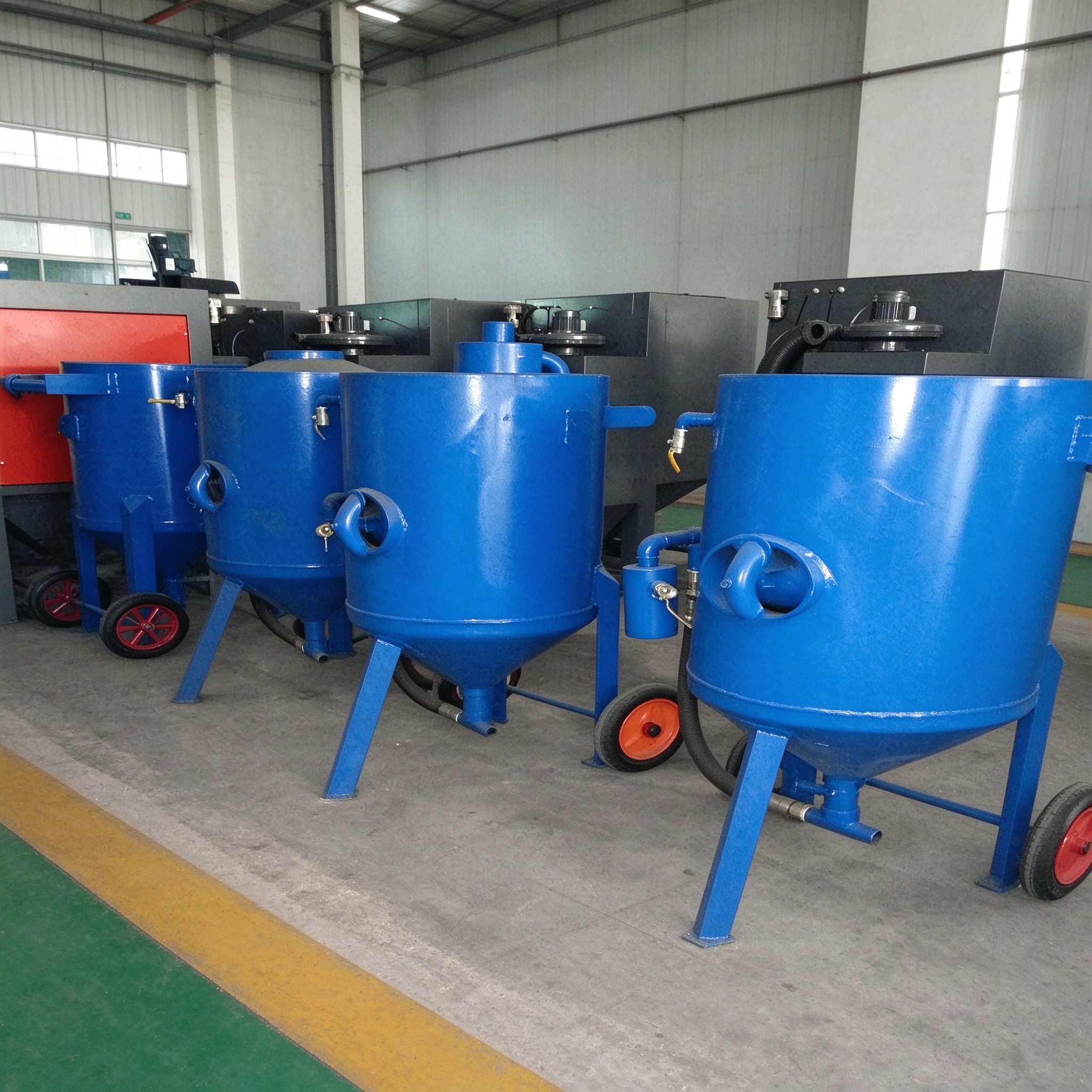
Wholesale, OEM, and Project Supply from a Factory
For distributors, contractors, and project buyers, factory supply capability matters as much as product specifications. Wuqiao Anxing operates multiple standardized assembly lines and reports an annual equipment production capacity of more than one thousand sets. This capacity supports batch orders, and the company has experience delivering dozens of machines in a single project. It has supplied large heavy-industry buyers, including Jiangnan Shipyard, and its products are exported to Europe, the Middle East, Southeast Asia, and other markets, with repeat orders from buyers in Myanmar, South Korea, and several Middle East countries.
Wholesale mobile sandblasting equipment buyers should confirm the scope of supply, spare-parts list, packaging, documentation, and after-sales responsibilities. Because the company also produces pressure vessel sandblasting tanks, sandblasting rooms, dust collection units, air compressors, blast guns, hoses, and abrasive recovery devices, it can support one-stop procurement for complete surface preparation projects. Small-batch customization and special-condition modifications are also available, which is useful for contractors who need a configuration that is not identical to a standard catalog model.
For OEM mobile sandblasting machine inquiries, prepare drawings, target specifications, component preferences, and delivery requirements for review. The factory can assess the technical scope and confirm which customization items are feasible. A clear technical review at the beginning helps avoid misunderstandings about pressure ratings, dust collection, control method, and commissioning responsibilities.
Maintenance and Safe Operation Tips for Mobile Sandblasting Systems
Regular maintenance protects the pressure vessel, reduces downtime, and keeps blasting performance consistent. Before each shift, check air pressure, hose condition, nozzle wear, blast pot seals, abrasive flow, and dust collector function. Replace worn nozzles and damaged hoses promptly, and keep the working area clear of accumulated abrasive. Follow the manufacturer’s manual for pressure vessel inspection and maintenance intervals, and do not exceed the rated working pressure.
Safe operation requires appropriate personal protective equipment, ventilation, grounding, and site controls. Operators should use respiratory protection, eye protection, hearing protection, and protective clothing. For outdoor work, establish exclusion zones and manage dust drift. For indoor or confined work, use adequate ventilation and dust collection, and confirm that the equipment and procedures meet local safety requirements.
After delivery, Wuqiao Anxing provides installation, commissioning, and operator training. Its service model includes remote guidance and on-site repair, supported by spare-parts stock. Operators should be trained in daily checks, simple fault diagnosis, and emergency shutdown procedures. Keeping a spare nozzle, hose, and key seal set on site can further reduce lost production time.
FAQ
What is a mobile rust removal sandblasting machine used for?
It is used to remove rust, mill scale, old paint, and surface contaminants from large or immovable metal workpieces. Typical applications include steel structures, ship hulls, bridges, pipes, storage tanks, and anti-corrosion coating preparation. With suitable abrasives and parameters, it can also support deburring, matte finishing, and surface strengthening.
Can a mobile sandblasting machine be customized for my project?
Yes. Customization usually covers blast pot capacity, pressure control, nozzle type, hose length, dust collection, abrasive recovery, and mobility. A manufacturer with engineering support can review workpiece dimensions, site conditions, air supply, and environmental requirements before proposing a configuration. Wuqiao Anxing Sandblasting Machinery provides pre-sales site surveys and selection drawings for custom projects.
How do I choose a reliable mobile rust removal sandblasting machine manufacturer?
Look at engineering capability, pressure vessel quality, wear-part life, dust control, production capacity, export experience, and after-sales support. Ask for the tank steel grade, pressure test records, nozzle material, dust emission approach, and service plan. A manufacturer with long-term experience in surface preparation and a complete parts supply is generally lower risk than a trading-only supplier.
What should I check before buying a mobile sandblasting machine for rust removal?
Confirm the workpiece size and access, required surface cleanliness, abrasive type, available compressed air, power supply, dust collection space, and local safety requirements. Check the pressure vessel certificate and test report, nozzle and hose specifications, control method, and spare parts availability. A site survey helps avoid undersized compressors or inadequate dust collection.
Does Wuqiao Anxing provide dust collection and environmental compliance options?
Yes. The company produces environmental dust-free sandblasting equipment and pulse dust collection units, and its environmental equipment is ISO14001 certified. Dust emissions are designed to be below applicable limits. For mobile outdoor work, the dust collection and containment plan should be matched to the site and local regulations.
What after-sales support is available?
The company provides installation, commissioning, and operator training after delivery, supported by remote guidance and on-site repair. Spare parts are kept in stock, and its domestic network includes resident after-sales personnel in key manufacturing regions. Export customers can discuss service and spare-parts arrangements with the factory.
Summary
Choosing a mobile rust removal sandblasting machine manufacturer is a technical procurement decision, not only a price comparison. The right supplier should be able to review the workpiece and site, size the pressure vessel and air supply, match dust collection to the environment, and support installation and maintenance after delivery. Wuqiao Anxing Sandblasting Machinery brings more than three decades of surface preparation experience, custom design capability, pressure vessel production, environmental dust collection, and export experience to mobile rust removal projects. By checking engineering support, tank quality, wear parts, dust control, production capacity, and after-sales service, buyers can select a mobile sandblasting system that supports safer operation, stable output, and lower long-term cost.