
A pressure blasting tank is the core of any productive abrasive blasting system. It stores the abrasive, holds it under compressed air pressure, and feeds it at a controlled rate into the blast hose so that the nozzle can deliver a consistent, high-velocity stream onto the workpiece surface. Whether you are removing mill scale from a steel plate, stripping old paint from a bridge girder, deburring castings, or creating a matte finish on stainless steel, the size, configuration, and build quality of the blasting pot directly determine how fast the job gets done and how much abrasive and compressed air you burn along the way.
Buyers who are comparing quotations often focus on the nozzle or the compressor and treat the pot as a simple accessory. In practice, the tank is where pressure stability, abrasive flow consistency, and operator safety all begin. A well-built pressure blasting tank keeps a steady working pressure, resists abrasive wear at the metering point, seals correctly, and passes proper pressure vessel testing before it ever leaves the factory. This guide walks through the main configurations available today — stationary, mobile, outdoor, and double-chamber — and explains how to match capacity, pressure, air supply, and dust collection so that the whole system performs as one unit.
What Is a Pressure Blasting Tank and How Does It Work?
A pressure blasting tank, also called a pressure blasting pot or pressure vessel sandblasting pot, is a sealed steel vessel that is filled with abrasive through a top hatch. Once the hatch is closed and the vessel is pressurized by the air compressor, abrasive is pushed down through a metering valve into the abrasive outlet and then carried by the air stream through the blast hose to the nozzle. Because the abrasive is fed by pressure rather than by suction, the exit velocity at the nozzle is significantly higher than with a siphon-style cabinet gun, which is why pressure systems are the standard choice for heavy-duty surface preparation.
The practical difference is productivity. A pressure-fed blasting pot maintains a dense, aggressive abrasive stream that removes rust, mill scale, and coating faster, and it holds that performance over long hose runs and at height. For contractors working on ships, storage tanks, pipelines, and structural steel, this consistency is what makes daily output predictable and labour costs controllable.
Because the vessel stores compressed air, it is a pressure vessel and must be treated as one. Wall thickness, weld quality, safety valve sizing, gauge accuracy, and hydrostatic testing are not optional details. They are the difference between a tool that runs for a decade and a hazard waiting to happen. Any serious pressure blasting tank manufacturer should be able to explain its steel grade, welding procedure, and test protocol clearly and in writing.
Core components of a pressure blasting tank
- Tank body and top hatch: the pressure vessel itself, with a quick-access fill opening, seal, and lifting points.
- Abrasive metering valve: controls abrasive flow rate; the most wear-prone area and the key to consistent finish quality.
- Pop-up or pinch valve assembly: opens and closes abrasive flow in step with the operator’s remote control.
- Air inlet, moisture separator, and filter: dry air prevents clogging and abrasive caking inside the pot.
- Pressure gauge, safety valve, and drain: essential for safe operation and daily inspection.
- Blast hose and nozzle: the delivery end of the system, where bore size governs air consumption.
- Remote control deadman system: pneumatic or electric, allowing the operator to start and stop blasting safely.
- Frame, wheels, or lifting lugs: for stationary mounting or site mobility.
Blasting Pot Configurations: Stationary, Mobile, Outdoor, and Double-Chamber
There is no single correct configuration. The right choice depends on where the work happens, how large the workpieces are, whether blasting runs continuously or in short bursts, and how the pot will be refilled. A workshop running small batches of machined parts has very different requirements from a contractor blasting a 40-metre bridge span in the open air.
| Configuration | Typical use | Refill method | Main advantage |
|---|---|---|---|
| Stationary pressure blasting tank | Fixed blasting stations, blast rooms, batch production | Manual fill at fixed position, or bulk hopper feed | Stable footprint, easy integration with recovery systems |
| Mobile blasting pot | Site work, repair jobs, scattered workpieces | Manual or hopper fill at the work face | Mobility on wheels or a tow frame |
| Outdoor blasting pot | Bridges, tanks, pipelines, shipyards, open yards | Bulk fill with weather-protected hatch | Weather resistance plus dust control planning |
| Double-chamber blasting pot | Long continuous runs, automatic lines, high output | Refill while blasting continues under pressure | No downtime for reloading abrasive |
Stationary pressure blasting tank for fixed workstations
A stationary sandblasting tank is bolted down or mounted on a fixed frame, usually beside or inside a blast room where dust is captured and abrasive is recovered. This layout suits plants that process a steady stream of castings, forgings, welded assemblies, or moulds, and where repeatability matters more than mobility. Because the pot does not move, the blast hose can be routed overhead on a balancer, reducing operator fatigue and hose wear.
Mobile blasting pot for on-site and field work
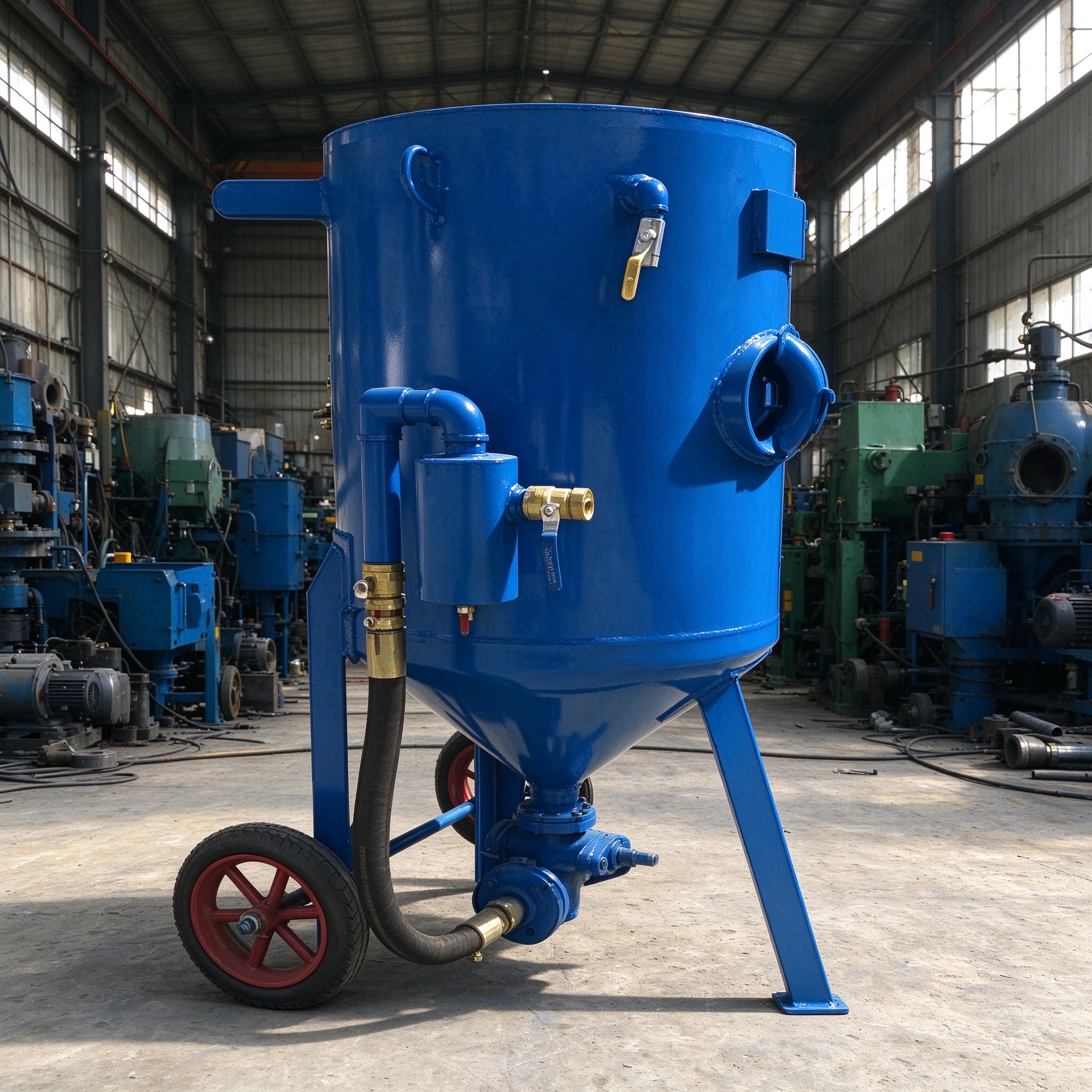
A mobile blasting pot adds wheels, a tow bar, or lifting lugs so the unit can follow the work instead of the work following the unit. This is the standard solution for maintenance contractors, shipyards, and fabricators who blast steel components in different bays or at different job sites. When specifying a mobile blasting pot, check the wheel and frame strength under full abrasive load, the hose length, and whether the unit can be lifted safely by crane or forklift.
Outdoor blasting pot: weather, dust, and compliance
An outdoor blasting pot faces conditions a workshop pot never sees: rain, humidity, wind, and airborne dust that must not drift beyond the site boundary. Moisture is the enemy of abrasive flow, so a well-designed outdoor blasting pot includes an effective moisture separator and a hatch that seals against water ingress. Dust control is equally important. Pairing the pot with a properly sized dust collection unit, blast enclosure, or containment screen keeps emissions within local limits and protects nearby workers.
Double-chamber blasting pot for continuous production
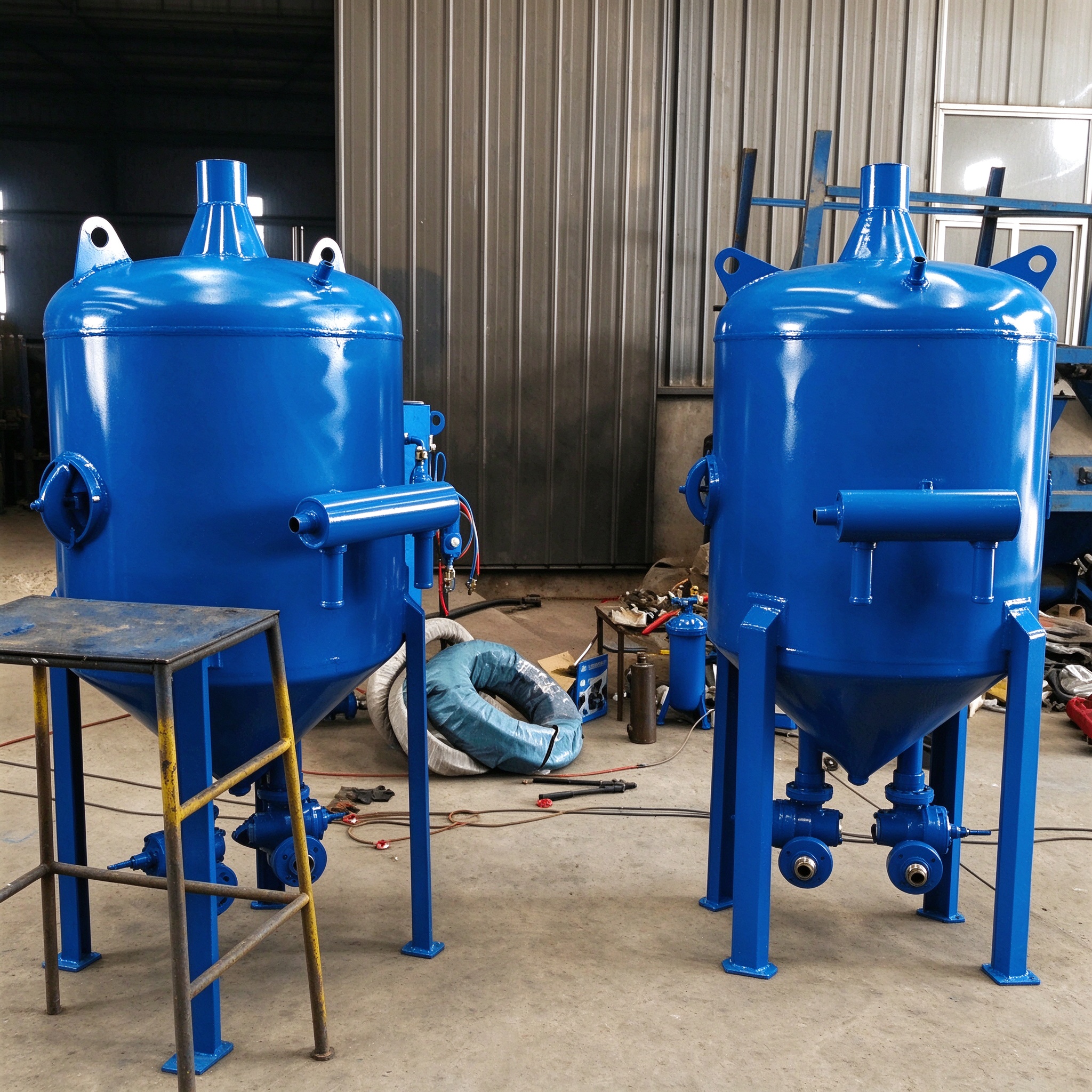
A double-chamber blasting pot solves the biggest weakness of a single-chamber pot: the stop-start cycle. With a single chamber, the operator must depressurize, refill, and repressurize, which interrupts output and creates pressure fluctuation at the nozzle. A double-chamber design uses an upper and lower chamber separated by a pressure-balanced valve, so abrasive can be loaded into the upper chamber while the lower chamber keeps blasting. The result is near-continuous blasting with a stable stream, which matters most on large surface areas, ship hulls, storage tanks, and automated blast lines where every minute of downtime has a cost.
How to Select Blasting Pot Capacity, Pressure, and Nozzle Size
Selection starts with three questions: how large is the workpiece, how many square metres per shift must be cleaned, and what compressed air is available on site. Capacity determines how long you can blast before refilling. Pressure determines penetration and cleaning speed. Nozzle bore determines air consumption, and the compressor must be able to feed that demand continuously.
| Selection factor | Typical industrial range | Practical note |
|---|---|---|
| Tank volume | Small pots for touch-up work up to large pots for heavy structural blasting; custom sizes available | Larger volume reduces refill frequency but adds weight and needs more floor space |
| Working pressure | Commonly around 0.4–0.8 MPa depending on abrasive and coating | Higher pressure increases cutting power but also abrasive breakage and nozzle wear |
| Nozzle bore | Small bores for fine work, larger bores for fast coverage | Air consumption rises sharply with bore size; size the compressor to the nozzle, not the pot |
| Blast hose length and bore | Keep hose runs as short and straight as practical | Long, curved hoses create pressure loss and inconsistent abrasive feed |
| Abrasive type | Mineral slag, garnet, brown alumina, steel shot, glass bead | Reusable steel media requires recovery equipment; single-use media favours continuous refill designs |
Match air supply to nozzle bore
Many underperforming blasting systems are simply starved of air. A pressure blasting tank cannot produce a dense stream if the compressor cannot hold pressure while the nozzle is open. Measure actual pressure at the pot inlet while blasting, not at the compressor. If pressure sags, the fix is usually more compressor capacity, a shorter or larger-bore hose, or a smaller nozzle — not a larger pot.
Choose control type: pneumatic or electric
Pneumatic control keeps the system simple and reliable, with few electrical components exposed to dust and moisture, which is why it remains popular for site work. Electric control allows integration with PLC systems, timers, pressure feedback, and automated blast lines. For plants planning a fully automatic conveying-type blasting machine or an integrated blast room, electric control with intelligent pressure regulation is usually the better long-term choice.
Pressure Vessel Manufacturing and Quality Control
The tank is only as good as its steel and its welds. Vessels should be built from pressure-vessel-grade plate rather than general structural steel, with welding procedures and welder qualifications suited to the material. After fabrication, each vessel should undergo hydrostatic testing well above its rated working pressure to confirm structural integrity, followed by a documented inspection of welds, seals, and fittings before painting.
Component quality matters just as much. Abrasive metering valves, seals, and nozzles take a constant beating, and these are the parts that decide your maintenance cost per tonne of abrasive. Wear-resistant ceramic nozzles, hardened metering components, and properly sized safety valves all extend service life. In practice, well-engineered blasting pots and their wear parts can deliver a notably lower failure rate and reduced energy consumption compared with poorly specified alternatives, because the system holds pressure instead of leaking it away.
Environmental design and dust emissions
Modern surface preparation projects are judged on dust as much as on surface profile. A pressure blasting tank should be selected together with a dust collection strategy: a sealed blast room with abrasive recovery, a pulse-jet dust collector, or a mobile containment system for site work. Choosing equipment that follows recognised environmental management practice and national emission standards helps plants pass inspections and keeps operators healthier.
Matching the Blasting Pot with the Air Compressor, Hose, and Dust Collector
A blasting pot is a system component, not a stand-alone machine. The compressor supplies the airflow, the vessel stores and meters the abrasive, the hose and nozzle deliver it, and the dust collector deals with what comes back. Where any one element is undersized, overall output drops and the operator compensates by blasting longer — which costs more in abrasive, fuel, and labour.
For the air side, a dedicated blasting compressor with a stable pressure band, an aftercooler, and effective moisture removal is strongly preferred. Variable-frequency drive compressors reduce energy use when demand fluctuates, while dedicated blasting compressors are built for continuous high-flow duty. On the delivery side, use a properly rated blast hose with abrasion-resistant lining, keep the run short, and inspect couplings regularly.
Dust collection should be sized to the actual blast rate, not to the room volume alone. For workshop applications, an integrated blast room with abrasive recovery and pulse-jet filtration keeps media in circulation and dust out of the air. For outdoor work, a containment structure plus a correctly rated collector is the practical route to compliance.
Installation, Commissioning, and Operator Training
A new blasting pot should not be treated as plug-and-play. Correct installation includes checking the foundation or wheel setup, verifying air supply pressure and flow, fitting the moisture separator upstream of the pot, and confirming that the safety valve and gauge are functional. Commissioning should include a leak test at working pressure, an empty-run test of the metering valve, and an abrasive flow test on representative workpieces to confirm a uniform finish.
Operator training then converts equipment into output. Operators should understand how to set and adjust pressure, how abrasive flow rate changes surface profile, how to recognise a clogged metering valve, and how to shut down and depressurise safely. Training also reduces wear: a nozzle held too far from the surface wastes abrasive and slows the job, while a nozzle held too close can damage the substrate.
Suppliers that support the process properly will survey the site before the equipment is specified, propose a layout that fits the available floor space and crane access, and follow up with installation, commissioning, and hands-on instruction. That support is especially valuable for first-time buyers moving from manual or siphon equipment to a pressure system.
Maintenance Checklist to Extend Blasting Pot Service Life
Most blasting pot failures are preventable and start small: a worn seal, a partly blocked moisture trap, a hose coupling that has been over-tightened. A short daily and weekly routine keeps a pressure blasting tank reliable for years.
- Drain the moisture trap and compressor receiver at the start of every shift.
- Check the safety valve and pressure gauge before use; never operate a pot without them.
- Inspect the metering valve and pop-up valve for wear each week and replace worn parts.
- Look for abrasive leaks at the hatch, seals, and couplings; leaks mean lost pressure and lost money.
- Rotate or replace the blast hose when the outer cover is damaged and the lining is exposed.
- Check nozzle bore size regularly; wear enlarges the bore and quietly increases air consumption.
- Keep the pot interior dry and free of caked abrasive, especially in humid outdoor climates.
- Record operating pressure and abrasive consumption so trends can be spotted early.
Safety Practices for Pressure Blasting Operations
Pressure blasting combines compressed air, hard abrasive, and high velocity, so safety procedures are non-negotiable. Operators should wear a supplied-air respirator or approved abrasive blasting hood, hearing protection, heavy gloves, and protective clothing. The blast area must be screened and signed, and bystanders kept well outside the blasting zone.
Equipment-side safety includes a functioning remote deadman control so the operator can stop abrasive flow instantly, a correctly rated safety valve that is never plugged or adjusted, and a strict rule that the pot is depressurised and locked out before any hatch is opened. Hoses and couplings should be restrained with safety cables in case of failure. Finally, pots should be inspected periodically and pressure-tested according to local regulations, with records kept on file.
How to Choose a Reliable Pressure Blasting Tank Manufacturer
For B2B buyers, the supplier matters as much as the specification. A manufacturer with long experience in surface preparation understands that no two sites are identical and can adjust tank capacity, pressure rating, frame design, metering type, and control mode to match the actual job. That engineering flexibility is worth more than a low headline price, because a mismatched pot costs the buyer every shift.
Look for a factory that builds both standard and custom units, offers a complete accessory range — compressor, blast hose, nozzles, abrasive recovery, dust collectors — and can supply or design an entire blast room rather than only a single tank. Ask about the steel grade used for the vessel, the pressure test procedure, weld inspection, and the documentation supplied with each unit. Ask how delivery is handled for batch orders and what happens if a wear part fails in the middle of a contract.
Service capability separates suppliers clearly. Confirm that the manufacturer can survey the site, provide layout drawings, install and commission the equipment, train operators, keep spare parts in stock, and respond quickly by remote guidance or on-site support. A blasting pot that stops working halts an entire production line or site programme, so response speed has a direct financial value.
FAQ
What is the difference between a pressure blasting tank and a siphon blasting system?
A pressure blasting tank stores abrasive in a pressurised vessel and pushes it directly into the air stream, producing a dense, high-velocity abrasive flow. A siphon system draws abrasive by vacuum created at the nozzle, which is simpler and cheaper but noticeably slower and less consistent over long hose runs. For heavy rust removal, mill scale, thick coatings, and large surface areas, a pressure pot is the practical choice.
How do I decide between a mobile blasting pot and a stationary one?
Choose a mobile blasting pot when the work moves between bays, sites, or structures, such as bridge repairs, tank farms, and shipyard blocks. Choose a stationary unit when blasting happens at a fixed station or inside a blast room with abrasive recovery. Many plants keep one stationary pot for regular production and a mobile unit for occasional site work.
When is a double-chamber blasting pot worth the extra cost?
A double-chamber blasting pot pays for itself when blasting runs for long continuous periods and refilling a single chamber would interrupt output. Because it can be refilled while blasting continues, the nozzle stream stays stable, surface quality becomes more uniform, and total output per shift increases. For automated lines and high-volume structural work, the gain is usually significant.
What air compressor capacity does a pressure blasting tank need?
The compressor must match the nozzle bore and working pressure, not the pot volume. Air consumption increases sharply as nozzle bore grows, so specify the compressor after the nozzle and pressure have been chosen, and allow margin for hose losses and altitude. Measure pressure at the pot inlet while blasting to confirm the compressor is actually keeping up.
What safety tests should a blasting pot pass before delivery?
The vessel should be fabricated from pressure-vessel-grade steel plate, welded to a qualified procedure, and hydrostatically tested at a pressure well above its rated working pressure. Each unit should be supplied with a functional pressure gauge and safety valve, and should pass leak, seal, and no-load running checks. Buyers should ask for test records and confirm that local pressure vessel regulations are met.
Can an outdoor blasting pot be customised for a specific project?
Yes. Capacity, pressure rating, frame and wheel configuration, hatch design, metering type, control mode, and dust collection integration can all be adapted. For outdoor projects, moisture protection and containment planning are usually the two most important custom requirements, followed by mobility and lifting arrangements for crane access.
Summary
A pressure blasting tank is a system-critical investment, not a commodity accessory. The right configuration — stationary, mobile, outdoor, or double-chamber — depends on workpiece size, production rhythm, site conditions, and available compressed air. Capacity and pressure must be matched to the nozzle and compressor, the vessel must be built and tested as a genuine pressure vessel, and dust collection must be planned from the start rather than added afterwards.
Buyers get the best result when they treat the pot, compressor, hose, nozzle, and dust collector as one engineered system, and when they choose a manufacturer able to survey the site, customise the specification, deliver in volume, and support the equipment through installation, training, and after-sales service. Get those elements right, and a pressure blasting tank becomes one of the most reliable and cost-effective tools in the entire surface preparation process.