
Industrial surface preparation depends on controlled abrasive delivery, stable air pressure, and equipment that can withstand demanding working conditions. A pressure blasting tank is one of the most important components in this process because it stores abrasive media, pressurizes the system, and feeds the blast stream at a consistent rate. For shipyards, steel fabricators, pipeline contractors, maintenance teams, and manufacturers, selecting the right pressure-fed sandblasting pot directly affects cleaning speed, surface quality, abrasive consumption, and operator safety.
Wuqiao Anxing Sandblasting Machinery Co., Ltd. is a specialized industrial surface treatment equipment manufacturer based in Wuqiao County, Cangzhou, Hebei Province. Since 1991, the company has focused on abrasive blasting equipment, pressure vessel blasting tanks, integrated blasting rooms, dust collection systems, and related accessories. This guide explains how pressure blasting tanks work, how different configurations compare, and how international buyers can choose a reliable sandblast pot for industrial surface preparation.
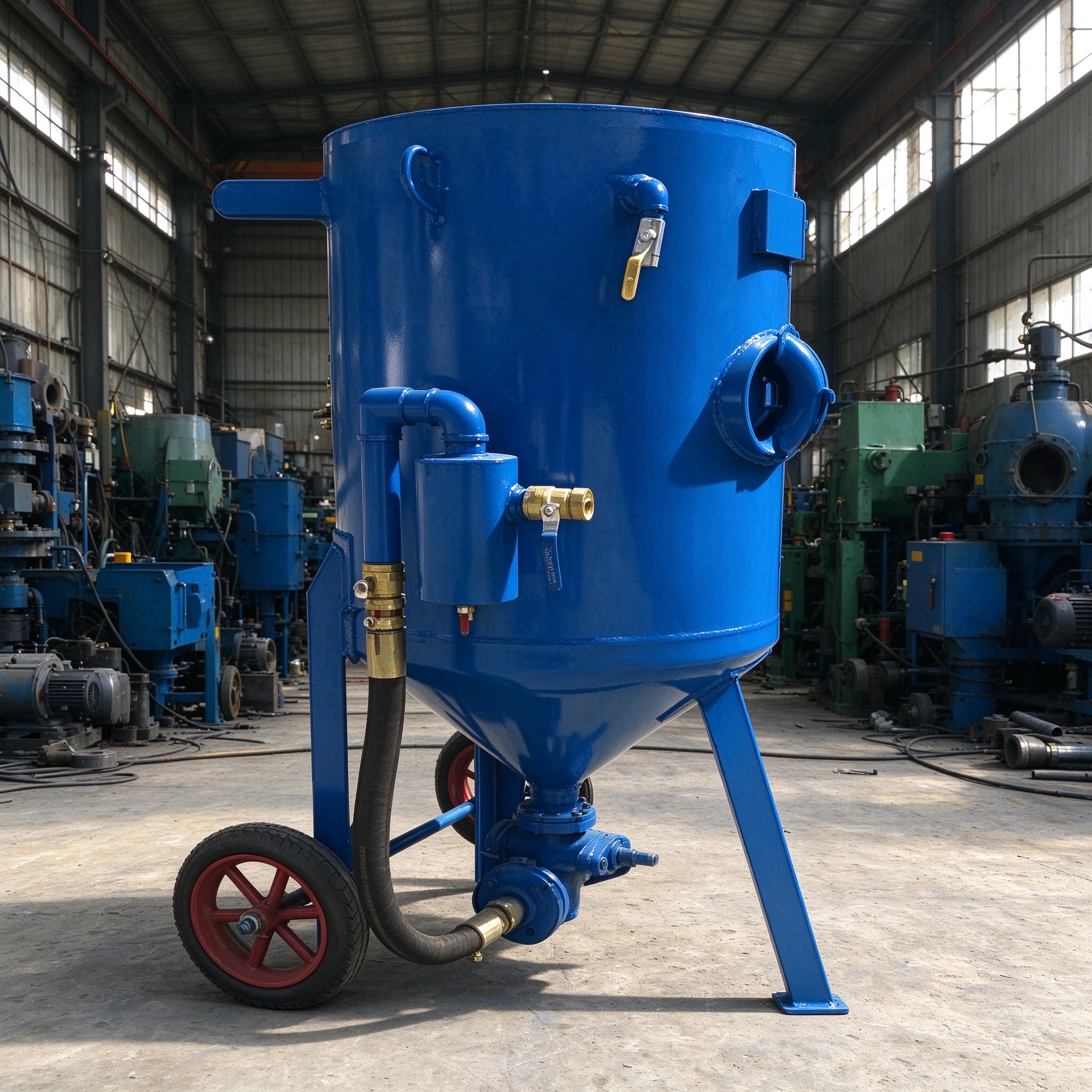
Understanding Pressure Blasting Tanks in Industrial Surface Preparation
A pressure blasting tank, often called a pressure blasting pot or pressure-fed sandblast pot, is a pressure vessel that holds abrasive media and delivers it into a compressed air stream. When the system is pressurized, abrasive flows from the tank through a metering valve and into the blast hose, where it is accelerated by compressed air and directed through a nozzle onto the workpiece. This pressure-fed method is widely used when higher productivity, better abrasive control, and consistent cleaning performance are required.
The pressure blasting tank is more than a simple container. Its design must balance pressure safety, abrasive flow stability, service access, moisture control, and operator usability. Key factors include tank volume, working pressure, abrasive metering system, air control method, mobility, and compatibility with dust collection equipment. In shipyard and outdoor blasting work, a mobile sandblast pot can significantly reduce handling time, while stationary pressure-fed systems are often preferred for fixed production lines or high-volume blasting rooms.
For B2B buyers, a pressure blasting tank should be selected as part of a complete surface preparation system. The blast pot must match the air compressor capacity, nozzle size, abrasive type, hose length, and required surface profile. If the tank is oversized for the available air supply, pressure recovery may be slow. If the abrasive metering system is not suitable for the selected media, the blast stream may become uneven or inefficient. Proper selection prevents unnecessary abrasive waste and keeps production predictable.
Core Design Features of a Pressure-Fed Sandblast Pot
A well-designed pressure-fed sandblasting pot includes several functional systems that work together: the pressure vessel, abrasive fill and discharge system, air inlet and control valves, safety devices, and operator controls. Manufacturers with pressure vessel experience can optimize these components for durability, serviceability, and continuous operation.
Wuqiao Anxing pressure vessel blasting tanks are produced with compliance-focused manufacturing processes. According to the company, tank shells are welded using 16MnR pressure vessel steel, and each tank undergoes a 2.5 times rated pressure hydrostatic test before delivery. These measures are important for industrial users who need dependable pressure containment and documented quality control. A pressure blasting tank is a safety-related component, so buyers should always review pressure test records, safety valve configuration, and operating instructions before purchase.
Fixed, Mobile, Electric, and Pneumatic Options
Pressure blasting tanks are available in fixed and mobile configurations, with electric or pneumatic control options. A mobile sandblast pot is suitable for outdoor sites, bridge maintenance, ship repair, and field construction where the blasting location changes frequently. Fixed pressure-fed systems are often used in workshops, blasting rooms, and production cells where the workpiece is brought to the equipment. Electric and pneumatic controls can be selected based on site power availability, automation requirements, and operator preference.
Double-Chamber Blasting Tanks for Continuous Abrasive Flow
For operations that require more continuous abrasive delivery, a double-chamber blasting tank can be specified. The dual-chamber concept allows abrasive filling and pressurization to be managed more efficiently during demanding work cycles. This configuration is useful when interruptions for abrasive refilling can reduce productivity, especially in large steel structure projects, shipyard work, and high-consumption blasting applications. Buyers should confirm the exact chamber design, pressure rating, and maintenance access requirements with the manufacturer.
Pressure Blasting Tank Configurations Compared
Different pressure blasting tank configurations serve different site conditions and production goals. The table below provides a practical comparison for industrial buyers evaluating mobile sandblast pots, outdoor blasting tanks, pressure-fed stationary units, and double-chamber designs.
| Configuration | Typical Use | Key Advantage | Buying Consideration |
|---|---|---|---|
| Mobile pressure blasting tank | Outdoor maintenance, bridge work, ship repair, field construction | Easy movement between work areas | Check wheel configuration, lifting points, hose length, and site access |
| Outdoor blasting tank | Steel structures, pipelines, heavy fabrication, anti-corrosion projects | Durable design for demanding weather and site conditions | Confirm moisture control, abrasive type, and dust containment plan |
| Pressure-fed stationary sandblast pot | Workshops, blasting rooms, production lines, repeated batch work | Stable integration with fixed air and dust collection systems | Plan layout, compressed air supply, and abrasive refilling access |
| Double-chamber blasting tank | Continuous blasting, high abrasive consumption, large workpieces | Better support for uninterrupted abrasive flow | Review duty cycle, pressure rating, controls, and maintenance procedures |
| Custom pressure vessel sandblast pot | Special layouts, non-standard capacities, integrated system projects | Adapted to specific workshop or site requirements | Provide drawings, pressure requirements, abrasive data, and operating conditions |
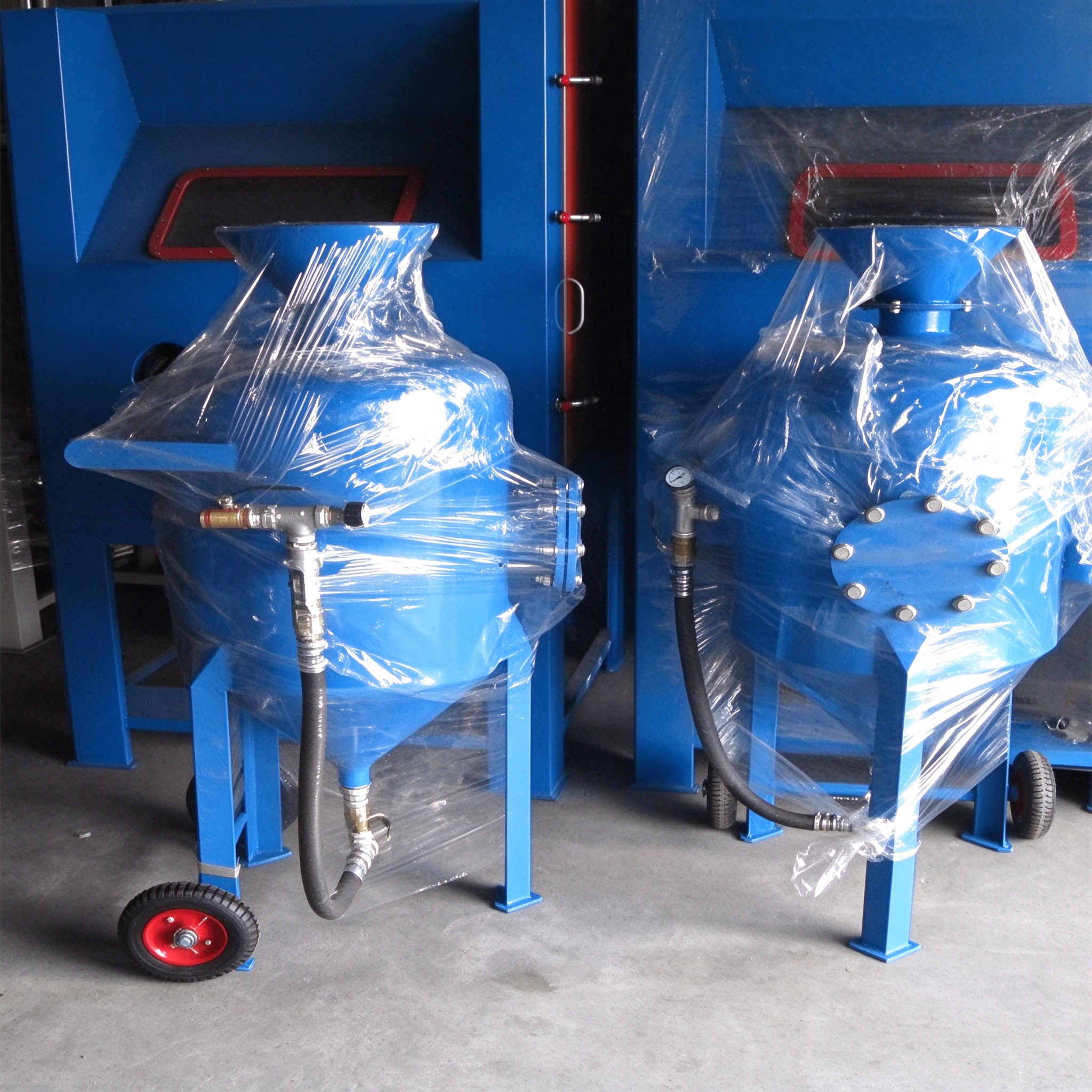
How to Select the Right Pressure Blasting Tank
Selecting a pressure blasting tank requires more than matching a tank volume to a price list. The correct choice depends on abrasive type, blasting pressure, nozzle size, air compressor output, working environment, and production rhythm. A systematic selection process helps avoid downtime, excessive abrasive use, and safety risks.
Match Abrasive, Nozzle, and Air Supply
Different abrasives require different metering and flow characteristics. Fine media may need more precise control, while coarse abrasives may require larger passages and more robust wear components. The blast nozzle size must be matched to the air compressor capacity; an oversized nozzle can cause pressure drop, while an undersized nozzle may reduce cleaning speed. Buyers should share abrasive type, target surface profile, nozzle preference, and available compressor output with the pressure blasting tank supplier.
Evaluate Mobility and Site Conditions
For outdoor and field work, a mobile sandblast pot or outdoor blasting tank is often the practical choice. Consider ground conditions, lifting points, wheel durability, hose routing, and storage. For shipyards and large steel fabrication yards, mobility can reduce manual handling and improve workflow between workstations. For fixed production, a stationary pressure-fed sandblasting pot may offer better integration with a blasting room and dust collection system.
Plan for Dust Control and Environmental Compliance
Abrasive blasting generates dust, and many industrial projects require dust containment or extraction. The pressure blasting tank should be planned together with the blasting enclosure, ventilation, and dust collector. Wuqiao Anxing produces environmental dust removal equipment and integrated blasting room systems, allowing buyers to source blasting and dust control from one industrial sandblasting tank manufacturer. This integrated approach helps support cleaner worksites and easier compliance planning.
Review Pressure Vessel Documentation and Safety Features
Before ordering, confirm the tank pressure rating, shell material, welding quality, safety valve arrangement, and test records. For custom pressure vessel sandblast pots, request drawings and technical clarification. Operators should receive training on pressure release, abrasive refilling, hose inspection, and emergency shutdown. Safety must be considered from the first specification discussion, not only after the equipment arrives.
Applications for Mobile and Outdoor Blasting Tanks
Pressure blasting tanks are used across many industries because abrasive blasting can remove rust, scale, old coatings, burrs, and oxidation before painting, coating, welding, or further processing. The right configuration improves surface consistency and reduces rework.
In shipyards and heavy fabrication, pressure blasting tanks support hull cleaning, weld preparation, and coating removal. Mobile units can be moved to different work areas, while higher-capacity systems support large surface areas. In steel structure and bridge projects, outdoor blasting tanks are used to clean beams, plates, and fabricated sections before protective coating. Pipeline contractors use pressure-fed sandblast pots for internal or external surface preparation where consistent abrasive delivery is required.
Other applications include automotive parts, hardware and molds, aviation components, glass and stone finishing, and general anti-corrosion maintenance. The process can also support matte finishing, texture creation, and surface strengthening when properly controlled. For workshops handling small precision parts, a closed blasting cabinet may be more suitable, while large outdoor workpieces often require a mobile or stationary pressure blasting tank matched with appropriate dust control.
Quality Control and Manufacturing Capability at Wuxiao Anxing
Wuqiao Anxing Sandblasting Machinery Co., Ltd. has focused on abrasive blasting equipment since 1991. The company operates standardized production facilities in Wuqiao County, Cangzhou, Hebei Province, and has developed capabilities for standard equipment production, large non-standard customization, and complete blasting and dust removal system projects. It was recognized as a Hebei Province technology-based SME in 2023 and selected as a national technology-based SME in 2025.
The company’s product range includes cabinet-type blasting machines, open mobile blasting machines, high-pressure water blasting equipment, dust-free environmental blasting machines, PLC automatic conveyor blasting systems, pressure vessel blasting tanks, complete blasting rooms, air compressors, blasting guns, wear-resistant blasting hoses, abrasive recovery units, and pulse dust collectors. This broad product scope allows buyers to source main equipment and consumables from one supplier, which can simplify procurement and spare parts planning.
In pressure blasting tank manufacturing, quality control covers material selection, welding, pressure testing, and final performance checks. The company states that its tank shells use 16MnR pressure vessel steel and that each tank is tested at 2.5 times the rated pressure before delivery. Automatic models use wear-resistant ceramic nozzles, which are described as having three times the service life of ordinary alloy nozzles. The company also reports that its adaptive pressure regulation, abrasive circulation, and intelligent dust removal technologies help reduce equipment failure rates by 30% compared with the industry average and lower energy consumption by 15%.
Wuqiao Anxing has experience supplying batch orders to large heavy industry projects, including shipyard-related procurement. Its production capacity reaches over one thousand sets per year, and its export experience covers Europe, the Middle East, Southeast Asia, Hong Kong, Macao, and Taiwan, with repeat orders reported in markets such as Myanmar, South Korea, and the Middle East. For international buyers, this mix of customization, batch delivery, and spare parts support is valuable when planning a pressure blasting tank project.
Installation, Operation, and Maintenance Best Practices
Proper installation and maintenance extend the service life of a pressure blasting tank and help maintain safe operation. The equipment should be installed on stable ground, connected to a clean and dry compressed air supply, and checked for correct pressure settings before use. Moisture in the air line can cause abrasive clumping and inconsistent flow, so water separators and regular draining are important.
Operators should inspect the blast hose, nozzle, couplings, safety valve, and control valves before each shift. Abrasive should be kept dry and free of debris. When refilling, the system must be depressurized according to the manufacturer’s instructions. Hose connections should be secured properly, and worn hoses or nozzles should be replaced promptly. Dust collection filters and abrasive recovery systems also require routine inspection to maintain airflow and containment performance.
For buyers new to abrasive blasting, supplier support is critical. Wuqiao Anxing provides pre-sales engineering surveys, equipment selection proposals, and workshop layout drawings. After delivery, technicians can support installation, commissioning, and operator training covering daily maintenance and basic troubleshooting. A spare parts stock and remote technical support help reduce downtime when replacements are needed.
Procurement Guide: How to Evaluate a Pressure Blasting Tank Supplier
When comparing pressure blasting tank suppliers, buyers should evaluate technical support, pressure vessel experience, customization capability, and after-sales service. A low initial price can become expensive if the tank is difficult to maintain or incompatible with the site’s air supply and abrasive plan.
Ask for a clear specification sheet covering tank volume, pressure rating, control type, mobility, inlet and outlet connections, safety features, and recommended air compressor capacity. For custom pressure vessel sandblast pots, request drawings and confirm that the supplier can support layout integration with dust collectors, blasting rooms, and abrasive recovery equipment. Confirm spare parts availability for valves, nozzles, hoses, and wear components.
International buyers should also discuss export packaging, documentation, installation instructions, and training options. A reliable industrial sandblasting tank manufacturer will ask about workpiece size, abrasive type, required surface cleanliness, daily working hours, and site conditions before recommending a model. This consultative approach is more useful than a generic quotation because it aligns the pressure blasting tank with the actual production requirement.
FAQ
What is a pressure blasting tank used for?
A pressure blasting tank is used to hold abrasive media and feed it into a compressed air stream for surface preparation. It is commonly used for rust removal, scale removal, paint stripping, deburring, matte finishing, and surface profiling before coating or welding.
How do I choose between a mobile sandblast pot and a stationary pressure blasting tank?
Choose a mobile sandblast pot when the work location changes, such as outdoor maintenance, bridge projects, ship repair, or field construction. Choose a stationary pressure-fed sandblasting pot when the workpiece is brought to a fixed blasting area, blasting room, or production line.
Can a pressure blasting tank be customized for shipyard or outdoor work?
Yes. Pressure blasting tanks can be customized with different tank capacities, mobile frames, control methods, wear-resistant components, and connections for dust collection. Buyers should provide details about the workpiece, site conditions, abrasive type, and air supply so the manufacturer can recommend the right configuration.
What maintenance does a pressure-fed sandblasting pot require?
Routine maintenance includes checking the safety valve, control valves, blast hose, nozzle, couplings, and pressure readings. Abrasive should be kept dry, moisture traps should be drained, and worn parts should be replaced promptly. The system must be depressurized before service or refilling according to the operating manual.
How does a double-chamber blasting tank improve productivity?
A double-chamber blasting tank is designed to support more continuous abrasive delivery during demanding blasting cycles. This can reduce interruptions related to abrasive refilling and pressurization, helping maintain workflow in high-consumption applications such as large steel structures and shipyard work.
What should I check before buying a pressure blasting tank?
Check the pressure rating, tank material, welding and pressure test records, safety features, abrasive metering system, air supply compatibility, mobility needs, and dust control plan. Also confirm supplier support for installation, training, spare parts, and customization.
Summary
A pressure blasting tank is a core component of efficient industrial surface preparation. The right choice depends on abrasive type, air supply, pressure requirements, mobility, dust control, and production rhythm. Mobile sandblast pots and outdoor blasting tanks suit field work and large structures, while stationary pressure-fed systems and double-chamber blasting tanks support fixed production and continuous abrasive flow.
Wuqiao Anxing Sandblasting Machinery Co., Ltd. combines decades of blasting equipment experience with pressure vessel manufacturing, custom project capability, environmental dust removal equipment, and after-sales support. For buyers seeking a reliable industrial sandblasting tank manufacturer, the company offers a practical path to select, customize, and maintain pressure blasting tanks for shipyards, steel structures, pipelines, maintenance, and other surface treatment applications. By matching the pressure blasting tank to the actual working conditions, businesses can improve cleaning consistency, reduce operating waste, and support safer, cleaner production.