
Rust never waits. Whether you are repainting a bridge girder, refurbishing a ship hull block, or restoring a batch of steel frames on site, surface preparation is the step that decides how long the final coating will last. A mobile sandblasting machine for rust removal is often the most practical answer, because it brings the blasting power to the workpiece instead of forcing you to move heavy steel into a fixed blasting room.
This guide explains what mobile rust removal sandblasting equipment actually does, which technical details matter most, how to compare suppliers, and how to avoid the expensive mistakes that show up six months after delivery. It is written for fabrication shops, coating contractors, maintenance teams, and procurement engineers who need equipment that works in real site conditions, not on a brochure.
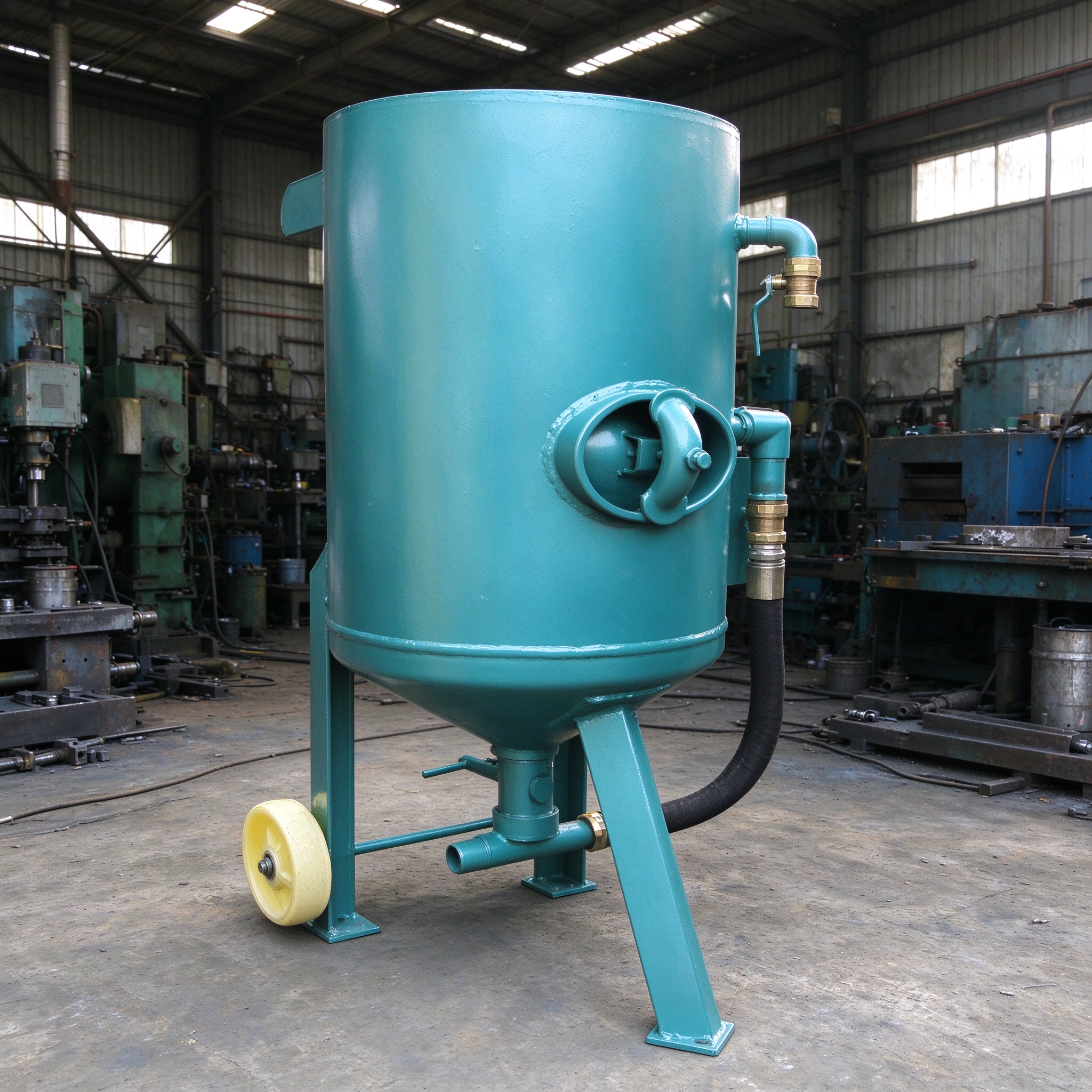
What Is a Mobile Sandblasting Machine for Rust Removal?
A mobile sandblasting machine for rust removal is a self-contained abrasive blasting system mounted on a wheeled frame or skid, designed to be moved between jobs. The core of the system is a pressure blasting pot that holds abrasive media, a pressure regulator, a remote control valve, and the hoses and nozzle that deliver the abrasive stream to the surface. Because the pot is pressurized rather than suction-fed, the abrasive exits the nozzle with far more kinetic energy, which is why pressure blasting is the standard method for removing mill scale, tight rust, and old coatings.
Mobile units differ from fixed installations in three important ways. First, they are built around transport: the frame, wheels, lifting points, and pot orientation are designed for forklift or crane handling between work areas. Second, they are usually paired with an independent dust collection or recovery system that can also be relocated, so the whole package stays site-friendly. Third, they are configured for outdoor operation, which means weather resistance, longer hose runs, and operator control designed to work at a distance from the pot.
For industrial users, the practical value is straightforward: you stop paying the logistics cost of moving heavy components into a blasting room, and you stop losing production time waiting for a fixed line to become available. The equipment travels to the steel, not the other way around.
Why Mobile Rust Removal Sandblasting Equipment Fits Modern Fabrication
Fabrication and coating work has shifted toward larger assemblies and more on-site activity. Bridge sections, pipeline spools, wind tower components, and ship blocks are frequently too large or too awkward to move economically. A mobile rust removal sandblasting machine solves this by matching portable blasting capacity to the physical reality of the job site.
There is also a compliance dimension. Modern surface preparation projects increasingly require documented dust control, because airborne silica and coating residue are regulated in most industrial markets. A properly specified mobile system is not just a blasting pot on wheels; it is a blasting pot combined with recovery and filtration, so the abrasive and the dust are captured rather than scattered across the yard. This is why buyers should evaluate the dust collection side of the package with as much care as the blasting side.
Finally, mobile equipment supports phased project work. A contractor can mobilize to one section of a site, complete the blasting and priming, then relocate. For maintenance teams inside a plant, the same machine can service different production bays in a single week without any fixed infrastructure investment.
Core Components and Technical Specifications to Check
When comparing mobile sandblasting machines, the specification sheet should be read as a risk document. Every number on it tells you something about how long the machine will last, how much downtime you will face, and whether it will pass a safety inspection.
The blasting pot is the first item to verify. Reputable manufacturers build pots from pressure vessel grade steel plate, not from repurposed pipe or general structural steel. Every pot should be welded by qualified welders and hydrostatically tested before shipment, typically at a pressure well above the rated working pressure. Ask for the test report, not just the certificate of conformity.
| Component | What to Verify | Why It Matters |
|---|---|---|
| Blasting pot / pressure vessel | Pressure vessel grade steel plate, qualified welding, hydrostatic test report at a multiple of rated pressure | Pot failure is the single most serious safety risk in abrasive blasting |
| Nozzle | Boron carbide or wear-resistant ceramic versus alloy steel | Nozzle wear directly changes blasting pressure, coverage rate, and abrasive consumption |
| Pressure regulation | Adjustable regulator with gauge, optional automatic pressure control | Different substrates and coatings need different pressures to avoid warping or over-blasting |
| Abrasive hose and fittings | Abrasion-resistant rubber hose rated for the working pressure, secure couplings | Hose burst is the most common cause of unplanned downtime on mobile units |
| Dust collection / abrasive recovery | Pulse-jet filter, filtration area, emission level, recovery hopper | Determines environmental compliance, abrasive cost per square meter, and site acceptance |
| Air supply | Air flow and pressure matching nozzle size, compressor rating, filtration and dryer | Under-supplied air is the most frequent cause of slow blasting and “weak” performance complaints |
A second group of details is often overlooked during the buying decision but becomes critical in daily use: the remote control dead-man valve, the moisture separator, the pot fill method, and the hose length. A remote control system lets the operator stop blasting instantly from the nozzle position, which is both a safety and a productivity feature. Moisture control matters because wet abrasive clogs the metering valve and produces an uneven blast pattern.
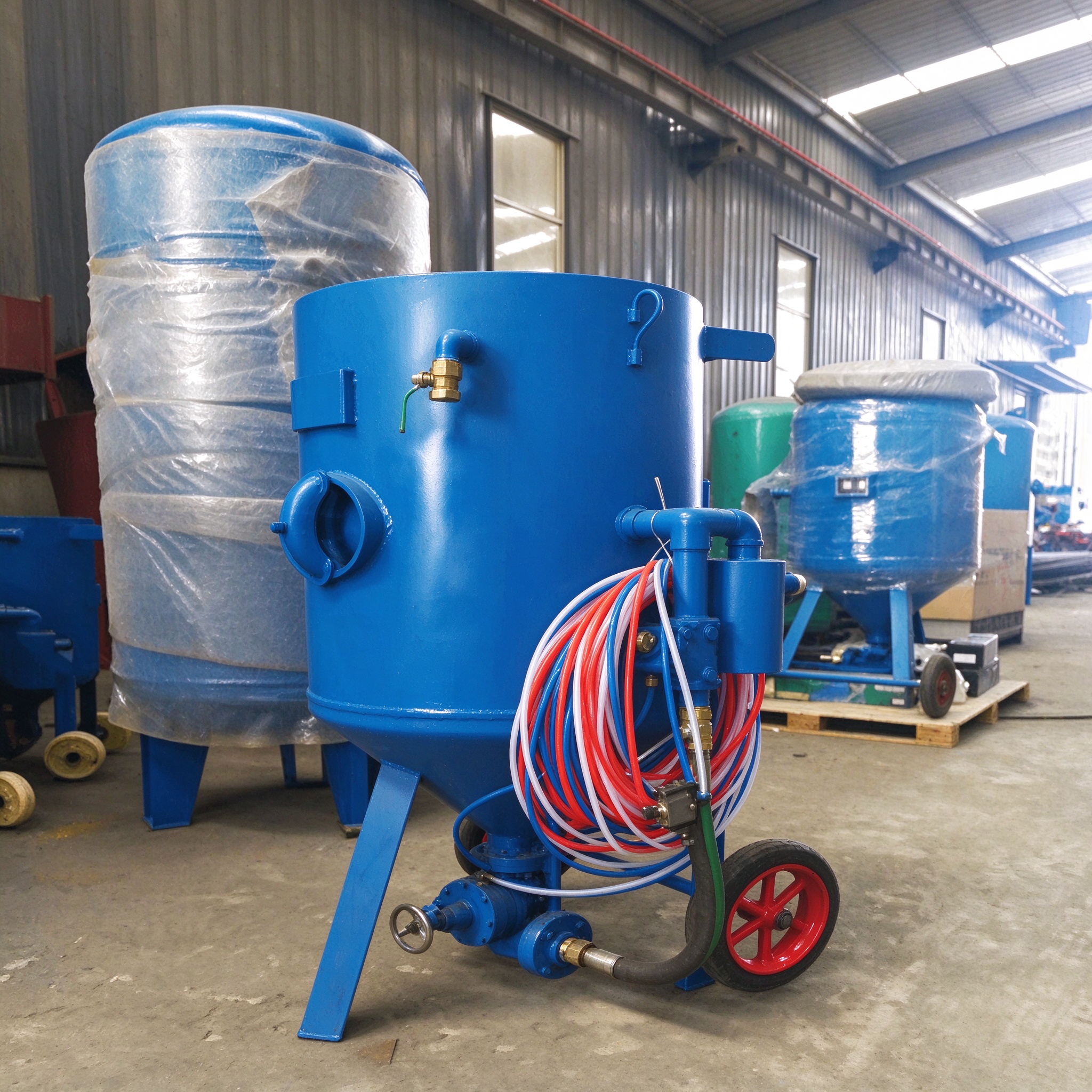
How to Choose a Reliable Mobile Sandblasting Machine Manufacturer
The question “which mobile sandblasting machine manufacturer is reliable” is really four questions in one: how long has the factory been building this equipment, can it prove pressure vessel and safety compliance, does it understand dust control, and will it still answer the phone two years after delivery. A supplier that scores well on all four is worth a premium; a supplier that scores well on price alone is usually expensive in the long run.
Check the Manufacturing Background and Industry Experience
Surface preparation equipment is a long-cycle product. The design details that prevent premature failure, such as the internal geometry of the pot, the metering valve clearances, and the wear pattern around the nozzle holder, come from years of field feedback rather than from a catalogue. A manufacturer with decades of continuous production in this specific category will usually have a more mature design than a trading company assembling purchased components.
Look for a factory that operates its own fabrication and machining capability. In-house plate cutting, welding, machining, and assembly mean the supplier controls weld quality, dimensional accuracy, and delivery schedules. It also means spare parts remain available years later, because the tooling and drawings stay in the same workshop. For buyers in Europe, the Middle East, or Southeast Asia, this matters even more, since importing a machine whose parts cannot be sourced locally turns a small repair into a long stoppage.
Verify Pressure Vessel and Safety Compliance
Ask directly for the hydrostatic test record for the pot, the steel plate grade used for the shell and heads, and the welding procedure. A serious blasting pot manufacturer will treat these as standard documents. If a supplier hesitates on this point, treat it as a warning sign, because a pressure vessel is not a component you want to certify after the fact.
Beyond the pot itself, check the safety accessories: pressure relief valve, working pressure gauge, inlet and outlet valves, and the remote control dead-man system. Confirm that the rated working pressure is stated clearly and that the relief valve is set at or below that rating. Operators should also receive a written procedure covering pot depressurization before refilling, nozzle change, and hose inspection.
Evaluate Dust Collection and Environmental Compliance
Environmental acceptance is now a project gate, not a nice-to-have. If your local authority or client requires dust control, an open blasting pot without collection will fail inspection, and retrofitting filtration later costs more than specifying it at the start. A proper package includes a pulse-jet cartridge or bag filter sized to the blasting airflow, a recovery hopper or floor sweep system, and a documented emission level.
For suppliers serving regulated markets, environmental management certification such as ISO 14001 is a useful signal that the manufacturing process and product design have been reviewed against environmental requirements. It does not replace local compliance testing, but it reduces the risk of buying equipment that was never designed with emissions in mind.
Confirm After-Sales Support and Spare Parts Availability
The real cost of a mobile blasting machine is measured in unplanned downtime, not in the purchase price. Ask how the supplier handles support: remote diagnosis by video call, technician dispatch, and stocked wear parts such as nozzles, hoses, metering valves, and filter cartridges. A supplier that keeps these items in stock can usually resolve a stoppage in days rather than weeks.
Also ask for commissioning support. A mobile system that is installed with the wrong nozzle-to-compressor match will underperform even if the machine itself is perfectly built. Supplier-side training on pressure setting, abrasive selection, and nozzle standoff distance often delivers more productivity gain than any hardware upgrade.
Mobile Versus Fixed Blasting Systems: Which Fits Your Work?
Mobile and fixed systems are not competitors; they solve different problems. The comparison below helps procurement teams decide where a mobile unit belongs in the equipment plan.
| Factor | Mobile Blasting System | Fixed Blasting Room |
|---|---|---|
| Best for | Large or immovable workpieces, on-site projects, distributed maintenance | High-volume small and medium parts, repetitive production lines |
| Installation | Minimal; requires open area, air supply, and dust collection | Requires civil work, ventilation ducting, and building permits |
| Abrasive recovery | Hopper or floor recovery; recovery rate depends on site conditions | Fully integrated mechanical or pneumatic recovery |
| Mobility | Relocatable by forklift, crane, or trailer | Not relocatable |
| Typical users | Coating contractors, bridge and pipeline crews, shipyards, plant maintenance | Manufacturers with steady part flow and fixed process requirements |
In practice, many factories combine both. A fixed automated room handles production parts, while a mobile unit covers oversized assemblies, field repairs, and peak demand. When planning, size the mobile unit around the largest single workpiece you realistically expect and the surface area you need to finish per shift, then match compressor output to the nozzle size.
Typical Applications for Mobile Rust Removal Equipment
Mobile blasting equipment shows up wherever steel needs to be cleaned before coating and wherever relocation beats transportation. In shipbuilding and heavy fabrication, mobile units prepare hull blocks and structural assemblies that cannot fit into a blasting hall. In bridge and pipeline construction, they travel along the route to clean weld zones, supports, and spool sections before primer application.
In general manufacturing, the same equipment supports maintenance work: stripping old paint from machine frames, removing scale from fabricated housings, and refreshing safety structures. Automotive and component workshops use smaller mobile configurations for removing oxidation and heat scale from brackets, rims, and welded assemblies, while achieving a uniform matte finish for bonding or painting.
Surface preparation in glass, stone, and metal finishing also benefits. Mobile units can produce a controlled matte or textured finish on architectural metal and stone surfaces, and they can clean weld discoloration from stainless steel without the chemical waste of pickling pastes. Because the machine is portable, smaller finishing shops can serve several product lines with a single investment.
Operating and Maintenance Best Practices
Most premature wear in mobile blasting equipment comes from three avoidable causes: wet air, wrong abrasive, and skipped inspections. Moisture in the air supply causes the abrasive to bridge in the pot and clog the metering valve, so install a moisture separator and drain it every shift. Use clean, dry, correctly sized abrasive; oversize grit accelerates hose and nozzle wear dramatically while delivering no extra cleaning power.
Build a short daily and weekly routine. Each shift, check the pot relief valve, confirm the gauge reads zero before opening the fill port, inspect the nozzle for oval wear, and check the hose for soft spots or abrasion. Weekly, inspect the couplings, test the remote control dead-man function, and clean or pulse the dust collector filters. Record the checks; a written log makes warranty claims and audits far easier.
Nozzle wear is the most commonly ignored cost driver. A worn nozzle increases air consumption and abrasive flow while reducing impact velocity, so blasting becomes slower and more expensive. Replacing nozzles on a schedule, instead of waiting for visible failure, keeps cycle times stable and protects the compressor from unnecessary load.
Getting a Quotation and Comparing Suppliers
The fastest way to get an accurate mobile sandblasting machine price is to send the supplier a short technical brief: workpiece type and size, surface area per shift, required surface cleanliness grade, available compressor output, whether dust collection is required, and the site conditions. Suppliers who ask follow-up questions about these points are usually the ones who will deliver a machine that fits.
Ask each candidate for a quotation that separates the blasting unit, the dust collection package, the air supply equipment, and the wear parts kit. Comparing lump-sum prices between suppliers is misleading because the scope often differs substantially. Also request a reference list in your region and ask how spare parts are shipped.
A manufacturer with an established export record across Europe, the Middle East, Southeast Asia, and other markets will typically have documentation, packing, and after-sales processes already adapted to international buyers. That experience shows up in small details, such as English-language manuals, export-worthy crating, and remote commissioning support.
FAQ
What is the best mobile sandblasting machine for rust removal on large steel structures?
For large steel structures, a pressure-fed mobile blasting pot paired with a relocatable dust collection system is usually the best fit. Pressure blasting removes tight rust and mill scale far faster than suction-type cabinets, and the mobile frame lets the unit follow the work. Choose pot capacity based on how long you want to blast between refills, and make sure the compressor output matches the nozzle size.
How do I know which mobile sandblasting machine manufacturer is reliable?
Check four things: continuous experience in blasting equipment manufacturing, documented pressure vessel testing and steel plate grade, a properly designed dust collection package, and a clear after-sales and spare parts policy. Ask for the hydrostatic test record and a reference list. A supplier that answers these questions directly is generally a safer partner than one that competes only on price.
What affects the price of mobile rust removal sandblasting equipment?
The main cost drivers are pot capacity and pressure rating, nozzle material, hose quality, whether dust collection and abrasive recovery are included, the air supply package, and the level of automation in pressure control. Customization for site conditions, such as extended hose length or special frame design, also affects price. Always compare quotations on scope, not headline figures.
Can a mobile sandblasting machine be used outdoors and on site?
Yes, that is exactly what mobile units are designed for. Confirm that the frame and wheels suit your transport method, that the pot is rated for the working pressure you need, and that the dust collection system is sized for outdoor use. Local environmental rules may require containment or filtration on site, so verify emission requirements before mobilizing.
What maintenance does a mobile blasting pot need?
Daily checks should cover the relief valve, pressure gauge, nozzle wear, and hose condition. Weekly checks should cover couplings, the remote control dead-man function, and dust collector filter cleaning. Keep the air supply dry, use correctly sized abrasive, and replace wear parts on a schedule rather than after failure.
Summary
A mobile sandblasting machine for rust removal is a productivity tool and a safety-critical pressure system at the same time. The right choice depends less on the headline specification and more on how well the pot is built, how completely the dust collection side is engineered, and how quickly the manufacturer can support the machine once it is on your site.
Buyers who compare suppliers on pressure vessel documentation, nozzle and hose quality, environmental design, and after-sales responsiveness consistently get better results than buyers who compare only price. Match the machine to your largest realistic workpiece, size the air supply correctly, and build a simple maintenance routine from day one. Done properly, a mobile blasting system delivers years of reliable surface preparation across multiple sites and multiple product lines.