
Selecting the right blasting equipment often decides whether a surface preparation project finishes on schedule and within budget. Among all the hardware involved, the mobile sandblasting pot for rust removal sits at the center of the workflow: it stores the abrasive, controls the pressure, and delivers the blast stream that strips corrosion, mill scale and old coatings from steel. For contractors, fabrication shops and maintenance teams, a poorly matched pot means wasted abrasive, uneven surface profiles and repeated rework. A well-matched pot means predictable output, lower consumable cost and a coating that actually holds.
Wuqiao Anxing Sandblasting Machinery Co., Ltd. has been building surface preparation equipment since 1991 in Wuqiao County, Hebei Province, and today operates two production sites with standardized workshops. As a sandblasting pot manufacturer with more than three decades of focus on blast cleaning and dust extraction, the company produces pressure vessels, blast cabinets, mobile pot systems, full blasting rooms and the supporting compressors and consumables that keep them running. This guide explains how mobile pots work, what specifications matter, and how to select the right configuration for your own site conditions.
What Is a Mobile Sandblasting Pot for Rust Removal?
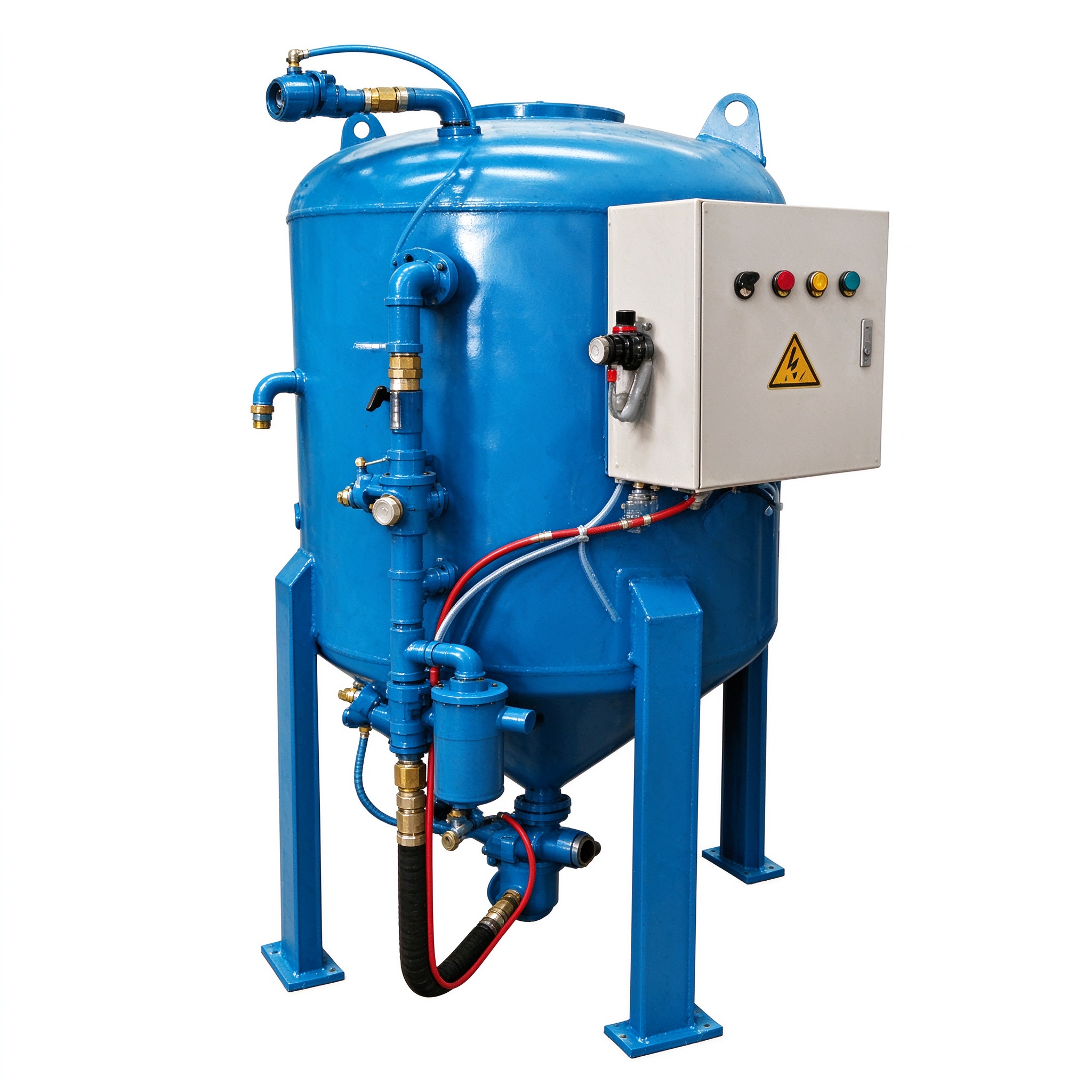
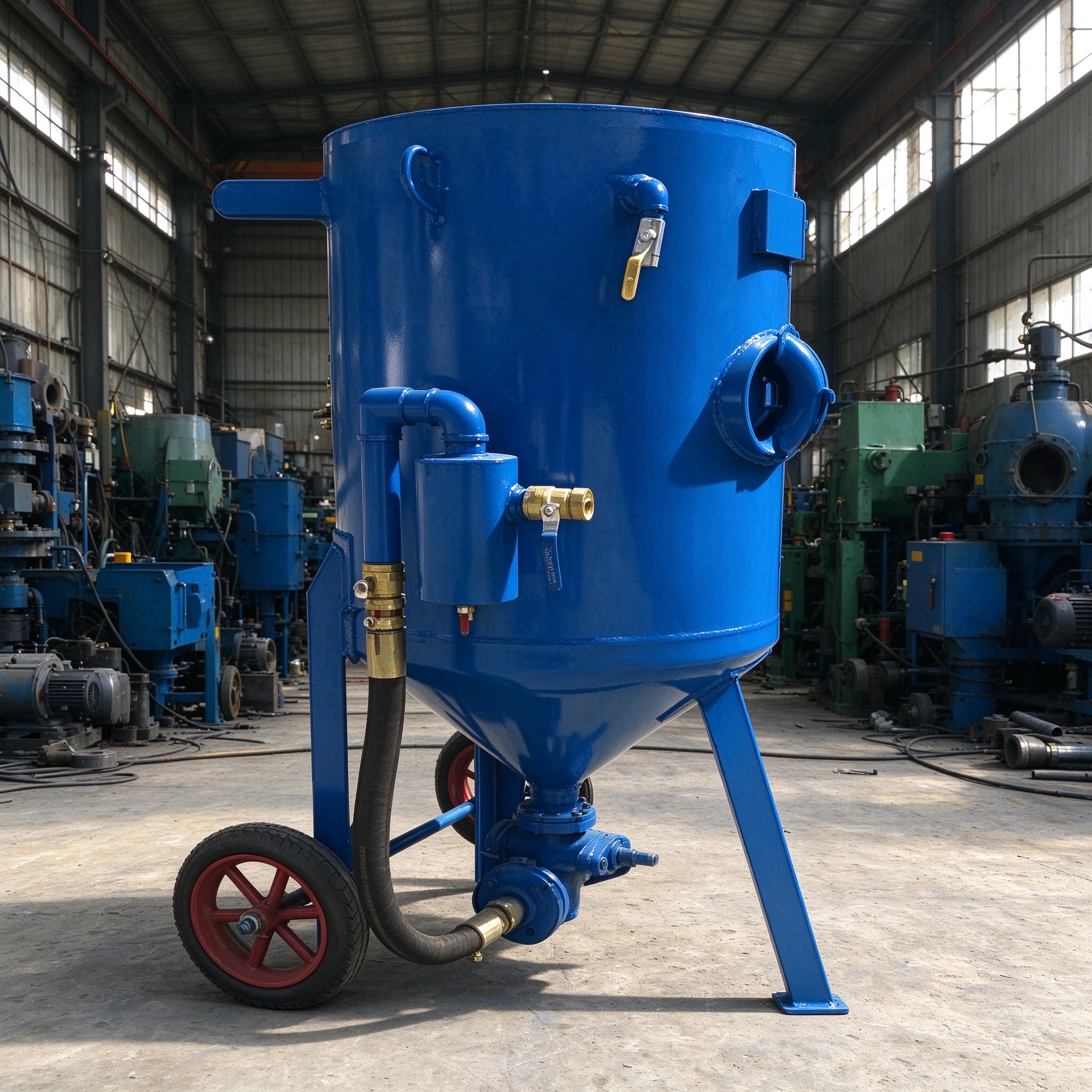
A mobile sandblasting pot is a pressure-rated vessel mounted on a wheeled frame or skid that holds abrasive media under pressure and feeds it through a metering valve into a blast hose. Compressed air enters the vessel, pressurizes the abrasive, and pushes it toward the nozzle, where it accelerates and strikes the workpiece surface. Because the unit is mobile, it can be moved to the workpiece rather than moving the workpiece to the machine — a decisive advantage for bridges, storage tanks, ship hulls, structural steel and other large fabrications that cannot easily be transported.
In rust removal work, the pot must deliver a consistent abrasive flow at a stable pressure. Fluctuating pressure produces an uneven anchor profile, which is one of the most common causes of premature coating failure. A properly engineered pot uses a reliable metering valve, a well-positioned abrasive inlet, and a pressure regulation system that can be adjusted to suit different media — steel grit, copper slag, garnet, aluminum oxide or glass beads — and different surface requirements.
Pressure vessel construction: the part buyers should inspect first
The heart of any pot is the pressure vessel itself. At Anxing, blasting pot bodies are welded from compliant 16MnR pressure vessel steel plate, a material selected for its strength and toughness under cyclic pressure loading. Every vessel is subjected to a hydrostatic test at 2.5 times the rated working pressure before shipment, which validates weld integrity and confirms the shell can withstand the repeated pressurization cycles of daily production blasting.
For buyers evaluating quotations from several suppliers, this is the single most important question to ask. A pot built from general structural steel may look identical on the outside, but its safety margin and service life under continuous industrial use are fundamentally different. Request the material certificate, the test record and the rated working pressure in writing before placing an order.
Why Mobile Pot Design Matters in Field Operations
Field blasting conditions are unforgiving. Equipment is dragged across gravel, exposed to abrasive dust, rained on, and operated by crews working long shifts. Design details that seem minor in a showroom become decisive on site. Wheel configuration, frame rigidity, hose connection placement and valve accessibility all influence how many hours a pot actually delivers blast time per week.
Portability is not only about wheels. A well-designed mobile unit balances the vessel, frame and handle so that one or two workers can reposition it safely on uneven ground. The blast hose outlet should be positioned to avoid sharp bends that wear through hose walls prematurely. The metering valve and moisture trap should be reachable without dismantling the frame, so that adjustments and routine cleaning can be done in minutes rather than hours.
Pressure consistency and abrasive flow control
Consistency separates a professional-grade pot from an entry-level unit. Anxing engineers developed an adaptive pressure regulation approach and an automatic abrasive circulation design, both supported by in-house utility patents covering blast structure, dust recovery and intelligent pressure control. In practical terms, these systems help maintain a stable blast stream as the abrasive column in the vessel drops, reducing the operator’s need to constantly readjust the valve.
The company reports that this design discipline contributes to an overall failure rate roughly 30% below the industry average and energy consumption about 15% lower. For a contractor running multiple nozzles across several shifts, that difference translates directly into fewer breakdowns, less downtime and a lower cost per square meter of prepared surface.
Key Specifications to Compare Before Buying a Sandblasting Pot
Comparing quotations becomes far easier when the same parameters are checked across every offer. The table below summarizes the items that most directly affect performance, safety and total cost of ownership. Use it as a checklist when reviewing technical proposals from any sandblasting pressure vessel supplier.
| Parameter | What It Affects | What to Verify |
|---|---|---|
| Vessel volume | Continuous blasting time between refills | Match volume to nozzle size and shift length |
| Rated working pressure | Blast intensity and achievable surface profile | Confirm pressure rating matches compressor output |
| Vessel steel grade | Safety margin and fatigue life | Request 16MnR or equivalent material certificate |
| Hydrostatic test | Weld integrity and pressure safety | Test at 2.5 times rated pressure, with record |
| Nozzle material | Consumable cost and blast consistency | Wear-resistant ceramic nozzles last longer than alloy |
| Control type | Operator convenience and remote safety | Pneumatic or electric control, deadman handle option |
| Mobility | Site repositioning effort and access | Wheel type, frame rigidity, lifting points |
| Dust control interface | Environmental compliance on site | Compatibility with recovery and pulse dust collectors |
Types of Sandblasting Pots and Where Each One Fits
No single pot configuration suits every job. Anxing manufactures fixed and mobile pressure vessels with electric or pneumatic control, and the family splits into several practical categories that buyers should understand before specifying a unit.
Small sandblasting pot
A small sandblasting pot is typically chosen for touch-up work, small fabrication shops, maintenance bays and jobs where the blasting station moves between workbenches. Its lower abrasive capacity means more frequent refills, but it also means lower compressed air demand, easier handling and a smaller footprint. For workshops treating brackets, frames, gates, handrails and similar components, a compact pot paired with a modest compressor often delivers the best return.
High pressure sandblasting pot
A high pressure sandblasting pot is specified when the job demands aggressive removal — thick mill scale, heavy rust pitting, multiple coating layers or hard abrasives that need extra velocity to be effective. Higher pressure shortens cycle time but also increases nozzle wear and abrasive consumption, so it should be matched carefully to compressor capacity. Undersized air supply is the most common reason a high pressure pot underperforms in the field.
Open top sandblasting pot
An open top sandblasting pot allows abrasive to be loaded from above without dismantling a sealed hatch assembly, which speeds up refilling on sites where crews work in short, intense cycles. The open top format is popular in rental fleets, mobile contracting units and applications where several operators share one pot across a shift. Buyers should confirm that the lid sealing arrangement still provides proper pressure retention and safety interlocking.
Anti-corrosion sandblasting pot
An anti-corrosion sandblasting pot is configured for coating and protective systems work — pipeline coating, tank lining, marine structures and industrial maintenance where surface profile and cleanliness directly determine coating adhesion. These units are usually paired with dust recovery, moisture removal and carefully selected abrasives so that the prepared surface meets the specification before the first coat is applied.
How to Select the Right Configuration for Your Project
Selection should begin with the workpiece, not the catalogue. Answer four questions in order: what is the largest and smallest part, what surface standard must be achieved, how many hours per day will the pot run, and what compressor capacity is available on site or planned for the project.
- Workpiece size and access: Outdoor structures and ship sections favor a mobile unit with a long blast hose; small precision parts are usually better served by a cabinet or a compact pot.
- Surface standard: Aggressive rust removal and deep profile requirements call for higher pressure and larger nozzle combinations.
- Duty cycle: Continuous multi-shift operation justifies a larger vessel and a control system that reduces operator fatigue.
- Air supply: Nozzle size must be matched to actual free air delivery, not the compressor nameplate rating.
- Environmental rules: Sites with strict dust limits should plan for recovery and pulse dust collection from the beginning rather than retrofitting later.
Anxing’s pre-sales engineers visit customer sites to survey working conditions and issue free equipment selection proposals and workshop layout drawings. For projects involving a full blasting room, the company can design and construct the complete system around the building dimensions and workpiece specifications, then integrate the pots, recovery equipment and dust collectors into one coordinated installation.
Manufacturing Capability and Quality Control
Delivery reliability matters as much as technical design. Anxing operates multiple standardized assembly lines with annual capacity reaching into the thousands of units, enabling stable lead times for bulk orders while still accommodating small batch customization and special-condition modifications. The company has supplied batch orders of dozens of units at a time to large heavy industry buyers, including long-term cooperation with major shipbuilding groups.
Quality control runs through the entire production flow. Vessels are welded from compliant pressure vessel steel, tested hydrostatically at 2.5 times rated pressure, and every finished machine passes blasting uniformity, sealing and continuous no-load running checks. Full automatic models are fitted with wear-resistant ceramic nozzles whose service life is roughly three times that of conventional alloy nozzles, reducing consumable spend over the life of the machine. Environmental equipment is manufactured to ISO 14001 environmental management practice, with dust emissions well below national limits, helping customers pass local environmental and safety inspections.
Typical Applications Across Industries
The same pot platform serves remarkably different industries once it is configured correctly. Shipyards and heavy fabrication yards use mobile pots for hull sections, decks and structural assemblies. Steel structure plants blast beams, columns and trusses before painting. Automotive and parts manufacturers remove scale and burrs from castings and welded components. Foundries and mold shops use blasting for surface texturing and cleaning. Bridge and pipeline contractors rely on mobile units for field coating preparation. Glass, stone and architectural workshops use finer media for matte and texture effects, while aviation and precision component suppliers use controlled blasting for surface strengthening and cosmetic finishing.
Because these applications differ so widely in abrasive type, pressure level and dust volume, a supplier’s ability to customize is often more valuable than a long standard product list. Anxing supports non-standard vessel sizes, special frame layouts, alternative control systems and complete blasting-plus-dust-extraction packages, so a single project can be delivered as one coordinated system rather than a collection of mismatched parts.
Maintenance Practices That Extend Pot Life
Blasting equipment fails predictably, and most failures are preventable. Moisture is the most common enemy: wet abrasive clumps, blocks the metering valve and produces an intermittent blast stream. Draining the moisture trap and air receiver daily, and keeping abrasive stored dry, prevents most feed problems.
- Inspect the blast hose for internal wear and replace before wall thinning becomes a safety risk.
- Check nozzle bore diameter regularly; an oversized bore wastes air and abrasive.
- Clean the metering valve and inspect seals at each scheduled service interval.
- Verify pressure gauge accuracy and confirm relief valve operation.
- Inspect vessel welds and fittings visually; keep the hydrostatic test record on file.
- Service the dust collector filters to maintain extraction efficiency and stay within emission limits.
Anxing supports customers after delivery with on-site installation, commissioning and operator training covering daily use, routine maintenance and basic troubleshooting. A rapid after-sales response network, stocked spare parts and combined remote guidance and on-site repair keep unplanned downtime low. Domestic coverage extends across nearly thirty provinces and regions, and export business reaches Europe, North America, the Middle East, Southeast Asia, Hong Kong, Macao and Taiwan, with repeat orders from buyers in Myanmar, South Korea and several Middle East markets.
Cost, Procurement and Supplier Evaluation
Purchase price is only one line in the total cost equation. A lower-priced pot that consumes more abrasive, needs more frequent valve repair and delivers inconsistent profile will cost more within a year than a properly built unit. When comparing sandblasting pot price quotations, ask each supplier for rated pressure, steel grade, test documentation, nozzle specification, spare parts availability and after-sales response terms.
Evaluating a manufacturer rather than a trading intermediary also reduces risk. A factory with in-house mechanical design, fluid pressure and dust extraction engineering teams can respond to technical questions directly, modify designs for special conditions, and supply matching consumables over the equipment’s full life cycle. Anxing’s recognition as a provincial science and technology SME in 2023 and as a national-level science and technology SME in 2025 reflects sustained investment in that engineering capability, backed by more than ten utility patents in blast structure, dust recovery and intelligent pressure regulation.
FAQ
What is the difference between a mobile sandblasting pot for rust removal and a fixed pot?
A mobile pot is mounted on a wheeled frame or skid so it can be moved to the workpiece, which suits bridges, tanks, ship sections and other large structures that cannot be brought indoors. A fixed pot is installed permanently, usually connected to a blasting room or a dedicated station, and is better for high-volume repetitive production where the workpiece travels to the equipment.
How do I choose between a small sandblasting pot and a high pressure sandblasting pot?
Start with the workpiece and the surface standard. A small sandblasting pot suits light rust removal, touch-up, small fabrications and limited air supply. A high pressure sandblasting pot is appropriate for heavy mill scale, thick coatings and hard abrasives that require higher velocity. Always confirm that your compressor’s actual free air delivery can support the nozzle size you intend to run, because insufficient air is the most common cause of poor performance.
Is an open top sandblasting pot suitable for contractor use?
Yes. An open top sandblasting pot speeds up abrasive loading, which is valuable on sites with short, intense work cycles and multiple operators sharing one unit. When evaluating this design, confirm that the lid sealing and safety arrangement still provide proper pressure retention and that the frame and wheels are robust enough for the terrain where the pot will be used.
What pressure testing should a sandblasting pot pass before delivery?
Vessels should be welded from compliant pressure vessel steel plate and hydrostatically tested at 2.5 times the rated working pressure. At Anxing, every pot body undergoes this test before shipment, and buyers should request the material certificate and test record as part of the technical documentation package.
Can an anti-corrosion sandblasting pot be integrated with dust collection equipment?
Yes. Anti-corrosion work usually requires both a consistent surface profile and controlled dust emissions, so the pot is typically paired with abrasive recovery and pulse dust collection. Anxing designs and supplies complete blasting and dust extraction systems, including full blasting rooms, so that pots, recovery units and collectors operate as one coordinated installation rather than separate purchases.
How long does delivery take for bulk orders?
With multiple standardized assembly lines and annual capacity in the thousands of units, the company maintains stable lead times for batch orders and has completed single deliveries of dozens of machines to large heavy industry customers. Small batch customization and special-condition modifications are also supported, with the schedule confirmed at the time of order.
Summary
Choosing a mobile sandblasting pot for rust removal is a specification exercise, not a price comparison. Vessel steel grade, hydrostatic testing, rated pressure, nozzle material, mobility design and dust control compatibility determine how safely and productively the unit will run over its service life. Buyers who verify these points before ordering avoid the hidden costs of inconsistent profile, frequent repairs and repeated consumable replacement.
With production roots going back to 1991, two manufacturing sites in Wuqiao County, Hebei Province, in-house engineering across mechanical design, fluid pressure and dust extraction, and a product range covering small sandblasting pots, mobile units, high pressure pots, open top pots and anti-corrosion configurations, Wuqiao Anxing Sandblasting Machinery Co., Ltd. supports customers from single-unit purchases to complete blasting and dust extraction projects. Site surveys, free selection proposals, workshop layout drawings, operator training and a stocked spare parts network are part of the package — the practical foundation for equipment that keeps running long after the delivery truck leaves.