
Surface preparation is one of the most important steps in any coating, painting or metal finishing process. Whether you are removing mill scale from structural steel, stripping old paint from a bridge, cleaning welds before inspection or preparing a surface for anti-corrosion coating, the efficiency and consistency of the blasting operation depend heavily on the equipment behind it. For many workshops, fabrication yards and maintenance teams, a small sandblasting tank is the most practical starting point: it is compact, easy to move, simple to operate and capable of delivering professional-grade results when it is correctly selected and maintained.
This guide explains the main types of sandblasting tanks, including the mobile sandblasting rust removal tank, the open sandblasting tank, the high pressure sandblasting tank and the anti-corrosion sandblasting tank. It also covers the specifications that matter most, how to match a tank to your workload, maintenance and safety practices, and what to look for when choosing a pressure vessel sandblasting tank manufacturer. The information is written for buyers in shipbuilding, steel structure fabrication, automotive parts, hardware and mould production, bridge and pipeline construction, and general industrial maintenance.
What Is a Small Sandblasting Tank and Who Uses It?
A small sandblasting tank is a compact pressure vessel that stores abrasive media and delivers it through a blast hose and nozzle using compressed air. The operator controls the flow of abrasive and air, directing the stream at the workpiece to remove rust, mill scale, oxidation, old paint, burrs or surface contamination. Compared with large stationary blasting rooms, a small tank offers fast deployment, low capital cost and the flexibility to work in different locations, which makes it popular in maintenance workshops, small fabrication shops, repair yards and on-site service teams.
Typical users include steel structure fabricators preparing beams and plates before painting, shipyards and ship repair teams cleaning hull sections and deck areas, automotive and machinery workshops removing rust from frames and components, and anti-corrosion contractors preparing pipes, tanks and structural steel before coating application. Because the tank is relatively small, it can be transported by forklift, crane or even by hand using a wheeled frame, so the same unit can serve multiple work areas during a single shift.
The capacity of a small tank is usually measured in litres or in abrasive weight, and it is balanced against the available compressor output. A tank that is too small will require frequent refilling and interrupt the work cycle; a tank that is too large for the compressor will not maintain stable blasting pressure and will produce uneven results. Matching tank volume, working pressure, nozzle size and air consumption is therefore the first technical decision in any purchase.
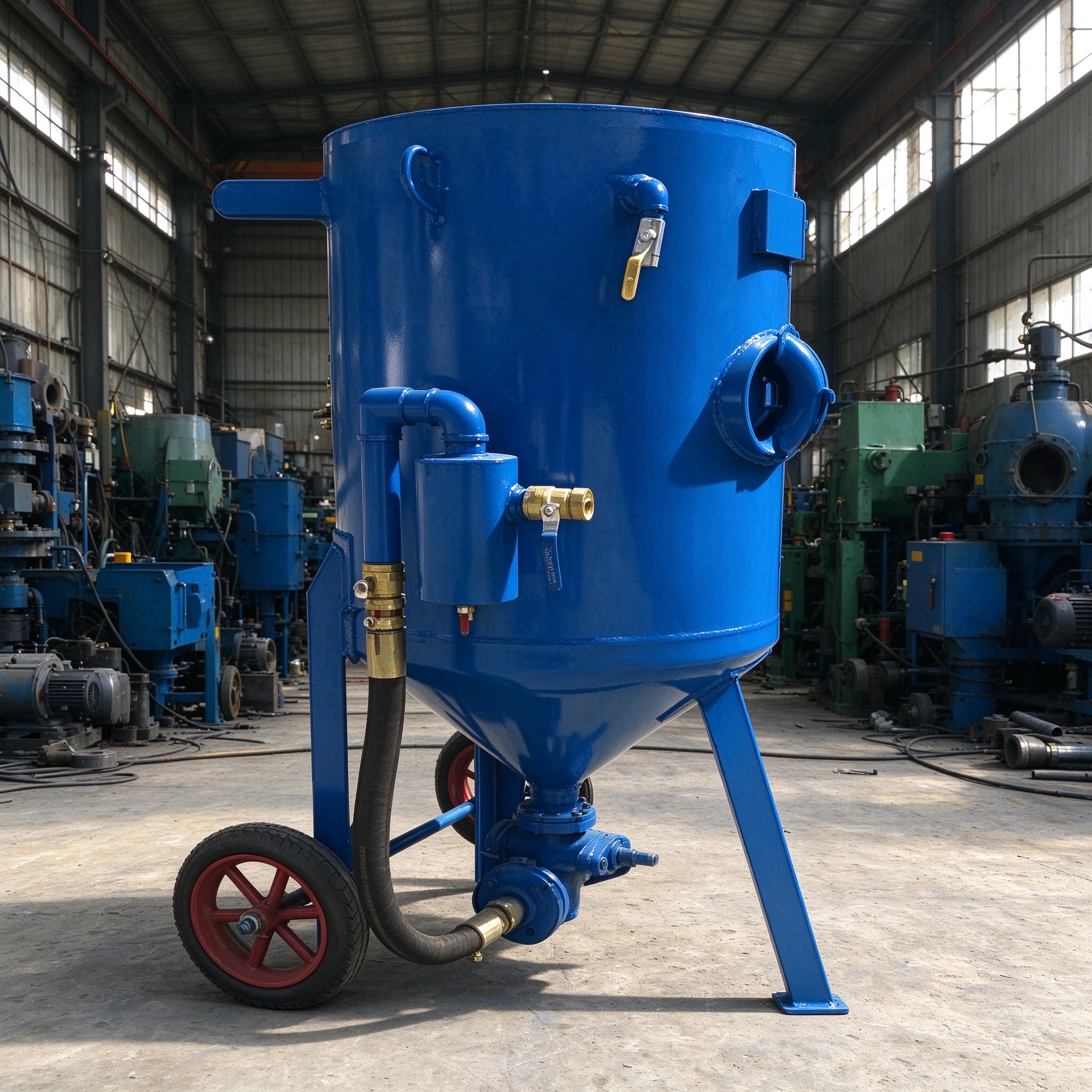
Types of Sandblasting Tanks: Mobile, Open, High-Pressure and Anti-Corrosion
Sandblasting tanks are not a single product category. Different designs suit different working conditions, and understanding the distinctions helps buyers avoid over-specifying or under-specifying equipment. The four most common configurations in industrial surface preparation are the mobile rust removal tank, the open tank, the high pressure tank and the anti-corrosion tank.
Mobile Sandblasting Rust Removal Tank
A mobile sandblasting rust removal tank is built on a wheeled chassis or skid frame so it can be moved between work areas, loaded onto a truck or positioned close to large workpieces that cannot be brought into a workshop. It is widely used for on-site rust removal on steel structures, bridges, storage tanks and pipeline supports. Mobility affects the design of the tank: the frame must be stable, the wheels or castors must handle the loaded weight, and the hose and control valve arrangement must remain accessible when the unit is parked on uneven ground.
For field work, a mobile unit should have reliable seals and a robust abrasive metering valve, because dust and moisture are constant challenges outdoors. Buyers should also confirm that the tank can be drained and cleaned easily between jobs, especially when abrasive type is changed or when the equipment will be stored outside for long periods.
Open Sandblasting Tank
An open sandblasting tank is designed for direct blasting without a fully enclosed cabinet or room. It is commonly used for large, awkward or immovable workpieces, such as structural frames, heavy machinery, tanks and vessels. The open configuration gives the operator freedom of movement and allows the nozzle to reach complex geometry, but it places more responsibility on the operator and the site to control dust, protect nearby workers and contain used abrasive.
When an open tank is used outdoors, wind direction, humidity and abrasive recovery all affect productivity. A well-designed tank still delivers consistent media flow, but the surrounding work area needs proper preparation. Many buyers pair an open tank with a dust suppression or recovery system to reduce airborne dust and comply with local environmental requirements.
High Pressure Sandblasting Tank
A high pressure sandblasting tank is selected when the surface is hard, the contamination is stubborn or the production rate must be high. Higher working pressure increases impact energy and can shorten cleaning time on heavy mill scale, thick coatings and forged or cast surfaces. However, higher pressure also increases air consumption, nozzle wear and the demands placed on the pressure vessel and its fittings.
Pressure rating must be matched to the compressor, hose, nozzle and safety accessories. A tank that is rated for high pressure but connected to an undersized compressor will not deliver the expected performance, while a low-rated tank pushed beyond its design limits creates a serious safety risk. Buyers should ask for the design pressure, test pressure and material specification before confirming an order.
Anti-Corrosion Sandblasting Tank
An anti-corrosion sandblasting tank is used in coating and protective systems where surface cleanliness directly affects coating adhesion and service life. In anti-corrosion work, the blasting step must produce a uniform anchor profile and remove all rust, salt contamination and loose material before the primer is applied. Consistency matters more than raw speed, because an uneven surface profile can lead to premature coating failure.
These tanks are often used in pipeline coating plants, steel structure painting lines and tank fabrication yards. The equipment should deliver stable abrasive flow, allow fine adjustment of pressure and be easy to clean so that contamination from previous jobs does not carry over into the next coating batch.
| Tank Type | Typical Use | Mobility | Key Consideration |
|---|---|---|---|
| Small sandblasting tank | Workshop maintenance, small parts, touch-up | Portable or bench-side | Match volume to compressor output |
| Mobile sandblasting rust removal tank | On-site rust removal, bridges, tanks, pipelines | Wheeled chassis or skid | Stability, sealing and outdoor durability |
| Open sandblasting tank | Large or immovable workpieces | Site-dependent | Dust control and abrasive recovery |
| High pressure sandblasting tank | Heavy scale, thick coatings, high productivity | Stationary or mobile | Pressure rating and air supply capacity |
| Anti-corrosion sandblasting tank | Coating preparation, pipeline and tank fabrication | Stationary or mobile | Uniform profile and clean media flow |
Key Specifications to Check Before Buying a Sandblasting Tank
The specification sheet of a sandblasting tank should be read like an engineering document, not a marketing brochure. The pressure vessel body, the abrasive metering system, the control valve, the hose and the nozzle all influence performance and service life. For buyers comparing quotations, the most useful approach is to confirm a small set of critical parameters and then compare the supporting service and spare parts offer.
Tank material and welding quality are the first items to verify. Industrial pressure vessels are commonly fabricated from pressure vessel grade steel plate, and the weld seams must be continuous, inspected and tested. A reputable pressure vessel sandblasting tank manufacturer will state the material grade, the design pressure and the test pressure rather than only listing the tank volume. Water pressure testing at a multiple of the rated working pressure is a standard verification step, and buyers should request the test record for the specific unit.
Air consumption is the second critical specification. The compressor must be able to supply the required volume of air at the working pressure while the nozzle is blasting. If the compressor is undersized, pressure will drop, the blast pattern will become weak and the operator will compensate by blasting longer, which increases abrasive consumption and labour cost. A simple rule is to select the nozzle first, then calculate air demand, then choose the compressor capacity, and finally confirm that the tank and hose can support that flow.
- Tank volume: match refill frequency to the working cycle and available handling equipment.
- Design and test pressure: confirm the pressure vessel rating and documented test records.
- Abrasive metering valve: check adjustment range, wear resistance and ease of cleaning.
- Nozzle and hose: confirm bore size, material and compatibility with the abrasive type.
- Seals and fittings: verify replacement parts are standard and readily available.
- Safety accessories: pressure gauge, relief device, moisture trap and grounding provisions.
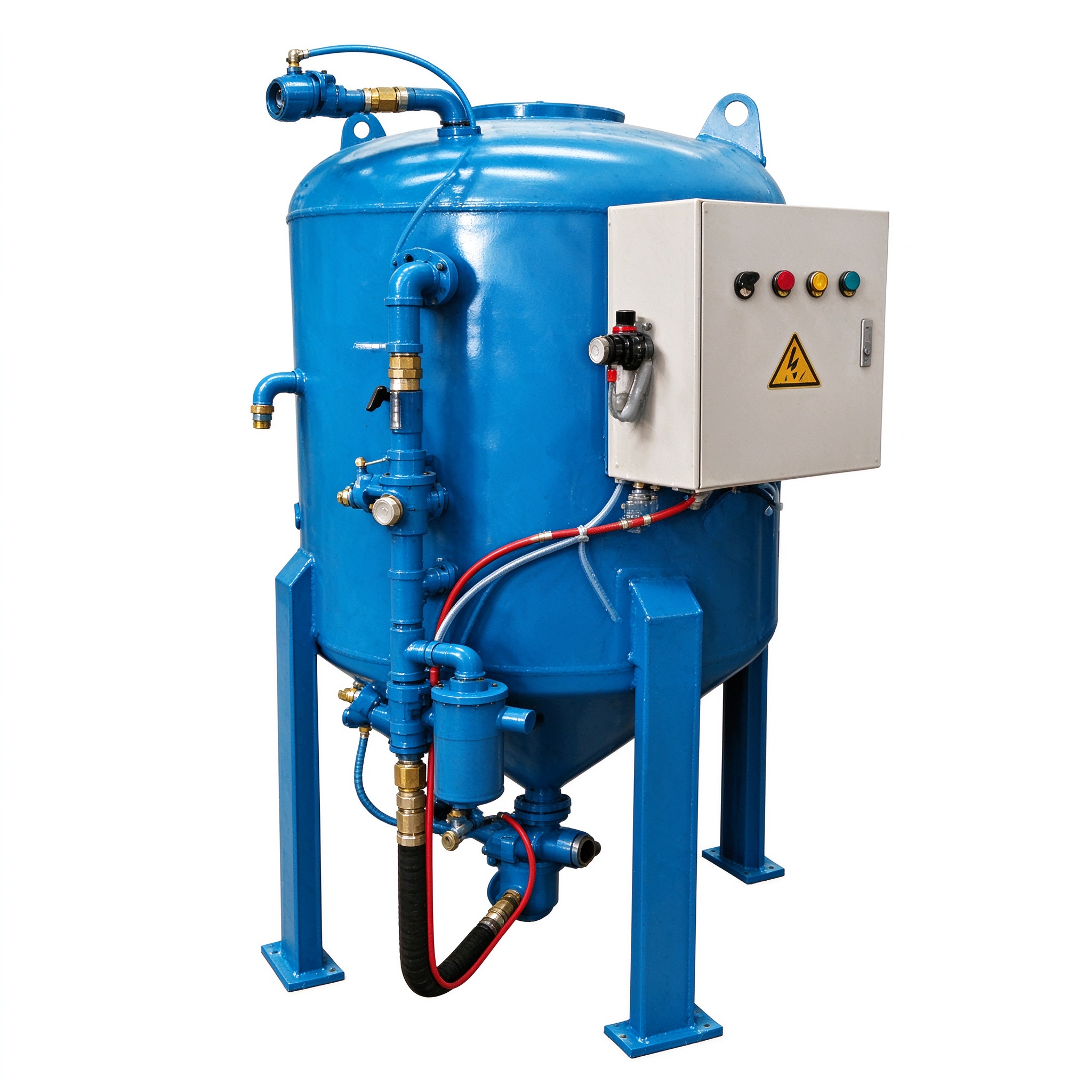
How to Select the Right Tank for Your Application
Selecting a tank starts with the workpiece, not the catalogue. A maintenance workshop that cleans small components intermittently has different requirements from a fabrication yard that blasts structural beams every day. The workpiece size, the type of contamination, the required surface finish and the working location together determine the most economical configuration.
For small parts, precision components and touch-up work, a compact small sandblasting tank combined with a cabinet or a controlled blasting area usually gives the best balance of cost and finish quality. For large structures and outdoor maintenance, a mobile sandblasting rust removal tank allows the equipment to travel to the workpiece. Where the workpiece cannot be moved and the surface is heavily contaminated, an open sandblasting tank with adequate dust control is often the practical choice. Where coating adhesion is critical, an anti-corrosion sandblasting tank with stable pressure regulation supports a consistent anchor profile.
Production volume also drives the decision. Low-volume users can justify a single portable unit, while higher-volume operations may need multiple tanks, larger abrasive storage or a fully integrated blasting and dust collection system. It is usually more economical to plan for the next two or three years of workload than to buy strictly for today’s requirement and then replace the equipment within a year.
| Application Scenario | Recommended Configuration | Reason |
|---|---|---|
| Small parts and repair work | Small sandblasting tank with cabinet or booth | Controlled containment and media recovery |
| Outdoor steel structure maintenance | Mobile sandblasting rust removal tank | Equipment moves to the workpiece |
| Large immovable workpieces | Open sandblasting tank with dust control | Reach and flexibility for complex geometry |
| Heavy mill scale and thick coatings | High pressure sandblasting tank | Higher impact energy and faster cleaning |
| Coating and painting preparation | Anti-corrosion sandblasting tank | Uniform surface profile and stable flow |
Maintenance and Safety Practices for Sandblasting Tanks
Sandblasting equipment operates under pressure and handles abrasive material, so maintenance and safety cannot be treated as afterthoughts. A simple daily and weekly routine prevents most common failures, extends the life of the pressure vessel and keeps the blast operation productive.
Before each shift, operators should check the pressure gauge, inspect the hose and couplings for wear, confirm that the metering valve moves freely and make sure the moisture trap is drained. Abrasive should be dry and free of debris, because damp media causes clogging and uneven flow. After the shift, the tank should be depressurised, the nozzle inspected and the work area cleaned of spent abrasive.
On a weekly or monthly basis, the hose, nozzle, seals and control valve should be inspected more closely. Worn nozzles increase air consumption and reduce blasting efficiency, so replacing them at the recommended interval is cheaper than continuing to blast with a degraded nozzle. Pressure vessel inspection should follow the manufacturer’s schedule and local regulatory requirements, and any repair to the vessel body should be carried out by qualified personnel.
- Wear approved respiratory protection, eye protection, hearing protection and protective clothing.
- Never open or service a tank while it is pressurised.
- Ground the equipment and control static when using dry abrasive.
- Keep bystanders clear of the blast area and control dust with suitable extraction or suppression.
- Record inspection dates, replacement parts and any abnormal pressure behaviour.
Choosing a Reliable Sandblasting Tank Manufacturer
Equipment reliability is largely determined before the first blast. Welding quality, material selection, valve design and assembly discipline separate a tank that runs for years from one that demands constant repair. Buyers should look for a manufacturer with a long production history, in-house fabrication capability and a documented quality control process, rather than a trading company that only assembles purchased components.
Wuqiao Anxing Sandblasting Machinery Co., Ltd. is a surface treatment equipment manufacturer based in Wuqiao County, Hebei Province, with production sites in the local development zone and Anling Town. The company’s team has focused on sandblasting equipment since 1991 and now covers research, production, sales, customisation and after-sales service. Its product range includes small and mobile sandblasting tanks, open and high pressure units, anti-corrosion configurations, pressure vessel sandblasting tanks, complete blasting rooms, dust collection systems, air compressors and blasting consumables. The company was recognised as a Hebei science and technology SME in 2023 and as a national science and technology SME in 2025.
On the manufacturing side, tank bodies are welded from 16MnR pressure vessel steel plate, and each vessel is subjected to a hydrostatic test at 2.5 times the rated pressure before delivery. Automatic models use wear-resistant ceramic nozzles with a service life reported to be three times that of conventional alloy nozzles. The company states that its adaptive pressure regulation, abrasive recirculation and intelligent dust removal and noise reduction technologies reduce equipment failure rates by about 30 percent and energy consumption by about 15 percent compared with industry averages. Environmental equipment is produced under ISO 14001 environmental management certification, and dust emissions are designed to stay below national limits.
For international buyers, supply capability matters as much as product specification. The company operates multiple assembly lines with annual capacity in the thousands of units, supports both standard production and custom pressure vessel fabrication, and has supplied batch orders to large heavy industry customers including Jiangnan Shipyard. Its products are exported to Europe, the Middle East, Southeast Asia and other regions, with repeat orders reported from Myanmar, South Korea and several Middle Eastern markets. Before requesting a quotation, buyers should prepare the workpiece size, contamination type, required finish, available compressor output and site conditions; this information allows the manufacturer to recommend a suitable tank volume, pressure rating and configuration.
FAQ
What is the difference between a small sandblasting tank and a mobile sandblasting rust removal tank?
A small sandblasting tank is compact and is typically used in workshops, maintenance bays or near fixed workstations. A mobile sandblasting rust removal tank is built on a wheeled chassis or skid so it can be moved to outdoor sites, bridges, storage tanks or large workpieces. The main differences are the frame design, mobility, sealing arrangement and outdoor durability rather than the basic blasting principle.
What pressure should a high pressure sandblasting tank operate at?
The correct operating pressure depends on the abrasive type, nozzle size, coating or scale thickness and the pressure rating of the vessel. The important point is that the working pressure must stay within the design rating stated by the manufacturer, and the compressor must be able to supply the required air volume at that pressure. Buyers should ask for the design pressure and the hydrostatic test record for the specific tank.
Can an open sandblasting tank be used outdoors?
Yes. Open sandblasting tanks are frequently used outdoors for large or immovable workpieces. However, outdoor use requires attention to wind direction, dust control, abrasive recovery and protection of nearby workers and equipment. Pairing the tank with suitable dust suppression or extraction equipment helps maintain a safer and cleaner work area.
How often should a sandblasting tank be inspected?
Daily checks should cover the pressure gauge, hose, couplings, metering valve and moisture trap. Hoses, nozzles and seals should be inspected more thoroughly on a weekly or monthly basis depending on usage. Pressure vessel inspection should follow the manufacturer’s recommendations and applicable local regulations, and the tank should never be opened or serviced while pressurised.
How do I choose a manufacturer for anti-corrosion sandblasting tanks?
Look for a manufacturer with in-house fabrication, documented material specifications, pressure testing records and a clear after-sales process. Confirm that the supplier can support the required tank volume, pressure rating, abrasive metering control and spare parts supply. For coating work, ask how the equipment maintains stable abrasive flow and a uniform surface profile, since these factors directly affect coating adhesion.
What information should I provide to get an accurate sandblasting tank quotation?
Provide the workpiece dimensions and material, the type of contamination, the required surface finish, the available compressor output, the working location and the expected production volume. This information allows the supplier to recommend a suitable tank type, volume and pressure rating, and to quote the correct nozzle, hose and dust control configuration.
Summary
Choosing the right sandblasting tank is a matter of matching equipment to the workpiece, the working location and the production target. A small sandblasting tank suits compact workshops and maintenance tasks, a mobile sandblasting rust removal tank brings the equipment to outdoor or remote workpieces, an open sandblasting tank handles large or immovable structures, a high pressure sandblasting tank delivers the impact needed for heavy scale and thick coatings, and an anti-corrosion sandblasting tank supports consistent surface profiles before protective coating.
Whatever the configuration, pressure vessel quality, material grade, testing records, abrasive metering control and after-sales support matter more than a low initial price. Buyers who confirm the design pressure, test pressure, air consumption and maintenance requirements before ordering usually avoid the most common causes of poor performance. Working with an experienced manufacturer that offers selection advice, custom fabrication and spare parts support reduces the risk of downtime and helps the blasting operation stay productive, safe and compliant over the life of the equipment.