
A sandblasting tank is the pressure vessel that stores abrasive and delivers it, together with compressed air, to the blasting nozzle, so its sizing, control mode, and build quality directly decide how consistently a surface preparation job runs. Getting the configuration right at the selection stage prevents most downtime later.
What Is a Sandblasting Tank and How Does It Work?
A sandblasting tank is a pressure vessel that holds abrasive and receives compressed air, then feeds a controlled abrasive-air mixture to the nozzle. Pressure regulation, abrasive flow, and sealing quality determine blasting consistency, while the tank body itself must be built to pressure vessel requirements for safe, continuous operation.
In a complete blasting system, the tank sits between the air supply and the nozzle. Compressed air enters the vessel, pressurizes the abrasive, and pushes it through the hose to the gun, where the nozzle shapes the stream. Because the tank forms the pressure boundary of the system, its welded construction, valve arrangement, and sealing quality matter as much as its working volume.
Wuqiao Anxing Sandblasting Machinery Co., Ltd. builds pressure vessel tanks in stationary, mobile, electric-control, and pneumatic-control versions, and the tank bodies can be custom built to different pressure-bearing sizes in line with pressure vessel standards. Each tank body is welded from 16MnR pressure vessel steel plate and is hydrostatically tested at 2.5 times its rated pressure before it leaves the factory.
Where the Tank Fits in the Blasting Circuit
No tank works alone. The parts around the pressure vessel decide how well the whole system performs, so they deserve the same attention during selection as the vessel itself.
- Adaptive pressure regulation keeps the blasting pressure stable as the nozzle opens and closes, which supports even surface results.
- Automatic abrasive circulation returns usable abrasive to the pressure side instead of discarding it after a single pass.
- A wear-resistant blasting hose and a matched blasting gun carry the abrasive-air mixture from the tank to the nozzle.
- Abrasive recovery devices and pulse dust removal units keep the working area cleaner and reduce abrasive waste.
- Automatic models use wear-resistant ceramic nozzles whose service life is three times that of ordinary alloy nozzles.
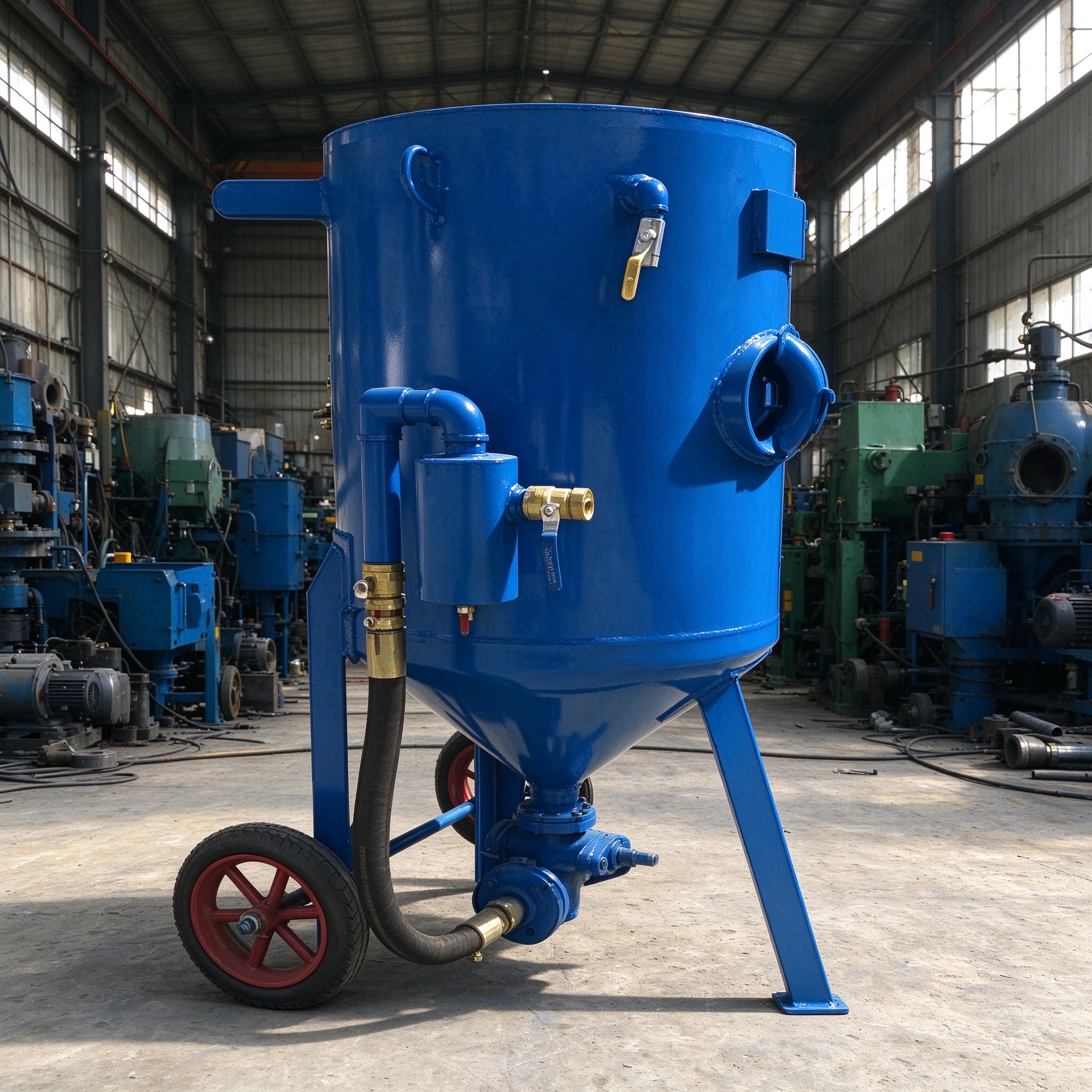
Mobile, Outdoor, Pressure, and Dual-Chamber Options Compared
Configuration choice comes down to three practical questions: where the work happens, how the abrasive is handled, and how pressure is controlled. Mobile and outdoor versions serve work that moves between sites or takes place outside a fixed booth, pressure-type units focus on steady delivery at the nozzle, and a dual-chamber option is matched to the project’s working cycle.
Mobile and Outdoor Configurations
A mobile sandblasting tank is used when blasting work shifts between locations, such as different structures on a large site or a series of components that cannot be brought to a fixed booth. Keeping the pressure vessel, controls, and hose connections on a movable base allows the whole system to be repositioned as a unit rather than rebuilt on site.
An outdoor configuration is used when the blasting itself happens in the open, for example on bridges, pipelines, or large steel structures that cannot be moved indoors. Outdoor use puts more weight on dust control and on how the equipment is sited, so the selection discussion should cover abrasive recovery, dust removal, and the layout of the working area before the order is placed.
Pressure-Type and Dual-Chamber Configurations
A pressure sandblasting tank feeds abrasive to the nozzle under pressure, and the control mode determines how the operator adjusts that pressure and starts or stops the flow. The product range covers both electric-control and pneumatic-control tanks, so the choice can follow the site’s control preferences and the way operators are used to working.
A dual-chamber arrangement is a configuration option rather than a default. Whether it suits a project depends on the working cycle and on how abrasive is supplied to the machine, and the practical step is to describe the job in detail to the supplier and confirm the arrangement before the build begins.
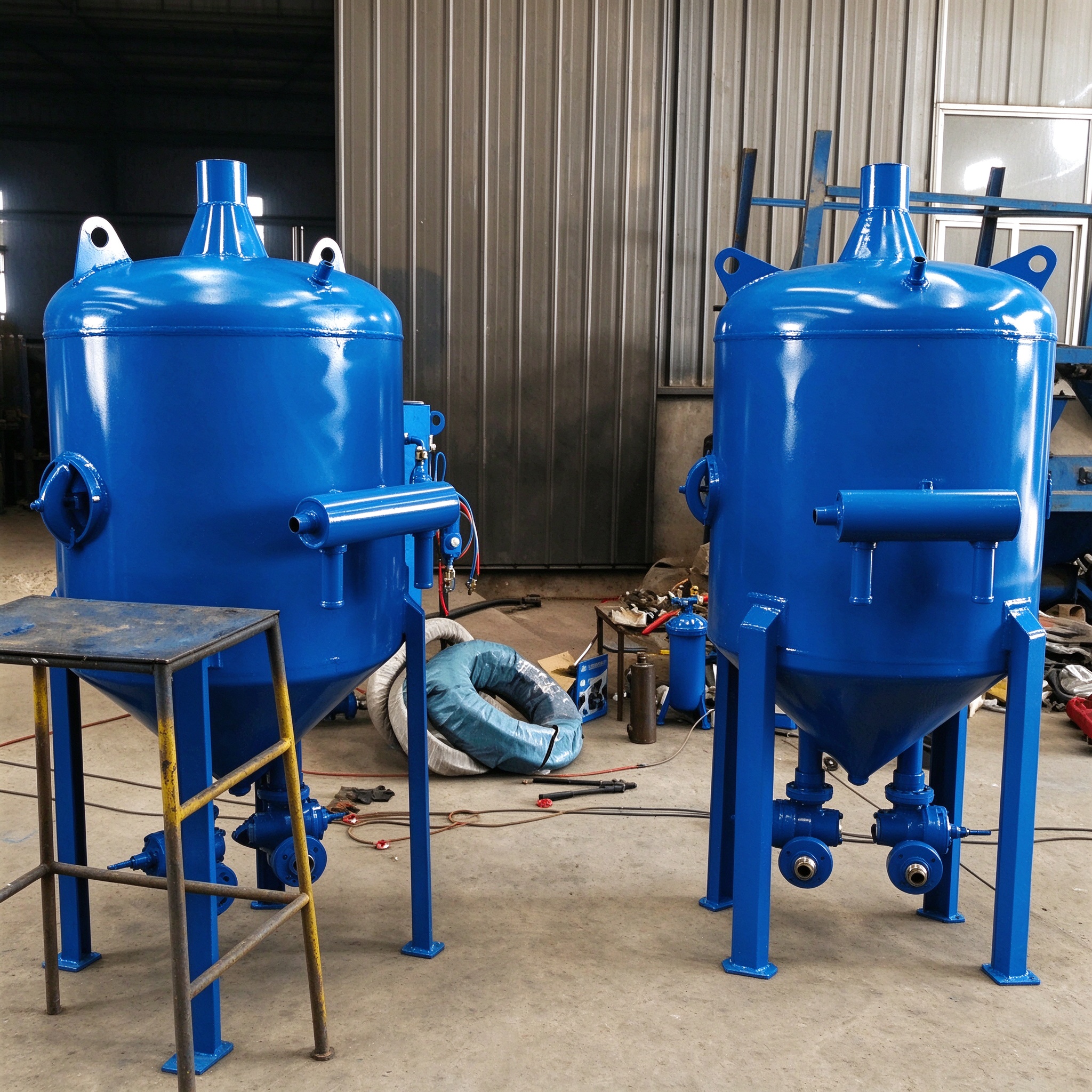
How to Match a Configuration to Your Workpiece
Matching a sandblasting tank to the workpiece starts with the part itself. Its size, weight, and handling decide whether blasting happens in a cabinet, a booth, or in the open; those answers then narrow the choice of working volume, pressure-bearing size, mobility, and control mode.
Workpieces that can be brought indoors usually point to a booth or a cabinet machine, while structures too large to move — bridges, pipelines, ship sections, steel frames — point to open-air work and a mobile or outdoor configuration. Working volume and pressure-bearing size follow from how much blasting each shift has to complete and from the nozzle and hose that the system will feed.
Control mode and dust control come next. A tank that is oversized for the work wastes compressed air, while an undersized one forces the operator to wait between cycles, so the throughput estimate behind the selection should be realistic rather than optimistic. Sites with strict dust limits should also plan the recovery and dust removal side of the system in the same discussion, not afterwards.
Applications and Process Outcomes Across Industries
The tank itself does not change the process, but its stability decides whether the process repeats predictably. With stable pressure and steady abrasive flow, blasting can deliver consistent rust removal, scale removal, deburring, paint stripping, matte finishing, texture work, and surface strengthening across very different materials.
Because the equipment is configured around the workpiece rather than around a single trade, the same pressure-side design logic serves a wide spread of production environments:
- Shipbuilding and heavy industry
- Steel structure engineering
- Automotive parts manufacturing
- Hardware and mold production
- Aviation components
- Glass and stone processing
- Bridge and pipeline work
- Anti-corrosion coating projects
In each of these settings the requirement is the same in principle: a repeatable surface before the next process step, whether that step is coating, inspection, assembly, or finishing. Where the surface result varies from part to part, the cause is usually found in pressure stability, abrasive feed, or sealing rather than in the abrasive itself.
Build Quality, Safety, and Environmental Control
Because the vessel stores compressed air and abrasive under pressure, build quality is a safety issue rather than a comfort feature. Welded pressure vessel steel, documented pressure testing, and sealing checks on the complete machine are the basics that keep a blasting system dependable over years of use.
On the production side, tank bodies are welded from compliant 16MnR pressure vessel steel plate, and every tank is hydrostatically tested at 2.5 times its rated pressure before dispatch. Complete machines then go through blasting uniformity, sealing, and continuous no-load running checks, and the finished equipment follows national air emission and pressure vessel safety standards. Environmental equipment carries ISO14001 environmental management certification, and dust emissions are kept well below national limits, which matters for plants preparing for local environmental and safety inspections.
Control technology contributes to both safety and running cost. Adaptive blasting pressure regulation, automatic abrasive circulation, and intelligent dust removal with noise reduction are developed in-house, and the resulting equipment shows an overall failure rate 30% lower than the industry average together with a 15% reduction in energy consumption.
Customization, Capacity, and Service Support
Tank selection rarely ends with a catalogue item, because site conditions, workpiece sizes, and dust rules differ from one plant to the next. A supplier that can survey the site, size the system, and support it after delivery removes most of the risk from the purchase.
Wuqiao Anxing Sandblasting Machinery Co., Ltd. is based in Wuqiao County, Cangzhou City, Hebei Province, an area known as the hometown of Chinese acrobatics. The manufacturer operates a standardized production site in the development zone and a second site in Anling Town, and its lineage in blasting and surface cleaning equipment goes back to 1991, giving it more than thirty years in the field. The company was recognized as a Hebei provincial sci-tech SME in 2023 and as a national-level sci-tech SME in 2025, and it holds more than ten utility model patents covering blasting structure, dust recovery, and intelligent pressure regulation.
Delivery capacity supports both serial orders and one-off builds. Multiple standardized assembly lines give annual output of more than a thousand sets, batch procurement projects for large heavy-industry buyers such as Jiangnan Shipyard have been handled with single deliveries of dozens of units, and small-batch customization or modification for special working conditions is also supported. Domestically, the sales network covers nearly thirty provinces and regions, with distributors and resident after-sales staff in the manufacturing clusters of North, East, and South China. Export business reaches Europe, America, the Middle East, Southeast Asia, and Hong Kong, Macau, and Taiwan, with repeat orders from customers in Myanmar, South Korea, and Middle East markets, and the installed base includes more than three hundred manufacturing customers.
Service follows the same structure from start to finish. Engineers survey the working conditions before sale and issue a free selection plan and plant layout drawings; production progress is reported while the machine is being built; technicians attend site after delivery to complete installation, commissioning, and operator training covering machine use, daily maintenance, and basic troubleshooting. Spare parts are held in stock, and fault support combines remote guidance with on-site repair, which keeps unplanned stoppage time down. The operating principle behind this is stated simply: quality first, integrity, user first, and worry-free after-sales support.
FAQ
What is a sandblasting tank used for?
It stores abrasive and delivers it with compressed air to the blasting nozzle, and it keeps the pressure side of the system stable. That makes it central to surface preparation work such as rust removal, scale removal, deburring, paint stripping, matte finishing, and surface strengthening.
How do I choose between a mobile and an outdoor configuration?
Choose the mobile version when the blasting work moves between locations, and the outdoor version when the work happens in the open. Both cases put extra weight on dust control and on how the equipment is sited, so confirm these points with the supplier before ordering.
Can a sandblasting tank be customized for a specific project?
Yes. Tank bodies can be built to different pressure-bearing sizes in line with pressure vessel standards, and mobility, control mode, and system layout can be matched to the site. Projects normally begin with a site survey and a selection plan.
How is tank quality checked before delivery?
Tank bodies are welded from 16MnR pressure vessel steel plate, and every tank is hydrostatically tested at 2.5 times its rated pressure before it leaves the factory. Complete machines also pass blasting uniformity, sealing, and continuous no-load running checks.
What support comes after delivery?
Installation, commissioning, and operator training are handled on site, covering machine use, daily maintenance, and basic troubleshooting. Spare parts are kept in stock, and support combines remote guidance with on-site repair.
Summary
Choosing a sandblasting tank is mostly a matching exercise: workpiece and site decide the configuration, the working cycle decides volume and control mode, and build quality decides safety and uptime. Confirm pressure-bearing size, mobility, and dust control with the supplier, and agree the installation, training, and service routine before the machine arrives on site.