
A sandblasting tank is the pressure vessel that stores abrasive and delivers it to the blast nozzle at a controlled rate, and it is the component that most directly determines how steady, safe, and economical a blasting operation can be. Choosing the right type and configuration keeps surface preparation consistent across every workpiece.
What Is a Sandblasting Tank and How Does It Work?
A sandblasting tank is a pressure vessel that holds abrasive media and uses compressed air to push it through a metering valve and hose to the nozzle. The pressure inside the vessel, the abrasive flow setting, and the nozzle choice together control how much material reaches the workpiece surface each second.
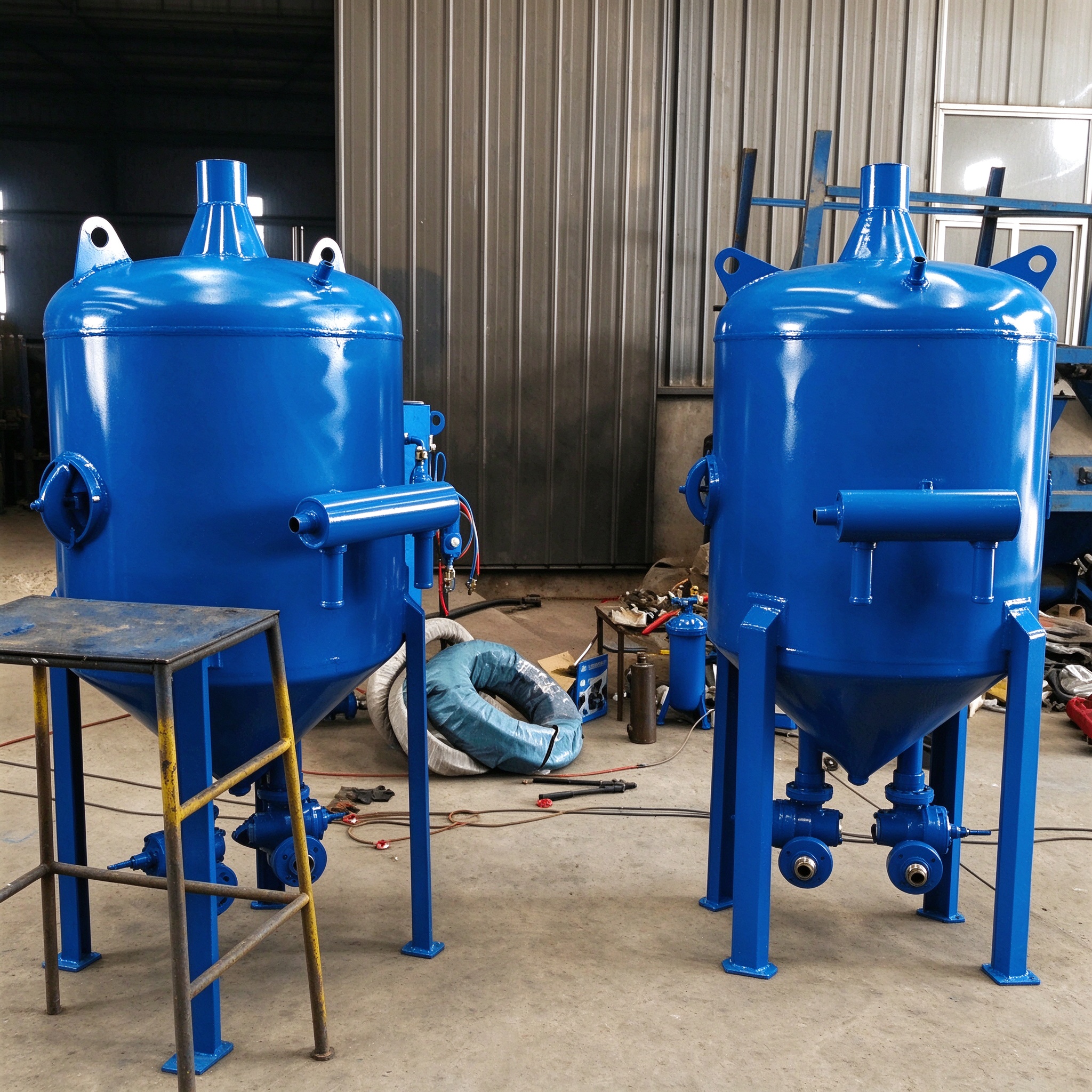
In practice the tank is only one part of a blasting circuit, but it sets the baseline for everything downstream. An undersized or poorly regulated vessel produces a pulsing, uneven stream that no nozzle adjustment can fix, while a correctly sized unit keeps the abrasive feed steady from the first minute of a shift to the last.
Main Components and the Pressure Path
Every pressure-fed unit follows the same sequence: air enters the vessel, pressurizes the abrasive bed, and drives media through a metering valve into the blast hose. Each element in that path has to hold its own under continuous cycling, and the weakest one sets the practical duty limit of the whole system.
- Shell and dished ends that contain the pressurized abrasive bed
- Fill and inspection openings with sealing covers
- Pressure regulator and metering valve assembly
- Abrasive hose, couplings, and the blast nozzle
- Safety valve, pressure gauge, and moisture trap
Wear concentrates at the metering valve and the nozzle, so service access matters as much as material choice. A layout that lets a fitter reach the valve without dismantling the whole assembly shortens every maintenance stop and keeps the vessel in productive use.
Sandblasting Tank Types: Mobile, Outdoor, Pressure, and Double-Chamber
The main configurations differ less in principle than in how they are moved, where they are used, and how the abrasive is released. A mobile unit, an outdoor unit, a pressure-fed unit, and a double-chamber unit each answer a different operational constraint rather than a different physics.
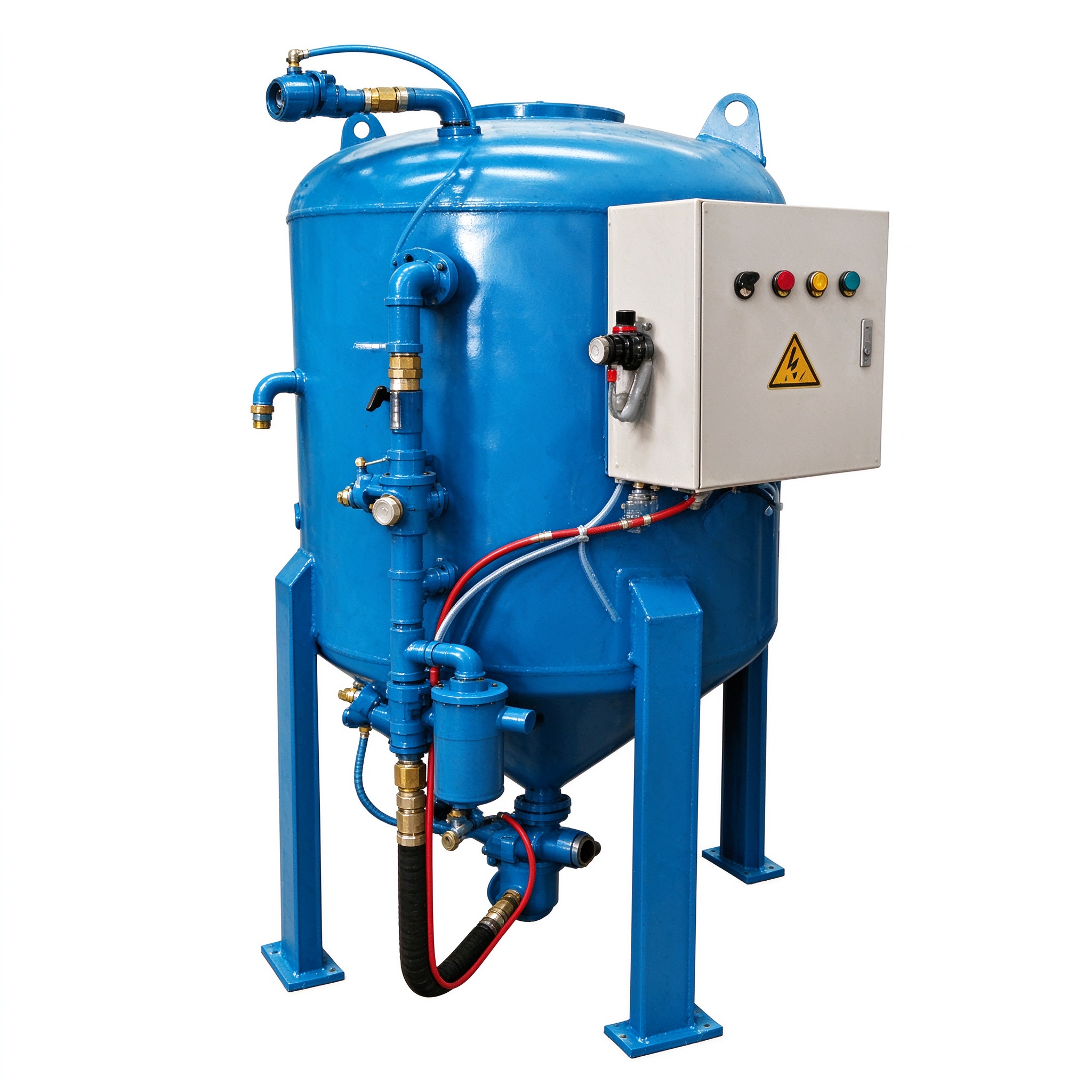
The differences show up in handling, not in the principle of pressure feed. Mobility is a question of chassis, lifting points, and footprint; outdoor service is a question of weather exposure and abrasive containment; chamber count is a question of how long the operator can blast before stopping to refill.
Matching the Configuration to the Work Condition
A qualitative comparison is usually enough to narrow the field before any technical discussion begins. None of the four configurations is universally superior; each one trades something away in exchange for the duty it is built to handle.
| Configuration | Where It Fits | What to Plan For |
|---|---|---|
| Mobile sandblasting tank | Work that shifts between sites or between workshops | Chassis, lifting points, and a footprint that clears site access |
| Outdoor sandblasting tank | Open-air blasting where the workpiece cannot be brought inside | Weather exposure, moisture control, and used-abrasive containment |
| Pressure sandblasting tank | Work that needs a steady, adjustable abrasive feed | Pressure rating, regulator condition, and valve wear |
| Double-chamber sandblasting tank | Long runs that should not stop for refilling | Chamber sequencing, seal condition, and operator training |
A single project can call for more than one configuration. A fabricator that runs bench work indoors and structural work on site may keep a fixed pressure-fed vessel in the shop and a mobile outdoor unit for field visits, rather than compromising on one machine that does neither job well.
How to Choose the Right Sandblasting Tank Configuration
Start from the workpiece and the site rather than from a product list. Abrasive type and grit size, the compressed air actually available, how often the vessel must be refilled, and how the unit will be moved narrow the choice faster than any single specification, and they expose mismatches early.
Air supply deserves attention before anything else. A vessel rated for a pressure the site compressor cannot sustain will never deliver its intended feed rate, and a unit that is oversized for the available air wastes capacity while producing an unstable stream. Match the pressure rating to the real supply, then size the abrasive volume to the shift pattern.
Safety, Compliance, and Maintenance Planning
Pressure equipment is regulated equipment, and a sensible selection process treats compliance as a design input rather than an afterthought. The points below apply to every configuration and are cheaper to settle before delivery than after installation.
- Confirm the pressure rating matches the air supply actually available on site
- Keep relief valves, gauges, and seals on a scheduled inspection list
- Train operators to depressurize and lock out before any service work
- Plan abrasive and dust containment for the place where the unit will run
- Hold spare nozzles, hoses, and valve parts to shorten unplanned stops
Quality Control Behind a Reliable Unit
Wuqiao Anxing Sandblasting Machinery Co., Ltd. is a surface-treatment equipment manufacturer based in Wuqiao County, Cangzhou, Hebei Province, with a standardized plant in the development zone and a second production site in Anling Town. The company has built blasting equipment since 1991 and covers research, production, sales, customization, and after-sales service.
Its range includes blasting machines, pressure-vessel blasting tanks in fixed, mobile, electric-control, and air-control versions, complete blasting room systems, and matching accessories such as compressors, blast guns, wear-resistant hoses, abrasive recovery units, and pulse dust collectors. Tank bodies can be customized to different pressure-bearing sizes in line with pressure-vessel standards.
On the manufacturing side, shells are welded from 16MnR pressure-vessel steel plate, and every vessel is hydrostatically tested at 2.5 times its rated pressure before dispatch. The company holds more than ten utility model patents covering blasting structure, dust recovery, and pressure regulation, reports a failure rate 30 percent below the industry average and energy consumption reduced by 15 percent, and its environmental equipment carries ISO14001 certification.
Delivery capacity runs to more than a thousand sets a year across several assembly lines, with batch orders of dozens of units handled alongside small-batch customization and modifications for unusual working conditions. Customers include large shipbuilding groups, steel structure fabricators, auto parts makers, precision manufacturing plants, and construction machinery producers; Jiangnan Shipyard is among the long-term accounts. Sales cover nearly thirty provinces in China together with export markets in Europe, the Middle East, Southeast Asia, and Hong Kong, Macao, and Taiwan, and the company was recognized as a Hebei technology-based SME in 2023 and a national technology-based SME in 2025.
FAQ
What is a sandblasting tank used for?
It holds abrasive media under pressure and feeds it to the blast nozzle, so the operator can clean, strip, descale, or profile a surface in a controlled and repeatable way.
When should I choose a mobile sandblasting tank instead of a fixed unit?
Choose a mobile sandblasting tank when the work moves between sites or workshops and the equipment has to follow the workpiece instead of the workpiece coming to the equipment.
Is a double-chamber sandblasting tank worth the extra complexity?
A double-chamber sandblasting tank lets the operator refill one chamber while the other keeps feeding abrasive, which suits long uninterrupted runs; short or intermittent jobs rarely justify the added controls.
How often should a sandblasting tank be inspected?
Inspection intervals should follow the pressure-vessel rules that apply where the unit is installed and the maintenance schedule supplied with it, with shells, seals, valves, and gauges all on the checklist.
What should I confirm before ordering a sandblasting tank?
Confirm the abrasive type and grit size, the compressed air actually available on site, how the unit will be moved or mounted, and who will handle pressure-part inspection after installation.
Summary
The right sandblasting tank is the one that matches the abrasive, the air supply, and the way the work actually moves, not the one with the longest feature list. Settle the configuration first, confirm that pressure ratings and inspection duties are covered, and choose a builder whose testing and documentation can be verified before delivery. Configuration, compliance, and service support decide how well a unit performs over its working life far more than any single specification on a datasheet.