
A high-pressure sandblasting tank delivers abrasive at controlled pressure so that rust, mill scale and old coatings break away evenly across a workpiece surface. The tank is a pressure vessel, and its shell, valve train and abrasive flow path decide how stable that blast stream stays through a full working shift.
How a High-Pressure Sandblasting Tank Works
A high-pressure sandblasting tank is a pressure vessel that stores abrasive and releases it into a compressed-air stream, so the operator can blast at a steady, adjustable rate. Air pressure, abrasive metering and nozzle size act together, and the balance between them determines cleaning speed and surface uniformity.
In a pressure-fed system the abrasive sits inside a sealed vessel. Air is admitted until the vessel reaches working pressure, and a metering valve at the bottom of the tank releases grit into the blast hose at a rate the operator sets. Because the abrasive is pushed by vessel pressure instead of being drawn by vacuum, the stream reaches the nozzle with more force than a suction-fed gun can produce, which shortens the time needed to cut through heavy rust and scale on plate and structural steel.
Pressure regulation is what separates a controlled blasting tank from a simple pot. A regulator holds the blast pressure at the level the job requires, an abrasive valve opens and closes from the remote control, and a moisture separator keeps damp air from turning the abrasive into slugs that block the hose. When those three elements are matched to nozzle size, the blast stays even from the first minute of a shift to the last, and the surface finish does not drift between sections of the same workpiece.
Core Components of a Pressure-Fed Blast System
The same building blocks appear in every pressure-fed configuration, whether the unit is fixed indoors or mounted on a frame for outdoor work:
- Pressure vessel shell that holds the abrasive charge under pressure
- Fill and pressurizing valves that seal the vessel before blasting begins
- Abrasive metering valve that controls grit feed into the air stream
- Remote control valve that lets the operator start and stop the blast at the nozzle
- Blast hose and nozzle that shape and direct the abrasive stream
- Air preparation, including a moisture separator that keeps the abrasive dry
Design, Welding and Testing Behind a Reliable Pressure Tank
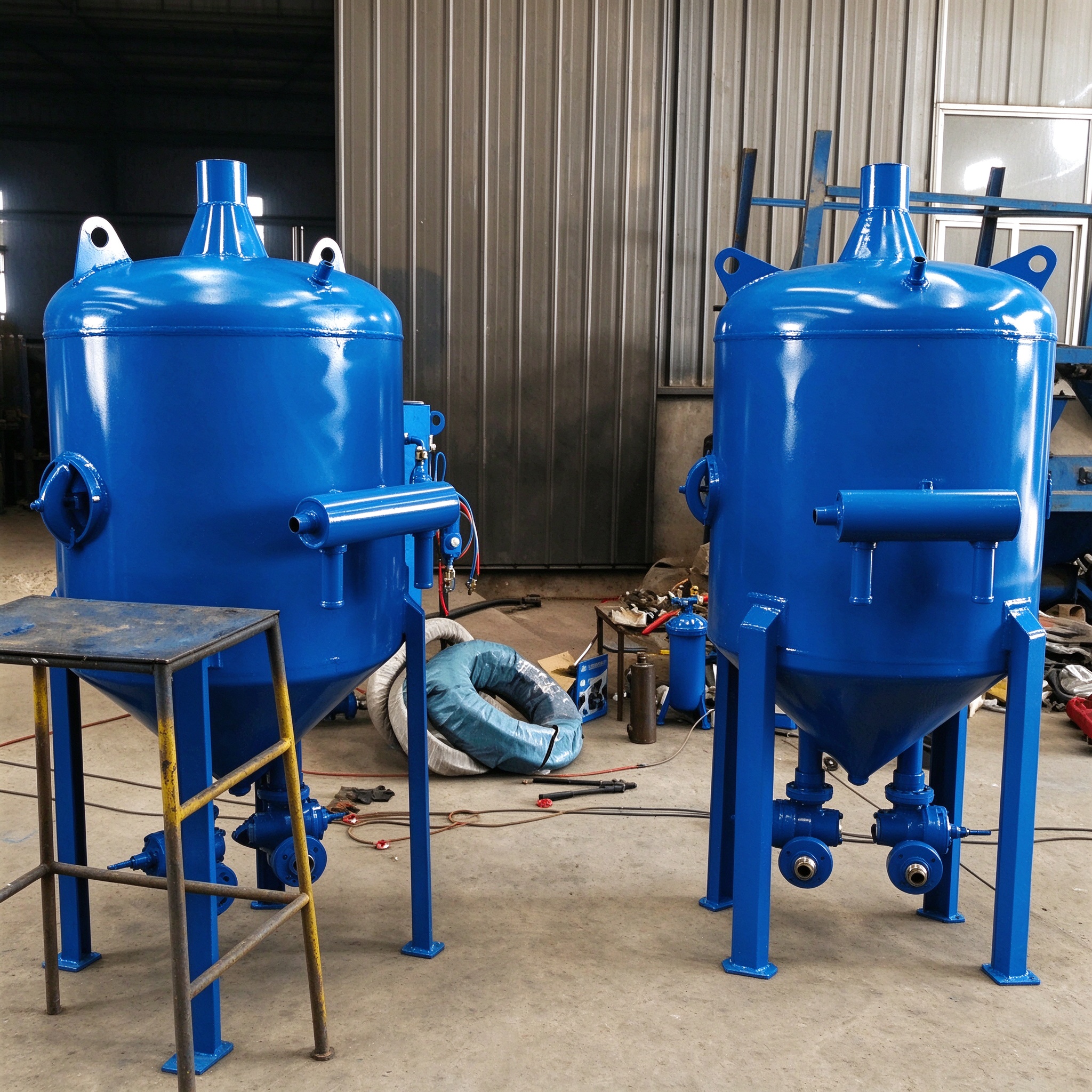
Reliability in a pressure tank comes from three things: plate grade, weld quality and proof testing. A tank built to pressure-vessel practice keeps its wall thickness, joint preparation and inspection records under control, so the vessel holds its rating through repeated fill-and-blast cycles instead of drifting out of tolerance.
Shell material matters because a blasting tank is a pressure vessel, not a storage bin. Vessels built for this duty use pressure-vessel steel plate such as 16MnR, welded and inspected as a vessel rather than as folded sheet metal. Wuqiao Anxing Sandblasting Machinery Co., Ltd. welds its blasting tank shells from 16MnR pressure-vessel plate and puts every vessel through a hydrostatic test at 2.5 times the rated pressure before it leaves the works, so wall integrity is verified before the tank ever sees abrasive.
Wear parts decide how long the machine holds its performance. A nozzle that has opened up from wear drops pressure at the nozzle mouth and widens the blast pattern, so operators end up chasing the surface instead of finishing it. Fully automatic models from the company are fitted with wear-resistant ceramic nozzles whose service life is three times that of ordinary alloy nozzles, which keeps the blast stream stable for far longer between changeovers.
Dust is the other half of the design. Blasting generates a heavy cloud of fines, and the vessel alone does not solve it; the dust has to be captured at the source and filtered before air leaves the work area. Environmental equipment from the company carries ISO 14001 environmental management certification, and dust emissions are held well below national limits, which is what makes a blasting installation practical to run in a plant that has to pass environmental inspection.
Manufacturing and Delivery Capacity
Wuqiao Anxing Sandblasting Machinery Co., Ltd. is based in Wuqiao County, Cangzhou, Hebei, with a standardized plant in the development zone and a second production site in Anling Town. Its lineage in blasting equipment goes back to 1991, giving the company more than thirty years of experience in derusting and surface cleaning equipment. It was rated a Hebei provincial science and technology SME in 2023 and a national science and technology SME in 2025. Its design team holds more than ten utility model patents covering blasting structure, dust recovery and intelligent pressure regulation, and the plant’s annual capacity reaches over a thousand sets, with multiple standardized assembly lines supporting batch orders alongside one-off customization and dedicated modifications for unusual working conditions.
Where High-Pressure Blasting Is Used in Surface Preparation
Pressure-fed blasting is used wherever a surface has to be cleaned back to bare metal before coating: ship hulls and structural steel, pipe and bridge work, automotive and machinery parts, castings and forgings, and stone or glass surfaces that need a uniform matte finish. The same equipment also strips paint and removes burrs from machined edges.
Shipbuilding and heavy fabrication rely on it because a hull or a bridge section cannot be brought indoors, and the coating specification will not hold on a surface that still carries scale. Structural and steelwork shops use it to prepare plate and sections before priming. Automotive and machinery plants use it on frames, housings and castings, while hardware and mold shops use a finer blast to clean tooling and blend edges. Glass, stone and decorative work use it for matte and texture effects rather than for heavy removal, and anti-corrosion contractors use it as the first step of a coating system where surface profile and cleanliness decide how long the coating lasts.
- Rust and mill scale removal from steel plate and structural sections
- Paint and coating stripping before re-coating
- Burr removal and edge cleaning on machined or cast parts
- Matte finishing and texture work on stone, glass and metal surfaces
- Surface preparation ahead of anti-corrosion coating
- Surface strengthening of parts that see wear in service
Tank Configurations for Different Work Sites
Not every job suits the same tank format. Fixed tanks stay in a blasting room with a permanent air supply; mobile and open-type units travel to the workpiece; anti-corrosion versions are aimed at coating and preservative work; and compact small tanks serve low-volume shops and touch-up.
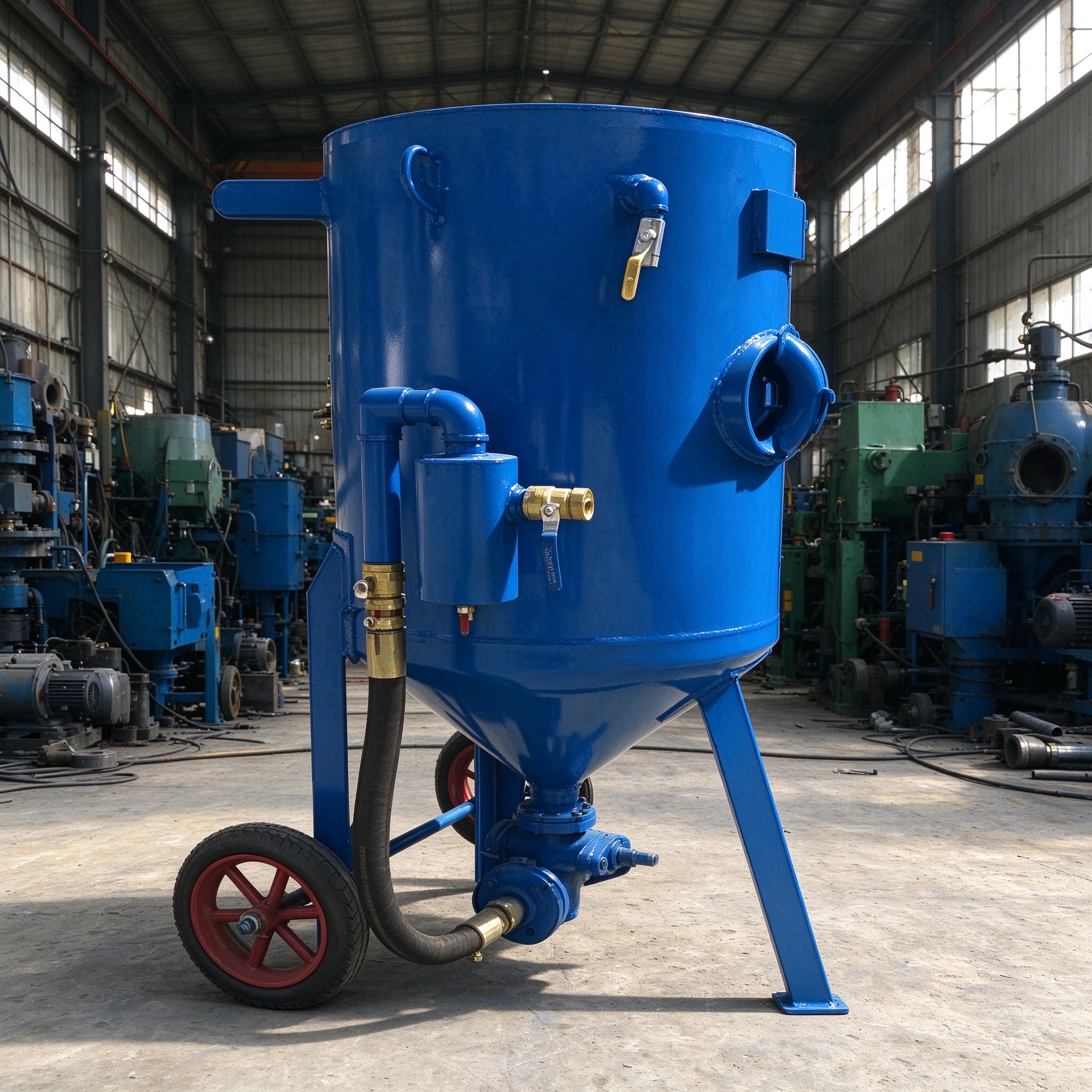
A fixed tank is installed where the air supply and dust collection are permanent, and it usually feeds a blasting room or a dedicated bay. A mobile derusting tank carries the vessel, valves and hose on a frame so the unit can be taken to a structure too large to move, such as bridge sections, storage tanks or ship blocks under repair. An open-type tank is used for outdoor work where the blast area is not enclosed; because no room wall holds the dust, containment and operator respiratory protection carry more of the load, and the site has to be organized around the blast rather than the other way round.
Small tanks suit workshops that blast intermittently or work on small components, where a large vessel would be idle most of the week. An anti-corrosion tank is set up for coating and preservative work, where the surface has to reach a defined cleanliness before the first coat goes on and where the abrasive and blast parameters must stay consistent across a large area so the coating adheres evenly. In every format the practical question is the same: does the vessel size, air supply and nozzle combination match the workpiece in front of the operator.
FAQ
What is a high-pressure sandblasting tank used for?
It cleans and prepares metal surfaces before coating, using abrasive carried in a pressurized air stream. Typical work includes rust and mill scale removal, paint stripping, burr removal and matte finishing on steel, castings, pipe, plate and structural parts.
How does a pressure-fed tank differ from a suction blasting setup?
In a pressure-fed system the abrasive is pushed out of a sealed, pressurized vessel, while a suction system draws grit through the gun by vacuum. Pressure feed generally produces a stronger, more consistent stream at the nozzle, so heavy rust and scale come off faster.
What should be checked before starting a high-pressure sandblasting tank?
Check the vessel, hoses, couplings and nozzle first, then confirm the air supply is dry and the pressure is set for the job. The operator should also confirm the blast area is contained, the dust collection is running and the required respirator, helmet and protective clothing are in place.
Why does the abrasive flow become uneven or stop?
Moisture in the air supply, a worn or partly blocked metering valve, and an oversized nozzle are the common causes. Drying the air, clearing the valve and matching nozzle size to the available air volume usually restores a steady stream.
How is a blasting tank maintained between jobs?
Drain moisture from the vessel and air line after each shift, inspect the hose and nozzle for wear, and check the seals and pressure gauge. Worn nozzles and couplings should be replaced before they affect blast pressure, and the vessel’s inspection schedule should be followed as recorded.
Summary
A high-pressure sandblasting tank is worth choosing when the job calls for a steady, adjustable blast stream and a vessel built to pressure-vessel standards. Shell material, weld quality, proof testing, nozzle wear and dust control are the points that decide how long the equipment holds its performance, while site conditions decide whether a fixed, mobile, open-type, anti-corrosion or small format fits best. Matching the tank to the workpiece and to the available air supply remains the practical route to consistent surface quality and predictable running cost.