
A high pressure sandblasting tank is the pressure vessel that stores and delivers abrasive at a controlled working pressure to the blast nozzle. It sets the pace of surface preparation, so working volume, pressure rating and abrasive flow must match the job before anything else is specified.
What Is a High Pressure Sandblasting Tank?
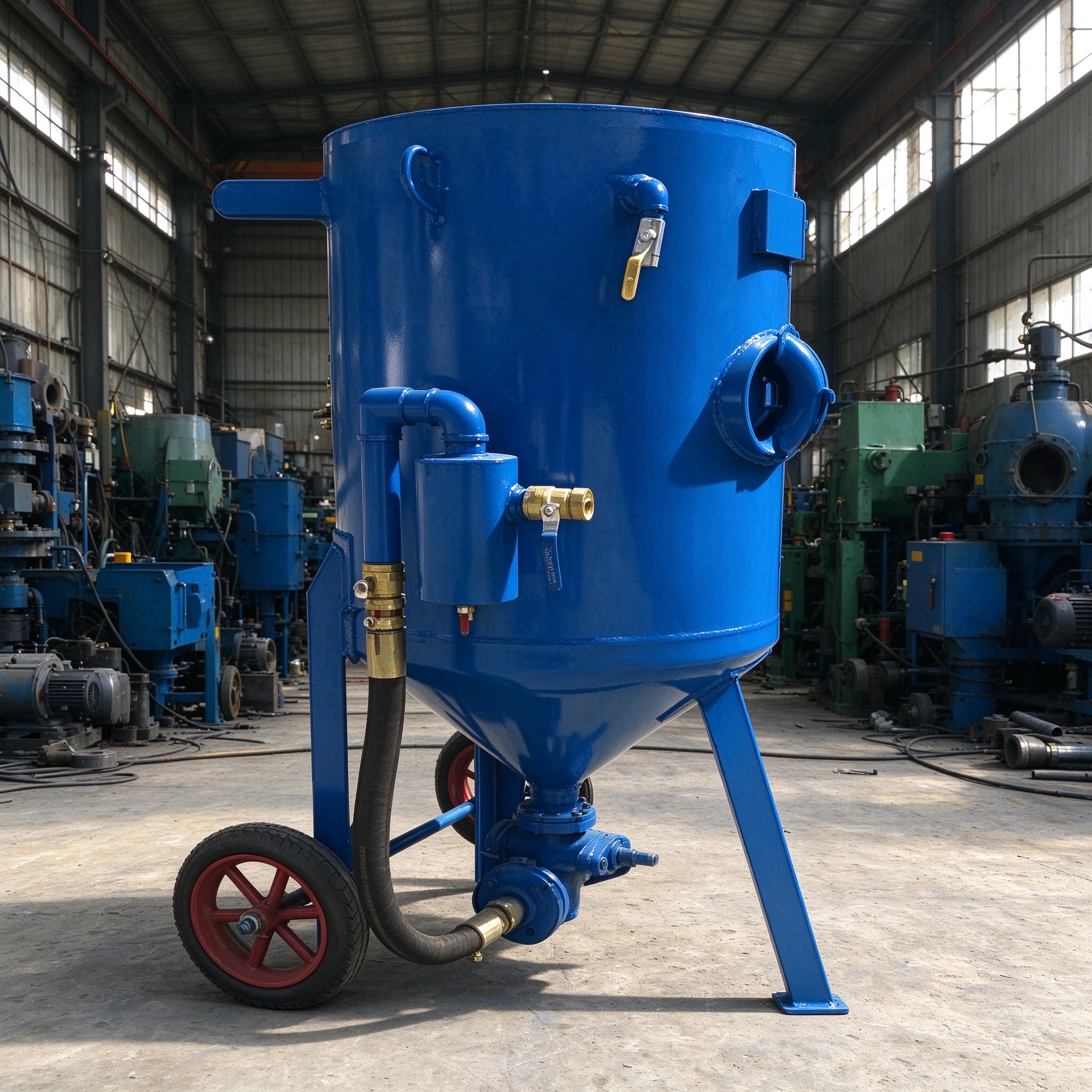
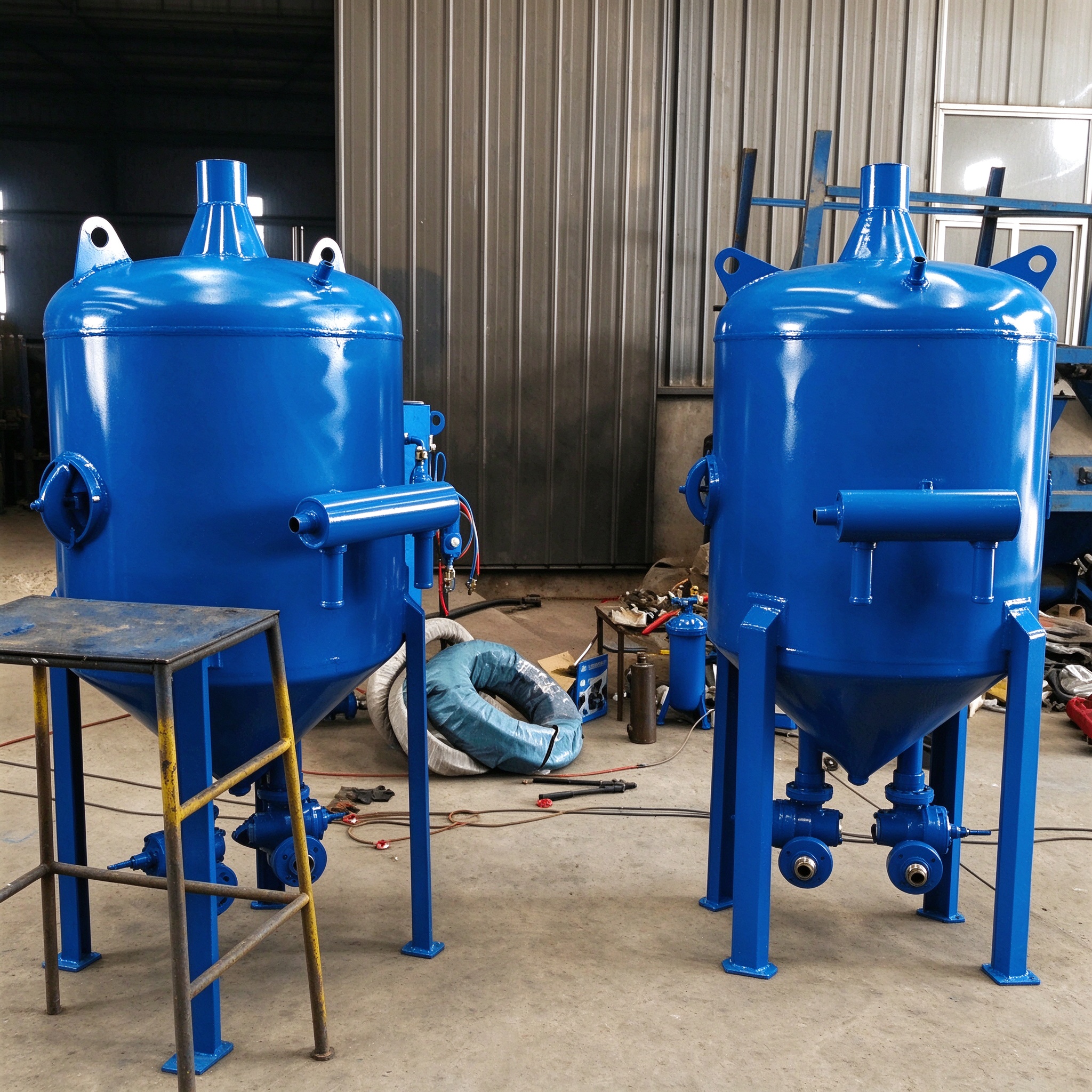
A high pressure sandblasting tank is a welded pressure vessel that holds abrasive and compressed air, then releases the mixture through a metering valve into the blast hose. It is built to withstand repeated pressurisation, so shell thickness, weld quality and pressure testing define how long it will serve.
The vessel keeps the abrasive supply separate from the compressed air supply until the moment of blasting. A metering valve, controlled pneumatically or electrically, regulates how much abrasive enters the air stream, while a grit or pop-up valve keeps the line closed whenever the operator releases the remote control. Because the tank is pressurised on every cycle, the shell, the closure and the safety valve are the parts that determine service life, and they are the first parts to check when a used unit is assessed.
How the Tank Fits Into a Blasting System
A tank does not work alone. It depends on a compressor that can hold the required air volume, a blast hose rated for the working pressure, a nozzle matched to that air volume, and dust collection that keeps the working area within the exposure limits that apply on site. When any one of these parts is undersized, the vessel is often blamed for problems that begin elsewhere in the circuit, which is why system matching matters as much as vessel quality.
The same blasting principle covers several vessel formats, and each one changes how the equipment is filled, moved and operated:
- small sandblasting tank
- mobile sandblasting rust removal tank
- high pressure sandblasting tank
- open type sandblasting tank
- anti-corrosion sandblasting tank
Matching Tank Size and Pressure to the Work
Selection starts with the blast rate the job requires, not with the largest unit available. Abrasive consumption per hour, nozzle size, compressor output and how long the operator blasts between refills together decide the working volume and the pressure rating the vessel must carry.
A common mistake is to size the tank around the compressor alone. In practice, refill frequency is what operators notice: a vessel that empties too quickly forces repeated shutdowns, and each shutdown costs time that no pressure increase can recover. Calculating abrasive draw per hour and matching it to a working volume that covers a realistic blasting window is more useful than buying extra capacity that is never used.
Small, Mobile, Open Type and Anti-Corrosion Options
Site conditions decide the format. A small sandblasting tank suits compact work where space is tight and the workload is moderate. A mobile sandblasting rust removal tank brings the blasting point to the structure instead of bringing the structure to a fixed station. An open type sandblasting tank is used where outdoor blasting is required and full containment is not practical, while an anti-corrosion sandblasting tank supports workflows in which surface preparation leads directly into protective coating application. Because each format changes how the vessel is mounted, filled and moved, the choice should follow the workflow rather than the catalogue order.
Pressure rating should be treated as a working limit rather than a target. Running continuously at the top of a vessel’s range accelerates wear on valves, seals and hoses, so a tank chosen with headroom usually delivers a steadier blast and fewer interruptions than one pushed to its maximum on every cycle. The same logic applies to abrasive choice: a grit that matches the surface condition keeps consumption predictable and reduces the load on the metering valve.
Operating and Maintaining the Equipment Safely
Safe operation depends on three habits: never pressurise a vessel that has not been checked, keep the abrasive dry and free of debris, and stop the blast before opening any closure. Most tank problems begin as small leaks or worn seals, so scheduled inspection and prompt replacement of consumable parts prevent the majority of failures.
Before each shift, the operator should look for abrasive leakage around the closure, listen for changes in the sound of the air flow, and confirm that the remote control stops the blast when released. Water or oil in the air supply is a frequent cause of clogging in the metering valve, which is why moisture traps and filters deserve the same attention as the vessel itself. Hoses and nozzles wear faster than the tank and should be treated as routine consumables rather than as parts to be repaired.
What Should Be Checked During an Inspection?
An inspection covers the shell, the weld seams, the closure mechanism, the safety valve, the gauge, the hoses and the grounding connections. Any deformation, cracking, corrosion pitting or damaged fitting should take the unit out of service for assessment rather than be returned to work with a temporary repair. Keeping a written record of each inspection makes it easier to spot a trend before it becomes a failure, and it supports the formal pressure-vessel checks that apply where the equipment is installed.
Manufacturing and Delivery Behind the Equipment
Reliability is decided long before the first blast. It comes from the steel specification, the welding procedure and the pressure test applied to each vessel, and buyers evaluating a supplier should ask how those three steps are controlled, because none of them can be judged from a catalogue photograph.
Wuqiao Anxing Sandblasting Machinery Co., Ltd. builds blasting equipment at two production sites in Wuqiao County, Cangzhou, Hebei, and has been active in the field since 1991. Tank bodies are welded from 16MnR pressure-vessel steel plate, and every vessel is subjected to a hydrostatic test at 2.5 times its rated pressure before dispatch. The company holds more than ten utility model patents covering blasting structure, dust recovery and intelligent pressure control, and reports an overall failure rate 30% below the industry average with energy consumption reduced by 15%.
Annual capacity reaches over a thousand units and sets, supported by standardised assembly lines that allow large orders to be scheduled alongside small custom batches. The domestic network covers nearly thirty provinces, and exports reach Europe, the Middle East, Southeast Asia and other markets. Support includes a site survey before selection, layout drawings, installation and operator training, plus a spare parts stock that shortens after-sales response.
FAQ
What is a high pressure sandblasting tank used for?
It stores abrasive and delivers it into a controlled air stream for surface preparation. Typical work includes rust and scale removal, paint stripping, deburring, matte finishing and surface strengthening before coating, and the same vessel can cover different tasks by changing the abrasive, the nozzle and the pressure setting.
How do I choose the right sandblasting tank size and pressure?
Start with the blast rate and the compressor output, then size the working volume so that refills do not interrupt the shift. Confirm that the pressure rating covers the work with some headroom, check that the format suits how the job moves, and verify that the supplier can support installation, training and spare parts.
What is the difference between a small sandblasting tank and a larger vessel?
The difference is mainly scale and duty. A small sandblasting tank suits compact work and moderate abrasive consumption, while a larger vessel is built for sustained blasting at higher working pressure and bigger abrasive volumes. Workload, site access and refill frequency decide which one fits.
How often should a blasting tank be inspected?
Follow the manufacturer’s documentation and the pressure-vessel rules that apply where the equipment is installed. Between formal inspections, check the shell, welds, closure, safety valve, gauge and hoses before each shift, and stop using the unit at the first sign of deformation, cracking or leakage.
Can blasting equipment be adapted to a specific site or workpiece?
Yes. Tank volume, mounting format, control type and connection points can be adapted to the site and the workpiece, and units can be supplied for small batches as well as larger orders. Drawings of the working area and details of the workpiece help the supplier propose a configuration that fits.
Summary
A high pressure sandblasting tank is only as good as the match between its working volume, its pressure rating and the job it serves. Confirm the blast rate and compressor output first, choose a format that follows the workflow rather than the catalogue, and treat inspection and consumable replacement as scheduled work instead of emergency repairs. Buyers who check steel specification, welding control and pressure testing before they discuss price usually end up with equipment that runs longer between stoppages.