
Choosing a box-type sandblasting machine manufacturer is mainly a matter of verified production capability rather than price alone. Buyers should confirm where the equipment is actually built, how non-standard requests are handled, which inspections run before shipment, and how quickly spare parts and on-site service reach the workshop once the machine is installed and running.
What a Box-Type Sandblasting Machine Manufacturer Should Provide
A box-type sandblasting machine manufacturer supplies an enclosed blasting cabinet in which abrasive is blasted and recovered inside a sealed workspace, making it suitable for small and medium parts that need uniform surface treatment. The unit should arrive as a complete system with cabinet, blast gun, dust collection, and abrasive recycling so production can start without assembling unrelated components.
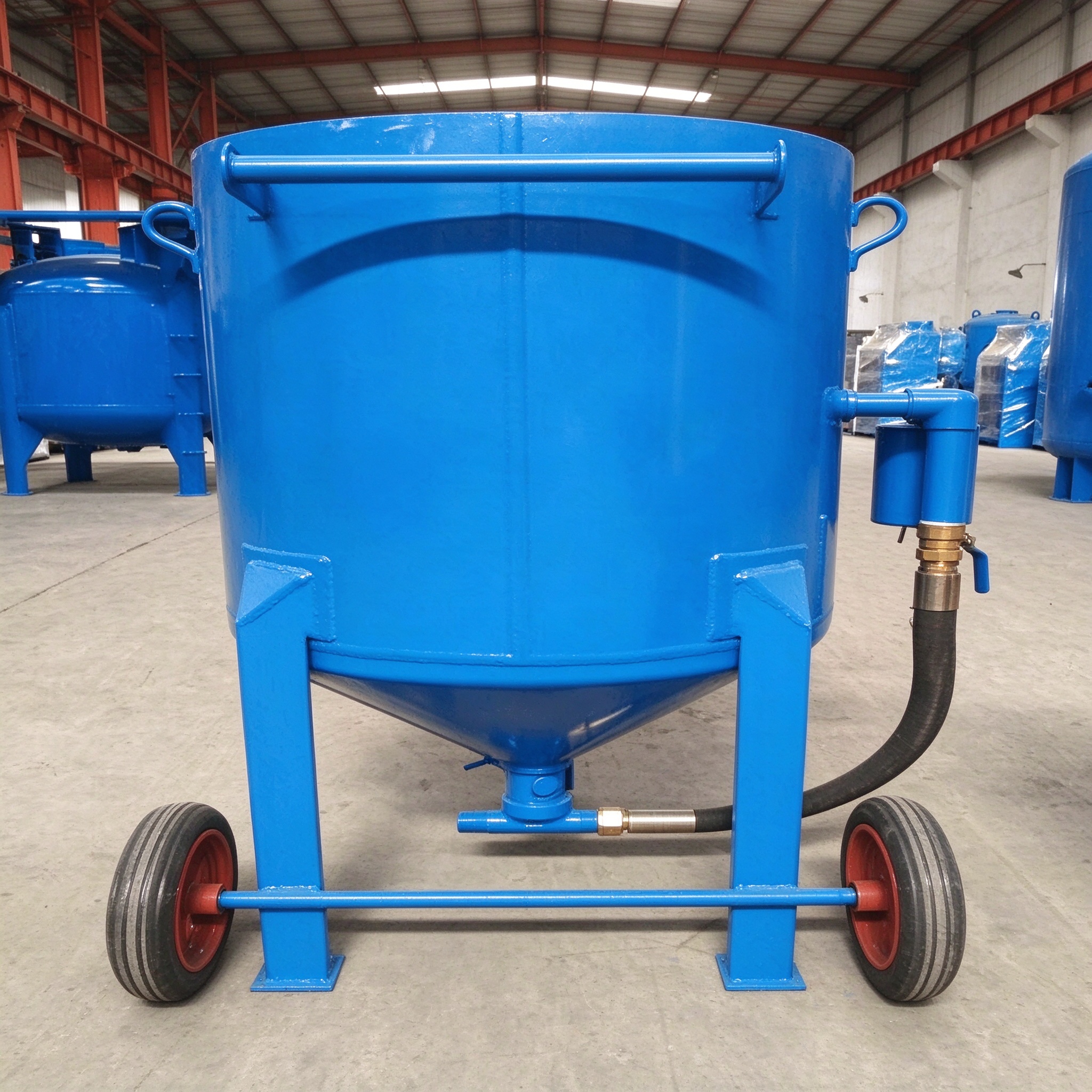
A cabinet alone rarely satisfies a mixed production floor. A supplier that builds the full range can match the enclosure to the workpiece instead of forcing one model onto every job, and can deliver the pressure vessel, dust removal, and air supply as one coordinated package.
Equipment Categories a Full-Range Supplier Covers
The four blocks below describe what an integrated supplier normally keeps in production, from a single cabinet through to a complete blasting room.
- Blasting machines: closed box-type cabinets, open mobile units, high-pressure water blasting equipment, dust-free blasting machines, and PLC automatic conveyor-type systems.
- Pressure vessel blast pots: fixed, mobile, electric-control, and pneumatic-control versions, with tanks built to pressure vessel standards at different pressure ratings.
- Blasting room systems: automatic blasting rooms and recovery-and-dust-removal integrated rooms, planned around plant dimensions and workpiece size.
- Supporting equipment: permanent-magnet variable-frequency air compressors, blasting air compressors, blast guns, wear-resistant blast hoses, abrasive recovery units, and pulse dust collectors.
How to Judge Manufacturing Strength and Quality Control
Manufacturing strength is judged by what happens before shipment: the steel grade used for pressure parts, the pressure test applied to every tank, the wear life designed into nozzles, and the inspection records attached to the finished machine. A buyer who asks for these details learns more than a buyer who compares price lists.
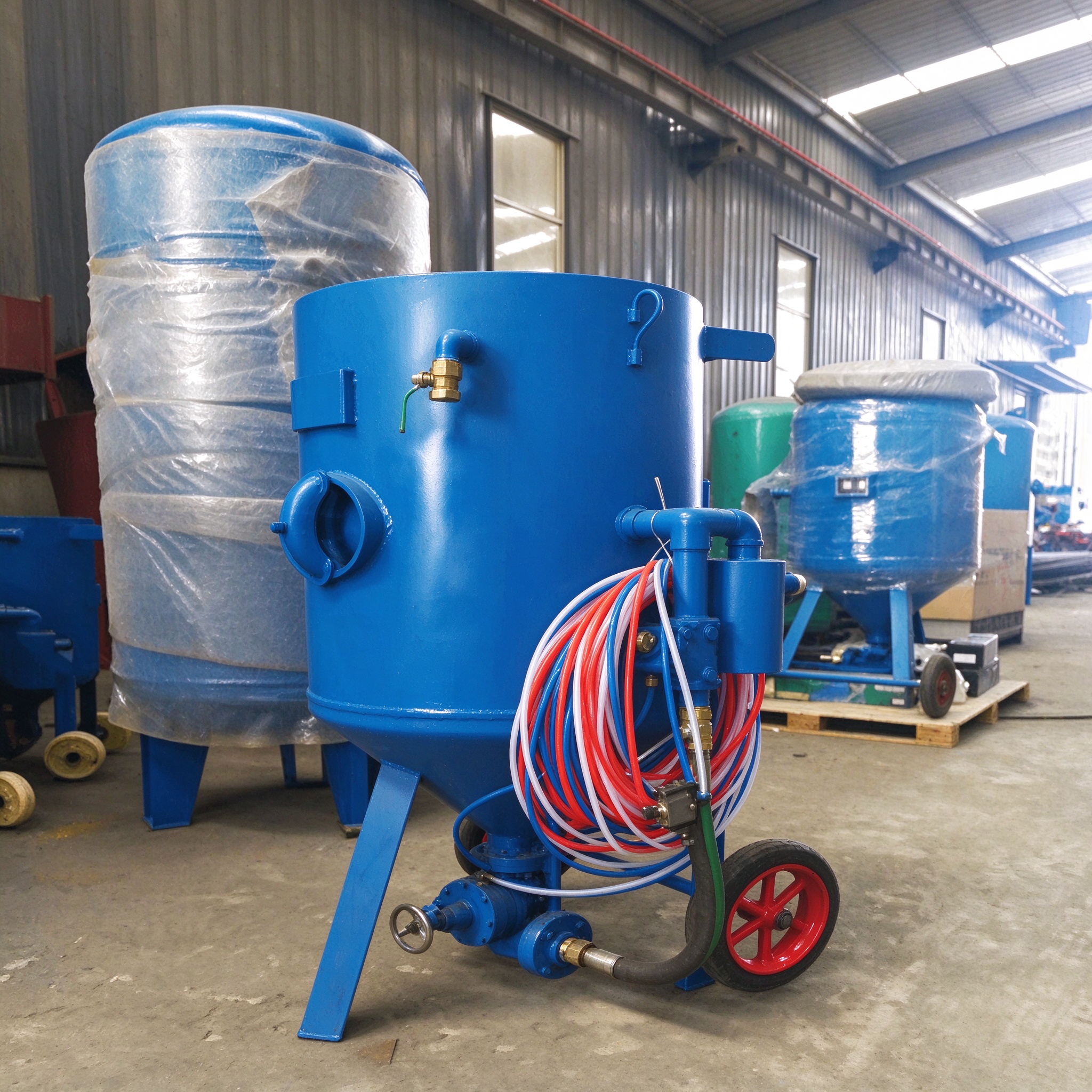
Wuqiao Anxing Sandblasting Machinery Co., Ltd. works to this standard. The company has operated in industrial surface treatment since 1991, runs two production sites in Wuqiao County, Cangzhou, Hebei, and was recognized as a Hebei sci-tech SME in 2023 and a national sci-tech SME in 2025. Blast pots are welded from 16MnR pressure-vessel steel plate, and every tank passes a hydrostatic test at 2.5 times the rated pressure with flaw detection before it leaves the plant. Automatic models use wear-resistant ceramic nozzles whose service life is three times that of standard alloy nozzles.
In-house development supports those specifications. The engineering team covers mechanical design, fluid pressure, and dust removal, and holds more than ten utility model patents related to blasting structure, dust recovery, and intelligent pressure regulation. Adaptive blast pressure control, automatic abrasive circulation, and intelligent dust removal and noise reduction together bring the overall failure rate about 30% below the industry average and reduce energy consumption by roughly 15%.
Environmental performance is documented rather than claimed: the environmental equipment carries ISO14001 environmental management certification, and dust emissions run well below the national limit, which matters wherever local environmental and safety inspections apply.
Delivery Capacity and Non-Standard Orders
The gap between a manufacturer and an assembler shows up in delivery planning. A plant with several standardized assembly lines and annual capacity of over a thousand sets can hold dates on large batches while still accepting small customized runs and special-condition modifications, and a concentrated delivery of dozens of machines in one order becomes a routine scheduling exercise instead of an exception.
Long-running cooperation with large heavy-industry buyers, including batch purchase projects for Jiangnan Shipyard, indicates that the same process discipline repeats across orders. For a buyer, that history is a practical signal that raw material, machining, assembly, and testing stages are already sequenced before the purchase order is signed.
Customization, Installation, and Service Support
Customization support decides whether a standard cabinet fits a real workpiece. A capable supplier surveys the actual working condition, issues a selection proposal and plant layout drawing, then builds the cabinet around part size, blasting process, and dust removal route, and finally installs and trains operators on site.
Before the order, engineers visit the plant to survey the working condition and issue a free equipment selection proposal together with layout drawings for the workshop. During production, progress is tracked and processing details are reported back to the buyer, so a change in workpiece specification can still be absorbed without restarting the schedule.
After delivery, technicians complete installation and commissioning and train the operating staff on machine use, daily maintenance, and simple fault diagnosis. A fast nationwide response system keeps common parts in stock, and remote guidance plus on-site repair work together to shorten unplanned downtime. The domestic network reaches nearly thirty provinces and autonomous regions, with cooperating dealers and resident after-sales staff in the North, East, and South China manufacturing clusters, while export business covers Europe, America, the Middle East, Southeast Asia, Hong Kong, Macao, and Taiwan, with steady repeat orders from Myanmar, Korea, and several Middle East countries.
Where Box-Type Sandblasting Machines Fit in Production
A box-type cabinet fits any workshop task that needs a controlled, repeatable blast pattern on smaller workpieces. Typical uses include rust and oxide scale removal, burr cleaning, paint stripping, matte finishing, texture engraving, and surface strengthening, and the enclosed design keeps abrasive and dust inside the working area.
The same configuration appears across shipbuilding and heavy engineering, steel structure fabrication, automotive parts, hardware and molds, aviation components, glass and stone processing, bridge and pipeline work, and anti-corrosion coating preparation. Buyers in these sectors usually run several process steps on one cabinet, so the enclosure opening, gun arrangement, and recovery path should be sized for the largest part in the mix rather than the average one.
FAQ
What does a box-type sandblasting machine manufacturer supply?
A box-type sandblasting machine manufacturer supplies an enclosed blasting cabinet together with the blast gun, abrasive recovery path, and dust collection needed to run it. The cabinet keeps abrasive and dust inside a sealed workspace, so small and medium parts can be treated with a repeatable blast pattern while the surrounding area stays clean. Confirm that the package is complete before comparing prices.
What is a box-type sandblasting machine source factory?
A box-type sandblasting machine source factory builds the equipment on its own production lines instead of reselling finished units. That arrangement normally means design, machining, assembly, and testing sit under one management system, which shortens lead time, keeps spare parts traceable, and leaves one point of responsibility when a special requirement appears.
How does a box-type sandblasting machine custom manufacturer handle special workpieces?
A box-type sandblasting machine custom manufacturer starts with the workpiece: part size, material, required surface finish, and the dust removal route the process needs. The cabinet opening, gun arrangement, and abrasive recovery path are then sized around those inputs, and the layout is checked against the available floor space before production begins.
How can I compare suppliers when buying from a box-type sandblasting machine wholesale manufacturer?
Compare suppliers on verifiable items rather than headline prices: the production site, the pressure test applied to tanks, nozzle wear life, annual capacity, and the response time for spare parts. Ask each candidate for a selection proposal and layout drawing built around your own workpiece, then weigh the answers together with the commercial terms.
Which box-type sandblasting machine is good for my workshop?
The right choice depends on part size, batch volume, and the finish required, so the answer comes from a workpiece assessment rather than a single model name. A sealed cabinet suits small to medium parts treated in batches, while heavier or oversized work usually calls for a different configuration. Ask the manufacturer to match the cabinet to your part and your layout.
Summary
Surface quality is decided inside the cabinet, so the supplier matters as much as the specification sheet. Evaluate a box-type sandblasting machine manufacturer on its production site, pressure-part testing, nozzle wear life, delivery capacity, and service reach, and put installation and operator training into the written scope. Custom workpieces, special working conditions, and plant layout limits should be answered with a selection proposal and drawings rather than a generic catalogue page, and commercial terms should be compared only after those technical answers are clear.