
A sandblasting tank is a pressure vessel that stores and meters abrasive for a blast system, and choosing one comes down to matching working pressure, control type, mobility, and vessel quality to the job. A well-matched unit keeps abrasive flow steady, protects the operator, and stands up to daily industrial use.
What a Sandblasting Tank Does in a Blasting System
A sandblasting tank holds pressurized abrasive and releases it at a controlled rate into the blast hose, so the nozzle receives a steady, predictable stream. Pressure, abrasive metering, and moisture control inside the vessel decide how quickly the surface is cleaned and how consistent the final finish is.
In a pressure-fed system, the vessel is filled with abrasive, sealed, and pressurized by the air supply. A metering valve at the bottom controls how much abrasive enters the air stream, while the operator controls the nozzle through a remote system that stops air and abrasive as soon as it is released. Because abrasive leaves the vessel under pressure instead of being pulled by suction, blasting speed and reach stay steady as the hose runs out.
The vessel is only one link in the chain. Air supply, hose diameter, nozzle size, and abrasive grade all interact with tank pressure and metering, so a unit that is too large or too small for the compressor either wastes air or fails to hold the working pressure the nozzle needs. Selection therefore starts with the compressor and the job, not with the tank alone.
Core Elements of a Pressure-Fed Vessel
These four elements decide how a pressure vessel behaves day to day, and each should be confirmed with the supplier before an order is placed.
- Vessel body and closure: the pressure-retaining shell, its welded seams, and the fill and inspection openings.
- Abrasive metering valve: the control that regulates how much abrasive enters the air stream.
- Remote control and deadman system: the hardware that lets the operator stop air and abrasive instantly.
- Air and moisture fittings: inlet, exhaust, and moisture-control hardware that keep abrasive flowing instead of caking.
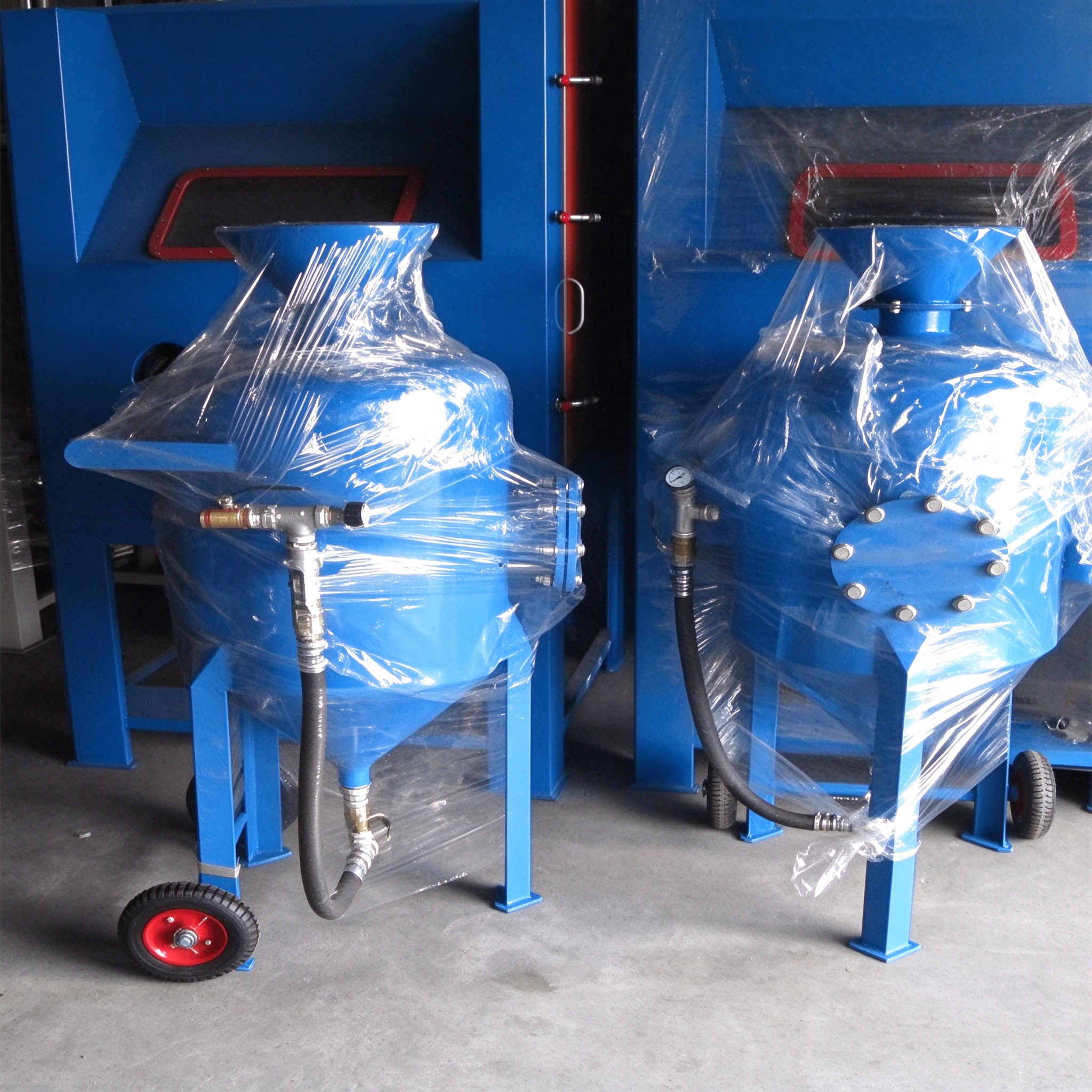
Configurations: Fixed, Mobile, and Pressure-Type Options
Configuration decides where and how the equipment can be used. Fixed units stay in one bay with a permanent air supply, mobile units travel to the work, and pressure-type designs hold and deliver abrasive under continuous pressure for higher output.
A fixed vessel suits a blasting room or booth where the work comes to the equipment. A mobile sandblasting tank, mounted on wheels or a skid, lets one unit serve several sites, which matters when the workpiece cannot be moved, such as a bridge section, a pipeline run, or a large steel fabrication. Control type is the second decision: pneumatic control keeps operation simple and robust in dusty conditions, while electric control adds interlocking and easier integration with automated lines.
An outdoor sandblasting tank usually needs extra attention to air supply and moisture control, because humid air and long hose runs are normal on site. Keeping the vessel and hose clear of standing water, draining the air line before each shift, and choosing an abrasive grade suited to the surface do more for outdoor productivity than simply raising pressure.
When a Double-Chamber Configuration Is Worth Discussing
A double-chamber sandblasting tank is the configuration normally raised when a project needs near-continuous abrasive supply and frequent refills would interrupt the work. It adds hardware and cost, so it should be specified only where the duty cycle genuinely justifies continuous feeding rather than short blasting cycles with planned refills.
Pressure-Type Designs and What They Change
A pressure-type sandblasting tank keeps abrasive under air pressure before it reaches the nozzle, which is what separates it from suction-fed equipment. The practical result is a faster, more consistent cut on heavy rust, mill scale, and thick coatings, together with better reach at the end of a long hose. The trade-off is that the vessel, its closure, and its controls must be built and maintained to pressure-vessel standards.
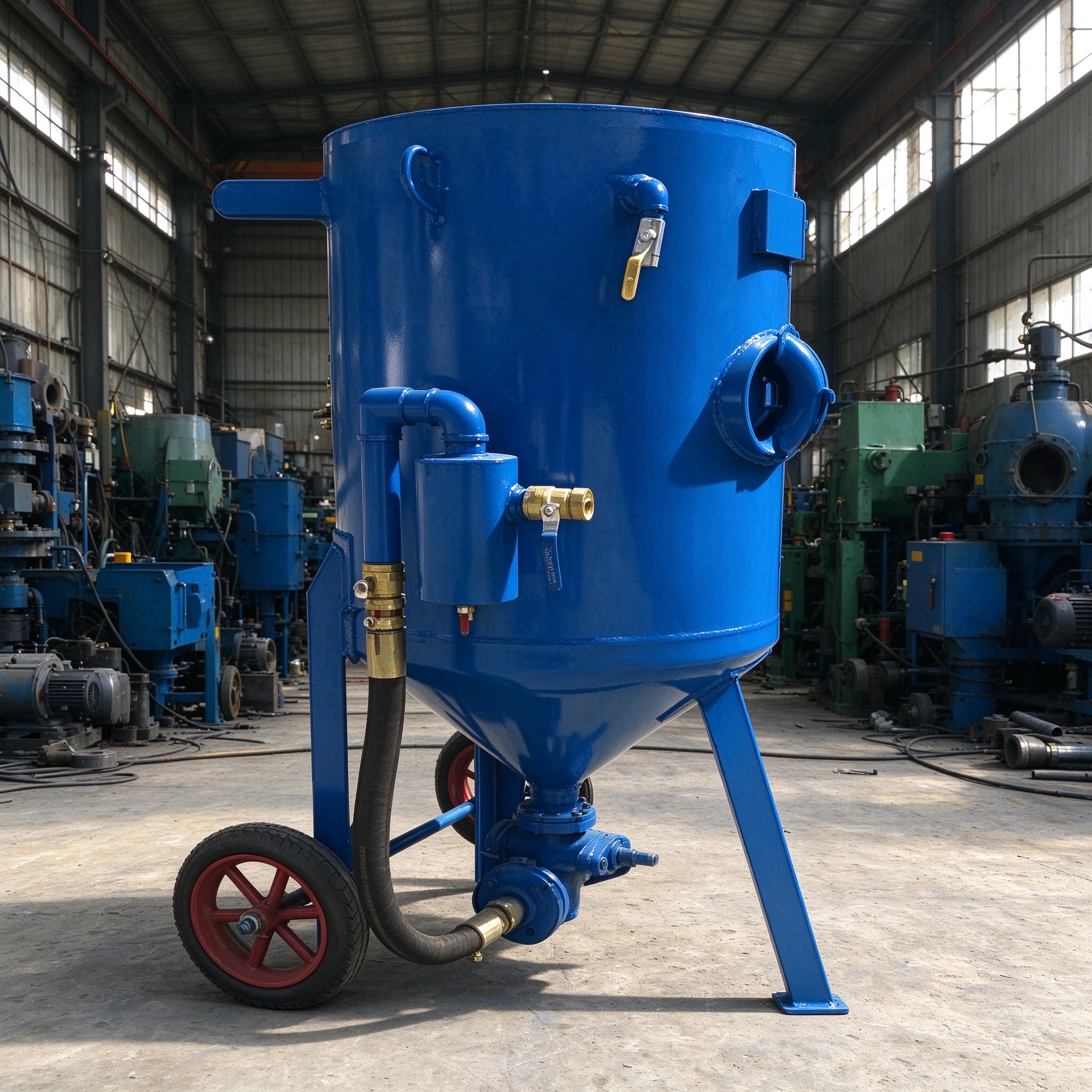
How to Choose the Right Unit: A Step-by-Step Selection Guide
Selection works backwards from the job: define the surface and the finish required, confirm the compressor and nozzle the system will run, then decide mobility and control type before comparing vessel documentation. Skipping a step usually shows up later as weak blasting speed, frequent clogging, or an oversized unit that wastes air.
Write the requirement down in the order it will be checked, and keep the same list when comparing quotations from different suppliers.
- Surface and specification: what has to be removed and what finish is acceptable.
- Air supply: compressor output and the pressure actually available at the nozzle, not only at the receiver.
- Duty cycle: continuous production, intermittent maintenance work, or a mix of both.
- Location: a fixed bay, a moving site, or outdoor work in changeable weather.
- Documentation and support: vessel test records, spare parts availability, and service response.
Selection Questions to Put to the Supplier
Ask directly and ask in writing. The answers show whether the supplier is sizing the unit to the job or simply quoting a catalogue item.
- Which vessel pressure rating and control type are proposed for this compressor and nozzle?
- How is abrasive metering adjusted, and how is the deadman system tested before delivery?
- What test records accompany the vessel, and how should they be read?
- Which consumables wear first, and what replacement routine is recommended?
- How do installation, commissioning, and operator training work after delivery?
A supplier who answers these points in detail is usually also able to adapt the unit later, when the workpiece mix or the compressor changes.
Vessel Quality, Welding, and Safety Checks
Vessel quality is the part that cannot be judged by appearance, so it has to be verified through plate grade, welding practice, and test records. A unit built from pressure-vessel grade steel that passes pressure testing before delivery is the difference between a long service life and a recurring maintenance burden.
Wuqiao Anxing Blasting Machinery Co., Ltd. builds every tank body from 16MnR pressure-vessel steel plate and hydrostatically tests each vessel at 2.5 times its rated pressure before it leaves the factory. The company states that its environmental equipment holds ISO14001 environmental management certification, that dust emissions sit well below national limits, and that its equipment follows national atmospheric emission and pressure-vessel safety standards. Its design team holds more than ten utility model patents covering blasting structure, dust recovery, and intelligent pressure regulation, and has developed adaptive pressure control, automatic abrasive recirculation, and dust and noise reduction in house. According to the manufacturer, these measures bring overall failure rates about 30 percent below the industry average and cut energy use by about 15 percent, while the ceramic nozzles fitted to its automatic models last around three times as long as standard alloy nozzles.
Translate that into a buyer’s checklist: confirm the plate grade, ask for the hydrostatic test record, inspect welds and closure hardware, and run the metering valve and remote control through a full cycle before acceptance. Safety also depends on use. The vessel should never be opened while pressurized, the air line should be drained, and the deadman system should be tested at the start of every shift.
Where These Vessels Are Used
They serve any operation that needs a consistent abrasive stream across a large or awkward workpiece, from shipbuilding and heavy steel fabrication to automotive parts, hardware molds, aviation components, glass and stone, bridges and pipelines, and anti-corrosion coating work.
Typical processes include rust removal, oxide scale removal, burr removal, paint stripping, matte finishing, texture engraving, and surface strengthening. Each process sets different demands: coating removal on a large steel structure rewards reach and steady pressure, while fine finishing on small components rewards accurate metering and a clean, dry air supply.
That range is why a single size rarely fits every buyer. A yard blasting bridge sections outdoors has different priorities from a workshop blasting small components, and the specification should reflect that difference rather than defaulting to the largest available unit.
Manufacturer Capability and Support
Wuqiao Anxing Blasting Machinery Co., Ltd. is based in Wuqiao County, Cangzhou, Hebei Province, and operates two production sites: a standardized plant in the development zone and a facility in Anling Town. Its work in blasting equipment reaches back to 1991, more than thirty years on blast cleaning and surface preparation, and the company was recognized as a provincial technology-based SME in 2023 and as a national technology-based SME in 2025.
Its range covers blasting machines such as cabinet units, open mobile units, high-pressure water units, dust-free units, and PLC automatic conveyor machines; pressure vessel sandblasting tanks in fixed, mobile, electric-control, and pneumatic-control versions with custom pressure ratings; complete blasting room systems; and ancillaries including permanent-magnet variable-frequency compressors, blasting compressors, blasting guns, wear-resistant hoses, abrasive recovery units, and pulse dust collectors.
Production runs across several standardized assembly lines with annual capacity of more than a thousand sets, and the company supports both batch orders delivered dozens of units at a time and small-batch customization or modification for special working conditions. Its domestic network covers nearly thirty provinces and regions, products are exported to Europe, the Americas, the Middle East, Southeast Asia, and Hong Kong, Macao, and Taiwan, and repeat orders come from Myanmar, Korea, and several Middle Eastern markets. The company reports long-term batch supply projects with large heavy-industry customers, including Jiangnan Shipyard, and more than three hundred manufacturing customers in total. Service includes on-site working-condition surveys, selection plans and plant layout drawings, installation, commissioning, and operator training, plus remote guidance and on-site repair with spare parts held in stock.
FAQ
What is a sandblasting tank used for?
A sandblasting tank stores abrasive under pressure and feeds it into the blast stream at a controlled rate, so the nozzle can clean, strip, or profile a surface. It is the core of a pressure-fed blasting system and works together with the compressor, hose, and nozzle to set blasting speed and finish quality.
How do I match a tank to my compressor?
Match on air pressure and air volume available at the nozzle, not on the tank size alone. Confirm the compressor output, the hose diameter, and the nozzle the system will run, then ask the supplier which vessel rating and metering setup holds that pressure steadily through a full working cycle.
Is a mobile unit better than a fixed one?
Neither is universally better; the choice depends on where the work is. A fixed unit suits a blasting bay where the workpiece comes to the equipment, while a mobile unit pays off when the workpiece cannot be moved, such as large steel fabrications, bridges, or pipelines. Mobility adds hardware that must be maintained, so specify it only when the work genuinely moves.
What should I check when accepting a new pressure-type sandblasting tank?
Confirm the pressure-vessel plate grade and the hydrostatic test record, inspect welds and closure hardware, and run the metering valve and remote control through a full cycle. Also check that the moisture trap and air fittings are correctly installed, and that the operator has been shown how to depressurize and drain the vessel safely.
How often should a blasting vessel be inspected?
Inspection intervals should follow the vessel rating, local pressure-vessel requirements, and how heavily the unit is used, rather than one fixed rule. Between formal inspections, check the closure, seals, metering valve, and remote control at the start of each shift and deal with wear before it becomes a leak or a blockage.
Summary
A sandblasting tank performs well when it is matched to the compressor, the surface, and the way the work moves. Confirm the vessel plate grade and test record, choose fixed, mobile, electric-control, or pneumatic-control configuration on the basis of the actual job, keep moisture out of the air line, and inspect the closure and deadman system daily. Buying from a manufacturer that documents its welding, tests every vessel before delivery, and supports installation and training reduces the risk that a low-cost unit becomes a costly one.