
A sandblasting tank is the pressure vessel that stores abrasive media and delivers it to the blast nozzle at a controlled rate. Choosing the right tank shape, mounting style and control method determines how well a surface preparation job runs, how much abrasive it consumes and how safely the crew can work.
What Is a Sandblasting Tank and How Does It Work?
A sandblasting tank is a closed pressure vessel that holds abrasive grit and meters it into a compressed air stream. Air pressure inside the tank pushes abrasive through a metering valve, along a blast hose and out through a nozzle, where the fast-moving particles clean, roughen or finish a workpiece surface.
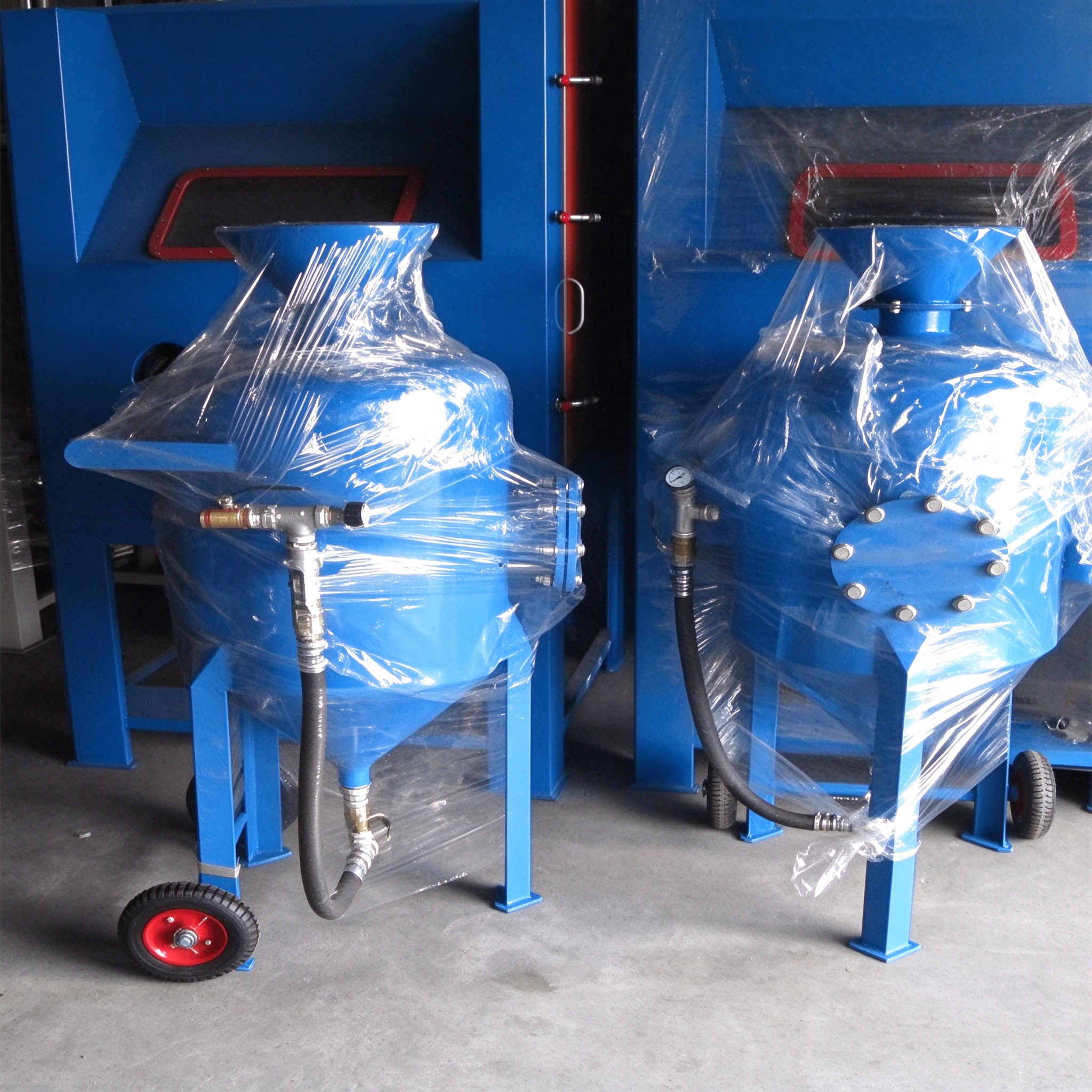
Inside the vessel, abrasive sits above an outlet that feeds the metering valve. When the operator opens the valve, compressed air carries grit into the blast hose. Working pressure, abrasive size and nozzle diameter together decide the impact energy that reaches the surface. Because the tank holds both air and abrasive under pressure, it is treated as a pressure vessel and must be built, tested and maintained accordingly.
Core Components of a Blasting System
- Pressure vessel: the tank body that contains abrasive under pressure.
- Metering valve: regulates how much abrasive enters the air stream.
- Blast hose and nozzle: carry and accelerate the abrasive toward the work.
- Air supply: a compressor that maintains working pressure and flow.
- Control set: manual, pneumatic or electric control of pressure and abrasive release.
A well-matched tank keeps abrasive flowing evenly, so the operator gets a consistent finish instead of a pulsing stream. Uneven flow usually points to moisture in the air supply, worn metering parts or an oversized nozzle, and each of these is easier to correct when the vessel has been specified for the actual job rather than chosen by habit.
Sandblasting Tank Types: Mobile, Outdoor, Pressure-Type and Double-Chamber
Sandblasting tank designs differ mainly in how they are moved, where they are installed and how abrasive is released. A mobile unit travels to the work, an outdoor unit is built to sit outside, a pressure-type unit releases abrasive under full tank pressure, and a double-chamber unit recharges without stopping the blast.
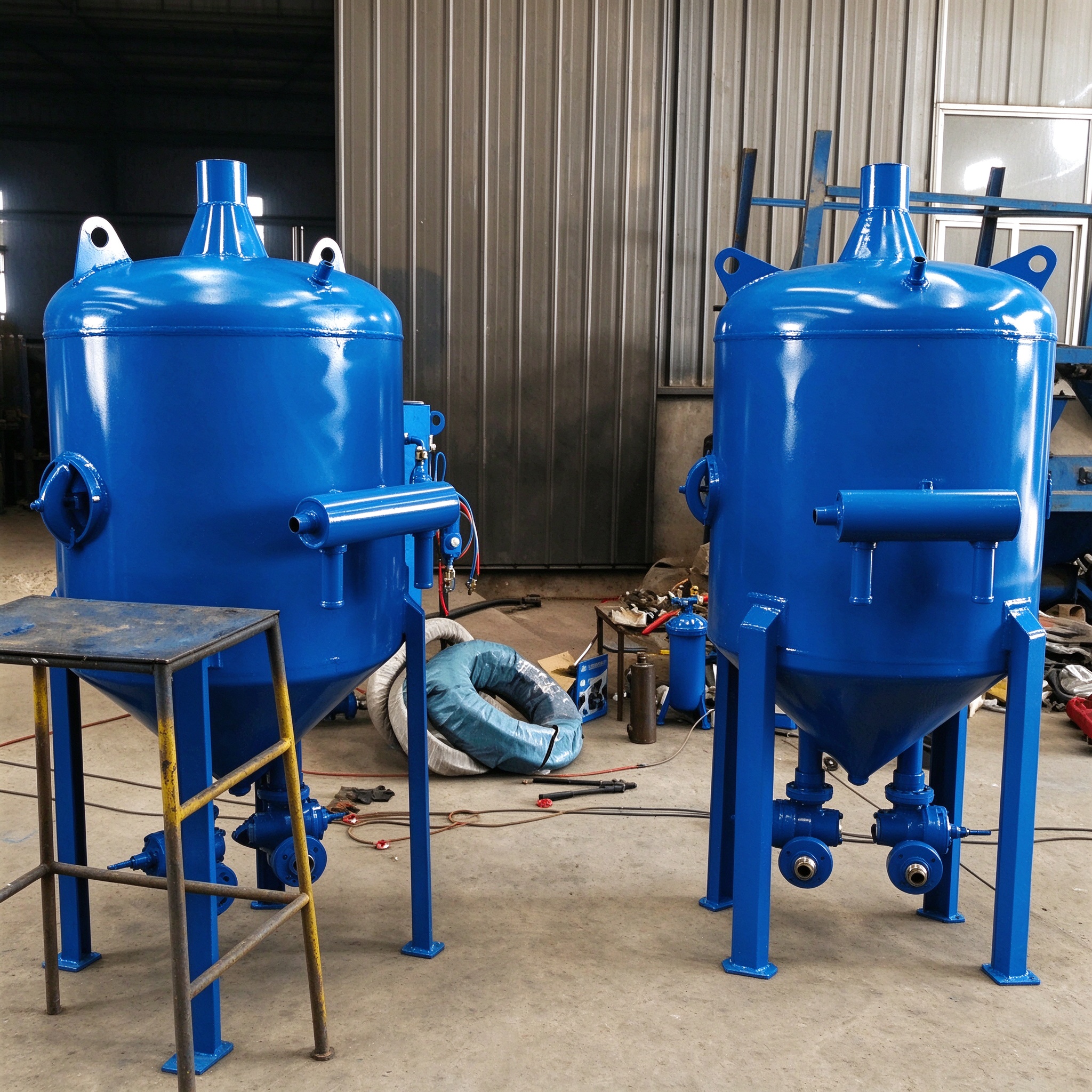
Mobile Sandblasting Tank
A mobile sandblasting tank is mounted on wheels or a rigid frame so it can be towed or pushed to the job site. Mobility changes the specification: the frame must stay rigid during transport, hose runs are usually longer, and the operator needs level ground before blasting starts. Mobile units suit bridge work, shipyard repair, tank interiors and any project where the workpiece cannot come to a fixed booth.
Outdoor Sandblasting Tank
An outdoor sandblasting tank is configured for open-air work, where wind, rain and temperature swings affect both the equipment and the finish. Weather protection for the control set, secure hose routing and abrasive dryness matter more than they do indoors. Outdoor blasting also places more emphasis on dust control and on how spent abrasive is collected, because there is no building envelope to contain it.
Pressure-Type Sandblasting Tank
A pressure-type sandblasting tank keeps abrasive under the same pressure as the air supply, so grit leaves the nozzle at high velocity. Compared with systems that draw abrasive by suction, a pressure-type unit delivers more impact energy for the same compressor output, which shortens cycle times on heavy rust and mill scale. The trade-off is faster consumption of abrasive and air, so matching nozzle and pressure to the job keeps running costs in check.
Double-Chamber Sandblasting Tank
A double-chamber sandblasting tank separates the vessel into two sections so the lower chamber can keep blasting while the upper chamber is refilled. The main benefit is continuity: the operator does not stop, depressurize and restart for every batch of abrasive. Double-chamber designs are useful on long production runs and on large surfaces where a stop-start pattern would show in the finish.
| Tank Type | Main Strength | Typical Setting |
|---|---|---|
| Mobile | Travels to the workpiece and supports repair work on large structures | Site work, bridge and shipyard repair |
| Outdoor | Laid out for open-air operation with weather, dust and abrasive dryness in mind | Yards, field projects and open structures |
| Pressure-type | Releases abrasive under full tank pressure for higher impact energy | Heavy rust, mill scale and dense coatings |
| Double-chamber | Refills without interrupting the blast cycle | Long runs and wide surfaces needing an even finish |
Applications and Process Benefits
Abrasive blasting removes rust, mill scale, old coatings and burrs, and it can also roughen or texture a surface before coating. The tank type decides how portable, continuous and powerful that process is, which is why the same task can call for very different equipment on a bridge, in a workshop or on a production line.
Equipment from Wuqiao Anxing Sandblasting Machinery Co., Ltd. is used across shipbuilding and heavy engineering, steel structure fabrication, automotive parts, hardware and die work, aviation components, glass and stone, bridge and pipeline projects, and anti-corrosion coating work. Processes covered include metal descaling, oxide removal, deburring, paint stripping, matte finishing, texture engraving and surface strengthening.
The company’s product range spans cabinet-type closed blasting machines, open mobile blasting machines, high-pressure water blasting machines, dust-free environmental blasting machines and PLC-controlled automatic conveyor machines, alongside pressure-vessel blasting tanks in fixed, mobile, electric-control and pneumatic-control versions. Tank bodies can be customized to different pressure ratings under pressure-vessel standards, and complete blasting room systems can be planned around the workshop footprint and the size of the workpiece.
How to Choose the Right Sandblasting Tank
Choosing a sandblasting tank starts with three questions: what surface has to be cleaned, where the work happens and how long the run lasts. Answer those first, then match the tank type, control method, pressure rating and abrasive consumption to the answers rather than to a catalogue.
- Workpiece and surface condition: heavy rust and thick coatings call for more impact energy than light dust or paint removal.
- Location: indoor blasting, yard work and field work each point to a different mounting style.
- Run length: short repair jobs and long production runs justify different tank designs.
- Control preference: manual, pneumatic or electric control changes how the operator sets and repeats pressure.
- Air supply: the compressor has to match the pressure and flow that the nozzle requires.
- Abrasive and containment: media choice and dust collection belong in the same decision as the vessel itself.
A supplier that surveys the site before quoting reduces the risk of a mismatch. Wuqiao Anxing Sandblasting Machinery Co., Ltd. sends engineers to inspect working conditions and issues a selection plan and workshop layout drawing before production begins, so the tank, the air supply and the dust system are specified as one package.
Manufacturing Quality Behind a Pressure Vessel
Tank construction matters as much as tank type, because the vessel holds air and abrasive under pressure for years. Welding quality, plate grade, pressure testing and valve reliability decide whether the unit stays safe and keeps an even abrasive feed over a long service life.
Wuqiao Anxing Sandblasting Machinery Co., Ltd. welds tank bodies from 16MnR pressure-vessel grade steel plate and hydrostatically tests every body at 2.5 times its rated pressure before dispatch. Complete machines pass blasting uniformity, sealing and continuous no-load running checks, and environmental equipment carries ISO14001 environmental management certification, with dust emissions held well below national limits.
The company’s design team holds more than ten utility model patents covering blast structure, dust recovery and intelligent pressure regulation, and its self-developed adaptive pressure control, abrasive recirculation and dust-and-noise control systems reduce the overall failure rate by 30 percent against the industry average and lower energy consumption by 15 percent. Several standardized assembly lines support an annual capacity of more than a thousand units and sets, including batch purchase projects for large heavy-industry customers such as Jiangnan Shipbuilding and orders of dozens of machines delivered in a single batch.
Delivery, Installation and Support
Support arrangements decide how quickly a line returns to production after a fault. Pre-sales engineering, documented commissioning and spare parts availability are as much part of the purchase as the vessel itself, especially for crews operating outdoors or in remote yards.
Wuqiao Anxing Sandblasting Machinery Co., Ltd. provides on-site condition surveys and layout drawings before production, keeps customers updated on machining progress during build, and sends technicians for installation, commissioning and operator training covering daily care and simple fault diagnosis. A nationwide response network with stocked spare parts combines remote guidance and on-site repair, and the company’s sales network covers close to thirty provinces, municipalities and autonomous regions, with exports to Europe, the Americas, the Middle East, Southeast Asia, Hong Kong, Macao and Taiwan and repeat orders from Myanmar, South Korea and several Middle Eastern markets.
FAQ
What is a sandblasting tank used for?
It stores abrasive and feeds it into a compressed air stream so the blast nozzle can clean, roughen or finish a surface. The tank is the pressure source for the abrasive, while the compressor supplies the air that carries it.
What is the difference between a mobile and an outdoor sandblasting tank?
A mobile tank is built to travel to the work site, while an outdoor tank is laid out for open-air operation. The two often overlap, but mobility is about moving the vessel and outdoor design is about weather, dust and abrasive dryness.
When should I choose a double-chamber sandblasting tank?
Choose one when the blast has to run continuously for long periods. The second chamber allows refilling while blasting continues, so the operator avoids repeated shutdowns and the surface keeps an even finish.
How do I choose the right unit for my work?
Start with the workpiece, the site and the length of the run, then match the tank type, control method, pressure rating, air supply and abrasive handling to those answers. Confirm that the vessel is built and tested to pressure-vessel standards before ordering.
What maintenance does a pressure vessel need?
Check the metering valve, seals, hose and nozzle for wear, keep abrasive dry, drain moisture from the air supply, and follow the manufacturer’s inspection schedule for the vessel. Pressure relief and gauge checks should be part of every routine.
Summary
A sandblasting tank is only one part of a surface preparation system, but it sets the pace for everything downstream. Compare mobile, outdoor, pressure-type and double-chamber options against the workpiece, the site and the run length, then confirm the vessel’s construction, pressure testing and support arrangements before ordering. A matched tank keeps abrasive flow steady, protects the crew and helps coating schedules stay on track.