A conveyor-type automatic sandblasting machine moves workpieces through a blasting chamber on a controlled conveyor while nozzles, abrasive recovery, and dust extraction work as one automated cycle. Parts receive the same treatment on every pass, so surface quality no longer depends on operator technique and repetitive production becomes easier to schedule.
What Is a Conveyor-Type Automatic Sandblasting Machine?
It is a blasting system built around a transport path: parts load at one end, pass through an enclosed blasting zone where nozzles apply abrasive, and exit cleaned. Because conveyor movement, blasting pressure, and abrasive circulation are coordinated, each workpiece sees a comparable blast pattern and cycle time.
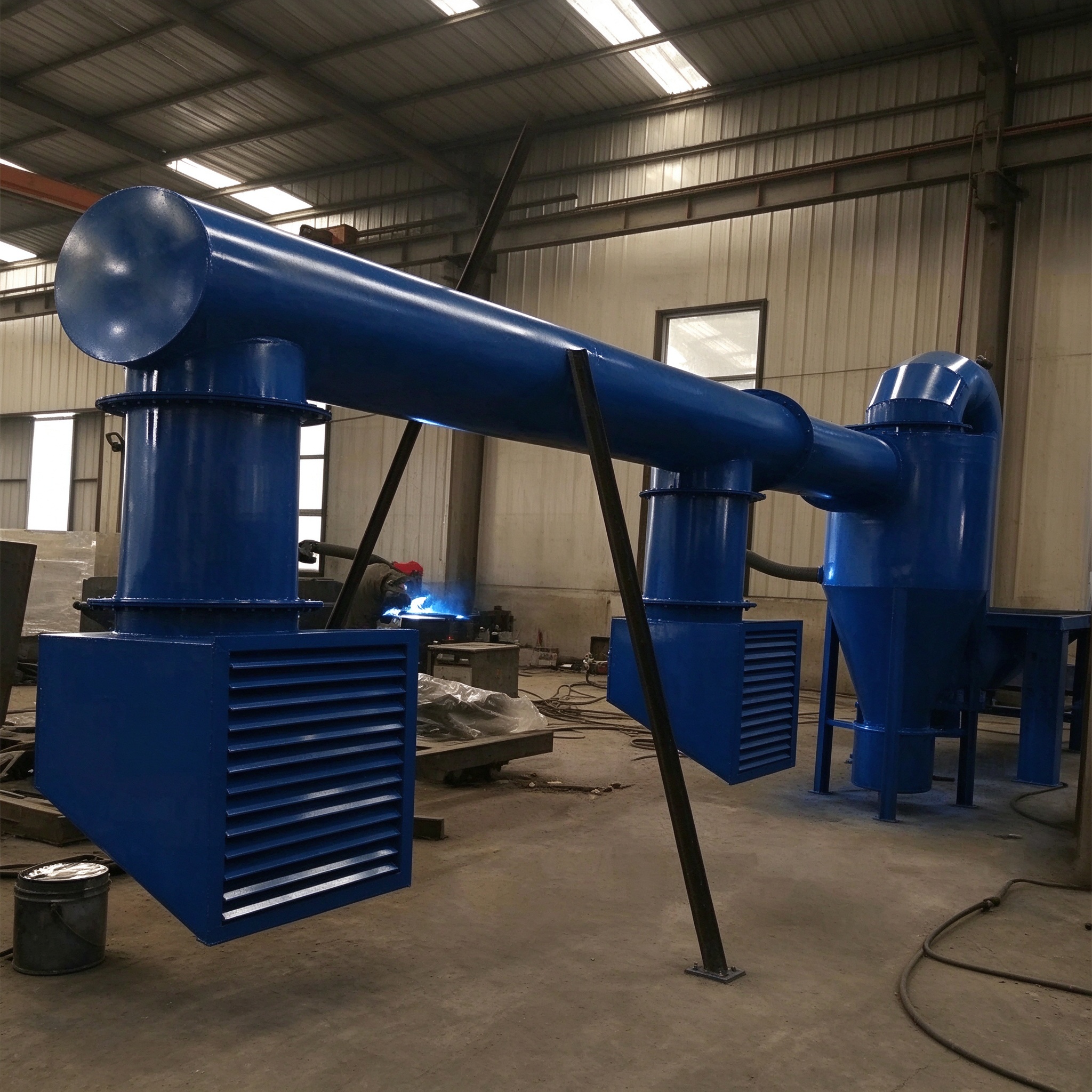
In practice the machine is a combination of a conveyor, one or more blasting stations, an abrasive recovery loop, a dust extraction unit, and a control cabinet. The control layer is what turns separate hardware into a process, because it links material handling with blasting and extraction so that stopping one element does not leave abrasive or dust uncontrolled. On fully automatic models, programmable logic control is the usual approach, with recipe settings stored and recalled for different workpieces.
Core Components and How They Work Together
Each subsystem has a defined job, and the finished surface depends on how well they are matched to each other and to the workpiece.
- Conveyor and fixturing: positions and transports workpieces through the blasting zone at a steady rate.
- Blasting chamber: contains abrasive and dust while the nozzles direct the stream at the workpiece.
- Nozzle set: defines the blast pattern, coverage, and the wear-related maintenance routine.
- Abrasive recovery system: separates reusable abrasive from dust and debris and returns it to the blast stream.
- Dust collector: captures airborne particles so the working environment and exhaust stay controlled.
- Control cabinet: coordinates start-up, shutdown, and process settings across the line.
Benefits of Automated Blasting in Continuous Production
Automation changes the economics of blasting in three ways: consistent surface results, lower manual handling per part, and tighter containment of dust and abrasive. When the process runs the same way for every workpiece, rework falls and downstream coating, painting, or assembly starts from a predictable surface.
It also changes how the work is planned. Parts can be sequenced so that loading, blasting, and unloading overlap, which keeps the line busy instead of waiting between batches. Manual booths cannot match that rhythm, because the operator works inside the same cycle.
Repeatability and Throughput
With manual blasting, the result depends on where the operator aims and how long the stream stays on one spot. On a conveyor system those variables become settings: conveyor speed, number and angle of nozzles, blast pressure, and abrasive flow. Once set, the same combination repeats for the whole batch, which is why volume parts that need a uniform finish are commonly moved onto this type of line.
Throughput comes from continuous flow rather than from blasting harder or faster. The practical limit is set by the workpiece envelope, the required surface standard, and how much fixturing each part needs, so those three factors belong in the specification conversation.
Dust Control and Working Environment
Blasting generates dust by design, so extraction is part of the process rather than an accessory. Enclosing the blasting zone and drawing air through a dust collector keeps abrasive fines and airborne particles out of the workshop and protects the abrasive loop from contamination. For plants that work under emission and safety inspection, this closed arrangement is often the deciding factor when equipment is specified.
Applications and Surface Processes Supported by the Equipment
The equipment is used wherever a surface has to be cleaned, roughened, or prepared before the next manufacturing step. Typical sectors include shipbuilding and heavy industry, steel structure engineering, automotive parts, hardware and molds, aerospace components, glass and stone processing, bridge and pipeline work, and anti-corrosion coating operations.
Surface Tasks the Process Can Deliver
Process settings are matched to the workpiece, so the same type of line can cover a wide range of surface tasks.
- Rust removal and oxide scale removal on metal surfaces.
- Burr cleanup and edge finishing after machining.
- Paint and coating stripping before re-finishing.
- Matte finishing and texture work on visible surfaces.
- Surface strengthening where a uniform blast pattern is required.
The workpiece decides the rest. A flat panel and a complex casting need different fixturing, different nozzle angles, and different handling, even when both run on the same conveyor format.
How to Choose the Right Conveyor-Type Automatic Sandblasting Machine
Choosing a system starts with the workpiece rather than with the machine. Part size, geometry, fixturing needs, required surface result, and production rhythm decide the conveyor format, the number of blasting stations, and the extraction capacity, so those points should be settled before quotations are compared.
Specification Questions to Settle Early
- What is the largest and the smallest part the line must handle, and how will each be fixtured?
- Which surface result is required: rust and scale removal, paint stripping, matte finishing, or surface strengthening?
- How many parts per shift must pass through, and can they be loaded without stopping the line?
- Which dust and emission limits apply at the installation site?
- Which control level is needed: operator-controlled steps, or stored recipes on a PLC-based system?
- Where will maintenance access, abrasive replenishment, and spare nozzles be located?
Layout matters as much as the blasting specification. The machine footprint, loading and unloading space, abrasive storage, and dust collector position all have to fit the building, and a plan drawn around the actual plant is more useful than a generic drawing. That is why a site survey and layout drawing normally come before the final configuration is fixed.
Installation, Operation, and Maintenance Essentials
Reliable operation comes from routine attention to a few wear points rather than from complex procedures. Nozzle condition, abrasive cleanliness, chamber seals, and dust collector filters account for a large share of the quality variation and unplanned stops on automatic blasting lines, so they belong on a fixed inspection schedule.
Operator training should cover the start-up and shutdown sequence, correct loading of parts, what a normal blast pattern looks like, and how to recognize the early signs of wear. Simple daily checks, such as viewing the blast pattern, listening for changes in the extraction system, and confirming an even abrasive feed, catch most issues before they affect the surface finish.
Safety practice follows the same logic. Interlocked access doors, dust control, and correct protective equipment are not optional extras on a blasting line; they are part of how the equipment is designed to be operated, and they should be reviewed with everyone who loads, runs, or maintains the machine.
Manufacturing, Quality Control, and Delivery Capability
Manufacturing capability decides whether a line can be delivered on schedule and kept running afterwards. Wuqiao Anxing Sandblasting Machinery Co., Ltd. works from two production sites in Wuqiao County, Cangzhou, Hebei Province, and has built blasting equipment since its predecessor business began in 1991, covering research, production, sales, customization, and after-sales service.
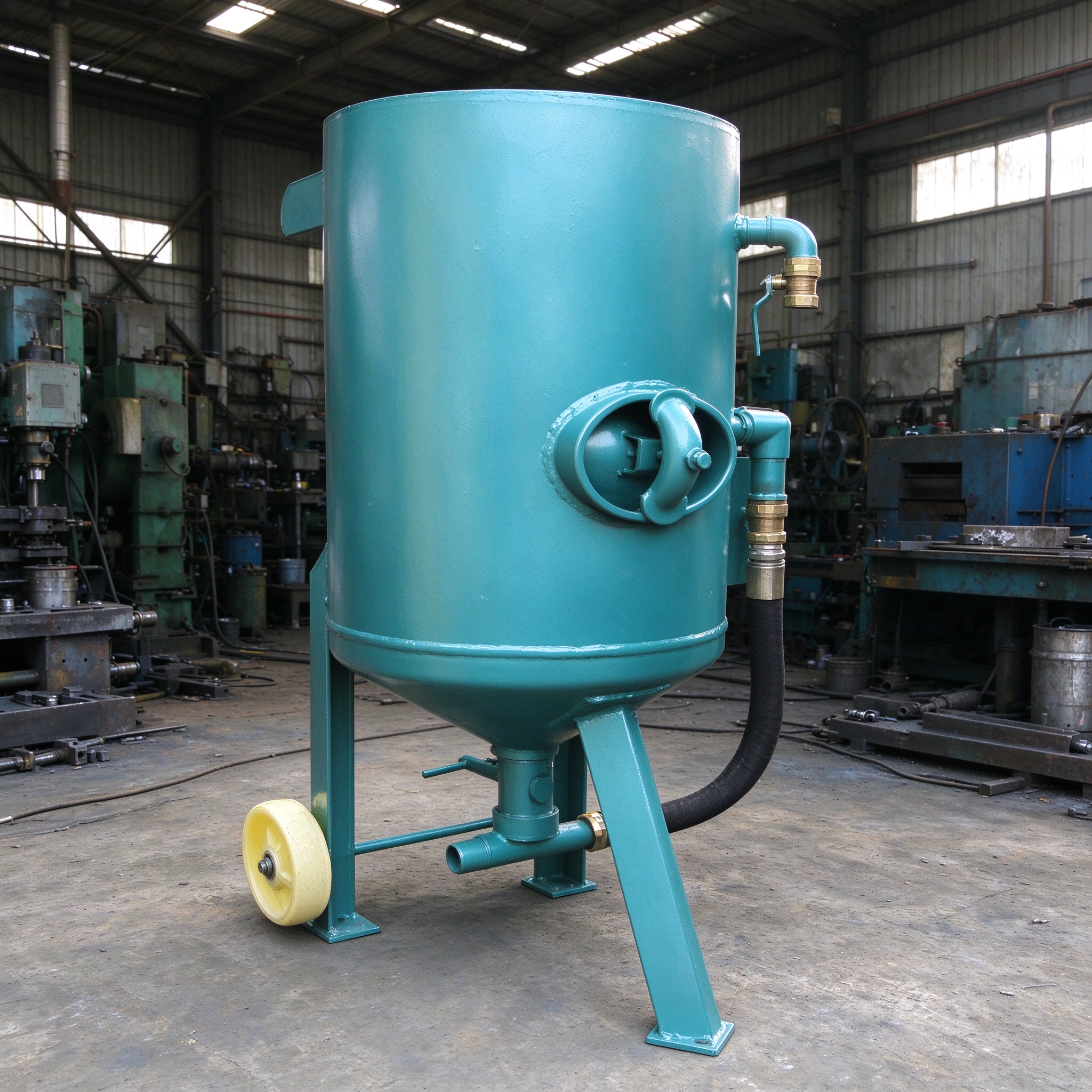
The product range covers the machine types a conveyor line is usually specified alongside: enclosed cabinet blasting machines, open mobile units, high-pressure water blasting machines, dust-free environmental models, and PLC conveyor-type automatic machines. Pressure vessel blast tanks are offered in fixed, mobile, electric-control, and pneumatic-control versions, with tank bodies built to pressure vessel requirements in different pressure ratings. Complete blast room systems, including automatic rooms and recovery-and-dust-removal integrated rooms, are planned around plant dimensions and workpiece size. Air compressors, blast guns, wear-resistant hoses, abrasive recovery devices, and pulse dust collector units complete the package.
On the quality side, the engineering team covers mechanical design, fluid pressure, and environmental dust removal, and the company holds more than ten utility model patents related to blast structures, dust recovery, and intelligent pressure regulation. Blast tank bodies are welded from 16MnR pressure vessel steel plate, and each tank is subjected to a hydrostatic test at 2.5 times its rated pressure. Automatic models use wear-resistant ceramic nozzles, which the manufacturer states last roughly three times as long as ordinary alloy nozzles. Completed machines are checked for blasting uniformity, sealing, and continuous no-load running.
Capacity supports both volume and customization. Multiple assembly lines allow an annual output of more than a thousand sets, large orders can be delivered as a single batch of dozens of machines, and small-batch or special-condition modifications are handled alongside standard production. Environmental equipment is covered by ISO14001 environmental management certification, and the company reports a fault rate about 30% below the industry average together with energy consumption about 15% lower.
Service, Training, and After-Sales Support
Service planning belongs in the equipment decision, because a blasting line that stops also stops everything downstream. Support around site survey, selection, installation, training, and spare parts availability is what keeps an automatic line productive across its working life.
What Support Covers in Practice
Before the order, engineers survey the working conditions on site and provide a selection plan and plant layout drawings. During production, progress is tracked and processing details are reported to the customer. After shipping, technicians install and commission the equipment and train operators on everyday use, daily maintenance, and simple fault diagnosis.
After-sales coverage includes a fast response mechanism with parts held in stock, remote guidance, and on-site repair, which shortens the downtime a failed wear part can otherwise cause. The domestic network covers nearly thirty provinces, autonomous regions, and municipalities, with dealers and resident service staff in the main manufacturing clusters of North, East, and South China; export business reaches Europe, the Americas, the Middle East, Southeast Asia, Hong Kong, Macao, and Taiwan, with repeat orders from customers in Myanmar, South Korea, and several Middle Eastern countries.
Long-term cooperation covers more than three hundred manufacturing units, including large shipbuilding groups, steel structure plants, automotive parts makers, 3C precision manufacturers, and construction machinery plants. Many of these machines run for years without major faults, which is the practical measure of how a blasting line holds up in daily production.
Frequently Asked Questions
What does a conveyor-type automatic sandblasting machine do?
It carries workpieces through an enclosed blasting zone on a conveyor and applies abrasive automatically, so every part in a batch receives a consistent surface treatment. The same line can handle rust removal, oxide scale removal, burr cleanup, paint stripping, and matte finishing when the process settings are matched to the workpiece.
Why is automation preferred over manual blasting for repeatable parts?
Automation removes the operator-to-operator variation that manual blasting introduces, because nozzle timing, conveyor speed, and abrasive flow are controlled together. For parts that repeat in volume, that consistency usually lowers rework and stabilizes the downstream coating or assembly steps.
Which workpieces are suitable for conveyor-fed blasting?
Parts that can be positioned or fixtured on a conveyor and passed through a blasting chamber are the natural fit, including automotive components, hardware and molds, aerospace parts, and glass or stone panels. Workpieces that cannot be supported steadily on a transport path need a different equipment configuration.
How is dust controlled during automatic blasting?
Dust is captured at the blasting zone and routed to a dust collector, so abrasive fines and airborne particles are contained instead of escaping into the workshop. Filter servicing and duct inspection are the routine tasks that keep extraction performance stable.
What routine maintenance matters most on an automatic blasting line?
Nozzle wear, abrasive cleanliness, chamber seals, and dust collector filters are the items that most often affect blasting quality and uptime. Checking them on a fixed schedule prevents uneven blasting and unplanned stops.
Summary
A conveyor-type automatic sandblasting machine is worth specifying when parts repeat, surface consistency matters, and dust has to stay contained. Settle the workpiece envelope, the required finish, and the production rhythm first, then match conveyor format, blasting stations, extraction capacity, and control level to those requirements. Before ordering, confirm how the supplier handles site survey, installation, operator training, spare parts, and repair response, because those commitments decide how much of the line’s working life is spent producing rather than waiting.