
A mobile abrasive blasting rust removal tank is a pressure vessel mounted on a wheeled or skid frame that feeds abrasive media to a blast nozzle. It removes rust, mill scale, and old coatings wherever the workpiece sits, because the unit travels to the job instead of the job travelling to a fixed cabinet.
What Is a Mobile Abrasive Blasting Rust Removal Tank?
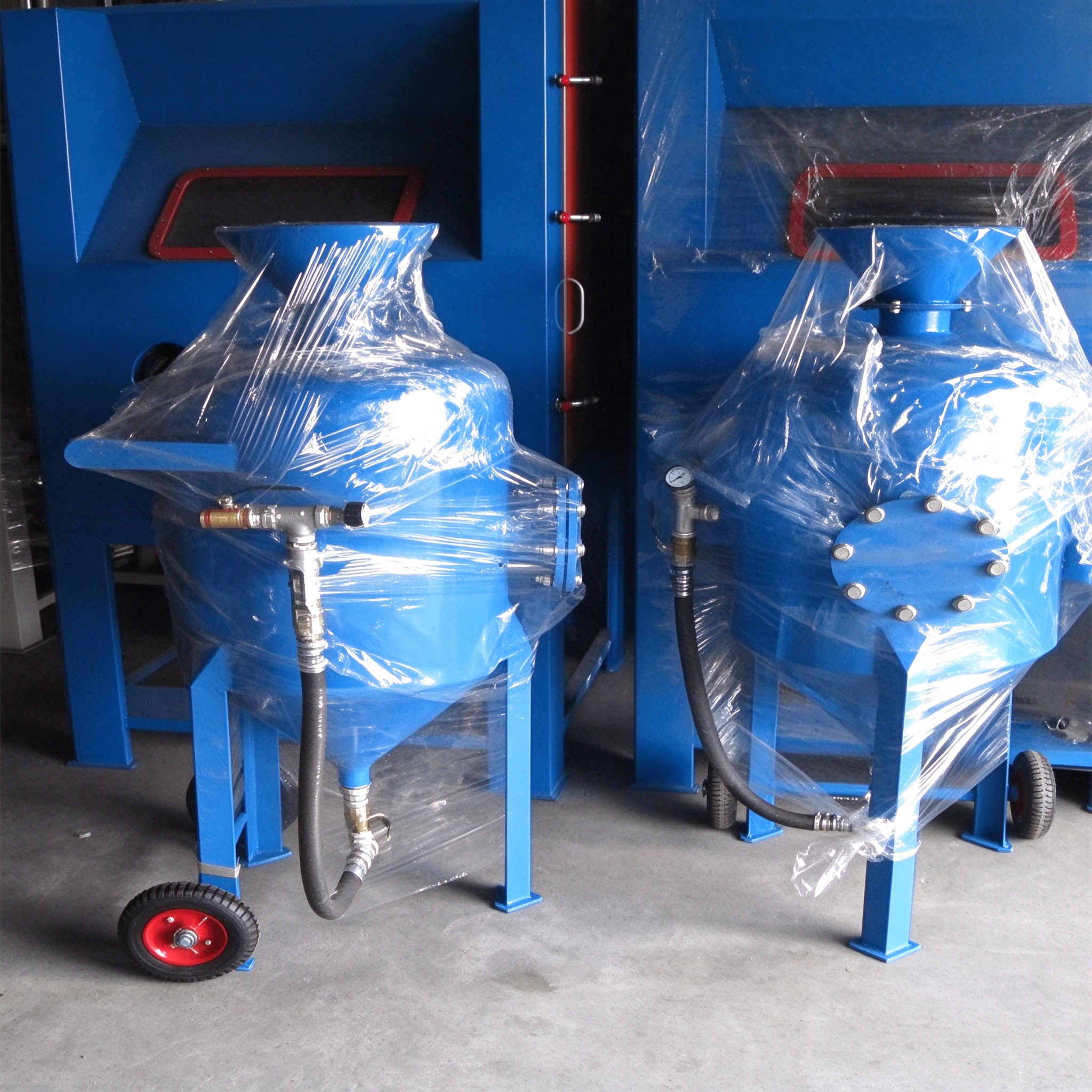
A mobile abrasive blasting rust removal tank is a portable pressure vessel that holds abrasive media under pressure and releases it through a metering valve into a blast hose. The frame and wheels make the whole assembly relocatable, which separates it from a fixed vessel bolted to a plant floor.
Compressed air enters the vessel and pressurises the abrasive bed. The metering valve controls how much abrasive drops into the air stream, and the mixture travels down the blast hose to the nozzle, where it accelerates before striking the surface. Working pressure, valve setting, and nozzle choice together decide the stripping rate.
Fixed pressure vessels suit a single workstation with a steady workload. A mobile unit covers the opposite case: scattered workpieces, outdoor structures, and jobs that change location. Both share the same pressure-vessel logic; only the frame and the handling arrangement differ.
Main Assemblies
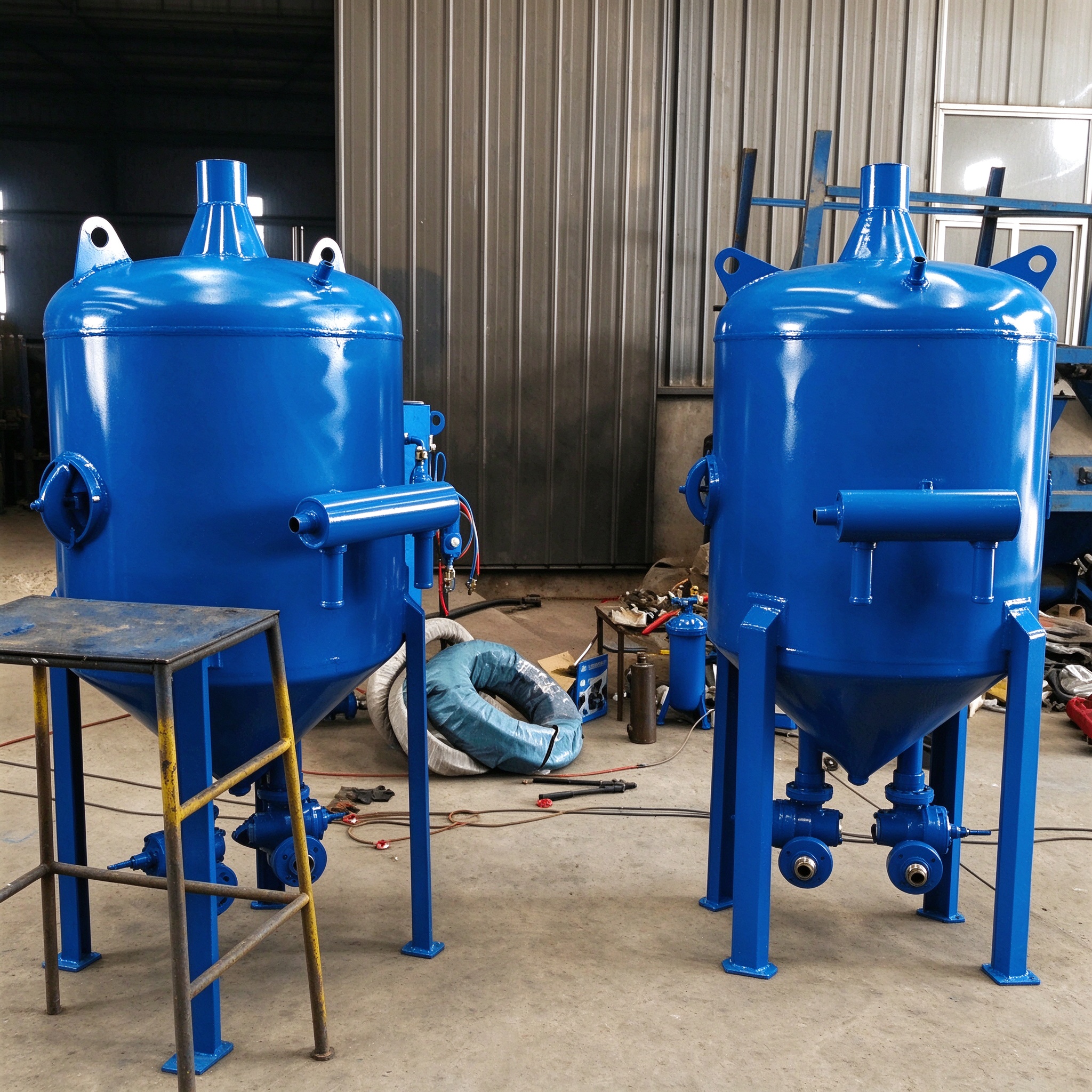
- Welded pressure vessel with dished ends and a sealed abrasive fill port
- Abrasive metering valve and air control valve
- Blast hose, coupling set, and nozzle
- Transport frame with wheels, lifting points, and tie-downs
- Moisture trap and inlet air fittings
Build Quality and Engineering Details That Matter
Build quality decides how long a mobile abrasive blasting rust removal tank stays in service. Shell material, weld quality, pressure testing, and the wear parts around the nozzle matter more than cosmetic finish, because each of them sits directly on the path of abrasive flow or pressure load.
Wuqiao Anxing Abrasive Blasting Machinery Co., Ltd. designs and builds blasting machinery, blasting rooms, and dust extraction equipment alongside its pressure-vessel blasting tanks. Its predecessor began building blasting equipment in 1991, and the company has stayed in surface preparation since then. Tank shells are welded from 16MnR pressure-vessel steel plate, and every tank is hydrostatically tested at 2.5 times its rated pressure before dispatch.
The same manufacturer reports more than ten utility model patents covering blasting structure, dust recovery, and pressure regulation, plus ceramic nozzles on automatic models whose service life is stated at three times that of ordinary alloy nozzles. Reported figures put overall failure rates 30% below the industry average and energy use 15% lower.
Finished units also go through abrasive uniformity, sealing, and continuous no-load running checks. The purpose of those checks is practical rather than administrative: a tank that leaks at the metering valve or starves the nozzle shows up as an uneven surface profile long before it fails outright.
Where Mobile Units Fit on Real Job Sites
A mobile abrasive blasting rust removal tank fits any job where the workpiece cannot reasonably be moved into a blasting room. That covers field structures, large fabrications, and repair work, and it also covers shops that run several small batches in different bays during the same week.
Typical settings include shipbuilding and heavy engineering, steel structure fabrication, bridge and pipeline work, anti-corrosion coating preparation, automotive parts, hardware and mould work, aviation components, and glass and stone finishing. The same unit may strip mill scale from a new fabrication in the morning and remove an old coating from a repair section in the afternoon.
On the process side, the work usually falls into metal descaling, oxide removal, burr clean-up, coating strip-back, matte finishing, texture work, and surface strengthening. A mobile tank handles these because the only thing that has to reach the workpiece is the nozzle and hose, not the whole machine.
How to Choose the Right Configuration
Choosing a configuration means matching vessel size, working pressure, control type, and support equipment to the workload in front of you. The practical answer is the smallest setup that still holds pressure and abrasive delivery steady through a full working shift.
Control type is the first branch point: electric control and pneumatic control are both available, and the choice usually follows site power availability and how often the operator needs to adjust settings. Support equipment matters just as much, because the tank is only one part of a working system. An air compressor matched to the nozzle, whether a permanent-magnet variable-frequency unit or a blasting-specific model, has to line up with the blast gun, the wear-resistant blast hose, the abrasive recovery arrangement, and the pulse dust collector.
A small abrasive blasting tank suits light or intermittent work where a full-size vessel would be over-specified. A high-pressure abrasive blasting tank is the choice when scale or coating is stubborn and needs more nozzle energy. An open-type abrasive blasting tank fits outdoor or large-format work without a sealed cabinet, and an anti-corrosion abrasive blasting tank is configured around surface preparation ahead of protective coating application.
Selection Checklist
- Working pressure and vessel size measured against the heaviest job on the schedule
- Electric or pneumatic control, based on site power and operator preference
- Transport arrangement, including lifting points and tie-downs
- Air compressor output matched to the nozzle in use
- Dust collection and abrasive recovery suited to the working environment
- Spare nozzles, hoses, and valve parts kept on site
Maintenance and Safe Operation Essentials
Maintenance on a unit of this kind centres on moisture, wear, and pressure integrity. Moisture caked into the abrasive causes clogging, worn nozzles and hoses change the blast pattern, and any defect on the pressure boundary is a safety matter rather than a performance matter.
Daily checks cover the moisture trap, the abrasive fill port, and the metering valve. Hose inner walls and nozzle bore wear deserve a fixed inspection interval, because both alter abrasive flow well before they fail. Any work on the vessel or valve set starts with full depressurisation and isolation.
Safe operation depends on ventilation, operator respiratory protection, and control of the dust the process generates. Blasting should not run in a confined space without airflow and extraction, and the unit should be earthed against static build-up while abrasive is flowing.
FAQ
What is a mobile abrasive blasting rust removal tank used for?
It is used to remove rust, mill scale, and old coatings from metal surfaces at the place where the workpiece sits. Field structures, large fabrications, and repair sections that cannot be moved into a blasting room are the usual targets.
What is a small abrasive blasting tank?
A small abrasive blasting tank is a compact pressure vessel sized for light or intermittent blasting work. Its lower abrasive volume and shorter working cycle suit small parts, touch-up work, and shops that do not run a continuous blasting line.
What is a high-pressure abrasive blasting tank?
A high-pressure abrasive blasting tank is a vessel and valve set built to deliver abrasive at elevated working pressure, which raises nozzle energy. It is normally chosen when heavy scale, thick coatings, or dense surface profiles have to be stripped quickly.
What is an open-type abrasive blasting tank?
An open-type abrasive blasting tank is a unit used without a sealed blasting cabinet, so blasting happens in open air or inside a temporary enclosure. It suits large or awkward workpieces that cannot fit into a cabinet, and it depends on dust control around the work area.
What maintenance does a mobile abrasive blasting rust removal tank need?
Maintenance focuses on moisture control, valve and seal inspection, hose wear checks, and nozzle replacement. The vessel and valve set should only be opened after full depressurisation, and worn parts should be replaced before they start to change the blast pattern.
Summary
A mobile abrasive blasting rust removal tank solves a specific problem: getting controlled abrasive delivery to a workpiece that cannot come to a fixed station. Selection comes down to working pressure and vessel size, control type, transport arrangement, and the support equipment built around the unit. Shell material, pressure testing, and wear-part choice decide how many years the equipment actually delivers, while routine moisture and wear checks decide whether it performs consistently between replacements. Buyers comparing options should match the configuration to the real workload rather than to the largest job on the drawing board.