
A mobile sandblasting derusting tank is a pressure vessel and blast unit built to be moved, so steelwork, pipework and heavy parts are cleaned where they stand rather than being hauled to a fixed cabinet. It strips rust, mill scale and old coatings with dry abrasive and leaves a surface ready for inspection and recoating.
What a Mobile Sandblasting Derusting Tank Does on Site
The unit pairs an abrasive pressure vessel with a movable frame, so the blast stream travels to the workpiece instead of the workpiece traveling to a cabinet. Compressed air pressurizes the vessel, abrasive is metered into the air stream, and the operator works from a hose and nozzle.
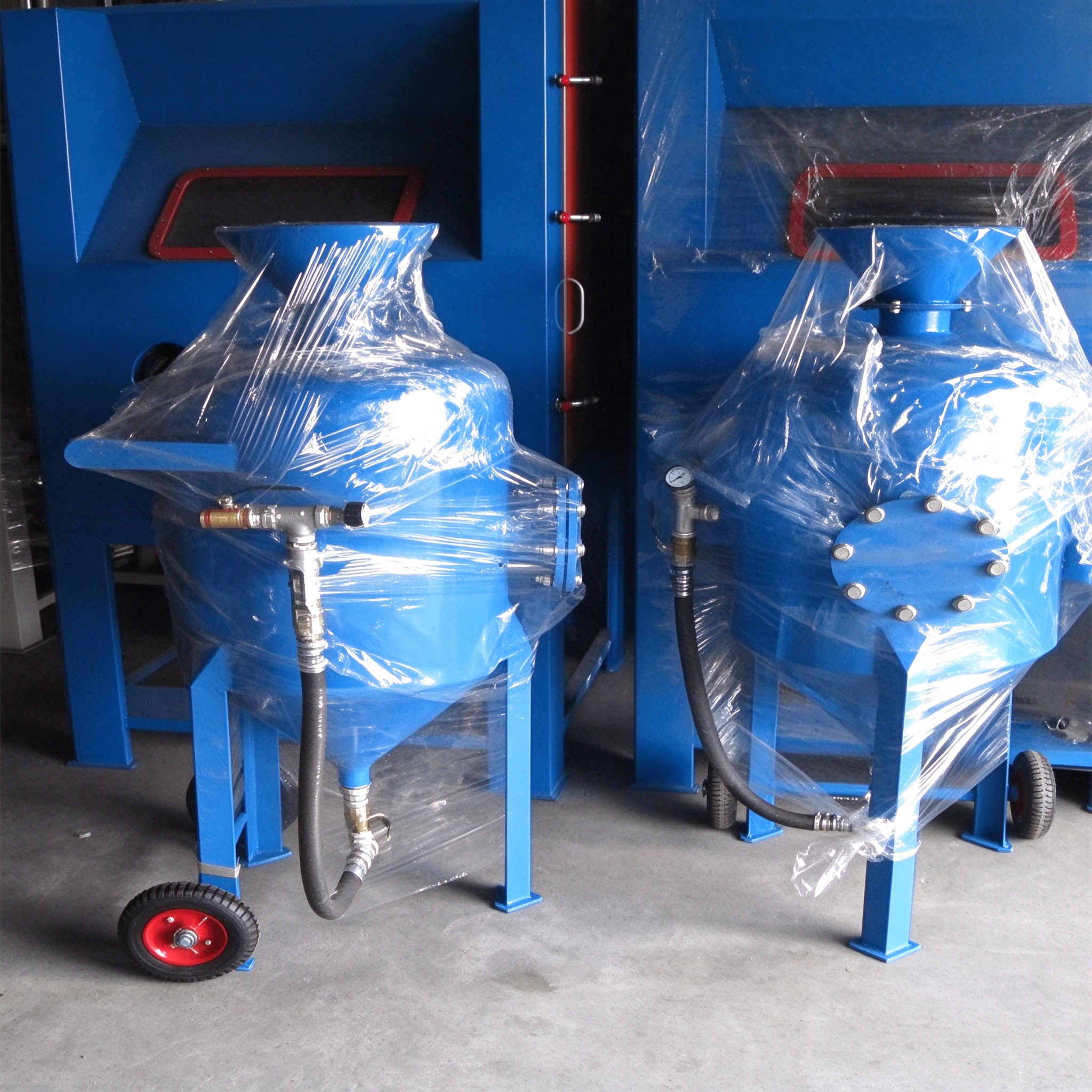
Because the vessel can stand beside the work, the hose run stays short and the operator is not limited by cabinet width or door size. The same arrangement handles flat plate, rolled sections, pipe spools and assembled frames, and one machine can serve several locations on a large site instead of tying the work to a single bay.
How the Pressure Vessel Feeds Abrasive
Compressed air pressurizes the vessel and abrasive is metered into the air stream through a control valve; the mixture then travels down the blast hose to the nozzle, where it is aimed at the surface. Moisture in the air supply is a common cause of uneven feed, so the air line is dried and drained before work starts, and the metering setting is adjusted as the nozzle wears.
Fixed, Mobile, Electric-Control and Pneumatic-Control Configurations
Pressure vessel blasting tanks are supplied in fixed and mobile versions, and in electric-control and pneumatic-control versions, so the operating arrangement follows the site rather than the other way round. Fixed tanks suit dedicated stations and blast rooms, movable versions follow the structure being cleaned, and the control type decides whether the operator works from a remote station or from controls carried at the nozzle.
- Fixed tanks for dedicated stations and blast rooms
- Mobile tanks for structures that cannot be moved
- Electric-control versions for remote operation
- Pneumatic-control versions where compressed air alone drives the controls
Where Mobile Derusting Work Fits in Industrial Surface Preparation
On-site blasting suits work that is too large, too heavy or too costly to move: steel structures, bridge and pipeline sections, ship blocks, machine frames and coated parts due for recoating. The vessel stays on the ground, the nozzle reaches the surface, and dust is captured at the point of work.
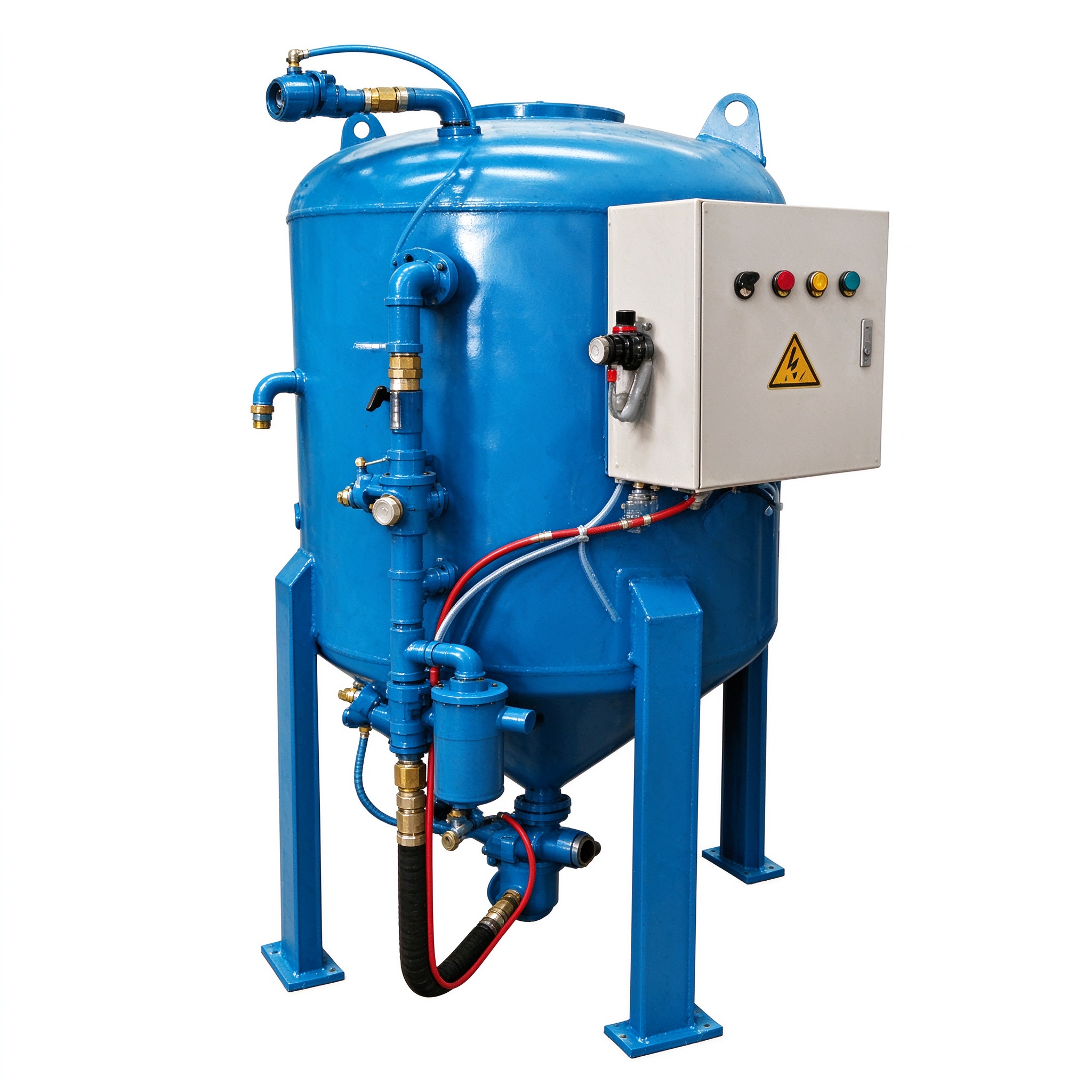
The equipment range covers shipbuilding and heavy industry, steel structure engineering, automotive parts, hardware and molds, aviation parts, glass and stone, bridges and pipelines, and anti-corrosion coating work. Typical tasks include metal derusting, oxide scale removal, burr removal, paint stripping, matte finishing, texture carving and surface strengthening, so one platform can serve several finishing steps instead of a single narrow operation.
Shipbuilding, Steel Structures and Bridge Work
Large welded assemblies are the clearest case for moving the blast unit rather than the workpiece. Blocks, girders, columns and bridge segments are cleaned in place before coating, and the same unit can be repositioned along the structure as the work front advances, which keeps handling equipment and transport out of the schedule.
Anti-Corrosion Coating Preparation
In anti-corrosion work the surface profile matters as much as the cleanliness, because the protective coating system bonds to the anchor pattern left by the abrasive. An anti-corrosion sandblasting tank is therefore specified around the coating schedule: the surface is blasted to the required condition, dust and spent abrasive are removed, and the primer follows before the profile is contaminated again.
When a Small Sandblasting Tank Is the Better Fit
A small sandblasting tank suits low-volume work, spot repair and confined access, where a large vessel would be difficult to position and slow to justify. It holds a smaller abrasive charge, can be moved by one operator between jobs, and keeps small batches of brackets, mold parts and repair sections moving without occupying a full blasting station.
Manufacturing Background and Quality Control
Wuqiao Anxing Sandblasting Machinery Co., Ltd. is a source manufacturer of blasting equipment located in Wuqiao County, Cangzhou, Hebei, with two production sites: a standardized plant in the development zone and a second site in Anling town. The company has worked on blasting, derusting and surface cleaning equipment since 1991, and was recognized as a provincial science and technology SME in 2023 and a national science and technology SME in 2025.
Its product system is arranged in four blocks: blasting machines, including cabinet, open mobile, high-pressure water, dust-free and PLC conveyor types; pressure vessel blasting tanks in fixed, mobile, electric-control and pneumatic-control versions, customized to the required pressure rating; complete blast room systems with recovery and dust removal built in; and supporting equipment such as permanent magnet variable-frequency air compressors, blasting air compressors, blast guns, wear-resistant hoses, abrasive recovery units and pulse dust collectors.
Tank bodies are welded from 16MnR pressure vessel steel plate, and every tank passes a hydrostatic test at 2.5 times its rated pressure before dispatch. Automatic machines are fitted with wear-resistant ceramic nozzles whose service life is three times that of ordinary alloy nozzles, and every machine is checked for blasting uniformity, sealing and continuous no-load running. Environmental equipment is covered by ISO 14001 environmental management and dust emissions are well below the national limit; the company reports a failure rate 30% below the industry average and energy use 15% lower. More than ten utility model patents support adaptive pressure regulation, automatic abrasive circulation, and intelligent dust removal and noise reduction.
Assembly lines support an annual capacity of up to a thousand sets. Batch projects for large heavy-industry buyers, including Jiangnan Shipyard, have been delivered in runs of tens of units, and small-batch customization and modification for special working conditions are also accepted, with lead times held steady for volume orders.
How to Choose the Right Unit for the Job
Selection starts with two questions: how often the vessel has to move, and how long each blast session runs. Everything else, from hose length to air demand and dust control, is planned around those two answers.
Match Vessel Size and Mobility to the Workload
A vessel that stays in one bay is served by a fixed tank, while a vessel that follows structures around a site is served by a mobile one. Abrasive capacity, refill interval, hose length and the number of operators all follow from the shape of the working day, so the specification should be built from the job rather than from a catalogue page.
Plan Air Supply and Dust Control Together
The compressor, the pressure vessel and the dust collector are one system, not three purchases. A permanent magnet variable-frequency air compressor and a blasting air compressor are matched to the blast demand, while a pulse dust collector and abrasive recovery unit close the loop so that dust and reusable abrasive are handled at the source instead of spreading across the site.
High Pressure Sandblasting Tank Options for Heavy Scale
Where the surface carries heavy scale, thick coatings or a specification that calls for a deeper profile, higher blast pressure is part of the answer. The pressure vessel, hose, nozzle and controls are specified as a set so the extra pressure is delivered consistently and safely, and the tank rating is confirmed against the duty rather than assumed.
Open Type Sandblasting Tank Layouts for Large Workpieces
When a workpiece cannot be enclosed, an open type sandblasting tank arrangement is used and the planning shifts to containment: the work area is screened, dust is captured near the nozzle, and ventilation is arranged so the surrounding area is protected. This is the usual approach for large frames, structural sections and site work.
Service, Training and After-Sales Support
Engineers survey the working condition before the order and issue a selection plan and plant layout drawing; production progress is reported while the machine is being built; and technicians attend the site for installation, commissioning and operator training covering daily care and simple fault finding.
Support continues after handover through a domestic network covering nearly thirty provinces, autonomous regions and municipalities, with dealers and resident after-sales staff in the manufacturing clusters of North, East and South China, and stocked spare parts behind remote guidance and on-site repair. Export business covers Europe, the Middle East, Southeast Asia and Hong Kong, Macao and Taiwan, with repeat orders from Myanmar, Korea and several Middle East markets, and long-term cooperation with more than three hundred manufacturing customers.
FAQ
What is a mobile sandblasting derusting tank used for?
It is used to blast rust, mill scale and old coatings from surfaces that are too large or too awkward to bring into a cabinet, with the vessel left on the ground while the nozzle travels over the workpiece.
Can the equipment be used outdoors on a bridge or pipeline site?
Yes. A movable pressure vessel is taken to the structure and the blasting is done at the surface, so the work is planned around the site, including dust capture and the protection of nearby surfaces.
How is each pressure vessel checked before delivery?
Each tank is welded from 16MnR pressure vessel steel plate and passed a hydrostatic test at 2.5 times the rated pressure before leaving the workshop, and every machine is also checked for blasting uniformity, sealing and continuous no-load running.
What should be checked before starting a blasting job?
The blast hose, nozzle and couplings are inspected for wear, the air supply is drained of moisture, and the operator respiratory protection, hearing protection and grounding are confirmed before abrasive is loaded.
Does the supplier provide installation and operator training?
Yes. Engineers survey the working condition first and issue a selection plan and plant layout drawing, then technicians attend the site for installation, commissioning and training that covers daily care and simple fault checking.
Summary
A mobile sandblasting derusting tank earns its place when the work is too big to move and the finish still has to hold: the vessel stays on stable ground, the nozzle goes to the surface, and dust is captured where it is generated. Choose on workload and mobility first, then on pressure vessel construction and testing, air and dust planning, and the service behind the machine.