Choosing a water-sand mixing sandblasting machine manufacturer comes down to three checks: verified build quality, real dust-control design, and dependable after-sales response. This guide explains how buyers compare factories, what to ask before ordering, and how customization, delivery, and operator training affect the final result.
What a Water-Sand Mixing Sandblasting Machine Manufacturer Provides
A water-sand mixing sandblasting machine manufacturer builds equipment that blends water with abrasive to reduce dust while cleaning metal surfaces. The usual product range covers cabinet units, pressure tanks, blasting rooms, and matching dust collection, so a single order can cover an entire surface preparation workflow without separate sourcing.
Wuqiao Anxing Sandblasting Machinery Co., Ltd. is a source manufacturer based in Wuqiao County, Cangzhou, Hebei Province, with a standardized plant area in the development zone and a second production site in Anling Town. Its equipment work began in 1991, and the business has grown from simple manual blasting units into a manufacturer that handles standardized batch production, large non-standard customization, and complete blasting and dust removal system contracting. It was recognized as a Hebei Province technology-based SME in 2023 and as a national-level technology-based SME in 2025.
The equipment serves shipbuilding and heavy industry, steel structure fabrication, automotive parts, hardware and molds, aviation components, glass and stone, bridge and pipeline work, and anti-corrosion coating projects. Typical tasks include rust removal, oxide scale removal, burr cleaning, paint stripping, matte finishing, texture carving, and surface strengthening, a process range wide enough that one workshop often runs more than one machine type.
Core Equipment Categories
- Cabinet-type closed sandblasting machines for small parts and precision work
- Open mobile sandblasting machines and high-pressure water sandblasting units for large structures
- PLC automatic conveyor-type machines for continuous production lines
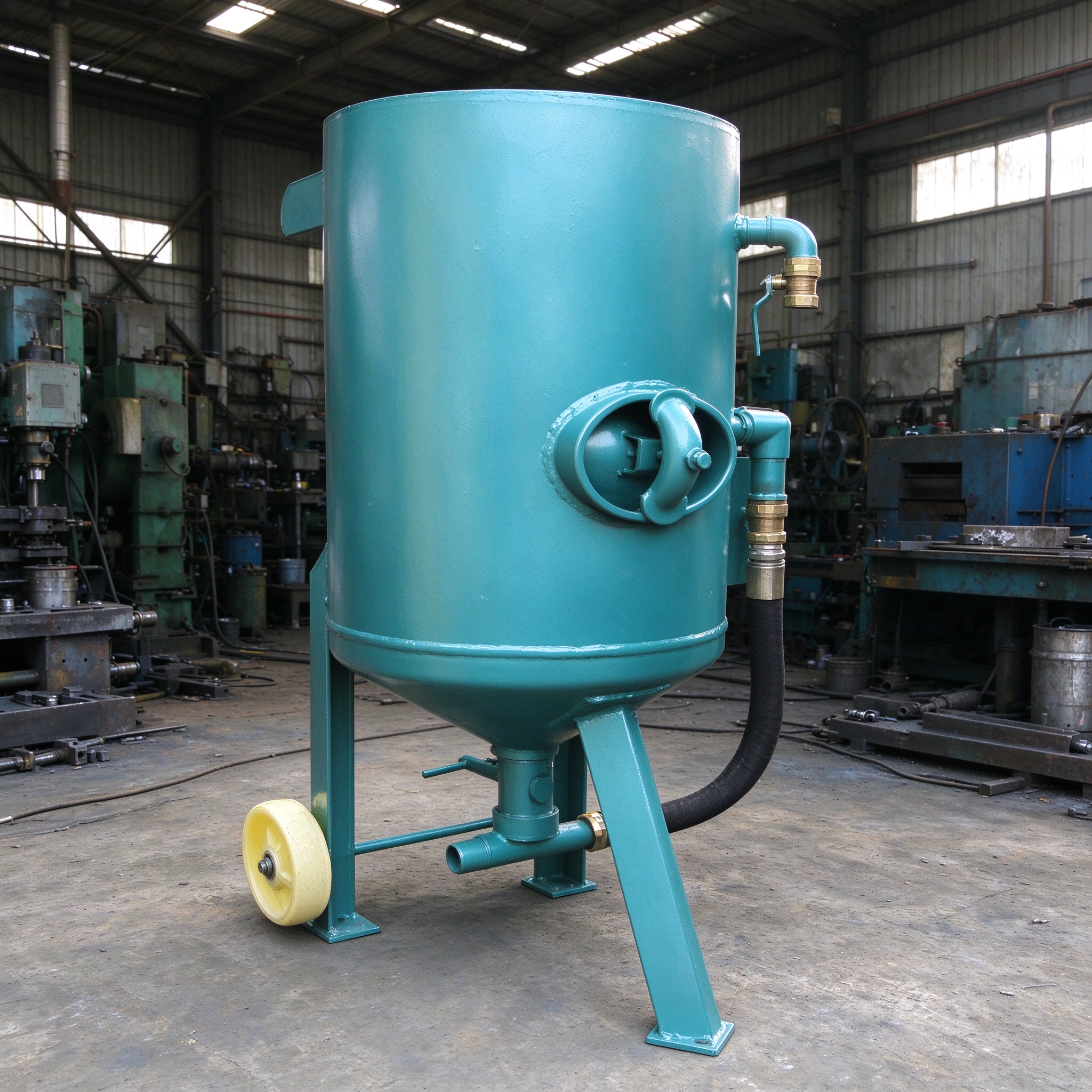
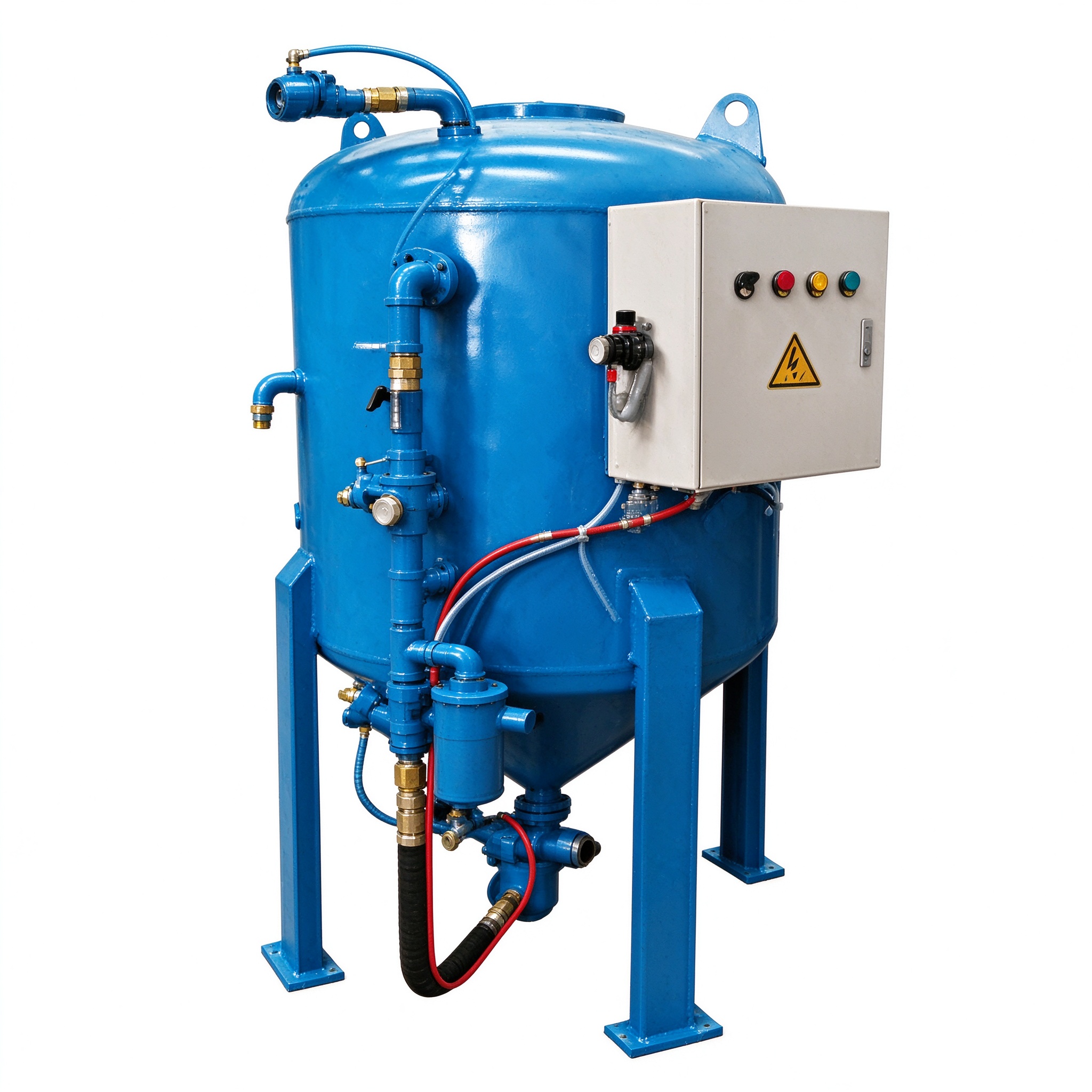
- Pressure vessel sandblasting tanks in fixed, mobile, electric-control, and air-control configurations
- Complete blasting room systems with recovery and dust collection built in
- Supporting equipment such as air compressors, blasting guns, wear-resistant hoses, abrasive recovery units, and pulse dust collectors
How Buyers Compare Sandblasting Equipment Suppliers
Buyers compare suppliers on four measurable points: material and welding quality, pressure testing discipline, dust emission control, and the speed of service response. A supplier that documents each of these points and can show how equipment was verified before shipment is easier to hold accountable than one that only quotes a price.
Price alone rarely separates strong suppliers from weak ones, because the real differences appear later, in nozzle life, in how often a hose fails, and in how quickly a spare part arrives. Buyers who request test records and written service commitments before signing usually avoid the expensive surprises that follow a rushed purchase decision.
Build Quality and Pressure Safety
Pressure safety is where documentation matters most. Tank bodies should be welded from pressure-vessel-grade plate and tested beyond working pressure, and a hydrostatic test at 2.5 times the rated pressure produces a clear pass-or-fail record that can be reviewed before acceptance. Wear parts follow the same logic: a ceramic nozzle that lasts about three times as long as a standard alloy nozzle changes the consumable budget across a full production year.
Machine-level quality also shows up in operating statistics. Equipment built with adaptive pressure regulation, automatic abrasive circulation, and controlled dust removal and noise typically runs at a lower failure rate and lower energy consumption than equipment assembled without those systems. That gap directly reduces unplanned downtime, which is usually the largest hidden cost in a blasting workshop.
Dust Control and Environmental Compliance
Dust control decides whether a workshop keeps running under current environmental inspection rules. A blasting system should be enclosed, connected to a pulse dust collector sized for the chamber volume, and designed so that emissions stay below the applicable national limits during normal operation rather than only during a test run.
Environmental management certification gives buyers a documented process to audit instead of a verbal claim. Where dust collection equipment is built and verified under an ISO14001 environmental management system, the commissioning report becomes a practical reference for local inspection and for internal maintenance planning.
Customization, Delivery, and After-Sales Support
Customization starts with the workpiece, not the catalog: size, weight, surface condition, and required finish decide the chamber, the abrasive feed, and the dust collection capacity. Delivery planning then sets how many units ship per batch, and after-sales support determines how quickly production recovers after a fault.
Non-standard work is common in this category. Chamber dimensions, loading height, abrasive recovery path, and pressure vessel configuration may all need adjustment when a workpiece does not fit a standard envelope. Where mechanical design, fluid pressure, and dust removal engineering sit in one team, those changes can be reviewed on paper before the machine is built instead of being discovered during commissioning.
Delivery scale matters when a project covers several units at once. A factory with standardized assembly lines and an annual equipment capacity of over one thousand sets can hold a stable schedule for batch orders while still accepting small custom runs, including modified machines for unusual working conditions. Overseas buyers should confirm export packing, documentation, and spare parts availability together with the delivery date.
After-sales terms belong in the contract. Pre-sales engineering visits, selection plans, and plant layout drawings reduce installation risk; on-site commissioning and operator training decide whether the machine reaches its expected output in the first week; a stocked spare parts inventory and a remote-first, on-site-second repair path shorten recovery time when a fault does occur.
Pre-Order Checklist
- Confirm workpiece dimensions and the required surface finish
- Verify pressure vessel material and hydrostatic test records
- Match dust collection capacity to local emission requirements
- Agree on installation, operator training, and spare parts terms
- Define batch size and delivery schedule in writing
FAQ
What does a water-sand mixing sandblasting machine manufacturer supply?
A single-source factory supplies the blasting unit, the abrasive and water feed system, the dust collection equipment, and the matching air compressor and consumables. Buying from one source keeps pressure ratings, hose sizes, and dust collection capacity matched, which reduces installation conflicts and simplifies spare parts planning.
How can buyers compare suppliers without visiting every factory?
Compare written records first: material certificates for the pressure vessel, hydrostatic test results, emission test data, and a spare parts list. Then check service terms, including response time, remote support, and whether installation and operator training are included, because those items decide how long a stoppage lasts.
Can a blasting system be customized for an existing workshop?
Yes. Customization follows the workpiece and the building rather than the other way around. Chamber size, loading method, abrasive recovery path, and dust collection layout can be adjusted to the available floor space, and the layout drawing should be approved before production begins.
What maintenance items keep a sandblasting machine running?
Nozzle wear, hose abrasion, abrasive cleanliness, and dust filter condition are the four items that most often affect output. Inspecting them on a fixed schedule and keeping spare nozzles, hoses, and filters in stock prevents small wear issues from turning into full-line stoppages.
How is dust controlled during sandblasting?
Dust is controlled by enclosing the blasting zone, pulling air through a pulse dust collector, and keeping exhaust within the emission limits that apply locally. Filtration sized to the working chamber keeps both operators and surrounding areas inside the compliance range during normal production.
Summary
Supplier selection is a documentation exercise before it is a price negotiation. A water-sand mixing sandblasting machine manufacturer that can show pressure test records, emission data, customization drawings, and a clear service commitment is the lower-risk choice for most workshops. Compare on those four points, confirm the layout, delivery schedule, and training terms in writing, and keep critical spares in stock so that routine wear never becomes a stoppage.