
A sandblasting tank is the pressure vessel that stores compressed air and abrasive, then releases a controlled blast stream through the nozzle. Tank type, chamber design, and pressure control decide how steady that stream stays, how much abrasive the job consumes, and how safely operators can work around the unit.
What a Sandblasting Tank Does in a Blasting System
In a pressure blasting system, the vessel holds abrasive under compressed air and feeds it at a steady rate into the blast hose. Pressure inside the tank, the metering valve setting, and the nozzle size together set blast velocity. When those three elements stay balanced, surface cleaning stays even from the first square meter to the last.
Abrasive feed is where most inconsistency begins. If the vessel releases too much grit at once, the stream becomes uneven, consumption rises, and the operator tends to compensate by changing distance or angle. If it releases too little, the work slows down and the surface may need a second pass. A tank with dependable pressure regulation and a clean metering path keeps the rate stable, which is what makes a blasting job repeatable rather than dependent on the person holding the nozzle.
The same logic explains why tank behavior shows up in final surface quality. Rust removal, mill scale removal, burr cleaning, paint stripping, matte finishing, and surface strengthening all depend on a grit stream that arrives at consistent speed. A vessel that surges or starves the stream leaves patchy results that no amount of operator skill can fully correct.
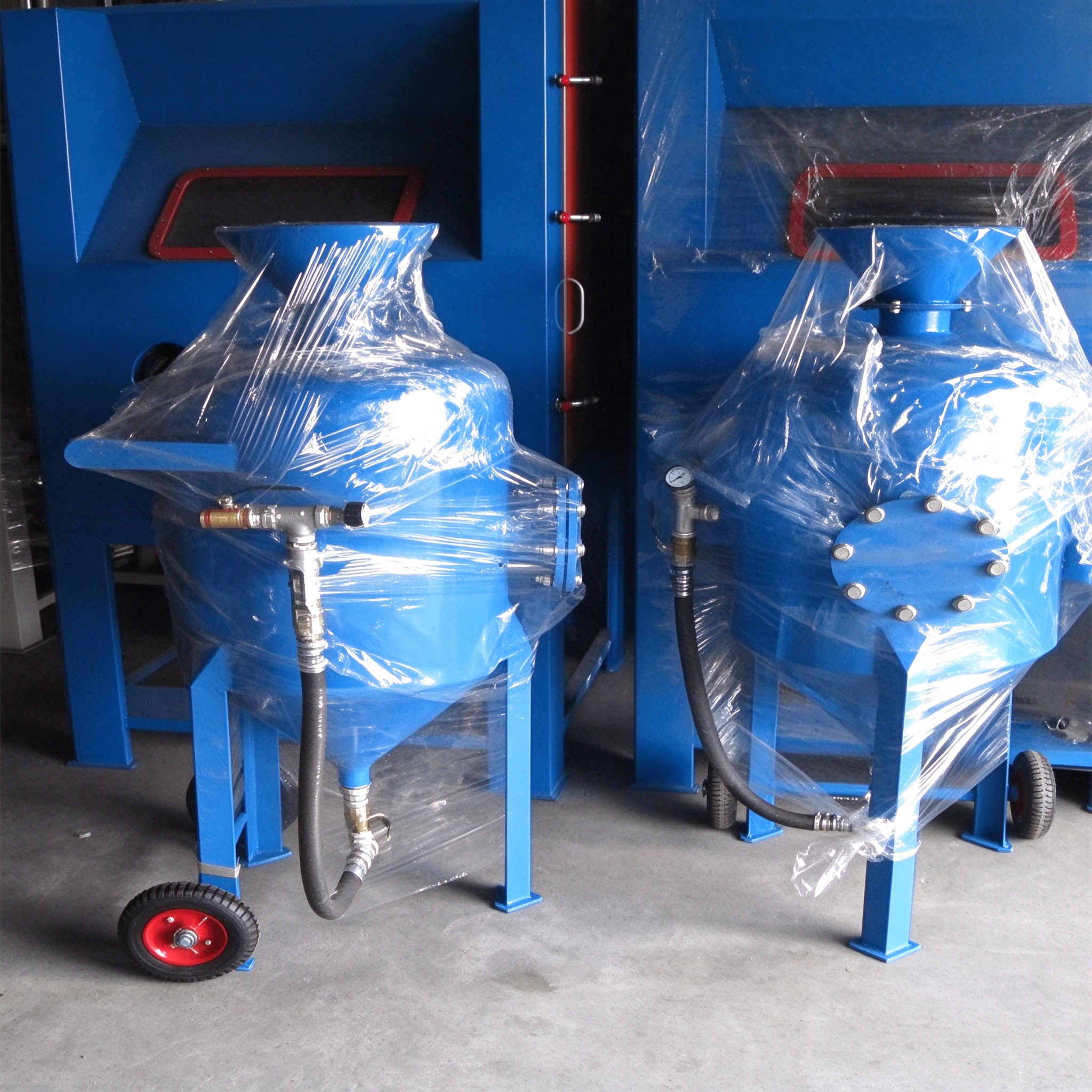
Sandblasting Tank Types: Mobile, Outdoor, Pressure-Type, and Double-Chamber
Tank choice usually follows the work location and the abrasive feed pattern. A mobile sandblasting tank travels to the job, an outdoor sandblasting tank is arranged for open-air work, a pressure-type sandblasting tank delivers a dense high-velocity stream, and a double-chamber sandblasting tank keeps feeding during reloads.
- Mobile sandblasting tank: the pressure vessel and its metering parts sit on a wheeled frame or skid, so the unit moves to the structure instead of the structure moving to a blasting room. This layout suits field work on bridges, pipelines, and outdoor steel.
- Outdoor sandblasting tank: built for open-air sites where wind, dust, and weather set the working conditions. The unit is normally arranged together with operator protection and dust control so the surrounding area stays workable.
- Pressure-type sandblasting tank: abrasive sits inside a pressurized vessel and leaves through a metering valve, producing a dense stream that suits heavy rust, mill scale, and thick coating removal.
- Double-chamber sandblasting tank: two chambers let abrasive be loaded into one side while the other stays under pressure, so the blast stream keeps running with fewer stops during long production runs.
These four configurations are not rivals so much as answers to different site conditions. A fixed production line and a bridge deck may use the same abrasive and reach the same surface profile, yet they need completely different mounting, dust handling, and reloading arrangements.
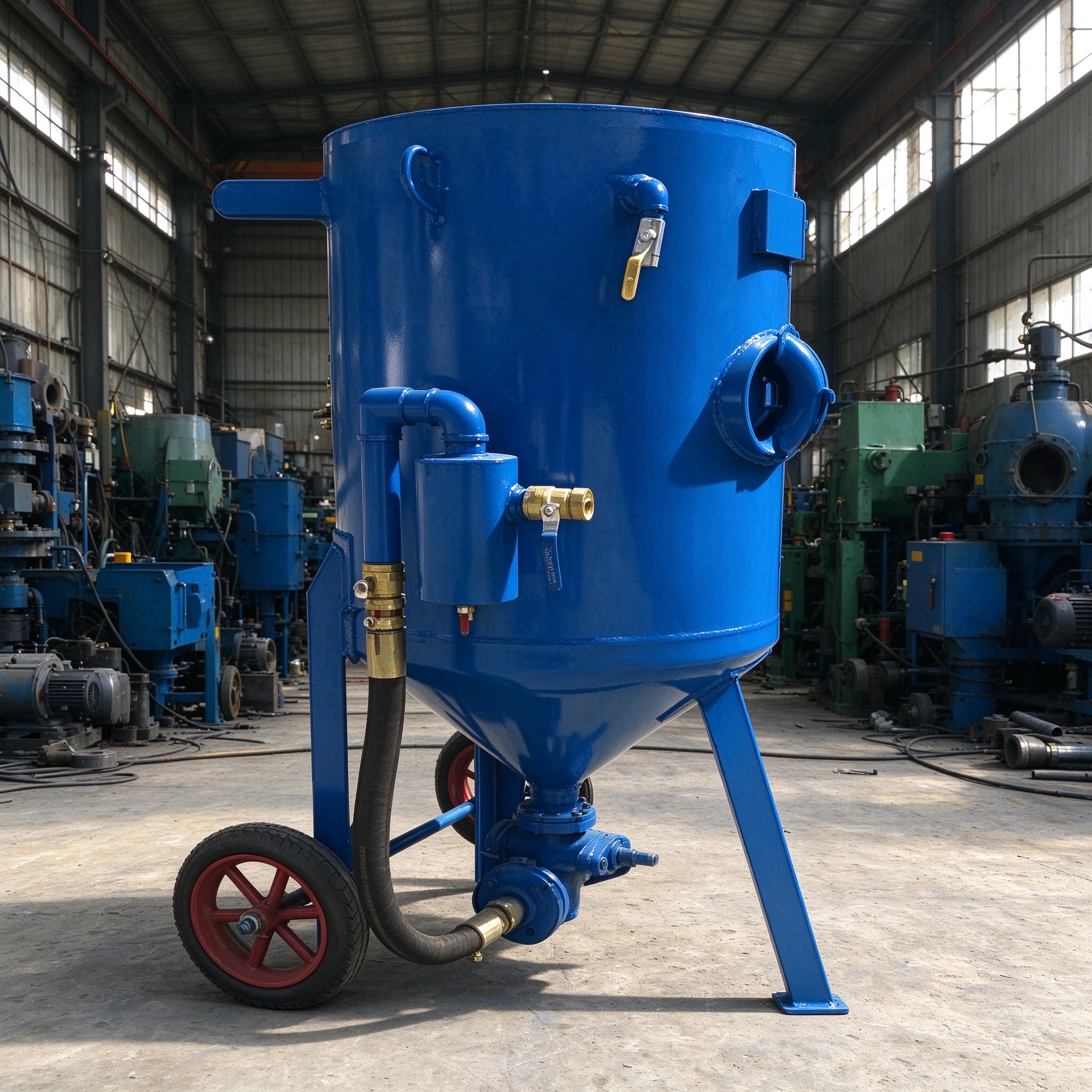
How to Choose a Sandblasting Tank for Your Work
Selection starts with three questions: where the blasting happens, how large the workpiece is, and how steady the abrasive feed has to be. Answer those first, then set vessel size, pressure control, and the dust arrangement around them. Buying the tank before the site conditions are clear is the most common reason a unit underperforms.
Start With the Site, Not the Specification Sheet
A fixed blasting room, an open yard, and a bridge deck each ask for a different configuration. Indoor work can be built around a fixed vessel and a recovery system; field work needs the tank to move and to tolerate dust and weather. Write down the available air supply, floor space, power, and the route the workpiece takes to the blasting area, then match the unit to that reality rather than to a catalogue page.
Match Pressure Control to the Coating or Scale
Heavy mill scale and thick protective coatings need a denser stream than light burr removal or matte finishing. Adjustable pressure regulation lets one unit cover both ends of that range without swapping the vessel. Confirm how pressure is set and how quickly it can be adjusted during a run, because that flexibility decides how many different jobs a single tank can handle.
Plan Abrasive Handling and Dust Together
A tank is only one part of the loop. Abrasive has to get in, dust and fines have to get out, and the blast stream has to stay clean. Recovery and dust collection planned after the vessel is ordered often force compromises in layout, extra ducting, or a smaller working area than expected. Settling the abrasive and dust side at the same time usually produces a simpler installation and a cleaner site.
Check the Support Path Before Ordering
Pressure equipment needs more than a delivery. Ask how installation is handled, who trains the operators, how spare parts are stocked, and how a fault is diagnosed when the line is down. A supplier that surveys the site before quoting and services the unit afterwards removes most of the risk from a purchase of this kind.
Manufacturing Control Behind the Equipment
Wuqiao Anxing Sandblasting Machinery Co., Ltd. builds pressure-vessel tanks, blasting cabinets, mobile blasting machines, blasting rooms, dust collection equipment, air compressors, and blasting accessories from two production sites in Wuqiao County, Cangzhou, Hebei, and has worked on blasting and surface preparation equipment since 1991.
Tank bodies are welded from 16MnR pressure-vessel steel plate, and every vessel goes through a hydrostatic test at 2.5 times its rated pressure before delivery. Complete machines are checked for blasting uniformity, sealing, and continuous no-load running. Automatic models use ceramic nozzles, and their service life is reported as three times that of ordinary alloy nozzles.
The design team covers mechanical design, fluid pressure, and dust removal, and holds more than ten utility model patents related to blasting structure, dust recovery, and pressure control. Adaptive pressure regulation, automatic abrasive circulation, and dust and noise control are developed in house. The company reports an overall failure rate 30 percent below the industry average and energy consumption about 15 percent lower.
Capacity supports both ends of the market: standard assembly lines, an annual output above one thousand units, batch orders of dozens of tanks at one time, and small custom builds for unusual working conditions. The company was recognized as a provincial science and technology small and medium enterprise in 2023 and as a national-level one in 2025.
Sales cover nearly thirty provinces and regions in China, with dealers and on-site service staff in manufacturing clusters across North, East, and South China. Export business reaches Europe, America, the Middle East, Southeast Asia, Hong Kong, Macau, and Taiwan, and repeat orders come from buyers in Myanmar, South Korea, and several Middle Eastern countries. More than three hundred manufacturing customers have taken delivery of equipment, including shipbuilding groups, steel structure fabricators, auto parts makers, precision manufacturing plants, and construction machinery builders.
Installation, Training, and After-Sales Support
Support starts before the order. Engineers visit the site to survey conditions, then issue a selection plan and plant layout drawings at no charge. During production, progress is reported with detail on each machining stage. After delivery, technicians handle installation, commissioning, and operator training that covers normal use, daily care, and basic troubleshooting.
After-sales runs on a nationwide response system with spare parts held in stock. Remote guidance resolves most issues, and on-site repair is available when it is needed, which keeps unplanned downtime short. Because the same team designs, builds, and services the equipment, questions about pressure settings, abrasive feed, or dust performance reach people who know the specific unit rather than a general call centre.
Frequently Asked Questions
What is a sandblasting tank used for?
It holds abrasive under pressure and feeds it into a blast stream for surface cleaning. A tank is the pressure component of a pressure blasting setup, and it serves rust removal, mill scale removal, burr cleaning, paint stripping, matte finishing, and surface strengthening across metal, stone, glass, and coated parts.
How does a mobile sandblasting tank work?
A mobile sandblasting tank carries the pressure vessel and metering parts on a wheeled frame or skid, so the unit travels to the workpiece. That layout suits field work such as bridge, pipeline, and outdoor structure cleaning, where bringing the steel to a fixed blasting room is not practical.
When should you use an outdoor sandblasting tank?
Use an outdoor sandblasting tank when the workpiece cannot be brought indoors and blasting has to happen in open air. The setup is arranged around wind, dust, and weather exposure, and it is normally paired with operator protection and dust control so the site stays workable through a shift.
What is the difference between a pressure-type sandblasting tank and a double-chamber sandblasting tank?
A pressure-type sandblasting tank keeps abrasive under pressure and releases it through a metering valve, which gives a dense blast stream. A double-chamber sandblasting tank adds a second chamber so abrasive can be reloaded without fully depressurizing the vessel, which reduces interruptions during long runs.
What maintenance does a sandblasting tank need?
Routine care centres on the vessel, the valves, and the seals. Inspect the vessel and fittings for wear, keep the metering valve and abrasive lines clear, check hoses and nozzles for erosion, and follow the scheduled pressure testing and parts replacement intervals set for the unit.
Summary
A sandblasting tank earns its place when the blast stream stays steady, the vessel holds pressure without trouble, and the unit fits the site it works on. Match the configuration to the work location first, then confirm pressure control, abrasive handling, dust management, and the support path behind the equipment. Get those four aligned and surface quality stays even while downtime stays low.