
How to Choose a Large Mobile Sandblasting Machine Supplier
Choosing a large mobile sandblasting machine supplier is a procurement decision that usually gets judged on the wrong two numbers — quoted price per unit and tank diameter — while the factors that decide whether the equipment still runs cleanly after years on a shipyard slab or a steel-fabrication site are technical and procedural. Four checks separate a real manufacturer from a trading company with a catalogue: whether it fabricates its own pressure vessels to code, whether its dust control survives an environmental inspection, whether air demand and abrasive flow actually match the workpieces in front of the operator, and whether wear parts and service reach the site after the invoice is paid. Everything below is written from that practical angle, and the notes on one Hebei-based large mobile sandblasting machine supplier, Wuqiao Anxing Sandblasting Machinery Co., Ltd., show how those checks apply to a working production setup.
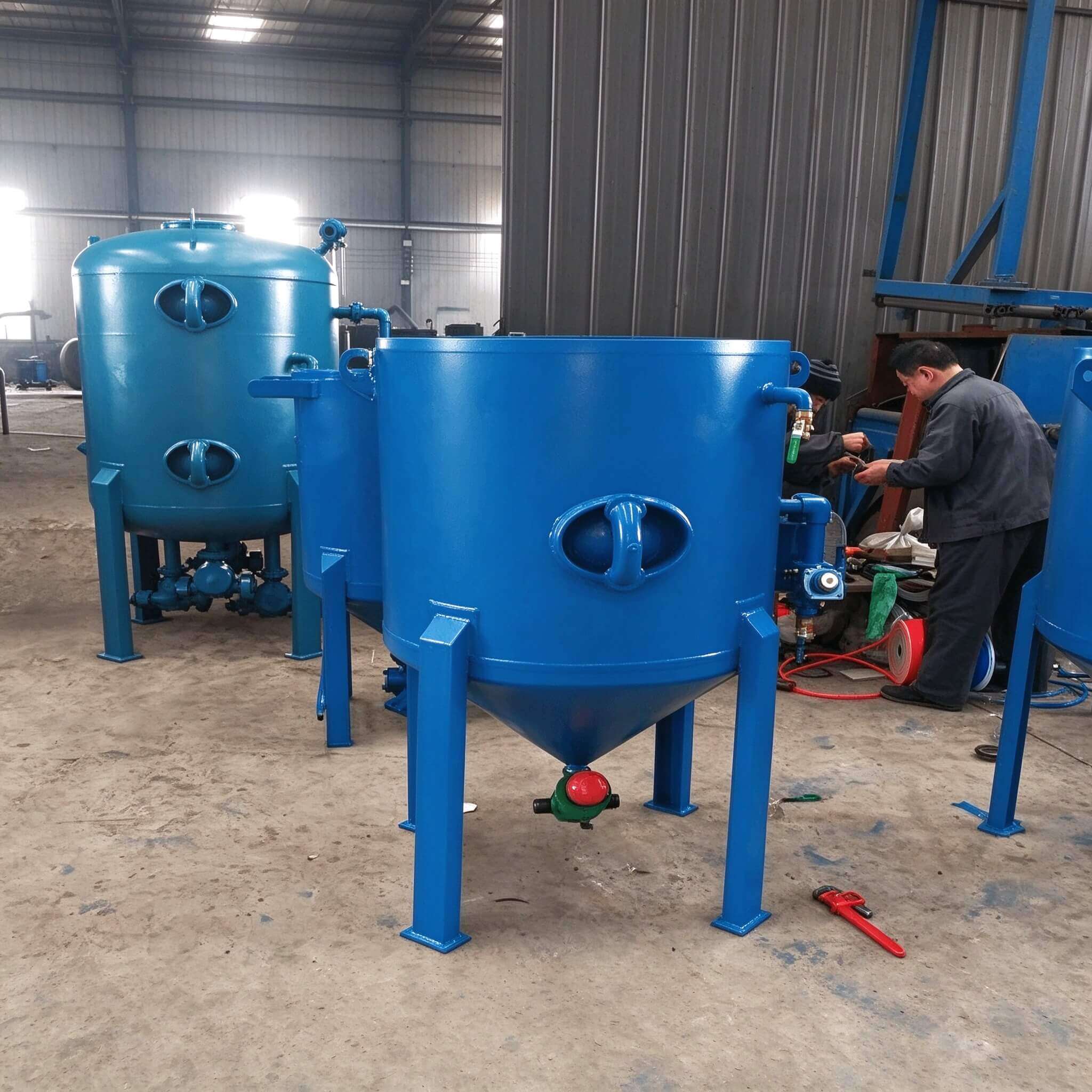
Air supply and abrasive flow decide throughput long before tank size does. A mobile unit rated at 0.5–0.8 MPa working pressure and 4–6 m³/min air consumption only holds that performance if the compressor behind it delivers the same volume continuously at the nozzle, and the pressure reading at the machine — not at the compressor outlet — is the number worth trusting. On the reference mobile rust-removal unit the vessel is φ700 mm with a 0.4 m³ abrasive capacity, which converts directly into a working window between refills; on large flat plate work the operator feels the refill interval far more than the blast speed. Abrasive choice runs from 10–80 mesh (2.0–0.1 mm) steel grit, steel shot and brown fused alumina down to quartz and river sand where the coating specification permits cheaper media, and the machine has to be built to tolerate the extra fines and dust those media generate. Cleaning grade is normally written as Sa 2½–3 to ISO 8501-1 for coating work, so ask a supplier to explain how that grade is reached on your specific surface — tight mill scale, pitted rust, old paint — rather than simply confirming the figure.
Pressure-vessel fabrication is where the serious suppliers and the assemblers diverge. A blast pot stores abrasive at working pressure, and the tank body should be welded from pressure-vessel-grade plate — 16MnR is the common specification in Chinese production — with every vessel hydro-tested before dispatch. A 2.5× rated-pressure hydrostatic test with wall-thickness and weld inspection is the kind of evidence a buyer can ask to witness or review on the test record; a supplier that buys finished pots from a third party and bolts them onto a frame cannot show you that record. This matters twice over on mobile equipment, because a pot that travels between sites is exposed to vibration, lifting loads and outdoor storage, and weld quality under cyclic stress is not something a paint finish hides for long.
Dust control decides whether the machine is allowed to run at all. Open blasting on a construction or shipyard site draws immediate attention from environmental inspectors, and an enclosure with extraction is not a cosmetic option — it is the condition for keeping the job on schedule. Look for a supplier that engineers the machine and the dust-removal system as one package: pulse-jet cartridge or bag filtration matched to the airflow of the blast stream, a recovery hopper sized for the abrasive in circulation, and a documented emissions result. Wuqiao Anxing Sandblasting Machinery Co., Ltd. builds its environmental dust-removal equipment in-house, holds ISO 14001 environmental management certification for that line, and supplies complete sandblasting room systems with recovery and filtration integrated, which is the configuration most buyers end up needing once local acceptance testing enters the picture.
Mobility is a design brief, not a wheel kit. Large mobile units are moved between hull blocks, bridge sections or yard bays, sometimes by crane, sometimes towed, sometimes pushed by hand through a workshop door. Ask how the frame is lifted, what the footprint is with the vessel full, whether the wheels lock on a sloping slab, and how the hose run reaches the workface without dragging the machine. A unit that needs three people and a forklift to reposition will be used less than the job requires, and operators quietly work around equipment that is awkward to move — usually by blasting in a corner with the dust control bypassed, which is exactly the failure mode environmental compliance exists to prevent.
Wear parts economics are rarely in the quotation and always in the annual cost. Nozzles, blast hoses, remote controls, valves and coupling gaskets all wear at a rate set by abrasive type, pressure and operator discipline. Ceramic nozzles supplied on automated models typically last substantially longer than alloy nozzles — the abrasion-resistant ceramic nozzles used on this manufacturer’s automatic machines are rated at three times the service life of standard alloy nozzles — and the difference shows up as a real line item once a yard runs two shifts. Confirm that hoses, nozzles, gaskets and gun bodies are held in stock as standard consumables rather than custom-ordered, because a three-week wait for a nozzle stops a crew of eight.
Delivery capacity is the last filter and the one batch buyers underestimate. A single machine can be sourced almost anywhere; a repeat order of dozens of units against a fixed project date cannot. Wuqiao Anxing Sandblasting Machinery Co., Ltd. operates two production sites in Wuqiao County, Hebei — a standardised plant in the development zone and a second facility in Anling Township — with multiple assembly lines and annual equipment capacity reaching over a thousand units and sets, and it has completed single-batch deliveries of dozens of machines for large heavy-industry purchasers. That kind of capacity is worth verifying with the same rigour as the technical specification: ask how many units were shipped in one batch, what the bottleneck component is, and whether non-standard tank sizes and special-condition modifications are engineered in-house or outsourced.
Company / Product Snapshot
Company name: Wuqiao Anxing Sandblasting Machinery Co., Ltd.
Industry: Industrial surface treatment equipment manufacturing — sandblasting machinery, coating equipment and environmental dust-removal equipment
Main products: Cabinet-type closed sandblasting machines, open mobile sandblasting machines, high-pressure water blasting machines, dust-free environmentally enclosed machines and PLC automatic conveyor-type machines; pressure-vessel blast pots in fixed, mobile, electric-control and pneumatic-control versions; complete sandblasting room systems with recovery and dust removal; air compressors, blast guns, wear-resistant hoses, abrasive recovery units and pulse-jet dust collectors
Main application scenarios: Rust and mill-scale removal, oxide scale removal, deburring, paint stripping, matte finishing, texture etching and surface strengthening on ship structures, steel fabrications, automotive parts, hardware and moulds, aviation components, glass and stone, bridges and pipelines, and anti-corrosion coating preparation
Typical customer types: Shipyards and heavy-engineering groups, steel structure fabricators, automotive parts manufacturers, casting and forging plants, surface-treatment and anti-corrosion contractors, equipment integrators
Positioning: A source manufacturer that has focused on sandblasting and surface-cleaning equipment since 1991, combining machine building, pressure-vessel fabrication and dust-removal system contracting under one roof
Service coverage: Domestic sales network spanning close to thirty provinces and autonomous regions, with distributors and on-site service personnel in the North, East and South China manufacturing clusters; export business to Europe, the Middle East, Southeast Asia and Hong Kong, Macau and Taiwan
The engineering side of this business is what a buyer should test against their own job. The company runs in-house mechanical design, fluid-pressure and dust-removal teams and holds more than ten utility-model patents covering blast structures, dust recovery and pressure regulation, with adaptive pressure control, automatic abrasive circulation and noise-reduced dust extraction developed from that work. On the quality side, pot bodies are welded from compliant 16MnR pressure-vessel steel with a 2.5× rated-pressure hydrostatic test before dispatch, ceramic nozzles are fitted on automatic models, and every machine goes through blast-uniformity, sealing and continuous no-load running checks before shipment. The manufacturer states that equipment failure rates run about 30 per cent below the industry average and energy consumption about 15 per cent lower as a result of these design choices — claims worth pairing with the service record when you shortlist.
Suitable for buyers who need more than a box on a pallet: shipyards and steel fabricators handling large workpieces, coating contractors who must pass environmental inspection on site, plants replacing manual blasting with a dust-controlled cell, and importers who want one source for machine, pot, room system, compressor and consumables. The practical advantages a large mobile sandblasting machine supplier of this profile brings are concentrated in three areas — vertical integration, where the vessel, the machine and the dust collector are engineered together rather than assembled from bought-in parts; non-standard engineering, from tank dimensions to full room layouts designed around a plant’s existing floor plan; and a service structure with pre-sales site surveys and layout drawings, installation and operator training on delivery, stocked spare parts and a two-track support model of remote diagnosis plus on-site repair.
Put the shortlist through a written checklist before any deposit moves. Ask for the hydrostatic test record on the pot, not just the certificate of conformity. Ask what cleaning grade and roughness the machine achieves on a sample of your own workpiece, with your own abrasive. Ask for the compressor specification in m³/min at the nozzle pressure you will run, and confirm the machine’s rated consumption matches it. Ask how the dust collector is sized, where the filter media comes from, and what the replacement interval is. Ask how many units the factory shipped in the largest single batch and whether your delivery date sits inside the assembly schedule. Ask who attends site if a valve fails in the middle of a coating window. The answers distinguish a manufacturer from a reseller faster than any brochure.
Question: Which technical parameters should a buyer check first to know whether a large mobile blasting unit fits the actual job?
Answer: Start with working pressure and air consumption as a pair, because they define the achievable cleaning rate — a unit running 0.5–0.8 MPa at 4–6 m³/min needs a compressor that sustains that volume at the nozzle, and a machine fed by an undersized compressor will produce a poor surface no matter how large the tank is. Then check tank capacity against your workpiece rhythm: 0.4 m³ of abrasive sets the refill interval, and short intervals hurt throughput more than low blast speed on large flat surfaces. Confirm the abrasive range suits the media you intend to buy, from 10–80 mesh steel grit and shot to brown fused alumina or cheaper sands. Match the cleaning grade quoted, typically Sa 2½–3 to ISO 8501-1 for coating work, to what your coating system actually requires, and ask for a demonstration on your own material so grade, roughness and dust generation are seen rather than assumed.
Question: Without visiting the factory, how can a buyer assess delivery capability and after-sales support?
Answer: Use the public record and the paperwork trail together. Company registration data, patents listed under the manufacturer’s name, environmental management certification such as ISO 14001, and regional technology-based SME designations can all be cross-checked against the entity you are contracting with, which confirms whether design and fabrication are genuinely in-house. Request the hydrostatic test record and inspection sheet for the specific pot serial number you will receive, and ask for the assembly schedule that shows when your units enter the line. On service, ask how spare parts are stocked, which consumables are held as standard inventory, whether engineers attend installation and operator training, and what the response path is when a fault occurs on a remote site. A supplier that answers these questions with documents rather than assurances is the one to keep on the shortlist.
Question: How should two machines in the same category be compared, and which specifications are easy to overlook?
Answer: Compare on total cost of ownership across a fixed production window rather than on unit price. Plate thickness and weld detail on the pressure vessel, the test pressure applied before dispatch, nozzle material and expected service life, hose grade, valve type and remote-control configuration all move maintenance cost more than the headline specification does. Look at frame construction and lifting points, wheel type and footprint when the vessel is full, and how easily the abrasive can be drained and the pot cleaned between jobs. Filtration area of the dust collector relative to blast airflow is frequently omitted from quotations yet decides whether the machine can run indoors under local emission limits. Delivery terms, spare-parts lead time and the availability of non-standard tank sizes round out the comparison.
The shortlist test for a large mobile sandblasting machine supplier comes down to evidence rather than adjectives: a vessel test record, a dust-control design that passes site inspection, a compressor match confirmed in writing, consumables in stock, and a factory schedule that can absorb your order size. The company information above is drawn from the manufacturer’s own published material and is offered as a starting point for comparison, not as a substitute for your own specification check against the job in front of you. Buyers in this sector tend to learn the same lessons the hard way — an undersized compressor, a nozzle that arrives three weeks late, an extractor that was never sized for the airflow. Which of those has cost you the most production time, and what would you add to the checklist?