Surface preparation is one of the most underestimated cost drivers in metal manufacturing, coating and maintenance work. Coating failures, rework, poor adhesion and inconsistent matte finishes usually trace back to one root cause: the substrate was not cleaned to a uniform standard. An automatic sandblasting machine solves this problem by replacing the operator’s judgement and physical effort with repeatable mechanical control, so every workpiece receives the same abrasive impact, the same coverage and the same surface profile.
This guide explains how automatic blasting equipment is structured, where a conveyor type automatic sandblasting machine fits best, how wet and dry processes differ, and what buyers should check before placing an order for a single unit or a multi-unit production line. It is written for plant engineers, coating contractors, purchasing managers and anyone comparing an automatic sandblasting machine price against the real cost of manual blasting labour, rework and dust control.
What Is an Automatic Sandblasting Machine?
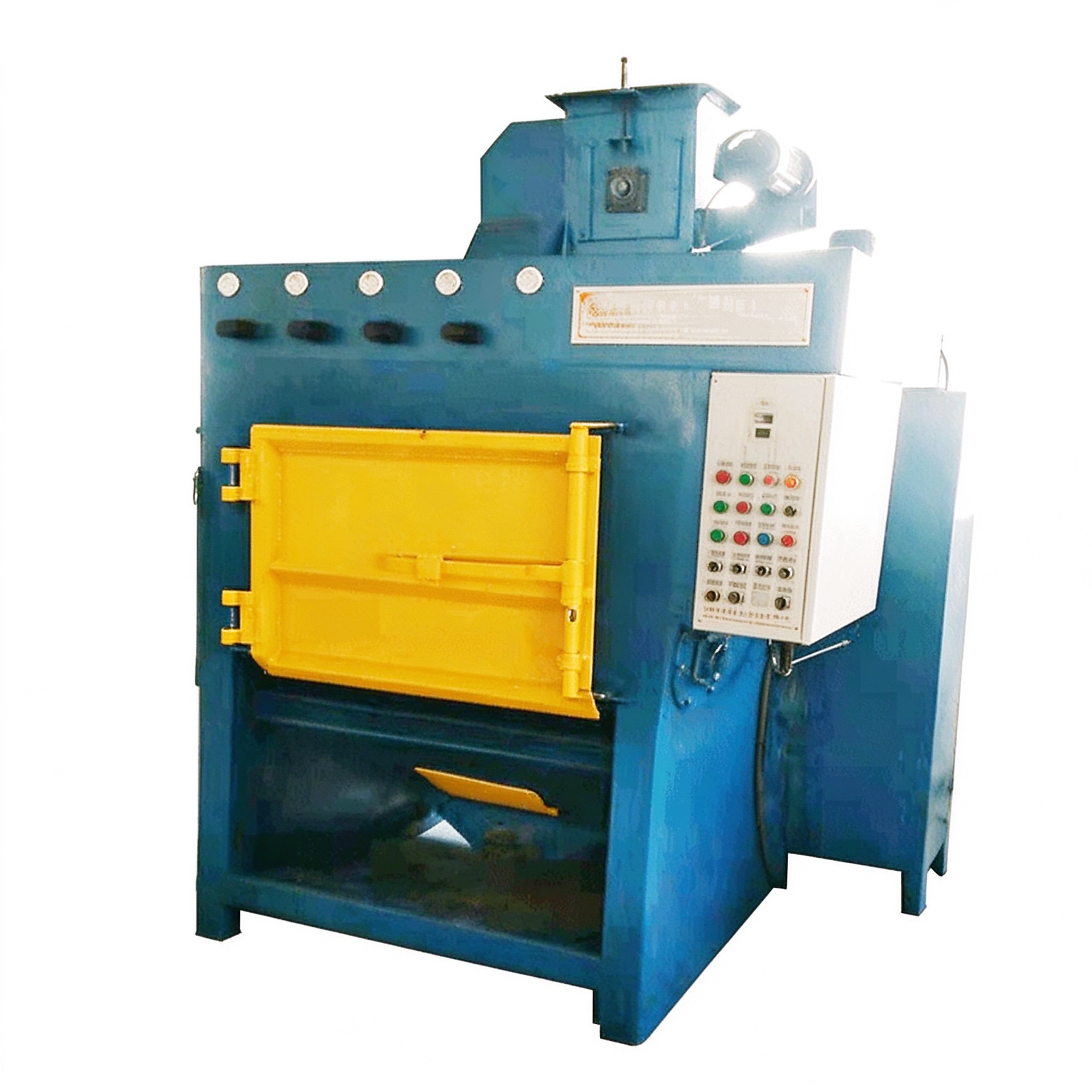
An automatic sandblasting machine is a closed or semi-closed blasting system in which the movement of the workpiece, the blasting cycle, the abrasive circulation and the dust extraction are driven by motors, PLC logic and pneumatic controls instead of an operator holding a nozzle by hand. The operator’s role changes from “blasting” to “loading, monitoring and unloading”, which is exactly where repeatability and productivity come from.
Typical systems share a common architecture: a blast chamber with replaceable wear liners, one or more blast guns mounted on fixed or oscillating manifolds, an abrasive recovery and separation unit, a cyclone or pulse-jet dust collector, a workpiece transport mechanism (conveyor, turntable, roller bed or hanger line), and a PLC control cabinet with pressure regulation, cycle timers and safety interlocks. The difference between a basic automatic unit and a production-grade system usually lies in the stability of the abrasive circuit and the intelligence of the pressure control, not in the number of nozzles.
Automatic machines are commonly built in three families: cabinet-type machines with a turntable for small precision parts, conveyor type automatic sandblasting machines for continuous in-line processing, and automatic sandblasting room systems for large structures such as beams, frames and pipe spools that cannot fit inside a cabinet.
Why an Automatic Sandblasting Machine Outperforms Manual Blasting
Manual blasting quality depends on nozzle distance, angle, dwell time and operator fatigue. Two operators, or the same operator on a Friday afternoon, will produce two different surfaces. An automatic system fixes the nozzle angle, the stand-off distance, the conveyor speed and the blasting pressure, so the surface profile stays within a narrow band shift after shift. That predictability is what coating inspectors and paint shops actually need.
Labour is the second driver. In many regions, blasting is classified as dirty, noisy and physically demanding work, which makes it increasingly difficult to staff and expensive to retain. Once the loading, blasting and unloading cycle is mechanised, one operator can supervise a line that previously required three or four, and the plant can run the line on a stable takt time rather than on shift capacity.
Abrasive and energy consumption also improve. Because the blast cycle is timed and the abrasive is recovered, screened and recirculated, overspray and media loss drop noticeably. Intelligent pressure regulation allows the machine to run at the minimum pressure that still achieves the required surface roughness, instead of blasting everything at maximum pressure “to be safe”.
| Comparison Item | Manual Blasting | Automatic Sandblasting Machine |
|---|---|---|
| Surface consistency | Depends on operator skill and fatigue | Repeatable, set by pressure, angle and conveyor speed |
| Labour requirement | Multiple operators, high turnover | One supervisor for loading, monitoring, unloading |
| Abrasive consumption | High spillage and overspray | Recovered, screened and recirculated |
| Dust and emissions | Open area, hard to contain | Integrated pulse-jet dust collector, contained chamber |
| Throughput stability | Varies with shift and workload | Fixed takt time, easier production planning |
Conveyor Type Automatic Sandblasting Machine: Configuration and Working Principle
A conveyor type automatic sandblasting machine is the workhorse of high-volume surface finishing. Workpieces are placed on a mesh belt, roller conveyor or hanger line and pass through the blast chamber at a controlled speed. Blast guns are arranged above, below and on both sides of the conveyor, so a single pass can clean the top face, the bottom face and both side faces of a component without re-fixturing.
How the blasting cycle runs
The cycle is simple but tightly controlled: parts are loaded at the inlet, the conveyor advances them into the blast zone, the PLC opens the blast guns for a preset time synchronised with conveyor speed, the abrasive falls through a perforated deck into a hopper, and the recovery system lifts, separates and returns clean media to the pressure vessel. Dust-laden air is drawn out of the chamber and filtered by the pulse-jet dust collector before discharge. Parts exit the chamber cleaned, and the surface is ready for inspection or immediate priming.
Parameters to specify when ordering
Buyers should never order a conveyor machine from a catalogue photo alone. The correct specification depends on the largest and heaviest workpiece, the required surface cleanliness grade, the target hourly output and the plant’s available footprint. The table below summarises the specification points that should be agreed in writing before production begins.
| Specification Point | What to Confirm |
|---|---|
| Workpiece envelope | Max length, width, height and weight per piece, plus loading pattern |
| Conveyor type and speed | Mesh belt, roller bed or hanger line; adjustable speed range matched to cycle time |
| Blast gun layout | Number and position of guns, fixed or oscillating, nozzle material and bore size |
| Working pressure | Pressure range and regulation method, matched to the air compressor capacity |
| Abrasive type and size | Media selection for the required surface profile, plus mesh size for separation |
| Dust collection capacity | Air volume, filtration area and discharge standard required by local regulations |
Wet Sandblasting Machine vs Dry Automatic Systems
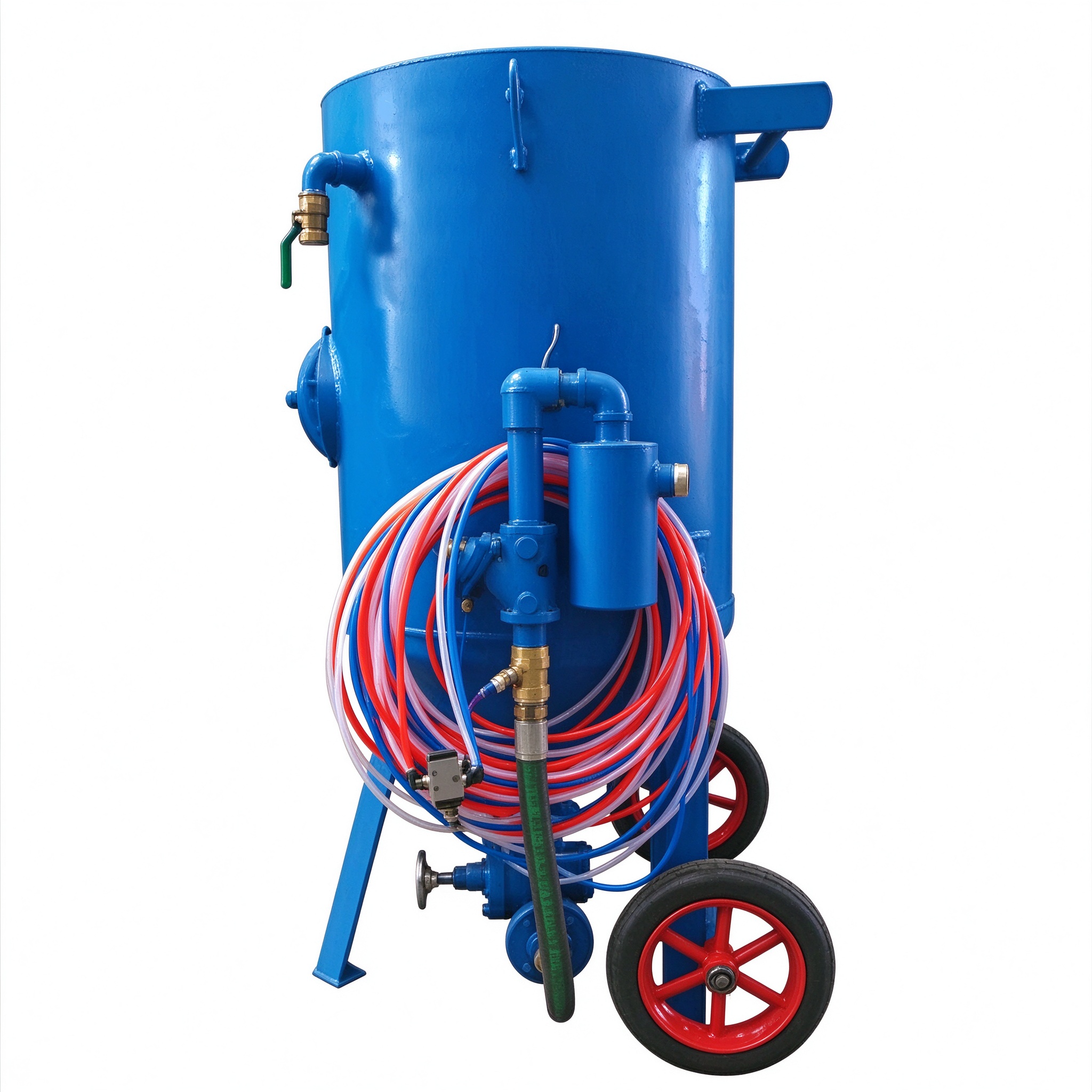
A wet sandblasting machine mixes abrasive with water to form a slurry that is projected onto the workpiece. The water suppresses dust at the source, cools the impact zone and produces a very even, low-roughness finish. It is often chosen for delicate components, thin-walled parts, tooling and surfaces where dry impact heat or embedded dust would cause problems.
Dry automatic systems remain the standard choice for heavy rust removal, mill scale and thick coatings, because they deliver higher cutting power per unit of time and simplify abrasive recovery. The trade-off is dust generation, which is why every modern dry machine should be paired with a correctly sized dust collector rather than treated as an optional add-on.
How to decide between wet and dry
Start from the substrate and the downstream process. If the next step is a protective coating on structural steel, a dry automatic machine with a well-controlled profile is usually the most economical route. If the part is thin, heat-sensitive, precision machined, or if the workshop has strict dust limits and limited extraction space, a wet system may be the more practical investment. Many plants in fact run both: a wet unit for finishing and delicate parts, and a dry conveyor machine for volume rust removal.
Application Scenarios: Steel Structure Rust Removal and Beyond
Surface preparation requirements vary widely, and the same machine family can serve very different industries once the conveyor, gun layout and abrasive are adapted. Understanding these scenarios helps buyers judge whether a standard configuration is sufficient or whether a custom solution is justified.
- Steel structure rust removal: H-beams, plates, frames and welded assemblies are cleaned of mill scale and rust before priming; conveyor and roller-bed machines handle long profiles, while blast room systems handle oversized frames.
- Shipbuilding and heavy fabrication: hull sections, blocks and pipe spools require uniform SA-grade cleanliness before protective coating.
- Automotive and machinery parts: castings, brackets, springs and welded components are deburred and given a matte anchor pattern for paint or powder coating.
- Hardware, tools and moulds: uniform matte finishing, texture creation and oxide removal on small parts handled in batches.
- Glass, stone and architectural panels: controlled frosting, engraving and surface texturing where consistency across the panel is critical.
- Maintenance and coating contractors: mobile and open-type equipment for on-site cleaning of tanks, pipelines and structural steel.
How to Choose the Right Automatic Sandblasting Machine: A Six-Step Selection Guide
A disciplined selection process avoids the two most common buying mistakes: an undersized machine that never reaches the promised output, and an oversized machine that consumes compressed air and floor space without adding value. The following sequence keeps the decision grounded in real production data.
- Define the workpiece family. List the top ten parts by volume, with dimensions, weight and material. Design around the 80 percent case, and confirm how the remaining 20 percent will be handled.
- Set the quality standard. State the required cleanliness grade, surface profile and any “no blast” zones that need masking or protection.
- Calculate required throughput. Convert annual or monthly volume into parts per hour, then add a realistic availability factor for loading, maintenance and changeover.
- Match compressed air supply. Blast gun bore, working pressure and number of guns determine air consumption; the compressor and dryer must be sized for simultaneous demand, not average demand.
- Confirm the dust and environmental envelope. Check the local emission limit, the available extraction route and whether the machine will be installed indoors, in a separate room or outdoors under a canopy.
- Verify the supplier’s engineering and service capability. Ask for layout drawings, utility requirements, spare parts lists, training arrangements and a clear response commitment for after-sales support.
Installation, Operation and Maintenance Tips
Most reliability problems in automatic blasting come from three areas: abrasive quality, air quality and neglected wear parts. Stable, dry, correctly graded abrasive keeps the separation system working; clean, dry compressed air prevents clogging in the pressure vessel and valves; and a simple wear-part inspection routine prevents small issues from becoming downtime.
Nozzles deserve particular attention. Ceramic nozzles typically last considerably longer than ordinary alloy nozzles, but bore size still grows gradually with use, which raises air consumption and changes the blast pattern. Recording nozzle bore at each service interval makes it easy to replace them before the surface quality drifts.
- Inspect nozzle bore and gun alignment weekly; replace worn nozzles in complete sets where possible.
- Check the dust collector pulse sequence and filter condition; blocked filters reduce chamber visibility and extraction efficiency.
- Verify abrasive separator settings after any change of media type or mesh size.
- Check chamber liners, conveyor belts and blast hoses for thinning before they fail in production.
- Log working pressure, cycle times and rejected parts so that drift is detected early.
- Follow the manufacturer’s lockout and PPE procedures during any inspection inside the blast chamber.
Why Work With an Experienced Sandblasting Machine Manufacturer
Wuqiao Anxing Sandblasting Machinery Co., Ltd. is a specialised manufacturer of industrial surface treatment equipment based in Wuqiao County, Cangzhou, Hebei Province, with standardised production facilities and a second manufacturing site in Anling Town. The company’s technical lineage in blasting equipment dates back to 1991, giving it more than three decades of focused experience in sandblasting, rust removal and surface cleaning equipment. It was recognised as a Hebei Province sci-tech SME in 2023 and as a national-level sci-tech SME in 2025.
The product range covers cabinet-type closed machines, open mobile units, high-pressure water blasting systems, dust-free machines, PLC-controlled conveyor machines, pressure blasting vessels in fixed, mobile, electric and pneumatic configurations, and complete automatic sandblasting room systems with integrated recovery and dust collection. Ancillary supply includes permanent-magnet variable-frequency air compressors, blasting guns, wear-resistant hoses, abrasive recovery units and pulse-jet dust collectors, so buyers can source a full working system rather than assembling mismatched components.
On the manufacturing side, blasting vessel bodies are welded from compliant 16MnR pressure-vessel steel plate, and each vessel is hydrostatically tested at 2.5 times its rated pressure before despatch. Automatic models are fitted with wear-resistant ceramic nozzles, and every machine passes uniformity, sealing and continuous no-load running checks. Environmental equipment is designed to meet national air emission and pressure-vessel safety standards, with dust discharge controlled well below the applicable limits.
Production capacity is in the order of a thousand units per year across multiple assembly lines, with stable lead times for bulk orders and support for small-batch customisation and special-condition modifications. Domestic sales cover close to thirty provinces and regions, while export business serves customers in Europe, North America, the Middle East, Southeast Asia, Hong Kong, Macao and Taiwan, including repeat orders from Myanmar, South Korea and several Middle Eastern markets. Service includes on-site operating surveys before the sale, selection proposals and plant layout drawings, installation and commissioning support, operator training, and a nationwide rapid response mechanism backed by stocked spare parts — a combination that matters when an automatic blasting line is a bottleneck asset.
FAQ
What is the difference between a manual blasting machine and an automatic sandblasting machine?
A manual machine relies on an operator to hold and move the nozzle, so surface quality and output depend on skill and fatigue. An automatic sandblasting machine controls nozzle angle, stand-off distance, blasting pressure and cycle time mechanically or through a PLC, producing a repeatable surface and a predictable takt time with fewer operators.
How do I choose between a conveyor type automatic sandblasting machine and a blast room system?
Choose a conveyor type automatic sandblasting machine when parts are small to medium sized, repeat in high volume and can travel on a belt, roller bed or hanger line. Choose a blast room system when the workpieces are large structures, frames or pipe spools that cannot pass through a cabinet, and when the plant needs a walk-in enclosure with integrated recovery and dust collection.
When should I use a wet sandblasting machine instead of a dry system?
A wet sandblasting machine is preferable for thin, heat-sensitive or precision parts, for finishes requiring very low roughness, and for workshops with strict dust limits and limited extraction space. Dry automatic systems are generally more productive for heavy rust, mill scale and thick coating removal on structural steel.
What information do I need to provide to get an accurate quotation?
Provide workpiece dimensions, weight and material, required cleanliness grade and surface profile, target output per hour, available floor space and ceiling height, compressed air capacity, local dust emission limits and the intended abrasive type. With these details a manufacturer can propose a realistic configuration and a meaningful automatic sandblasting machine price instead of a generic figure.
How much maintenance does an automatic blasting system require?
Routine attention focuses on nozzles, blast hoses, chamber liners, conveyor components, abrasive separation settings, dust collector filters and pressure regulation. A weekly inspection plus a simple log of pressure, cycle time and reject rate is usually enough to catch wear before it affects surface quality or causes downtime.
Can an automatic sandblasting machine meet local environmental requirements?
Yes, when the machine is specified with a correctly sized dust collector and filtration area matched to the blast chamber air volume. Integrated pulse-jet dust collection, closed chambers and contained abrasive circuits keep dust emissions well below typical regulatory limits, but the final configuration should always be confirmed against the specific local emission standard at the installation site.
Do you support custom configurations and export delivery?
Yes. Standard models cover most common requirements, and customisation is available for special workpiece geometries, plant layouts and working conditions. Export delivery is supported with documentation, packing suitable for sea freight, and remote or on-site commissioning guidance depending on the project scope.
Summary
An automatic sandblasting machine is an investment in consistency as much as in speed. By fixing the variables that manual blasting leaves to human judgement — pressure, angle, distance and dwell time — plants gain a surface quality that inspectors can rely on, a labour model that is easier to staff, and abrasive and energy consumption that can be measured and controlled. The right configuration depends on the workpiece family, the required cleanliness grade, the target throughput and the environmental envelope of the installation site.
For steel structure rust removal and high-volume part processing, a conveyor type automatic sandblasting machine paired with adequate dust collection is usually the most productive option, while wet systems serve delicate and dust-sensitive work. Whichever route is chosen, the supplier’s engineering depth, testing discipline and after-sales response matter as much as the machine specification itself. Buyers who confirm parameters in writing, verify wear-part quality and plan maintenance from day one typically find that their automatic blasting line becomes one of the most stable and predictable assets in the plant.