
Choosing a sandblasting machine manufacturer is one of the most consequential purchasing decisions in any surface treatment operation. The equipment sits at the front end of your production or coating process, so a poorly specified machine does not simply cost money at the point of purchase — it slows down every downstream step, drives up abrasive consumption, creates dust and compliance problems, and turns into a maintenance burden for years. For buyers sourcing from overseas, the challenge is even greater, because the supplier’s real manufacturing capability, quality control discipline, and service responsiveness are often invisible behind a quotation sheet.
This guide explains what a capable sandblasting machine manufacturer should be able to demonstrate, how to read a quotation properly, and which technical and commercial questions separate a long-term equipment partner from a one-off trading intermediary. It is written for plant managers, project engineers, coating contractors, and procurement teams who need equipment that runs reliably under real production conditions.
Why the Sandblasting Machine Manufacturer You Choose Matters
Sandblasting equipment operates in one of the harshest environments in a factory: high-pressure air, abrasive wear, continuous dust load, and constant start-stop cycling. Two machines with identical external dimensions can behave very differently over a five-year period depending on how the blast cabinet is sealed, how the abrasive recovery system is designed, how the pressure vessel is welded, and how the dust collector is sized. These differences are engineering decisions made at the manufacturer’s design stage — not something a buyer can fix later with better maintenance.
A manufacturer with long-term specialisation in surface treatment tends to have accumulated solutions for the specific problems that appear in the field: abrasive leakage at the door seals, uneven blasting on complex geometry, pressure fluctuation in the blast pot, nozzle wear, and dust escaping into the workshop. A general trading company reselling mixed machinery usually cannot provide that depth, and when a wear part fails or a control sequence needs adjustment, the response is often a delay rather than a solution.
Specialisation also matters for compliance. Pressure vessels, dust collection systems, and workshop ventilation are subject to safety and environmental requirements that differ by market. A manufacturer who builds these systems as a core product, rather than as an accessory, is far better positioned to deliver equipment that passes inspection without modification.
Core Equipment Types a Capable Sandblasting Machine Manufacturer Should Cover
Surface treatment requirements vary enormously between a precision component shop blasting small machined parts and a steel fabrication yard cleaning welded girders before coating. A manufacturer with a broad, well-defined product range can recommend the correct configuration instead of forcing your application into the one model they happen to stock. The following four categories represent a complete purchasing scope for most industrial projects.
| Equipment Category | Typical Configurations | Suitable Applications |
|---|---|---|
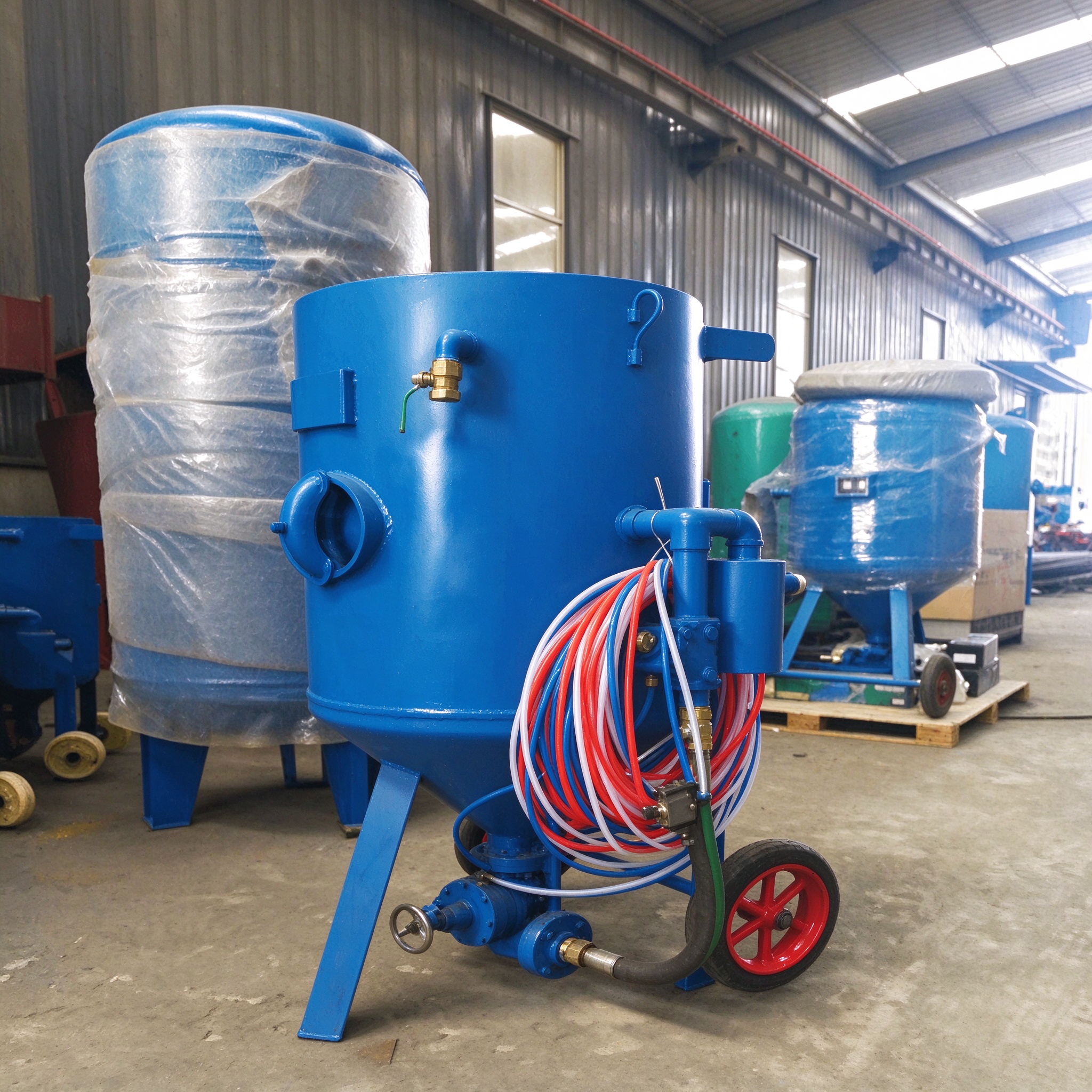
| Sandblasting machines | Cabinet type, open mobile type, high-pressure water blasting, dust-free环保 units, PLC automatic conveyor type | Small precision parts through to large structural components and outdoor rust removal |
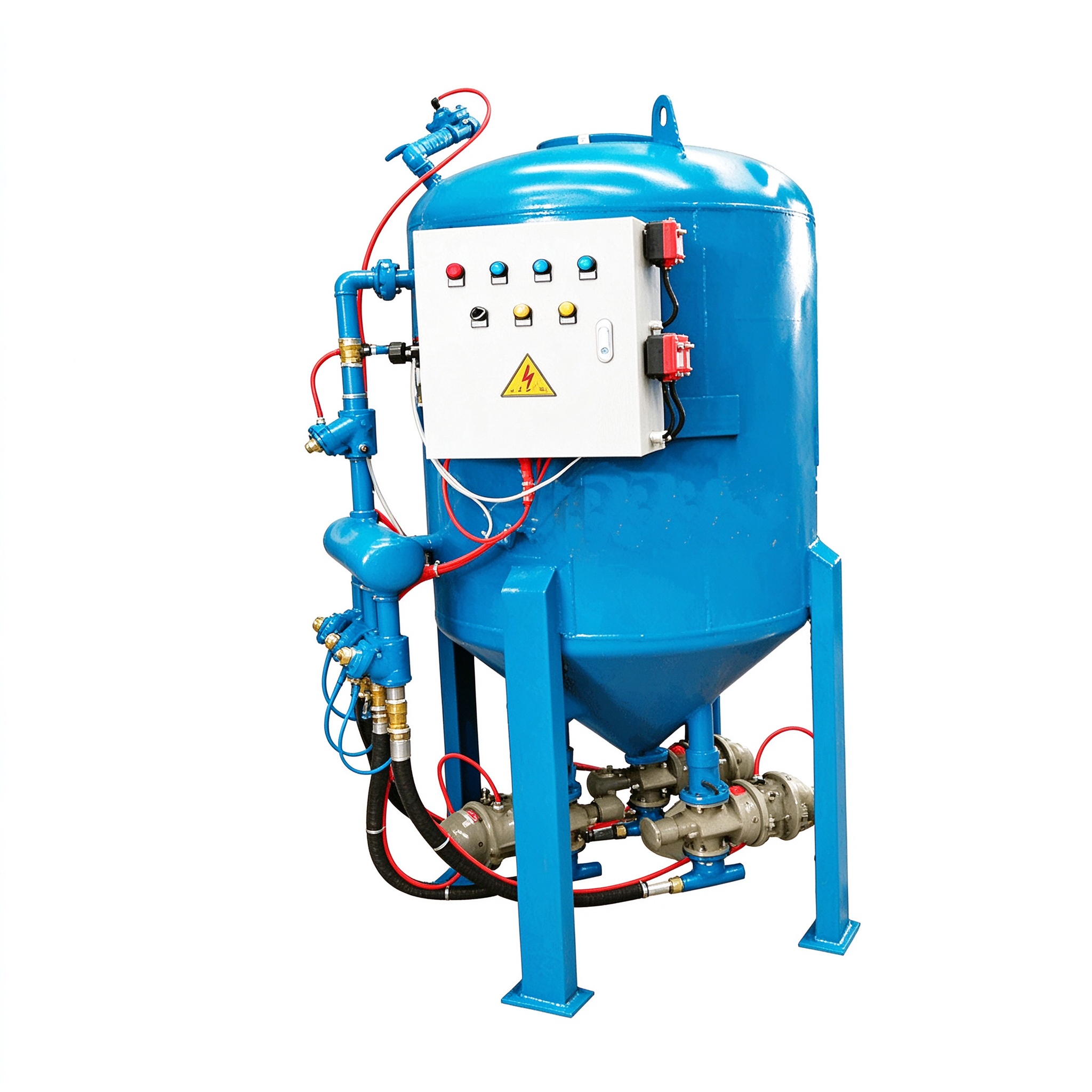
| Pressure vessel blast pots | Fixed, mobile, electric control, pneumatic control; custom vessel sizes to pressure vessel standards | Site blasting, tank and pipeline work, shipyard and bridge projects |
| Blast room systems | Fully automatic blast rooms, recovery and dust extraction integrated rooms, layout design and installation | High-volume workshop production where dust control and throughput both matter |
| Supporting equipment and consumables | Permanent magnet variable-frequency air compressors, blast nozzles, wear-resistant blast hoses, abrasive recovery units, pulse-jet dust collectors | Complete system integration and spare-part continuity |
When a supplier can cover all four categories, the practical benefit is not simply convenience. It means air supply, blast pressure, abrasive grade, nozzle size, recovery capacity, and dust extraction are matched to each other at the design stage instead of being assembled from mismatched parts after delivery. Mismatched systems are one of the most common reasons buyers report poor blasting quality and excessive abrasive waste.
Quality Checks That Separate a Strong Sandblasting Machine Manufacturer from a Weak One
Every manufacturer will claim good quality. The useful question is which specific, verifiable checks are performed, and whether they can be documented. Ask for these details before signing, and expect clear answers.
Pressure vessel integrity and material traceability
If the quotation includes a blast pot, the vessel is the single most safety-critical item in the system. Reputable manufacturers use dedicated pressure vessel steel plate rather than general structural plate, and hydrostatically test each vessel before shipment. Ask what test pressure is applied relative to the rated working pressure, whether the test is applied to every unit or only to samples, and whether material certificates are available. A manufacturer that routinely tests each vessel at a multiple of its rated pressure — and can show the records — is operating to a fundamentally different standard from one that welds and paints without documentation.
Blast uniformity, sealing, and continuous running tests
Beyond the vessel, the assembled machine should be evaluated for blast pattern uniformity, cabinet sealing, and sustained no-load running. Sealing is where cheap machines fail first: abrasive dust escapes through door gaps, cable entries, and recovery ducting, which increases housekeeping cost and creates respiratory risk in the workshop. A supplier who tests sealing and continuous operation before shipment will catch these defects in their own factory rather than in yours.
Nozzle and wear-part specification
Wear parts dominate the long-term cost of ownership. A machine equipped with ordinary alloy nozzles may need replacement far more often than one fitted with wear-resistant ceramic nozzles, and the difference in nozzle life directly affects labour downtime as well as consumable spend. The same logic applies to blast hoses and cabinet liners. When comparing quotations, always normalise the wear-part grade — otherwise the cheapest offer frequently turns out to be the most expensive per operating hour.
Environmental compliance and dust control design
Dust is both a health issue and a permitting issue. Look for a manufacturer that designs the dust extraction system as part of the blast machine rather than as an afterthought, and that works to recognised environmental management standards. Ask for the expected emission performance relative to local limits, the filtration arrangement, and how the pulse-jet cleaning cycle is controlled. In many markets, equipment that cannot demonstrate compliant dust control simply cannot be installed legally in a workshop.
How to Compare Quotations from Sandblasting Machine Manufacturers
Comparing quotations on headline price alone is the most common procurement mistake in this category. Two offers for a “cabinet sandblasting machine” may differ in steel thickness, nozzle material, dust collector capacity, control system, safety interlocks, and spare-part package — which means they are not really the same product. A structured comparison keeps the evaluation honest.
| Comparison Point | What to Ask the Supplier | Why It Matters |
|---|---|---|
| Scope of supply | Is the compressor, dust collector, abrasive recovery and spare-part kit included? | Incomplete scope creates hidden cost after delivery |
| Wear-part grade | Nozzle material, hose grade, cabinet liner thickness | Determines consumable cost and downtime frequency |
| Test documentation | Vessel test records, running test report, inspection checklist | Evidence that quality control actually happened |
| Delivery and capacity | Monthly output, multi-unit order lead time, custom-build schedule | Protects your own project timeline |
| Service model | Installation support, operator training, spare-part stock, remote diagnostics | Directly reduces unplanned downtime cost |
A further consideration is scalability. A supplier that produces equipment on standardised assembly lines and can ship dozens of units in a single batch has a different cost structure from a workshop building one machine at a time. That difference shows up in unit price on volume orders, and it also affects how predictably the delivery date will hold. At the same time, the same supplier should be able to handle non-standard requirements — unusual workpiece dimensions, restricted workshop height, or a specific extraction layout — without treating every custom request as a first-time engineering exercise.
Matching the Machine to the Application: Practical Selection Advice
The most reliable way to avoid over- or under-buying is to describe your process in numbers, not adjectives. Share the workpiece size range, the material, the target surface finish or cleanliness grade, the throughput per shift, the available compressed air capacity, the workshop footprint, and the local dust emission requirement. A competent manufacturer will then propose a configuration and explain the reasoning.
- Small precision components: a cabinet type machine with controlled pressure and fine abrasive gives repeatable results with minimal overspray.
- Large structural steel and weldments: open mobile blasting with a properly sized blast pot delivers the reach and abrasive flow rate needed for area coverage.
- High-volume serial production: a PLC-controlled conveyor machine or automatic blast room keeps cycle times consistent and removes operator variability.
- Coating removal and surface profiling: pressure, abrasive type, and nozzle distance need to be tuned together, so adjustable pressure regulation is worth specifying.
- Dust-sensitive or indoor sites: an integrated recovery and pulse-jet dust collection system is effectively mandatory.
What Service Support Should You Expect After Delivery?
Equipment reliability is a design outcome, but uptime is a service outcome. Before ordering, confirm the installation and commissioning arrangements, whether on-site operator training is included, how spare parts are stocked, and how a fault is diagnosed when the machine stops. Remote guidance resolves a large share of issues quickly, but there must be a route to on-site assistance when the problem is mechanical.
Ask specifically about consumable and spare-part availability — nozzles, hoses, door seals, valves, and filter elements. A machine that cannot be quickly supplied with the right wear part becomes a bottleneck regardless of how well it was built. Buyers with multi-site operations should also confirm that support coverage is consistent across regions, not just at the point of sale.
It is also reasonable to ask about the manufacturer’s own engineering depth. Clean-sheet design capability, in-house fabrication, and an internal quality function indicate a supplier that can respond to problems with modifications rather than excuses. Where a manufacturer holds recognised technology or environmental certifications, that is a useful signal of process discipline — though it should always be verified against the actual inspection records for your specific order.
FAQ
How do I identify a reliable sandblasting machine manufacturer?
Look for depth of specialisation, verifiable testing, and a complete equipment range. Ask for pressure vessel test practice, blast uniformity and sealing checks, the grade of wear parts supplied, and the service model after delivery. A manufacturer that answers these questions with documentation — rather than general assurances — is a far safer partner than one competing purely on price.
What information should I provide to get an accurate quotation?
Provide workpiece size and material, required surface result, production volume per shift, available compressed air capacity, workshop footprint, and local dust emission limits. With these figures a manufacturer can propose a specific configuration, including machine type, blast pot size, nozzle selection, and dust collector capacity, and give a quotation that is genuinely comparable with other offers.
Can sandblasting equipment be customized for my workshop?
Yes. Blast room dimensions, recovery layouts, conveyor arrangements, vessel sizes, and control systems can all be adapted to the building and the workpiece. Custom work is most efficient when the supplier receives layout drawings or site measurements early, so the design is fixed before fabrication begins.
What is the difference between a cabinet machine and an automatic blast room?
A cabinet machine is a compact, enclosed unit suited to smaller components and lower volume, where the operator works at the cabinet. An automatic blast room is a walk-in or conveyor-fed system designed for large workpieces and higher throughput, with integrated abrasive recovery and dust extraction. The right choice depends mainly on component size and the number of parts processed per shift.
How can dust emissions be controlled during sandblasting?
Dust control comes from the system design, not from a single filter. Enclosure sealing, correctly sized extraction airflow, pulse-jet filter cleaning, and abrasive recovery all need to work together. Specify equipment built to recognised environmental management standards and confirm the expected emission performance against your local regulatory limits before installation.
How long does delivery usually take for a standard or custom machine?
Standard machines from a manufacturer with high-volume assembly capacity can typically be shipped considerably faster than fully custom systems, which require design, fabrication, and testing. Ask for a production schedule broken down by stage, and confirm whether the lead time quoted includes testing and packing rather than only fabrication.
Summary
Selecting a sandblasting machine manufacturer is a technical evaluation as much as a commercial one. The decisive factors are whether the supplier designs and builds the full system — machine, pressure vessel, dust extraction, and supporting equipment — whether it can show documented quality checks on every unit, and whether it can support the machine through its operating life with training, spare parts, and responsive service. Price remains important, but it should be compared on a normalised scope that accounts for wear-part grade, included accessories, and test documentation.
Buyers who define their application in measurable terms, compare quotations point by point, and verify quality claims before signing consistently end up with equipment that delivers stable blasting results, lower abrasive consumption, and fewer unplanned stoppages. That is the practical definition of a good supplier decision — and the standard against which any surface treatment equipment investment should be judged.